The habit of looking

Tags

, , , ,

Someone asked me recently how you become a good birder. Well, I’m not sure I am, yet, a good birder but I was reminded of some thoughts I read in Simon Barnes’s most excellent book How to be a bad birdwatcher (Short Books, London, 2006) (which you really should read): ‘I have developed the habit of looking: when I see a bird I always look, wherever I am.’ And, in response to seeing a ‘How often do you go birdwatching?’ questionaire in a birdwatching magazine, ‘I don’t go birdwatching. I am birdwatching’ (my emphasis).

180203 Collared dove

This photograph is, I think, an example of what Simon meant. A couple of days ago I went for a wander around the local town of Barry and was at the station, waiting for my train home, when, out of the corner of my eye, I noticed movement above me. Two birds were walking along the beams that support the platform roof. So, of course, I had to look closer to see what they were – two lovely Collared doves – and, as I had my camera in my backpack, I had to quickly grab a couple of photos before my train pulled in. I am always looking! I am always birdwatching!

Signs of spring: Marsh marigolds

Tags

, , , ,

180202 Marsh marigolds (2)

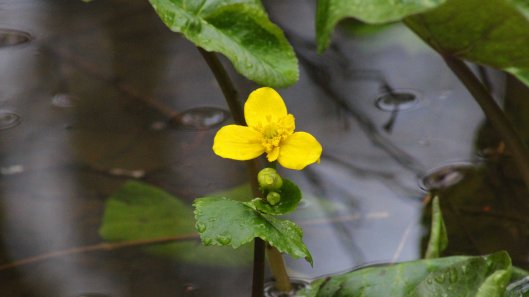
Though it’s hard to believe today, as I look out the window at yet another grey rainy day and the temperature is set to go down all day not up, here is yet another sign that spring really is just around the corner. I spotted these Marsh marigolds (Caltha palustris) blooming in a muddy pond in Cardiff’s Heath Park last week.

180202 Marsh marigolds (1)180202 Marsh marigolds (3)

January at Cosmeston

Tags

, , , , , , , , , , , , , , , , ,

180201 1 Long-tailed tits & Blackbird

7 January Gale-force winds were blasting across the exposed areas around the lake today but, with blue skies overhead, the park was full of people out walking, despite the chill. The wee birds were hungry and I was greeted with much happy peeping wherever I scattered seed and virtually mobbed at the dragon tree in Cogan Woods, by Great, Blue, Coal and Long-tailed tits, Dunnocks and Robins, Chaffinches and Nuthatches, Blackbirds and a Reed bunting were all happy to accept any tasty little morsels.

On the lakes the birds were mostly hunkered down, as it was too windy for flying. Teal, Gadwall, Pochard and a Shoveler were some of the highlights.

17 January After much scrutinising of the huge numbers of gulls that you nearly always find at Cosmeston, I spotted my first Common gull of the year.

180201 10 Common gull

23 January A regular Cosmeston-going birding friend had reported an adult Yellow-legged gull the previous day and I fancied a good walk so I headed to Cossie for a look. These was no sign of the gull but I was delighted to see one of the Marsh tits that frequents a particular spot in Cogan Woods, and it became bird number 67 on this year’s list, before I strode quickly home in pouring rain (yep, drenched!).

180201 11 Marsh tit

I’ve been to Cosmeston a couple more times this month but those outings were more about braving the rain  to satisfy my cravings for fresh air and exercise than nature-watching, particularly as it’s been too wet to have camera and binoculars out and about. Let’s hope February is a bit drier.

Wild words: catkin

Tags

, , , , ,

Catkin: According to the Oxford Dictionary, a late 16th century noun, from the now-obsolete Dutch word katteken for kitten (how sweet is that?), meaning a downy, hanging flowering spike of trees such as willow and hazel, pollinated by the wind.

And now is the time to see catkins, at least where I live in south Wales. I took these photos of male Hazel catkins (Corylus avellana) earlier this week, the gusty breeze helping to spread their yellow pollen, hopefully to fall on the tiny pink female flowers of neighbouring trees, there to develop into fruit and later nuts.

180131 Hazel female flower

January on the Ely embankment

Tags

, , , , , , , , , , , ,

31 December 2017 I’m being a bit sneaky here as I managed to fit in one last walk along the embankment before the start of 2018 but after I’d written my December summary. So, on the last day of last year there were 5 Turnstones, 2 Redshanks, 2 Pied wagtails and 2 Grey wagtails, 1 Rock pipit and a couple of Crows.

1 January 2018 The very next day, New Year’s Day, I passed this way as part of a complete circuit of Cardiff Bay. It was a glorious blue-sky day but there were just 3 Turnstones present.
180130 Ely embankment birds (5)

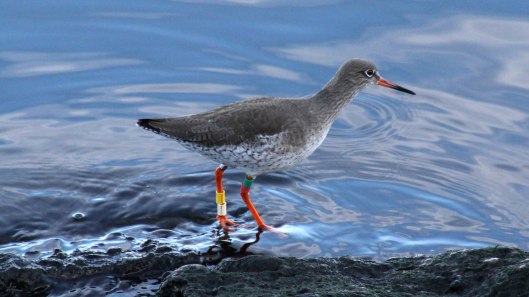
11 January This was another glorious day and another circuit of Cardiff Bay, though in the opposite direction. And it was a bumper day for the Ely embankment, with four Redshanks (including the ringed bird, shown above, which I’ve seen and written about previously), 6 Turnstones, 1 Pied and 4 Grey wagtails, and a Rock pipit.

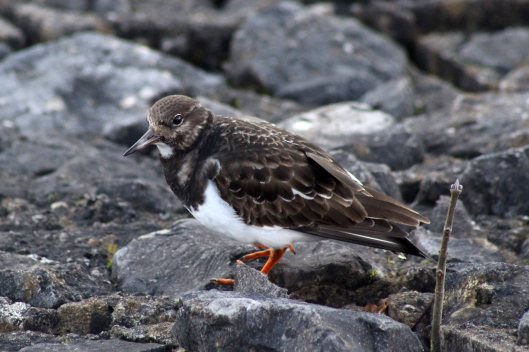
16 January With 40-mph winds blasting down from snow-covered areas further north, the air temperature was hovering below zero when I walked along the embankment late morning. I wasn’t surprised, then, to find very few birds around – a single Turnstone that was wandering along half way up the embankment (not wanting to put its feet in the chilly water?), which was good for me as it was closer for photos, and just two Grey wagtails. There weren’t many birds on the river either, just a couple of coots, one Great crested grebe and several Black-headed gulls looking hopefully in my direction.
180130 Ely embankment birds

20 January I didn’t get out till late afternoon as it had rained most of the day, so the light was going as I strolled along the embankment path. But I was pleasantly surprised to see a few birds: my friends the Grey wagtails never disappoint (two of those); just one Turnstone poking away amongst the stones; and two Redshanks, including my little buddy the colour-ringed bird. Floating along the river were a Little grebe, a Great crested grebe and a pair of Goosanders – the latter were scared away by a boat cruising by and flew off towards the other side of Cardiff Bay, where I had seen a pair a week or so previously – perhaps the same birds.

25 January I detoured along the embankment on my return from a longer walk and was delighted to find six Turnstones (lovely to see so many), two Redshanks (but not my little ringed mate), two Grey and two Pied wagtails.

Leafminer on bramble

Tags

, , , , , , , ,

Following on from my Leafmines 101 post and the one about leafminers on Hart’s tongue fern, here’s another leaf mine I think I can identify (note the ‘I think’!).

180129 Stigmella aurella on bramble (1)

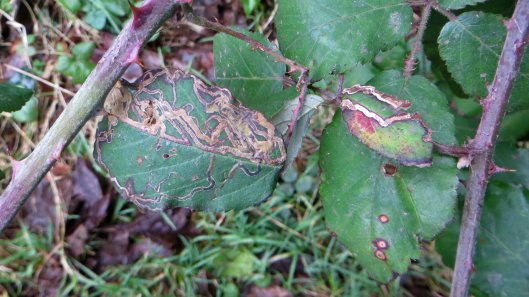
The reason I’m hesitant about positively IDing this one is because there are two species of micro moth whose larvae produce very similar mines on bramble (Rubus fruticosus agg.) leaves. One is the Glossy bramble pigmy moth (Stigmella splendidissimella) but the more likely in this case is the Golden pigmy moth (Stigmella aurella).

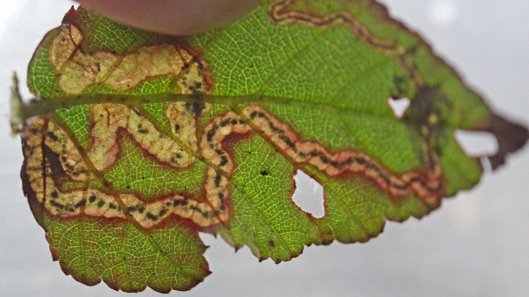
Though it’s very common and widespread in Britain, I’ve never seen this tiny moth (images on the UK moths website here) but the mines its larvae create on bramble leaves are everywhere I look. As you can see, the mine starts out small but, as the larva within chews and chews, so it widens its mine to accommodate its expanding girth.

You can see if the inhabitant is still at home by holding the leaf up to the light. Most of these seemed to be empty, as you can see from the images below (the central black lines are the frass). I’ve never actually opened a mine to have a look at the larva when it has been inside but, if I did, I would see an orangey-yellow grub with a brownish tinge to its head (there are images on the Bladmineerders website here).

180129 Stigmella aurella on bramble (4)180129 Stigmella aurella on bramble (5)

Another winter ten

Tags

, , , ,

It was about time I had another go at WildflowerHour’s current challenge: ‘our weekly winter challenge is #thewinter10 which is to find ten different wild flowers in bloom each week. Once you’ve found them, work out what they are, and post them for the rest of us to see.’

So, on Thursday’s walk, though I was really looking for birds, I also remembered to cast my eyes downwards for flowers. And, on one relatively short stretch along the western edge of Cardiff Bay, I found my ten: Creeping buttercup (I think). a Dandelion species, Nipplewort, Petty spurge, possibly Common mouse-ear, Red dead nettle, Groundsel, Sweet meadow grass, Gorse, and Red clover.

Little brown jobs

Tags

, , , , ,

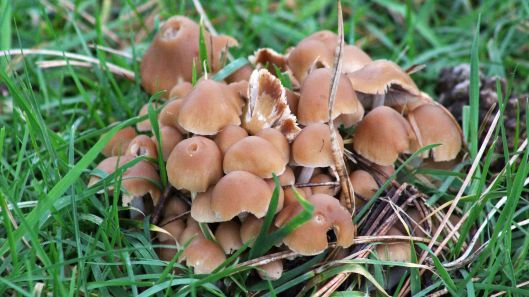
Though I have since learnt that this expression is also used by birders, ‘Little brown job’ is a term I first heard used in relation to fungi, the many and varied, brownish-hued conglomerations of fungi that have few distinguishing characteristics (unless you’re a whizz with a microscope) and so can often be notoriously difficult to identify. Here are some I’ve seen this week.

180127 Little brown jobs (1)180127 Little brown jobs (2)180127 Little brown jobs (3)180127 Little brown jobs (4)180127 Little brown jobs (5)180127 Little brown jobs (6)

A gathering of grebes

Tags

, , , , ,

Six is the highest number of Little grebes (Tachybaptus ruficollis) I’ve ever seen in one group – these were on Roath Park Lake a couple of days ago – but the really tricky thing was to get them all above water and in shot at the same time!

180125 Little grebes (1)

One, two, plus two with their heads below water … and two circles of bubbles.

180125 Little grebes (2)

One up, three on their way under … and two nowhere to be seen.

180125 Little grebes (3)

Nope!

180125 Little grebes (4)

Almost!

180125 Little grebes (5)

YES! Success at last.