Peacocks aplenty

Tags

, , , ,

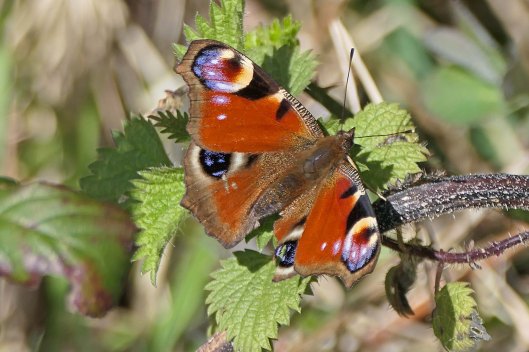
I didn’t see my first Peacock butterfly (Aglais io) of the year until 30 March, which is much later than usual – these are butterflies that overwinter as adults so can emerge from hibernation on warm sunny days even in winter. Now, just six days later, my count is up to eight, as we – and the butterflies – bask in a spell of unseasonally dry and warm spring weather.

I’ve discovered that, when I first see a new butterfly species each year, I have a tendency, a predilection, a need even to photograph every single one I see, as if taking their image makes them real – or perhaps it’s just my attempt to capture the heartfelt joy I feel at seeing butterflies on the wing, and relive that feeling when I’m looking at my photographs at home. After a few days, and having seen several, I begin to relax and focus more on taking better images – at least, I think the photograph below, taken today, is better than the earlier ones above.

Finally, a Wheatear

Tags

, , , , , ,

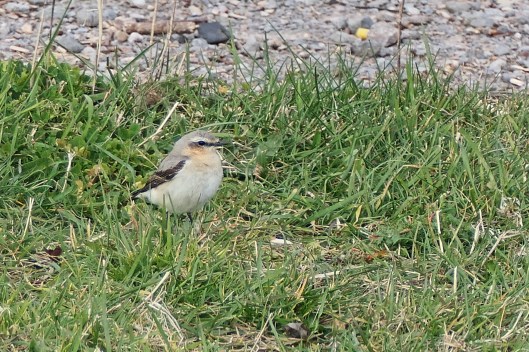
Maybe it’s because we’ve had a lot of fine clear weather and, rather than dropping down to rest in Cardiff Bay, they’ve continued their flights north. Maybe they just don’t like the look of the place, with the increasing numbers of people and out-of-control dogs. Whatever the reason, there’s been a notable absence of migrating Wheatears around the Bay this year, with just one bird noted a couple of days ago and then two, a male and a female, this morning. And that’s around two weeks later than usual – for three of the past four years, I’ve seen my first Wheatears on 20 March. Fortunately, I had already decided to walk around part of the Bay this morning so was there when I bumped in to the birder who’d just seen the male Wheatear, and here he is (the bird not the birder) …

A new rookery

Tags

, , , , , ,

During the Springs of 2022 and 2023, birders throughout Wales volunteered their time to check suitable locations for rookeries, the multi-nest colonies where Rooks raise their young. The survey, organised by the Welsh Ornithological Society, was conducted to establish concrete information about the breeding population in Wales because Rooks are now red-listed, their numbers threatened by changing land use and human occupation, amongst other things.
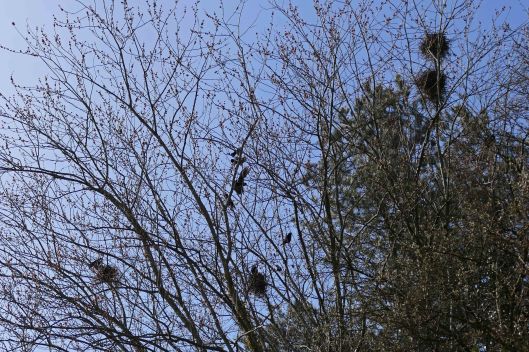
I didn’t take part in the survey as one of my birding friends had already put his hand up for my local area and, as I don’t drive, getting around an alternative 2-square-kilometre tetrad would have proven difficult, but I did chat about where I’d seen Rooks with my friend. His searches of the local area only produced one rookery, which is well known locally and has been established for a very long time – the street where it’s located is called Rookery Lane!
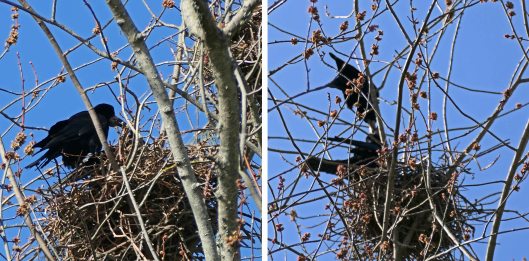
So, you can perhaps imagine my surprise and delight when, during Sunday’s local meander, I spotted a new rookery. It’s adjacent to a series of fields where horses graze and where I’ve often seen Rooks feeding – in fact, the photo and video I included in my post Rook pair-bonding behaviour, 18 February, were taken at that location. I think this new Rookery has only been established very recently, perhaps even this year, as it certainly wasn’t around in Spring 2023 when the survey took place, and I’ve never noticed it when I’ve walked that way previously.

I counted just 5 nests, and at least 8 Rooks – others may have been off looking for food. Not being familiar with Rook breeding behaviour, I initially thought the adult birds were feeding well-grown young but I’ve since been informed that, as Rooks only begin breeding in March, this was more likely to be adults feeding their partners so they don’t have to leave the nest when they’re sitting on eggs or raising their young. I’ll certainly be keeping a close eye on these trees during the next couple of months, hoping to catch glimpses of any chicks as they grow and fledge.

Speckled woods on the wing

Tags

, , , , ,

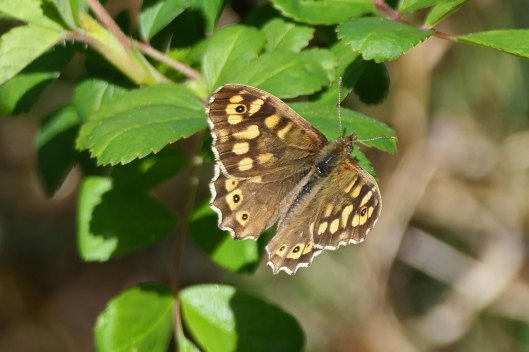
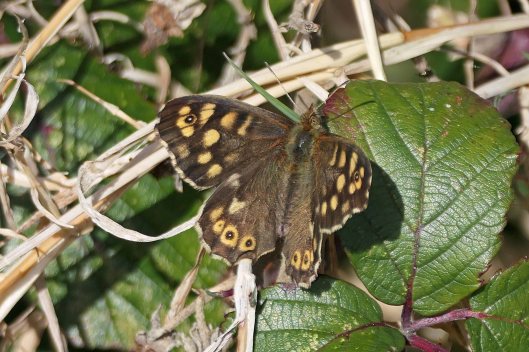
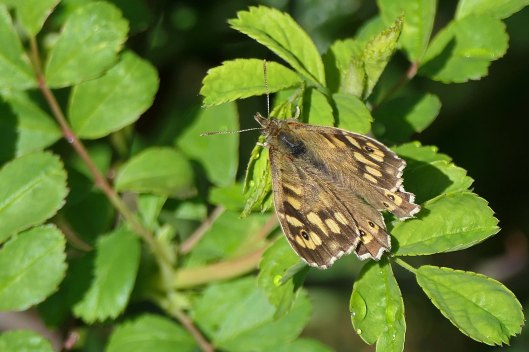
Sunday was a brilliant day for butterflies, with my first three Speckled woods of the year, each in a different location, all basking on hedgerows and flitting out to defend their territories as I passed by.

With its rich chocolately brown background colour mixed with small circular dollops of creamy yellow, it’s almost like a living crème egg … or is my imagination just being overly affected by the bombarding of pre-Easter advertisements?

My brilliant guide book, Life Cycles of British & Irish Butterflies, tells me that the Speckled wood was once called the Wood argus, the name Argus coming from the ‘many-eyed shepherd of Greek mythology’. That seems a very apt name for this beautiful creature.

Spider: Zygiella x-notata

Tags

, , ,

I mentioned in a post last week (Spider: Steatoda nobilis, 25 March) that I’d had confirmation of my identification of two recent spider finds on my local park railings; this is the second of those spiders, Zygiella x-notata, also known as the Silver-sided sector spider.

Though I didn’t see it, this orb weaver is most well known for a singular feature of its web – for some unknown reason it always misses out one sector when constructing its circular web (you can see a photo of this on Wikipedia here), and so another of its common names is Missing sector orb weaver.

According to my guide book, these spiders are often found in places occupied by humans, so houses, sheds, and other types of building, as well as amongst vegetation in urban areas, and they are widespread around the world. The individual I found was too busy consuming its prey to be concerned with web building but I will look out for that distinctive web during future checks of the park railings.

Leafhopper: Mocydia crocea

Tags

, , , ,

Though I’d seen a few tiny green leafhoppers flitting around Bramble bushes on warm sunny days, this gorgeous little creature is the first leafhopper I’ve managed to get photographs of this year, and, even better, it’s a species I’ve not seen before. This is Mocydia crocea, a stunningly marked hopper which, according to the British Bugs website, can be found ‘amongst grass in many habitats, from woodlands to hay meadows.’ It’s supposed to be widespread but there were just 22 records in the Welsh database before I added this one.

The British Bugs website also warns that this species can be tricky to identify as it is easily confused with two other species but there’s a handy photo showing the features to look for and I’m fairly confident I’ve identified this correctly.

False puffball

Tags

, , , , ,

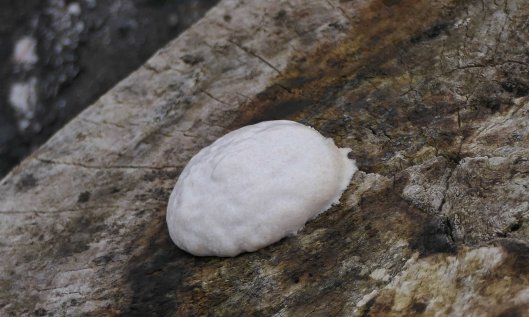
It’s been a while since slime featured here but, as it’s Fungi Friday (yes, I know slime isn’t exactly a fungus) and I happened to spot some slime yesterday, slime it is for today’s post, folks.

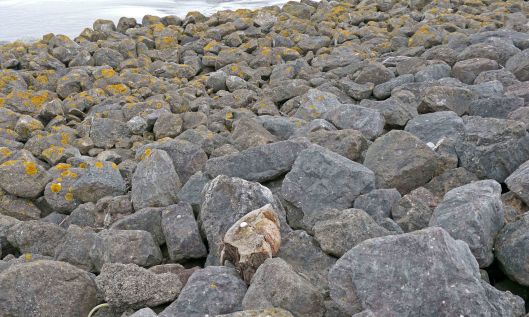
This particularly slime doesn’t really look like your typical example, which is presumably why its common name is False puffball; its scientific name is Reticularia lycoperdon (also known as Enteridium lycoperdon). And I spotted it in rather an odd place, growing on a stump that must have been thrown up on to the outer Barrage rocks in Cardiff Bay during a particularly high tide. You can read more about these intriguing organisms and see examples of the various stages of their life cycle on the excellent NatureSpot website.

10-spot ladybird

Tags

, , ,

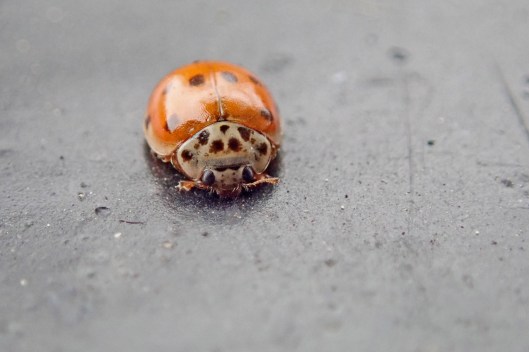
This sweet little creature was a lovely surprise on the park railings earlier. It was tiny, looked only half the size of the many Harlequins that were lumbering along nearby.

I wasn’t sure which of the ladybird species it was until I got home and checked. Though its colours and markings can vary greatly, this is a 10-spot ladybird (Adalia decempunctata), a species I’ve only seen once before and that was back in 2016.

They prefer woody places, whether they be actual woodland or parks or simply gardens with plenty of trees, and they can be found from now until October, so I’ll be keeping my eyes peeled for more.

Starlings and bee-flies

Tags

, , , , ,

Starlings and bee-flies may seem like an odd combination but these were the highlights of yesterday’s walk. First, I listened spellbound to the extraordinary range of sounds this gorgeous Starling and its friends were producing – and I’ve heard that the human ear isn’t capable of hearing the full range of its acoustic repertoire, which is even more astounding. And don’t even get me started on those fabulous feathers.

Meander … amble … stroll … and I ended up having a mooch around my favourite scruffy and neglected Cardiff park, which always manages to turn up something special (as long as you ignore the rubbish and the occasional druggie lurking in the vegetation). Yesterday, up popped my first two Dark-edged bee-flies (Bombylius major) of 2025, those little bundles of flying fluff that hide a dark and gruesome lifecycle of parasitism on their solitary bee cousins. They are cute to look at though.