Colour variations in Large reds

Tags

, , , , ,

This was initially going to be a ‘Yay, the dragonflies are on the wing’ blog but then I went down a rabbit hole of how Large red damselflies change colour over time and how there are several variations in their colour patterns, and here we are.
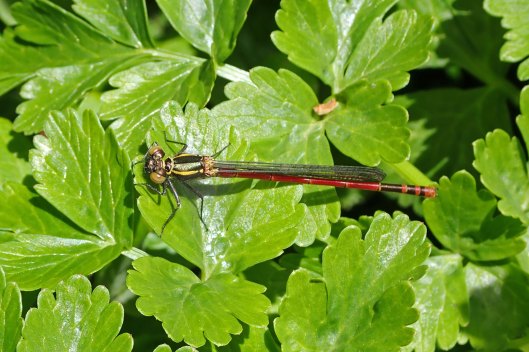
I saw my first odonata of the season, the Large red damselfly (Pyrrhosoma nymphula) shown above, on 21 April, but I’ve been holding off blogging about it until I found one that showed how these beauties change colour as they mature. The photo below was taken this morning, and I hope you can see how the antehumeral stripes (the longitudinal stripes on the sides of the thorax) have changed from yellow in the newly emerged damselfly to red in the older specimen. The eyes also darken to a very deep red as the damselflies age.
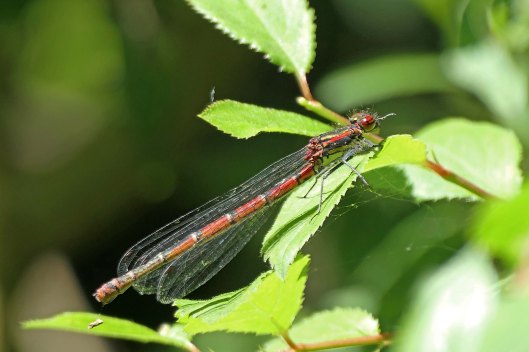
The ‘rabbit hole’ article, ‘In-depth Identification Feature – Large Red Damselflies’ by John Curd (which you can read on the British Dragonfly Society website), also pointed out the different colour forms’ based upon the extent of dorsal black on the abdomen’. John’s photos show the variations, which, I am a little ashamed to admit, I had never noticed before, and that led me to go back through my own photos of Large red damselflies.
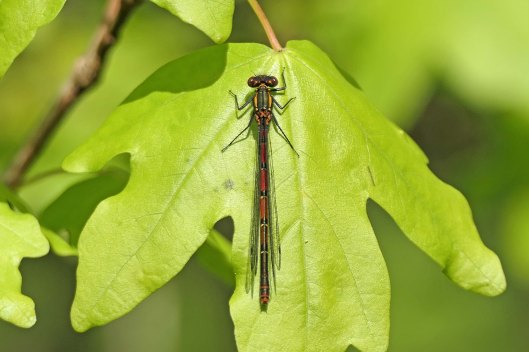
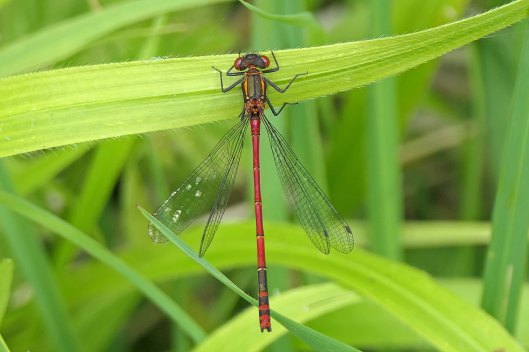
It turns out I’ve only ever photographed two of the variations: f. (form) typica/intermedia, shown above, which has more black at the sutures along the abdomen, and f. fulvipes, below, which has much less black. The latter seems much more common in my area, based on my photographs. The third form (or third and fourth, as some argue this one has two types), f. melanotum, is entirely black and is much rarer.
A feast for the eyes

Tags

, , ,

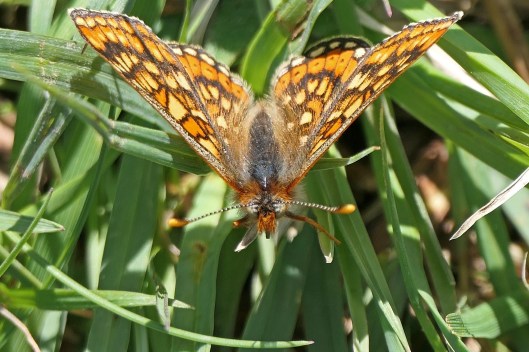
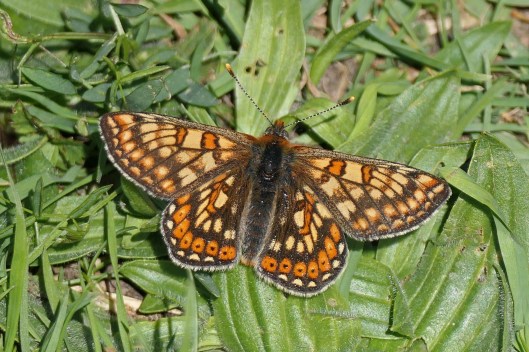
This was the truly magical sight that awaited me when I arrived at Lavernock Nature Reserve last Tuesday morning.

As I walked the footpaths across the fields, more Marsh fritillaries than I’ve ever seen before were flitting up briefly from their perches before settling back down again in the grass.

I’d heard last Sunday that the first fritillaries of the year had been spotted, which is around 10 days earlier than any previous year. That seems to be the norm with butterflies this year, with our warmer than usual and very dry Spring weather.

These Marsh fritillaries were illegally introduced to Lavernock back in 2022, a practice that seems to be increasing across Britain. Whether they will continue to thrive is unknown but, in the meantime, and despite the manner of their arrival and their unknown provenance, they are certainly a joy to behold.

Birding news

Tags

, , , , , ,

Spring bird migration passed rather quietly this year, presumably because most incoming birds chose to fly straight through to their breeding locations rather than stop off here on the south Wales coast for a breather. And the breeding process is in full swing with the local birds – they’re either shouting from the bush tops about what a great mate they would be, or rushing around trying to find insects to feed hungry chicks.

In view of the breeding madness going on all around it, I was very impressed with how calm and serene this Dunnock was looking. Perhaps it’s too young to breed, or maybe its first attempt at nesting failed and it hasn’t yet tried again.

Sadly, I’m fairly sure this year’s nesting attempt has failed for my Crow family. For a couple of weeks, the male was desperate for food and quite obviously taking it back to one specific location in the woods, either to feed his mate and/or their offspring. But today both the male and female appeared for food and they had reverted to their usual practice of flying off short distances to stash food amongst low vegetation, then coming back for more. That’s the second year their breeding attempts have failed, which is concerning.

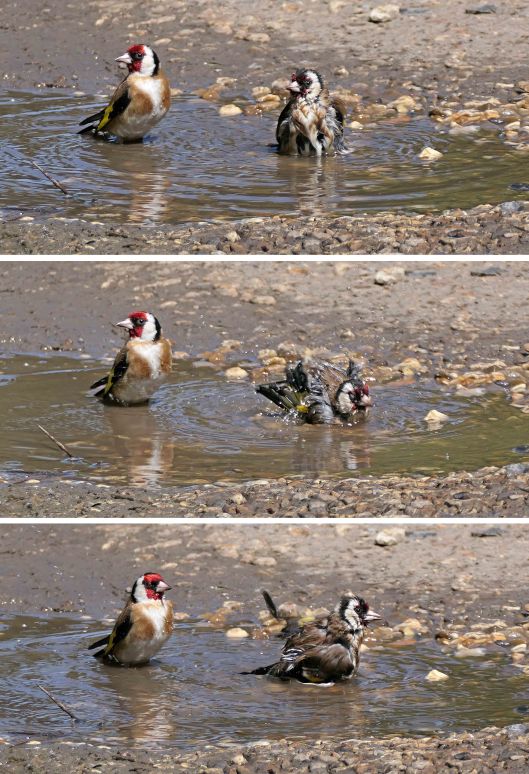
When the stress of life and breeding and chicks all gets too much, what’s a bird to do but find a nice puddle and have a good splash! These Goldfinches really looked like they were having fun.

Anyone for a mocha?

Tags

, , ,

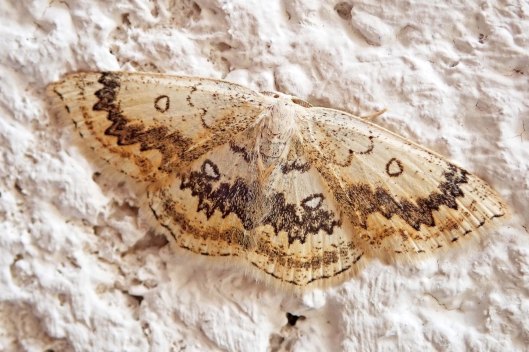
I’m not a coffee drinker but perhaps the person who gave this moth its common name was. Meet The Mocha (Cyclophora annularia), a gorgeous moth that’s described as scarce on the UK Moths website, though it seems from looking at the NBN Atlas for this species that sightings are concentrated in southern Britain so scarce the further north you go. Perhaps surprisingly, I found this one sitting on a house wall as I walked past this morning.

Spiders: Philodromus species

Tags

, , ,

When I got my new guide book*, I very naively assumed it would help me identify all the spiders I saw. I should have known from tackling all the other types of creatures I’ve been trying to put names to that nothing is ever that easy.

These three spiders are a case in point. They all belong to the Philodromidae, the running crab spiders, of which, in Britain, there are 17 eight-eyed species in four genera.

Though they share a similar crab-like body structure, the three shown here all look quite different to my eye, and I thought I would be able to identify them but no! Highlighted in red in my book are those words I never like to read: ‘Microscopic examination of the genitalia is necessary to confirm identification of all species in these genera.’

* Lawrence Bee, Geoff Oxford and Helen Smith, Britain’s Spiders: a field guide, 2nd ed., Princeton University Press, Princeton, 2020.

Leafhopper: Issus species

Tags

, , , , , ,

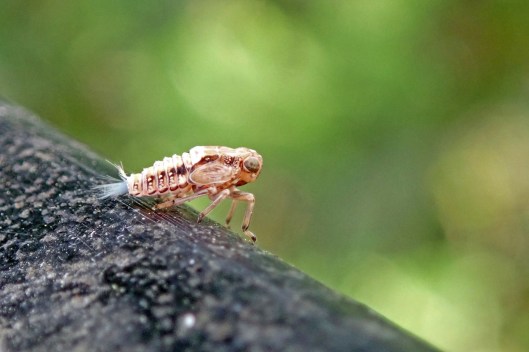
I’ve found two of these little leafhopper nymphs recently but was waiting for verification from the national recorder before posting about them. I recorded them as Issus coleoptratus but the recorder has changed them to Issus species.

The recorder is the expert, I certainly am not an expert but, in this case, I do think these are Issus coleoptratus, and here’s why. According to the Naturespot website entry for this species, there is only one confusion species, which is the much rarer Issus muscaeformis. Naturespot also includes excellent macro photographs of the identification features to look for on a nymph, which are more than 7 sensory pits on its back and pale horizontal bands on the frons (face), both of which I can see in my photos.

I will just have to look for the adult leafhoppers when they appear between June and November and hope that they will convince the national recorder. Meantime, I’m still really pleased to have found a new-to-me leafhopper species.

Herb-Paris revisited

Tags

, , , , , ,

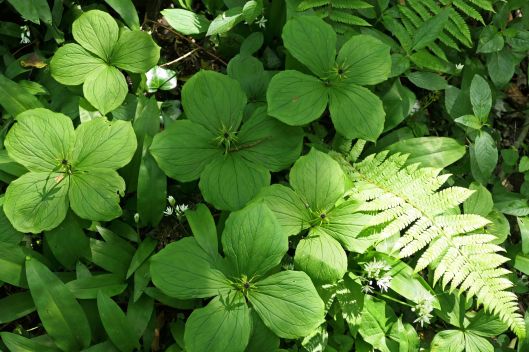
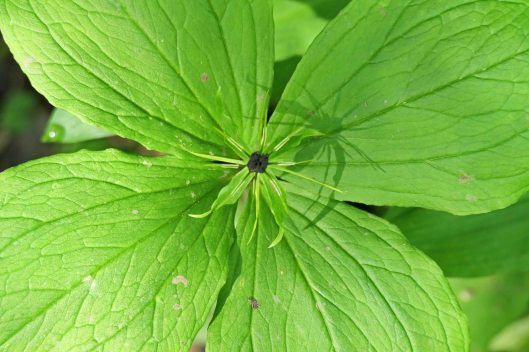
I’ve written about Herb-Paris (Paris quadrifolia) a couple of times before (Herb-Paris, May 2017 and Devil-in-a-bush, April 2021) but it’s such a lovely and unusual plant that I feel it deserves another post, this time primarily of images that I captured when I went on my annual Herb-Paris pilgrimage to Cwm George woodland, in Dinas Powys, earlier this week.

A Wasp beetle

Tags

, , , ,

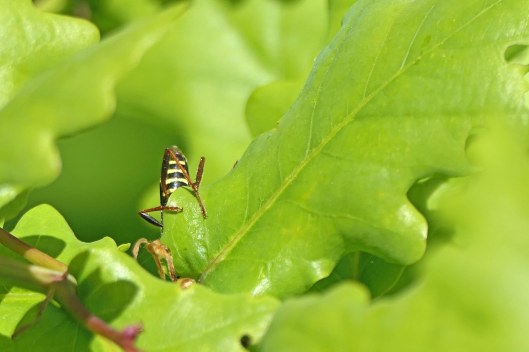
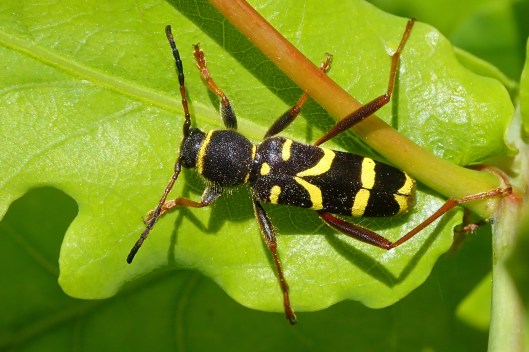
Some of the creatures I encounter when leaf fossicking are off in the blink of an eye and I get no more than a tantalising glimpse of something intriguingly colourful disappearing into the undergrowth. For a horrible moment this morning, I thought that was going to be the case when I spotted the stripey underbelly of this Wasp beetle (Clytus arietis) heading behind a leaf.

Luckily for me, it re-emerged on the other side, then proved remarkably tolerant of me and my camera as I took lots of photos. I’ve only seen this wasp-mimicking beetle once before and that was back in 2016, so I was particularly pleased it proved co-operative for me today.

Butterfly catch up

Tags

, , , , , , ,

Just as it’s always magical to see my first butterfly of the year, so is it just as special each time I see the first of each new species. These are the four most recent beauties that have made me smile.

On 25 April my first Large white of 2025 flitted along the footpath next to me, sipped on a Dandelion, then settled on a Bramble leaf long enough for me to photograph.

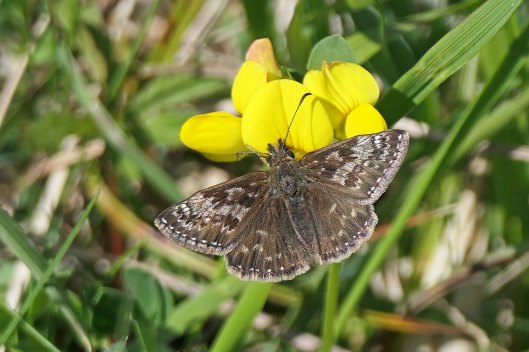
The next butterfly species to appear for me locally, on 27 April, was this lovely Dingy skipper at an unexpected location – a bonus!

The last few days of hotter than usual temperatures have presumably triggered the early emergence of some species. This stunning male Common blue popped up on 28 April, five days earlier than my previous earliest date.

And, this very morning, eight days earlier than I’ve ever seen one before, I caught a flash of brilliant orange and there sat this gorgeous Small copper, always a treat to see.

First brood

Tags

, , , , ,

The Moorhens that make their home in the dipping pond at Cosmeston Lakes Country Park are prolific breeders, producing on average three broods of between 5 and 7 chicks each year. The little cutie pictured here is one of this year’s first brood and, though one parent was keeping an eye on this one and its siblings, the other adult was already preparing their next nest. According to the BTO, though the record for Moorhen survival currently stands at over 11 years, their average lifespan is just 3 years, and they begin breeding at age one. With statistics like that, you’d think our waterways would be overrun by Moorhens but their predation rate is high, with both wild and domestic mammals taking their toll, as well as birds like Grey herons and the large gull species feasting on the smaller chicks. This Moorhen chick may be a little sweetie but its life will almost certainly be a tough one.