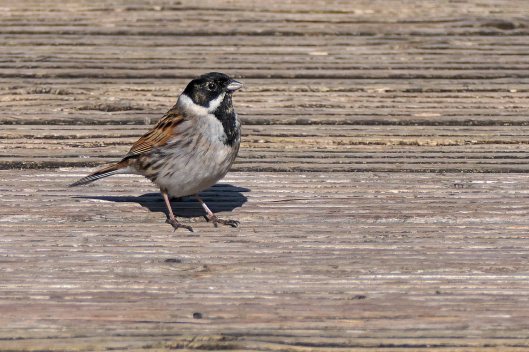
Male Reed bunting

Tags

, , , , , ,

As the reed beds at Cardiff Bay Wetlands Reserve are extensive and quite dense I hear the resident Reed buntings more often than I see them so I was charmed, during yesterday’s visit, by the close proximity on the boardwalk and very confiding nature of this handsome male. I can’t help but wonder if he thought I might give him a seed reward as he strutted this way and that, with all the swagger of someone used to performing on a catwalk rather than a boardwalk.

Two more ladybirds

Tags

, , , ,

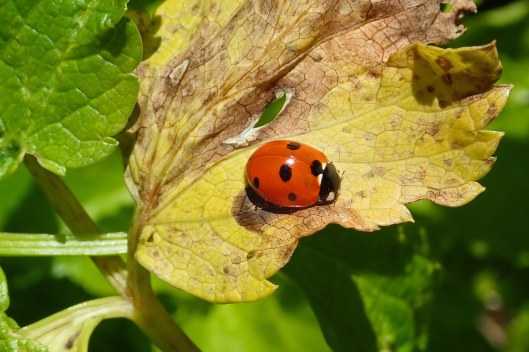
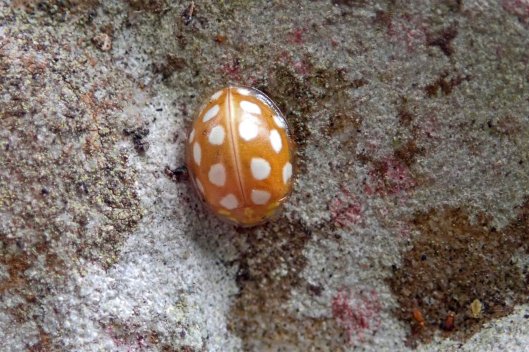
My ‘ladybird species seen in 2025’ total has risen to the highly unimpressive total of …

three, now that I’ve seen a few 7-spot ladybirds (Coccinella septempunctata) and a single Orange ladybird (Halyzia sedecimguttata). Other people seem to be finding several species of ladybirds clustering on headstones in graveyards so I’m planning a trip very soon to my favourite old cemetery. Fingers crossed!

Old man heron

Tags

, , ,

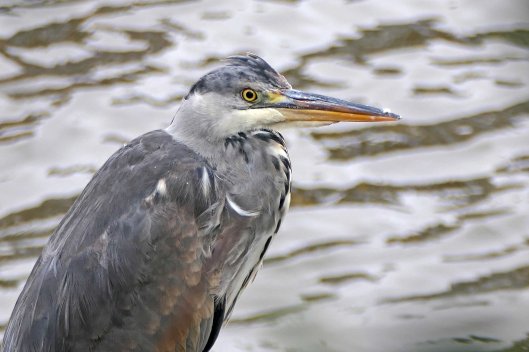
There’s a particular branch on a particular tree alongside the River Ely where a Grey heron sits and cogitates about life, the universe and, probably, where its next meal is coming from.

The heron is mostly obscured from the view of passing dog walkers by the riverside trees amongst which he sits but at least one keen-eyed photographer (moi) knows this is a favourite spot and looks for him there.

These three photos of old man heron (though it could be a female – I’m not sure how you tell the gender of Grey heron, or even if you can) were taken at the same spot, almost exactly a month apart, on 31 December, 25 January and 26 February.

And, now that I look at them together, I’m not sure if it is the same bird – I’ve always assumed it was because of the bird’s preference for this particular spot. His plumage looks a little different, though there is a pale spot near the end of his beak that is unchanged from one month to the next. What do you think?

Flowers and beyond

Tags

, , , , , , , , , ,

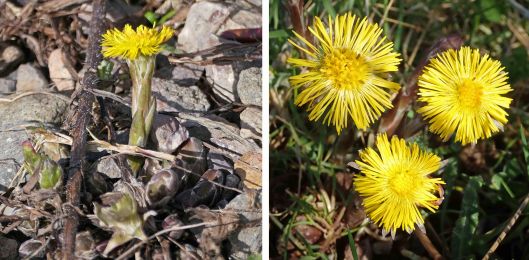
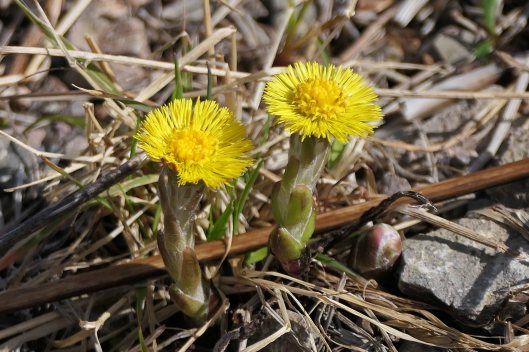
Every year I celebrate my first sighting of Colt’s-foot (or Coltsfoot, if you prefer; Tussilago farfara), as the aggressive way it punches its way through overgrown vegetation, layers of dead leaves, even a covering of gravel seems to express for me Nature’s determination to put the cold dark days of winter behind.

And, of course, the sight of these bright bursts of golden yellow seems to mirror the sun’s reappearance in our skies and the ever-lengthening daytime hours.

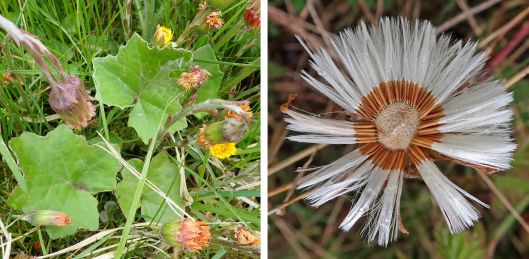
My focus for this plant has always been on its flower so this year I thought I would also show what comes after. This is a plant whose leaves appear much later than its flowers; in fact, the flowers are often beginning to set their seed before the leaves emerge. The shape of the leaf, supposedly resembling the shape of the underside of a colt’s foot, is how this plant got its common name. And I think you’ll agree that the seedhead is rather beautiful too.

My first Brimstone

Tags

, , , , ,

The sunshine is working its magic! Though our overnight temperatures are still dipping below zero (Celsius), the days are finally full of blue skies and sunshine, and that has encouraged more insects to awaken, including this handsome male Brimstone. As butterfly fanciers will know, these newly emerged males rarely stay still; they patrol their territory constantly, sprinkling their pheromones over the vegetation, always searching for the females that emerge a little later than them. As I watched this one though, I realised that, after every two or three circuits, he was resting in the same place, and I managed to fire off a few quick photographs before he flew off again on his relentless search for a mate.

Black-tailed godwits

Tags

, , , , ,

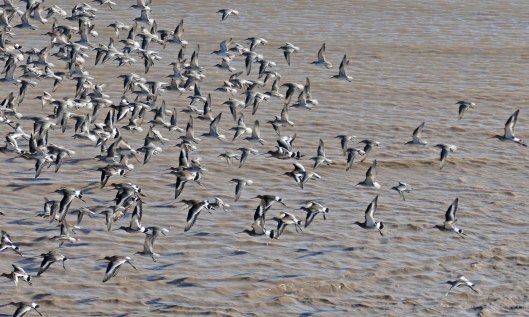
The most numerous bird species in Monday’s murmuration (see Wednesday’s blog for photos) was undoubtedly the Black-tailed godwit (Limosa limosa). With their long legs, necks and beaks and well-proportioned bodies, these are elegant birds.

We have two species of godwit in Britain, Black-tailed and Bar-tailed (Limosa lapponica), and, at first glance, they can be difficult to tell apart but, as you can see in some of my photos, the Black-tailed have broad white wing-bars and their white tails finish with a black band, hence their name.

Some of these local birds are starting to change in to their breeding plumage of brick-red heads, necks and breasts, which is why the birds’ colours pictured here are so different. Only a very small number of Black-tailed godwits breed in the UK; most, if not all, of the birds pictured will soon be heading north-west to their breeding grounds in Iceland.

And that breeding location is one of the reasons Black-tailed godwits are now on the British red list, as the lowland Icelandic grasslands these birds favour are increasingly being converted to arable production and forestry. Climate change and environmental pressures are also affecting the locations in Britain where the birds over-winter, so they are facing pressure all year round. I feel privileged to have seen so many of these stunning creatures at such close quarters and to see their incredibly well synchronised aerial display earlier this week.

Beautiful bumbles

Tags

, , ,

This week we’ve had a couple of blue-sky days and much-wanted sunshine, with more in the forecast. And, though the overnight temperatures and winds are still quite cold, the daytime temperatures have risen just enough to cause some insects to awaken and emerge.

During today’s wander around Cardiff’s Grangemoor Park, I spotted these two beautiful Buff-tailed bumblebee queens, one drawn to willow flowers that are just beginning to open and another with her tongue stuck deep into the bright yellow flowers of a gorse bush. Finally, it feels like Spring is in the air.

Murmuration

Tags

, , , , , , ,

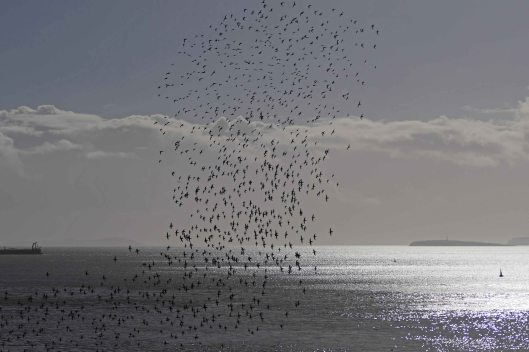
When you hear or read the word murmuration, you probably think of Starlings and the incredible sight of thousands of those birds flying though the evening sky in perfect unison. But it isn’t only Starlings that execute such amazing aerial displays; many other species of bird perform similar feats of synchronised flying and, on Monday, I was privileged to see just such a spectacle.
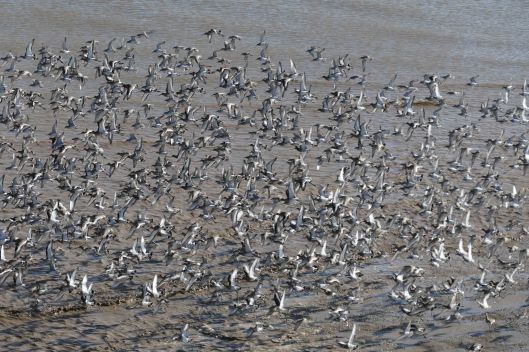
As soon as I arrived at the Cardiff Bay Barrage, I saw a large flock of birds flying around the area outside the Barrage, on the edge of the Bristol Channel. Luckily for me, the birds settled on one of the mudflats and began feeding. In my almost ten years of living in the area, I had never seen so many waders doing this; they usually feed on mudflats north of Cardiff.
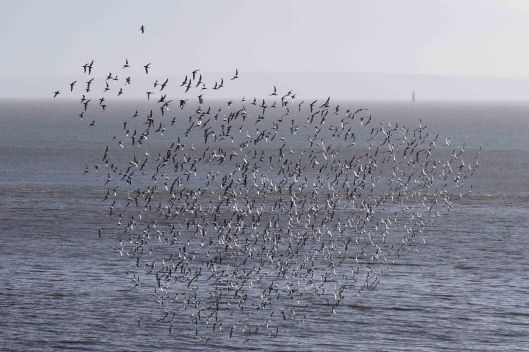
The flock must have been several hundred strong and consisted of three species of wader, Black-tailed godwit, Knot and Dunlin. For 45 minutes, I watched and listened to and photographed these stunning birds, sharing my delight and wonder with a man who was out walking his dog and who’d never seen anything like this sight in his many years of living locally.
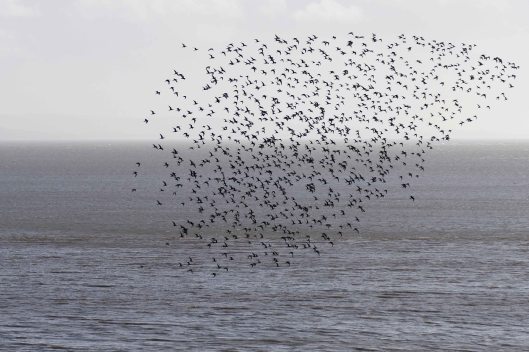
Then, for some unknown reason, the Barrage operations staff opened more of the sluice gates that allow water in Cardiff Bay to flow out in to the Bristol Channel, creating a small wave that swiftly encroached on the area of mud where the flock was feeding, and eventually covering it completely. As the wave reached them, the birds took to the air, creating an ever expanding cloud of flying birds. As one, they flew around the outer Barrage area, looking for another place to land but there was nowhere. For perhaps ten minutes, they swirled high into the air, then back down towards the water, wheeling left and right in perfect harmony, before abandoning their search for more mudflats and heading northwards along the coast. It was a sublime aerial symphony that I will never forget.

Hoovering Shelduck

Tags

, , , , ,

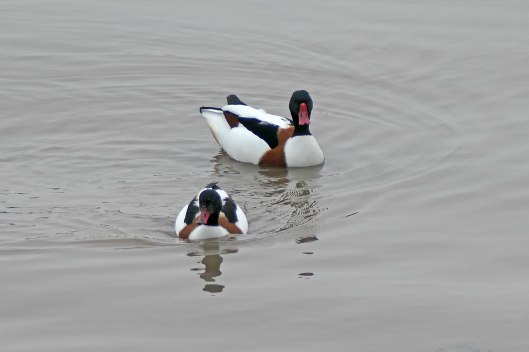
According to a research report* published on the British Trust for Ornithology’s website, the Shelduck (Tadorna tadorna) was ‘one of the most common waterbird species at Cardiff Bay prior to barrage-closure’. When the report was written, in 2003, Shelduck were still using the Bay as a roosting site between tides, albeit in small numbers. Twenty-two years later, the Bay has become so overwhelmed by human water traffic (jetboats, speedboats, water taxis, yachts, kayakers, paddleboarders) that it is rare to see Shelduck within the Bay itself.

Fortunately, there are still reasonably untouched areas of mudflat along the coast between Cardiff and Newport, and Bridgwater Bay, a National Nature Reserve renowned for its population of Shelducks, is a relatively short flight across the Bristol Channel from Cardiff Bay. So, the birds can often be seen, at a distance, feeding on the tidal mudflats outside the Barrage at low tide. And, occasionally, as happened one day last week, a pair will arrive early and wait for the lowering tide along the beach below Penarth Heads or, in this case, in the Barrage basin. This is the only time I get to see these beautiful birds up close so I sat on a rock and watched and, as the mud was exposed, took this short video of them hoovering and filtering the mud for tiny invertebrates.

* S. J. Holloway, N. A. Clark & N. H. K. Burton, ‘The Numbers and Status of Waterbirds using Cardiff Bay from 1999/2000 to 2002/2003‘, BTO Research Report No.319, The National Centre for Ornithology, Norfolk, July 2003.

First Water vole of the year

Tags

, , ,

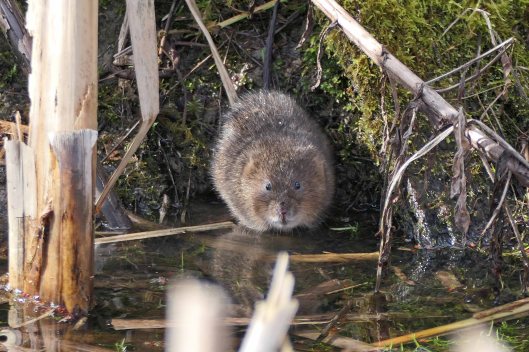
Saturday was probably the warmest day of 2025 so far, and it was noticeable how this rise in temperature affected the wildlife. Flies were basking in the sun on Ivy leaves, a bumblebee went buzzing past as I bent to photograph a wildflower (likely a Buff-tailed queen), and this Water vole popped out briefly to survey its domain and check the pond for edibles. It didn’t linger long as it’s the half-term school holiday here this week and the country park was awash with noisy children, but it was still a treat to watch this cute furry bundle, if only for a short time.