Stump puffballs

Tags

, , ,

I haven’t found much fungi lately so it was nice, during a walk earlier this week, to spot this little colony of Stump puffballs (Lycoperdon pyriforme).

I had a chuckle at this explanation of its scientific name from the First Nature website:

The genus name Lycoperdon literally means ‘wolf’s flatulence’ and just begs the question who got close enough to a wolf and stayed there long enough to become an expert on such matters. For most of us, surely such an odour cannot be a practical diagnostic feature for identifying the Stump Puffball, Lycoperdon pyriforme.
Nothing at all to do with funeral pyres, the specific epithet pyriforme comes from Latin and simply means pear shaped.

My, what long legs you have

Tags

, , ,

This little critter was hanging on to a house wall I passed yesterday. I’m fairly sure it’s a cranefly species and it might be Tipula pagana. However, although I’ve lightened it a lot, my photo doesn’t show the identifying features well enough and, according to what I’ve read, it shouldn’t be out and about at this time of year. It was certainly nice to see an insect at last, as, understandably, they are all hiding away at the moment.

Cattle egrets

Tags

, , , , , , , ,

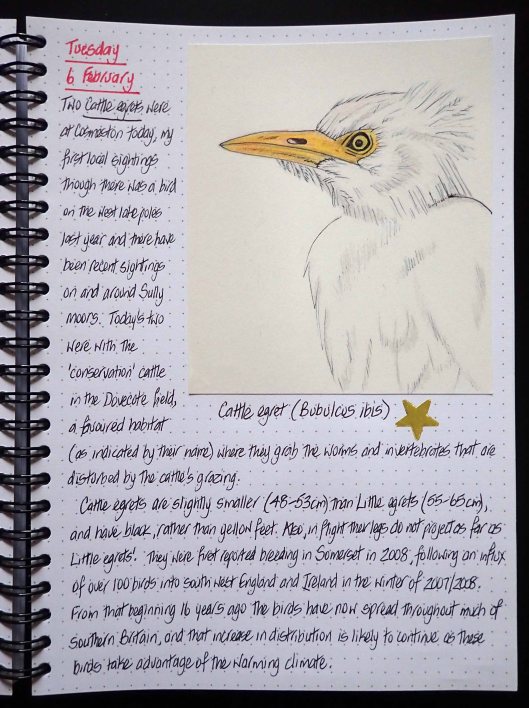
Okay, one more post about nature journaling and, hopefully, that will be the last for a while. The reason I’m focusing on my journal again today is due to the abysmal state of weather forecasting in this country. After several days of un-forecast rain and drizzle, yesterday’s forecast was for more drizzle and rain, so I went out in full waterproofs and with just my cheapo camera. What happened? You guessed it – not a single drop of water fell from the sky until late afternoon, and I didn’t have my good camera with me to take photographs of my first ever local sightings of Cattle egrets. So, this is where drawing comes in handy, to illustrate what I’ve seen.

240207 cattle egret

p.s. The gold star is not me marking my own homework. It’s a visual indication of how superb it was to see these gorgeous egrets in my area.

Another day, another Jay

Tags

, , , , , ,

I hesitated before deciding to share this but the truth is that the miserable weather means I’m struggling a little to find daily content for the blog so here we are. I’ve always kept a nature journal, recording my finds from my walks, but this year I’ve decided to challenge myself by illustrating my journal with at least one drawing each day. I initially thought I would draw flora and fauna but so far I’ve focused on birds, and I might just stick to birds this year, as there’s so much to learn – and this is certainly helping to hone my observation skills! As I’m a complete novice when it comes to drawing, I started out copying other people’s quite stylised drawings I found online, using just a black ballpoint. I’ve now progressed to drawing from photos, and using ballpoint and coloured pencils. I hope, eventually, to be able to sketch in the field, and perhaps use watercolours, but I’m just taking things slowly, not pushing myself too hard too soon.
All of which was to explain why today you are seeing my drawings of a Jay’s head! Apparently, you can teach an old dog new tricks.

240206 jay drawing

A garrulous Jay?

Tags

, , , ,

Is it any wonder the Jay’s scientific name is Garrulus glandarius? Garrulus is from the Latin garrire which means chattering, babbling or noisy, and that is, of course, where the adjective garrulous (meaning excessively talkative) also comes from. (The epithet glandarius is from Latin meaning ‘of acorns’.) The Jay often announces its presence by screeching like a Banshee but the gorgeous Jay in my photo was making much more gentle sounds, chortling quietly to itself, as if it had just heard a good joke. Garrulous, yes, but It was also quite delightful!

240205 jay

Waders little and large

Tags

, , , , , , ,

Like a bird giant, a Curlew strides past this small grouping of Ringed plovers and Dunlins.

240203 waders (1)

At first glance, I thought there were only a couple of the smaller birds snoozing at the water’s edge but, as the tide was coming in, their slumbers kept being interrupted by waves splashing over them, so every few minutes they had to shuffle a bit further up the beach. And when that happened, more little heads would pop up from where they’d been tucked down amongst the rocks.

240203 waders (2)

Alexanders rust and springtails

Tags

, , , , , , ,

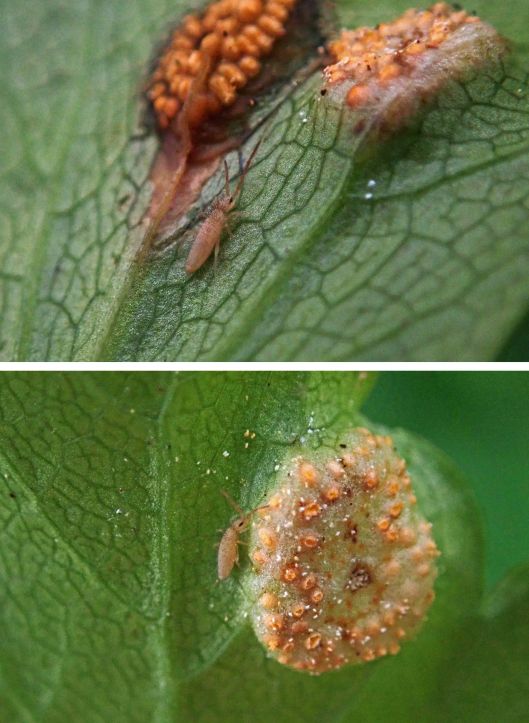
One of the most abundant plants along the South Wales Coastal Path, even in the depths of winter, is Alexanders (Smyrnium olusatrum), and, almost as soon as it breaks ground, it seems to have rust on its stems and leaves. This rust, Alexanders rust (Puccinia smyrnii), is only ever found on this plant species, and when I was examining the rust recently, I noticed it was providing a meal for some tiny springtails. I’m not sure which springtail species these are – they can be tricky to identify, but many species are known to snack on fungi, fungal spores, mould and bacteria so I guess they find the rust spores a tasty meal.

240202 springtail eating alexanders rust

Hiding in the Ivy berries

Tags

, , ,

It’s been a bit of struggle finding invertebrates this month – everything’s tucked away out of the cold and the rain – so I was very pleased to see this Red-legged shieldbug trying to hide in this little clump of Ivy berries. If it’s not careful a hungry bird will have a crunchy treat when it comes feeding on the berries.