J is for Jay

Tags

, , , , ,

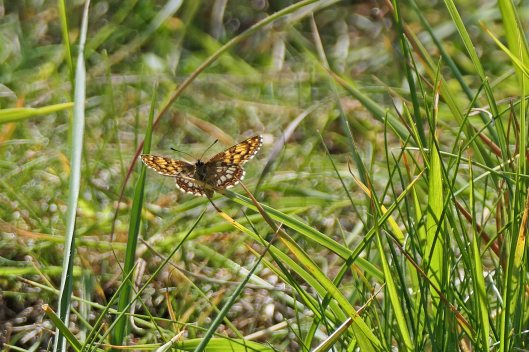
They can be quarrelsome and raucous, are known for stashing acorns as winter fodder, and have colourful plumage that might more usually be found on a tropical bird. The Jay’s scientific name (Garrulus glandarius) is so appropriate: the words are both Latin, Garrulus meaning babbling, noisy, chattering, and glandarius meaning ‘of acorns’.

231215 jay (1)

Jays have been plentiful this year in my local woodlands, which is wonderful. I’ve managed to get reasonable photos a few times, and have blogged about them twice, Two Jays on 20 April and, on 12 October, A Jay and its acorn.

231215 jay (2)

I is for ichneumon

Tags

, , , , ,

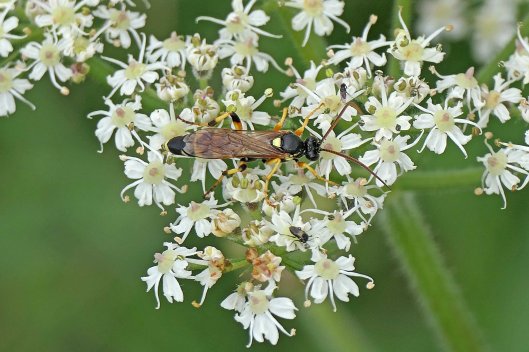
I’m not very good at photographing and/or identifying bee and wasp species (they’re almost never still, and they can be tricky to identify) so I was very happy to nail not one, but two wasp species in August. Both were ichneumon wasps, the first, which featured in An ichneumon, 10 August, is Amblyjoppa fuscipennis.

231214 Amblyjoppa fuscipennis

And this second beauty was also distinctive enough for me successfully to identify. Meet Ichneumon sarcitorius (from Another ichneumon, 11 August).

231214 Ichneumon sarcitorius

H is for hairstreaks

Tags

, , , , ,

H is for hairstreaks, purple and green. For me, 2023 was a particularly good year for Purple hairstreaks. On 21 July, in Purple sheen, I blogged about those I had already seen at Lavernock Nature Reserve and at Casehill Woods, but I was lucky to see them in three more locations, at Ystrad Mynach on 25 July, in Dingle Park on 27 July, and finally one at Cosmeston on 1 August. The photos below are from my Ystrad Mynach encounter, where I almost stood on a Purple hairstreak that had been blown on to the pavement in front of me from its large Oak tree across the narrow busy road, probably by the many passing high-sided trucks. After taking a few photographs, I took the tiny creature back across the road and placed it as near to its tree as I could reach.

231213 purple hairstreak

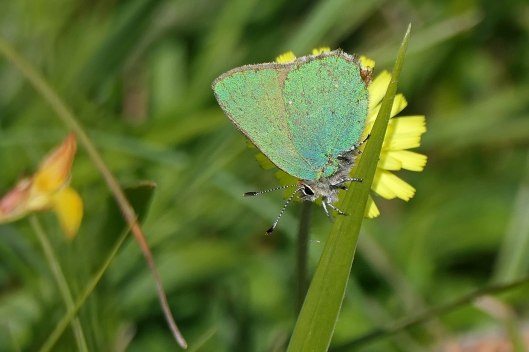
There are no local places to see Green hairstreaks so I was particularly delighted in June to see my first in four years (A streak of green), at Charlton Kings Common just outside Cheltenham.
231213 green hairstreak

I also enjoyed a lovely encounter with a White-letter hairstreak this year but thought I’d highlight in this blog the Purple (for those special in-the-hand moments) and the Green (for the first sighting in so long).

G is for Goshawk

Tags

, , , ,

For many years the Goshawk was my bogey bird. Other birders would see them in my local area but I wouldn’t. I’d go on bird club trips to locations where they were known regularly to appear but they didn’t. I would occasionally think I’d seen one but, when more experienced birders reviewed my photographs, they always thought the birds were Sparrowhawks. Finally, FINALLY, on 25 July I spotted a bird that everyone agreed was a Goshawk! You can perhaps imagine my delight and relief at finally getting my bogey bird. It was certainly one of the highlights of my birding year.

231212 goshawk

F is for Firecrest

Tags

, , , , , ,

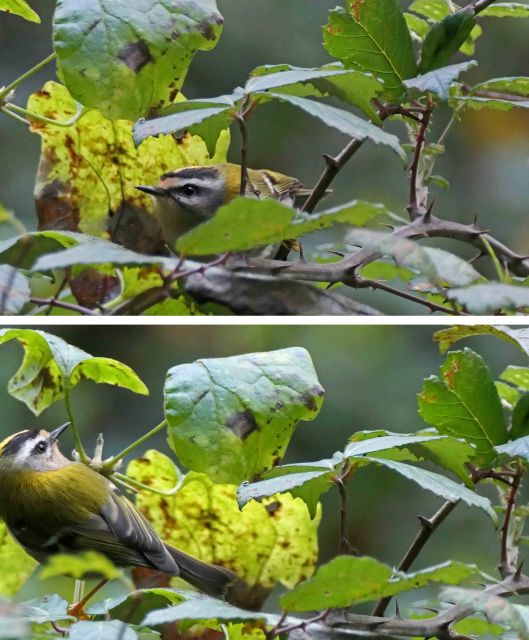
Initially, the letter F was going to be for flies then two fabulous little birds popped up last Tuesday and stole the show (though there were also flies that day). The birds were two Firecrests, probably those first discovered at this location in early November and not seen since, despite me and other birders looking for them. The site has quite dense vegetation so little birds like these can easily disappear.

231208 firecrest

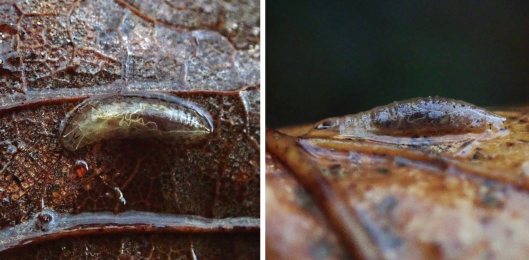
And the flies? Well, I had spent about 20 minutes walking through the area, had stood at various spots searching for movement in the trees and bushes, but not seen any sign of the Firecrests. So, as this is an area with lots of lovely deciduous trees, I decided to ferret through the leaf litter for any nice invertebrates. I’d turned over about 50 soggy, muddyish leaves before I had some success, finding these two Lauxaniidae fly larvae. I’d just finished taking some photos of them when I heard a special little peeping and there were the Firecrests.

231208 Lauxaniidae

E is for earthstar

Tags

, , , ,

I have never seen as many earthstars as I did during a visit to a Cardiff Cemetery a few weeks ago. There must have been over 50 Collared earthstars (Geastrum triplex) growing under the pine trees at the entrance to the cemetery, a location where I’ve never before seen them despite many visits over several years, so it was a very special sight indeed. And as these are the fungi that originally inspired the name of this blog, I felt I had to include them in this end-of-year countdown.

231210 earthstars

D is for damselfly

Tags

, , ,

Damselflies have flitted in to these pages three times this year: a Large red damselfly appeared as if by magic in A damsel dropped in on 2 May and a pair of the jewel-like Beautiful demoiselles featured in The beautiful couple on 7 June. The damselfly highlight, though, didn’t appear until late June, when I saw Small red-eyed damselflies for the very first time (Lifer: Small red-eyed damselfly, 29 June), and what gorgeous little creatures they are. My photographs do not do them justice, so I’m very much looking forward to seeking them out and photographing them again in the new year.

231209 small red-eyed damselfly

C is for Coleophora

Tags

, , , , , , ,

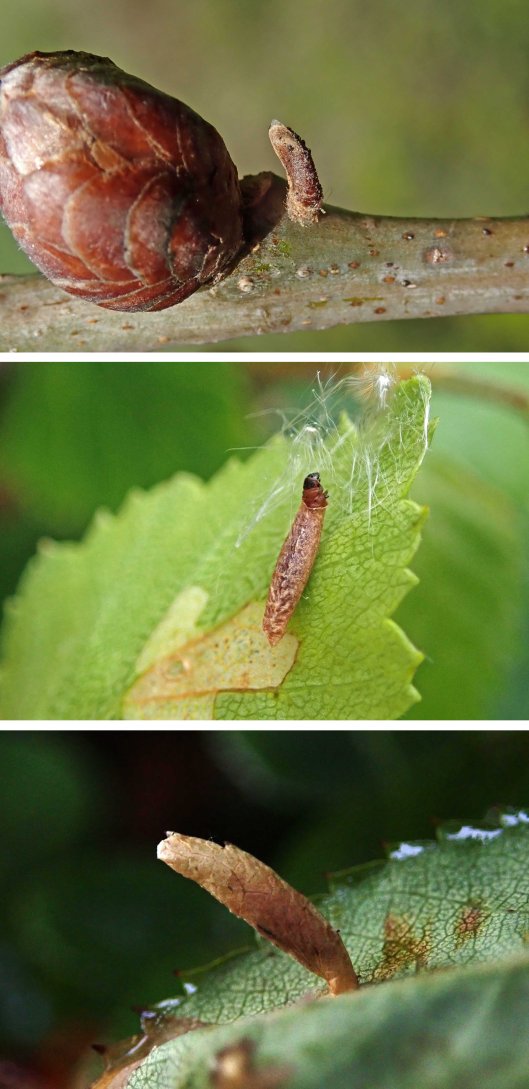
Coleophora: the clue’s in the name, which is a combination of the Greek word koleós meaning sheath and phora meaning carrier. Coleophora is a genus of moths whose larvae construct a case, which they carry around with them and live in, kind of like a snail. These year’s Coleophora finds include Coleophora lutipennella and Coleophora serratella, both in May, and Coleophora gryphipennella just a few weeks ago. You can see from the photos below how diverse their cases are – and these are some of the simpler designs.

231208 Coleophora

A is for aphid

Tags

,

As I did two years ago, I’m going to use my last 26 posts to count down alphabetically to the end of the year, sometimes celebrating special finds, often highlighting particular species or families, occasionally indicating the flora and fauna I want to learn more about. That countdown also began with A is for aphids and with my announcement that I intended to look at their various species more closely in 2022. That didn’t really happen; in fact, my fascination with aphids didn’t really kick in until 2023 was half over.

231206 aphids (1)

Initially, aphids were the victims, food for hoverfly larvae (Yummy aphids, 21 June). Next, I found some new galls that were caused by aphids (Galls: Pemphigus spyrothecae, 17 July). Then began my slide down the slippery (and often confusing) slope towards aphids and their parasites, with A parasitised aphid on 19 September; Aphid mummies on 26 September; the 10 October post: A confusion of pie crusts; and more mummies, this time black in colour, Black mummies on 19 October. I finished my 2023 aphid obsession with a chance sighting on 25 October Aphids: Tuberolachnus salignus, and I’m already excited about what I might find next year.

231206 aphids (2)