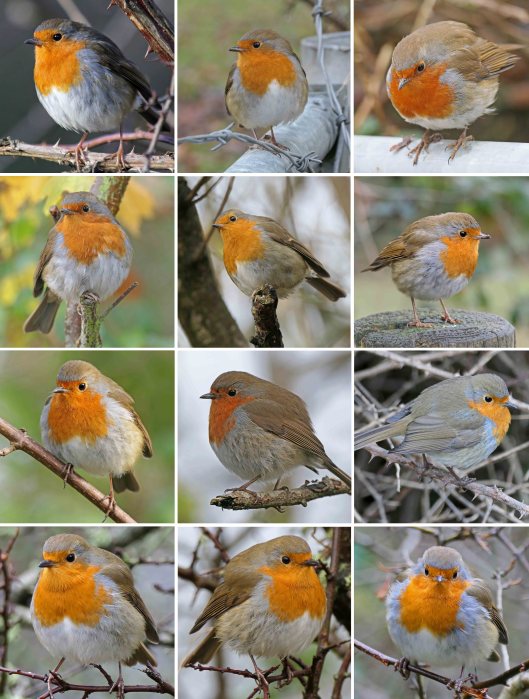
Rotund Robins

Tags

, , ,

I feel for the birds when the temperatures plummet. I’m feeling cosy in hand-knitted woollens, fleece-lined trousers and wind-cutting jacket, whereas all they can do is fluff up their feathers to retain a layer of warmth close to their skin. It seems to work for them though, as long as it doesn’t get too cold. And little birds like these Robins are even more adorable than usual when they look like little balls of fluff.

231205 robins

Leafmines: Gracillaria syringella

Tags

, , , , ,

These finds date from early November but it’s taken a while to get their identity confirmed. These are the larval leafmines of the gorgeous little moth Gracillaria syringella, shown here on Wild privet (Ligustrum vulgare) though they can also be found mining the leaves of Lilac species (Syringa, hence the epithet in their scientific name), Ash (Fraxinus excelsior) and Jasmine (Jasminum sp.).

231204 Gracillaria syringella (1)

Once hatched from their eggs, the larvae initially feed within a gallery mine (difficult to see in my images so I’ve marked them with a red arrow), then broaden their horizons into a large blotch. My finds were late in the year – the mines of Gracillaria syringella can usually be found in June and then again during August-September.

231204 Gracillaria syringella (2)

Slip-sliding

Tags

, , , , , , ,

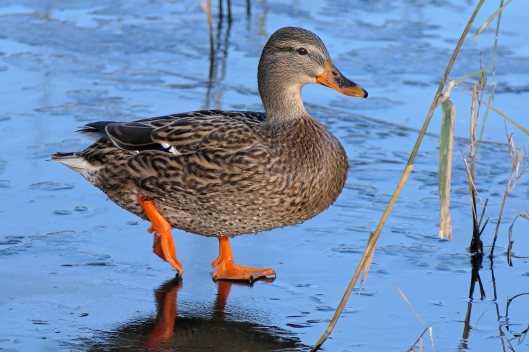
After a few sub-zero-Celsius nights and not much higher daytime temperatures, the pond at Cardiff Bay Wetlands Reserve had mostly frozen over, and the Mallards and a Coot were sticking to a small open area on the far side. But, when a couple arrived with food for the birds, Ms Mallard was tempted out of her little patch of unfrozen water to reach the treats. I felt a bit mean but I couldn’t help laughing at her slip-sliding her way across the ice.

231202 mallard

Snowy disco

Tags

, , , , ,

Though many parts of Britain are currently revelling in their first snowfalls of the winter, here in my part of south Wales the white of a crisp frost is as close as we’ve got to that beauty and the only snow of note is a fungus, with the very appropriate name of Snowy disco (Lachnum virgineum).

231201 snowy disco (1)

Though there are other white cup-shaped fungi, this one can be distinguished by the hairiness of its short stem and the underside of the cup. That hairiness is also the reason you often see these tiny cups with miniscule droplets of water attached – the water ‘sticks’ to the hairs. Though these fungi are described as widespread and common, I don’t see them very often and, in fact, I only found these because I was picking up small logs in a woodland to check for any invertebrates beneath them. The Snowy disco was a very nice bonus!

231201 snowy disco (2)

Noble false widow

Tags

, , , ,

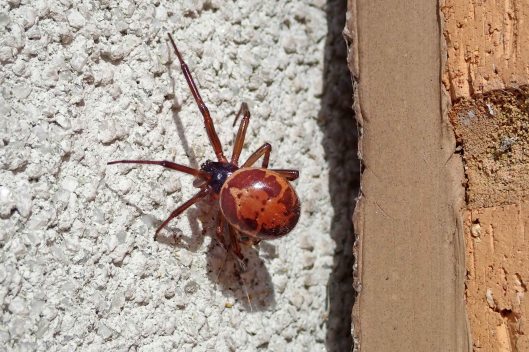
I found my first false widow spider, a Noble false widow (Steodata nobilis), at the end of October but it’s taken a few weeks for confirmation of my identification to filter through the recording system, hence the delay in showing you this little beauty. It had chosen its spot well: the outer wall of an apartment block, on the southern side where it could enjoy any sun and with a nearby crack between building and boundary wall where it could escape when threatened.

231130 false widow spider

People often freak about spiders, and the false widows get some bad press because they get confused with the black widows (Latrodectus spp.), but these creatures are relatively harmless, especially when treated with respect. Yes, they might give a person a little nip if they’re trapped (e.g. in clothing) but so would you if you felt trapped and in danger, right? (The Natural History Museum website has a great page on identifying these lovely spiders.)

A Moorhen reflects

Tags

, , , , ,

The lake is still overflowing from all the recent rain and that overflow area is more still that the waters of the lake itself. When I approached yesterday to check out which birds were present, this Moorhen was walking along the edge, its progress so slow that it wasn’t disturbing the watery reflections. The day was dull and grey so the light on the bird was not the best but I still took rather a lot of photos.

231129 moorhen reflects

Leafhopper: Ribautiana tenerrima

Tags

, , , ,

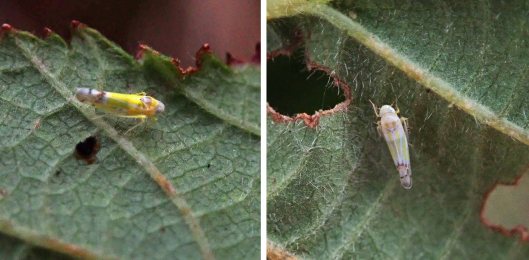
Over the years I’ve seen many small green-looking leafhoppers on Bramble and, knowing that small green-looking leafhoppers can be very difficult to identify, I’ve tended to ignore them. Last week, when Bramble-leaf-turning, I noticed that these little hoppers had some quite subtle markings on their backs (some with more saturated colour than others) that might help to distinguish them from others of their kin and, as they were keeping relatively still, I was able to get some photos (though grainy due to the dim light).

231128 Ribautiana tenerrima (1)

These have now been confirmed as Ribautiana tenerrima sensu lato, one of the most common species in Britain, that can be seen on Brambles and several other plant species between June and December. As there are other very similar Ribautiana species, for recording purposes, where we can’t distinguish one from the other, we use the catch-all name Ribautiana tenerrima sensu lato, with sensu lato meaning ‘in the broad sense’.

231128 Ribautiana tenerrima (2)

Leafmines: Stigmella anomalella

Tags

, , , , , ,

This particular Dog rose (Rosa canina) was generous with its leafminers. Not only did I see the feeding signs and case-bearing larva of Coleophora gryphipennella (see my 13 November blog post) but I also found my first leafmines of Stigmella anomalella, also known appropriately enough as the Rose leaf miner (there are photos of the adult moth on the UK Moths website).

231127 Stigmella anomalella

As you can see, the larvae create long meandering galleries that are initially narrow and completely filled with frass, then later widen to show clear space on either side of the line of frass. The British Leafminers website notes that the gallery often ‘crosses back over itself’ as my image shows – well, actually, it’s crossing back under itself, but you get the idea. I was also lucky to spot larvae in mines on two of the leaves I looked at. These mines can be found around July and then again between October and December, so check out those Dog rose leaves before they all fall.

231127 Stigmella anomalella (2)

Three campions

Tags

, , , , ,

Here are three campions I’ve found during this week’s walks. The first was a late-flowering surprise I found on Wednesday and is in the best condition of these three campions as it was photographed before the hard frost we had yesterday, Saturday. This is the lovely Red campion (Silene dioica).

231126 red campion

The White campion (Silene latifolia) also looked lovely when I saw it on Wednesday but these photos were taken today so the flowers were showing the effects of the weather, drooping, wet from this morning’s drizzle, the petals almost transparent but still pretty. I’ve included a second photo, a side view of the flower so you can see the difference between White and the third campion, below, which also has white petals.
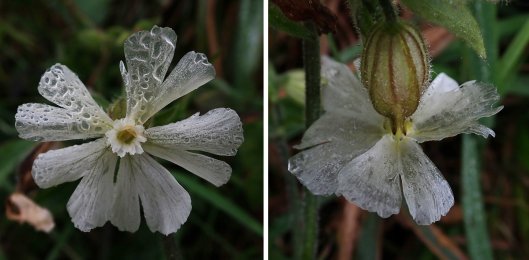
231126 white campion

And this is the third campion of the week, very much past its best now, with the merest slivers of petals still remaining. The shape that gives the Bladder campion (Silene vulgaris) its name is very obvious and, once again, I’ve included a second image, this one taken in June, to show this pretty flower at its best.
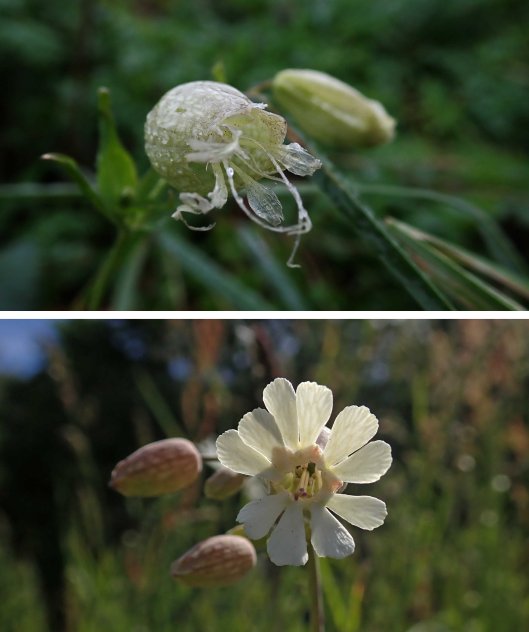

231126 bladder campion