• ABOUT
  • BIRDING 2018
  • Birding 2019
  • BLOG POSTS
  • Butterflies 2018
  • Resources

earthstar

~ a celebration of nature

earthstar

Tag Archives: autumn migration

More migrants passing through

01 Saturday Sep 2018

Posted by sconzani in birds, nature

≈ 4 Comments

Tags

autumn migration, birding, birdwatching, British birds, Chiffchaff, Cosmeston, Cosmeston Lakes Country Park, migrating birds, Pied plycatcher, Redstart, Wheatear, Whinchat, Whitethroat, Willow warbler

My local country park, Cosmeston Lakes, has been awash with migrating birds this past week. And it’s not just me getting better at finding them – according to birders who’ve been checking the area much longer than I’ve lived nearby, this has been a bumper year for sightings.
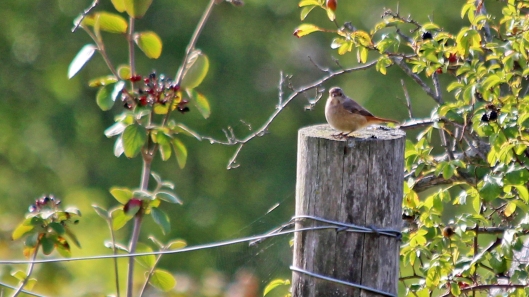
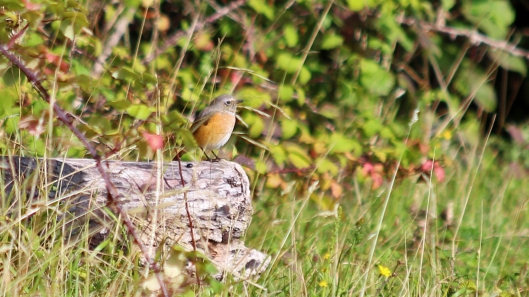
180901 Redstart female 2408180901 Redstart male 2408

On 24 August I found two Redstarts, a male and another that may have been a female or an immature bird that hadn’t yet developed its full adult colouration.
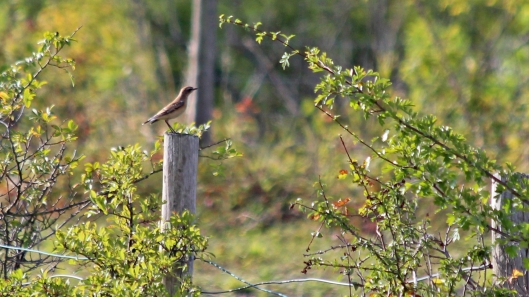
180901 wheatear 2408

Also on the 24th I had a very fleeting view of a Wheatear that popped up from grass to fencepost, then was off in the blink of an eye.

180901 whinchat 2708

On the 27th my birding friend Della texted me to say she’d found a Whinchat. That was the fastest I’d ever walked to Cosmeston and, luckily, the bird waited for me – and, in fact, stayed around most of the week so I saw it several times.
180901 common whitethroat

180901 chiffchaff180901 willow warbler

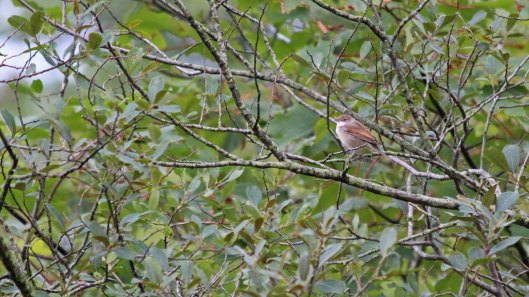
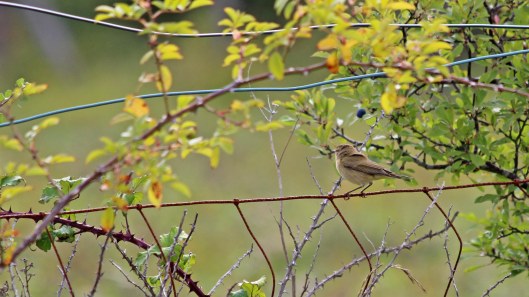
During my frequent visits to Cossie this week, I’ve seen ones and twos of Whitethroat and Chiffchaff, and tens of Willow warblers. These are the ones I spotted on the 30th.
180901 redstart 2908

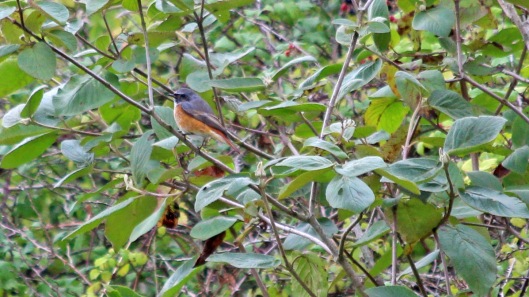
Also on 30 August, I spotted another Redstart and, from the dark head colours, I could tell this one was definitely a male.
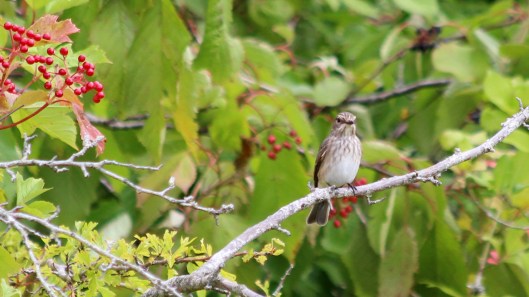
180901 pied flycatcher

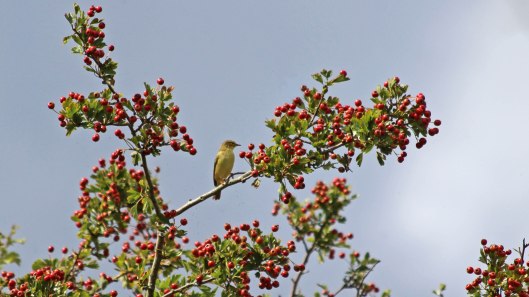
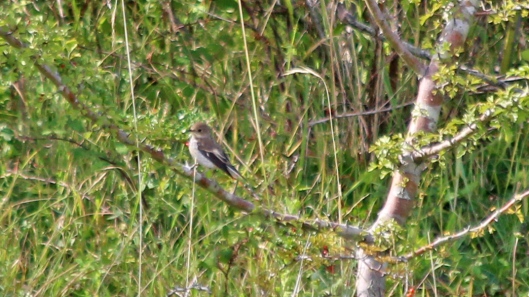
The week ended with a bang! My birding friend, Graham, let me know that he’d seen a Pied flycatcher with a small group of Spotted flycatchers, a most unusual visitor. Luckily, I was on the coastal path heading homeward so was able to divert towards Cosmeston and, with Graham’s help, got distant views of this beautiful little bird catching flies along the tree line. What a stunning week it has been!
Like Loading...

Seeing spots before my eyes

27 Monday Aug 2018

Posted by sconzani in autumn, birds, nature, seasons

≈ Leave a comment

Tags

autumn migration, bird migration, birding, birdwatching, British birds, Cosmeston, Cosmeston Lakes Country Park, Muscicapa striata, Spotted flycatcher

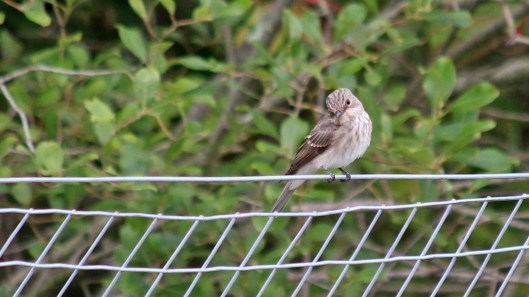
The autumn bird migration is now in full swing in south Wales and almost every day migrating birds are being spotted at Cosmeston Lakes Country Park, where they’re stopping off to refuel before they tackle their long flights to warmer over-wintering locations in Europe and Africa. One that I find particularly charming is the Spotted flycatcher (Muscicapa striata), which is not really spotted at all, more streaky and stripy. The scientific name is more accurate: Muscicapa is a combination of the Latin word musca, meaning fly, and capere, meaning to catch, and the epithet striata is from the Latin striatus, meaning striated.

180827 spotted flycatcher (1)

I saw my first Spotted flycatcher at Cossie on 7 August.

180827 spotted flycatcher (2)
180827 spotted flycatcher (3)

A week later, on the 15th, I had two sightings.

180827 spotted flycatcher (4)
180827 spotted flycatcher (5)
180827 spotted flycatcher (6)

The 20th was a bumper day, with three birds, two obviously travelling together, and another doing its own thing.

180827 spotted flycatcher (7)

And last Friday, the 24th, a birding friend put me on to a single bird, that was catching flies in the paddock I walked through on my way home. Fingers crossed I manage to see a few more before they all disappear for the winter.

Like Loading...

Cardiff’s lovely Little gull

14 Tuesday Aug 2018

Posted by sconzani in autumn, birds, nature

≈ Leave a comment

Tags

autumn migration, autumn passage of birds, birding, birdwatching, British birds, British gulls, Cardiff Bay, gulls, Hydrocoloeus minutus, Little gull

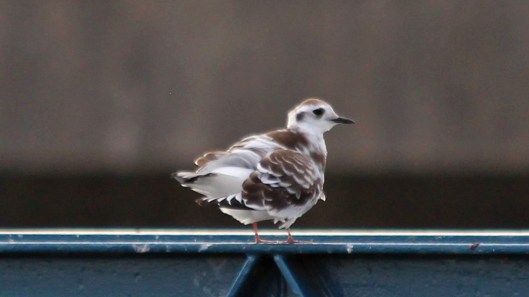
I mentioned a few days ago, in my post about the autumn passage of birds now getting  underway, that a juvenile Little gull has recently been spending time in Cardiff Bay. As it’s such a lovely creature, I thought I’d go back and try for another look and more photos. My camera gear’s not the best so these shots aren’t the crispest you might see but I think you’ll agree this is one beautiful small gull.

180815 Little gull (1)

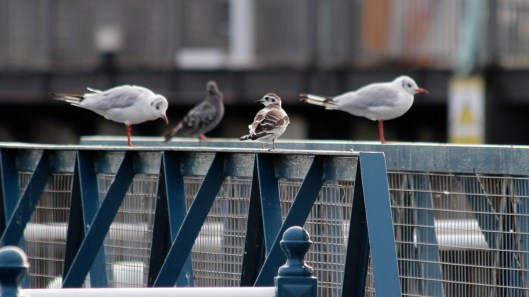
The Little gull (Hydrocoloeus minutus) is perfectly named (minutus, as you might have guessed, means small, minute): in the photo below you can clearly see its petite stature in comparison to the Black-headed gulls and Feral pigeon perched near it.

180815 Little gull (2)

According to the RSPB website, between 400-800 Little gulls over-winter in Britain but, locally, here in south Wales, they are uncommon visitors, mostly seen on passage in spring or autumn. My first-ever Little gull sighting was during this year’s spring passage, in Cardiff Bay on 10 April, but that bird spent much of its time flying around in the centre of the bay, visible only through ’scopes and binoculars.

180815 Little gull (3)
180815 Little gull (4)

So, it’s been especially nice that our current visitor has been flying, perching and feeding much closer to shore where I, and many other people, have been able to get a better look at it. Soon, I’m sure, it will head south to meet up with others of its kind who will spend their winter around the coastlines of the Mediterranean and western Europe. Fly well, little beauty!

180815 Little gull (5)

Like Loading...

The autumn migration is underway

11 Saturday Aug 2018

Posted by sconzani in autumn, birds, nature

≈ 1 Comment

Tags

Arctic tern, autumn migration, bird migration, birding, birdwatching, British birds, Cardiff Bay, Ely embankment, Little gull, Spotted flycatcher, Turnstone, Willow warbler

It’s that time of year, tinged ever so slightly with sadness but enlivened with occasional moments of great excitement, when bird populations begin their autumn migration. My local Swifts have headed south for the winter and I shall miss their dawn and dusk screaming, the sound of summer for me, and there have been good numbers of Swallows and House martins swirling above Cardiff Bay, in a final feeding frenzy before they too head south.

180811 1 willow warbler
180811 2 willow warbler

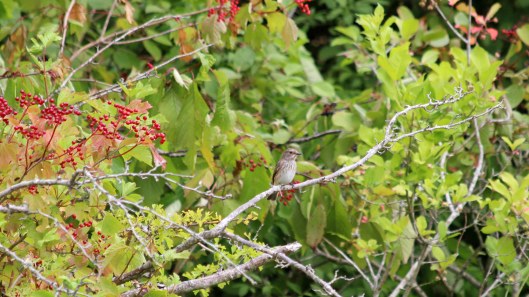
I’ve spotted small flocks of Willow warblers and Chiffchaffs, moving through my local nature reserves and parks, stocking up on nutrients before they also begin their long flights. And, this week, a Spotted flycatcher became my 186th bird species for 2018, when I saw it passing through Cosmeston.

180811 3 Spotted flycatcher

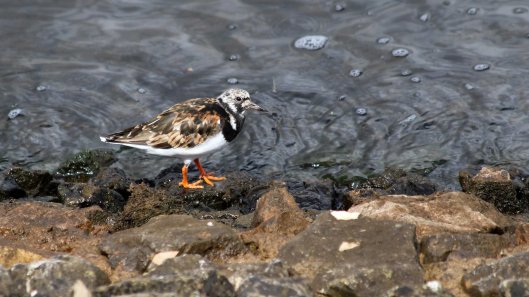
As well as those birds that are departing for sunnier wintering spots, there are also birds returning from their colder breeding locations to spend the winter in Britain’s relatively warm climes. I saw my first two returning Turnstones, still in their summer plumage, during a wander along the Ely embankment on Wednesday.

180811 4 turnstone

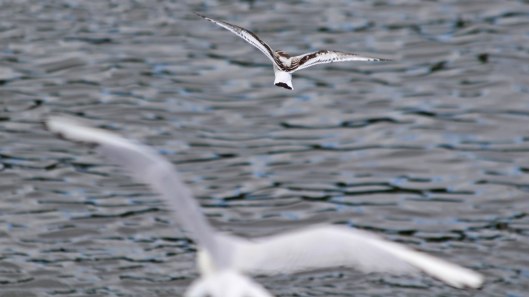
Also at Cardiff Bay this week have been a couple of those birds that provide birders, local and distant alike, with a quickening of the heart rate. First, a first summer Arctic tern arrived to join the Cardiff Bay bird population, and then a juvenile Little gull also joined the party, though neither bird has been welcomed by the local gulls.

180811 5 arctic tern

180811 6 little gull
180811 7 little gull

I saw both birds being chased and mobbed on Wednesday, and a little later that same day my friend John caught some amazing shots of a Black-headed gull almost drowning the Little gull – luckily, it escaped. (Bird xenophobia? No one seems to know why the local gulls are being so aggressive.)

180811 8 arctic tern being chased

Above, Arctic tern being chased; below, Little gull also being pursued

180811 9 little gull being chased

Let’s hope further newcomers are given a warmer welcome to our local waters and, indeed, let’s just hope for further newcomers – there’s nothing quite like an exciting sighting to quicken a birder’s pulse!

Like Loading...

Autumn migration: Stonechats

15 Sunday Oct 2017

Posted by sconzani in autumn, birds, nature

≈ Leave a comment

Tags

autumn, autumn migration, birding, birdwatching, Cardiff Bay Wetland Reserve, Cosmeston Lakes Country Park, Grangemoor Park, migrant birds, Saxicola torquata, Stonechat

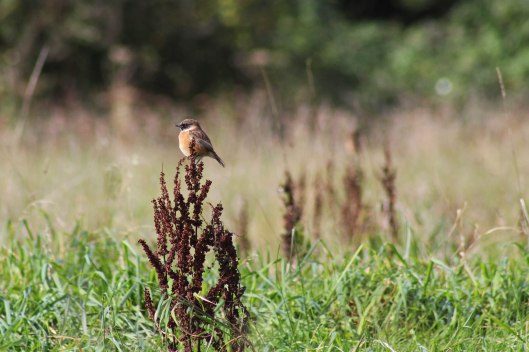
Meet the Stonechat (Saxicola torquata), the bird whose song sounds like two pebbles being rapped together, hence its common name.

171015 Stonechat (4)

These little birds, about the size of your average Robin, usually live a little north of where I live in south Wales, preferring the plantations of conifers that grow in the Welsh valleys and the heathland of the Brecon Beacons. But, come the cooler temperatures of autumn they begin to move south to over-winter in slightly warmer climes.

171015 Stonechat (3)

I saw my first local bird at the Cardiff Bay Wetland Reserve on 17 September, a pair at Cosmeston Lakes Country Park on 6 October, and then a solitary female at Grangemoor Park last Sunday, 8 October.

171015 Stonechat (1)

Stonechats are not always easy to spot, as they duck down amongst tall grass and wildflowers in their search for insects and seeds, and their colours act as good camouflage. But, luckily, they also have a habit of perching on the tops of those grasses and wildflowers and on low shrubs so they can keep an eye out for threats – and humans with cameras! – so I have managed to get a few distant photos.

171015 Stonechat (2)

Like Loading...

Autumn migration: Garganey

30 Saturday Sep 2017

Posted by sconzani in autumn, birds, nature

≈ Leave a comment

Tags

Anas querquedula, autumn migration, birding, birdwatching, British birds, British ducks, ducks, Garganey, migrating birds, Roath Park Lake

When sightings of rare birds are reported, the birds are usually in out-of-the-way locations that are difficult to access by public transport so I can’t go looking but yesterday was different. A ‘scarce and very secretive’ duck had been spotted at Roath Park Lake, my old stomping ground, so I hopped on a train and was there like a shot.

170930 Garganey (1)

The bird was a Garganey (Anas querquedula) and it was certainly living up to its reputation: I spent 30 minutes or so walking and looking and couldn’t spot it (though the Teal and Shovelers were an added bonus amongst the resident water birds). A fellow birder told me he’d seen the Garganey briefly through his ’scope but it had then disappeared under overhanging tree branches. So, I went for a walk around the park, watched a young Heron fishing in the sluice and enjoyed the autumn colour, before heading around the lake again on my way back to the train. And there it was!

170930 Garganey (2)

The female Garganey looks much like a female Mallard at first glance but she is a much smaller duck, the markings on her face are stronger, with the eye stripe giving her quite an exotic look, and she has a bill that shows she’s a dabbler. She was very active, constantly ducking her head under the water for plant material and insects – in fact, most of my photos are of a headless duck!

170930 Garganey (5)
170930 Garganey (6)
170930 Garganey (7)

Garganeys are only seen in small numbers in Britain, as they pass through during spring and autumn migration, so being able to see and watch this beautiful female was a treat indeed!

170930 Garganey (3)
170930 Garganey (4)
Like Loading...

Autumn migration: Red admiral

21 Thursday Sep 2017

Posted by sconzani in insects, nature

≈ 2 Comments

Tags

autumn migration, British butterflies, butterflies, butterflies on migration, butterfly, migrating butterflies, Red Admirable, Red Admiral

170921 Red admiral (3)
170921 Red admiral (1)

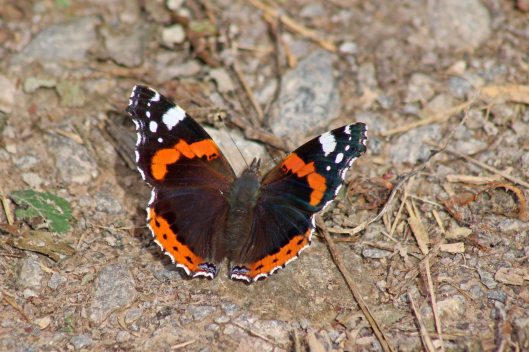
During my walk along the coastal path near Penarth earlier this week, I saw more than 20 Red admiral butterflies. Now, it may be that they had gathered in such large numbers in that particular location because the ivy flowers had recently opened and they fancied drinking deeply of their nectar (as did a huge number of bees and hoverflies) but it may also be that they were heading south on their autumn migration to southern Europe and north Africa.

170921 Red admiral (4)

The Red admiral (Vanessa atalanta) was once known as the Red admirable – a bit of a mouthful, which is probably why the name changed – and has a surprisingly ominous history. In Bugs Britannica Richard Mabey reviews the evidence, in various texts and old paintings, and concludes that the Red admiral was once thought to represent sin or temptation:

The flickering band of scarlet on the butterfly’s forewings, vivid against a dark, smoky background, suggests the flames of a smithy – hence its French name, le Vulcain, after Vulcan, the blacksmith of the Gods. But, to Christians, it also suggested the flames of Hell … This surprisingly hellish image of the Red admiral was gradually forgotten during the Enlightenment, when artists started to draw butterflies for their own sake. But perhaps the story of a ‘red butterfly’ said to have been hunted in the north of England and the Borders as a witch is an echo of a previous, more sinister characterisation.

How anyone could imagine something as beautiful as this harmless butterfly could be so malevolent is beyond me!

170921 Red admiral (2)

Like Loading...

Autumn migration: Chiffchaff

20 Wednesday Sep 2017

Posted by sconzani in autumn, birds, nature

≈ Leave a comment

Tags

autumn migration, bird migration, birding, birdwatching, British birds, Chiffchaff, Phylloscopus collybita

Although this little warbler can be seen all year round, most of its kind migrate in August and September, which is why, during the past couple of weeks, I’ve been seeing an awful lot of these pretty birds in my local parks and nature reserves. They’ve been fattening up on flies and other insects before they head south to the Mediterranean and west Africa.

170920 Chiffchaff (7)

This is the Chiffchaff, Phylloscopus collybita. As it has a tendency to nest low down amongst brambles and evergreen shrubs, it has earned itself such vernacular names as bank-bottle and bank jug, but I have no idea where most of its other common names originate from: feather bed, feather pokel, huck muck, lesser pettychaps, Peggy, sally picker, thummie, and wood oven.

170920 Chiffchaff (1)
170920 Chiffchaff (2)
170920 Chiffchaff (3)

One thing I have learnt about the Chiffchaff, however, is to try to get a good look at the colour of its legs because if it’s not singing its distinctive ‘chiff chaff’ song, then its dark-coloured legs are one way to tell it apart from its look-alike, the Willow warbler.

170920 Chiffchaff (4)
170920 Chiffchaff (5)
170920 Chiffchaff (6)
Like Loading...
Newer posts →

About me

sconzani

sconzani

I'm a writer and photographer; researcher and blogger; birder and nature lover; countryside rambler and city strider; volunteer and biodiversity recorder.

View Full Profile →

Follow earthstar on WordPress.com

Enter your email address to follow this blog and receive notifications of new posts by email.

Recent blog posts

  • The Marl Med gull January 29, 2026
  • Recording Grey squirrels January 28, 2026
  • Jimmy Wren January 27, 2026
  • Millipede: Nanogona polydesmoides January 26, 2026
  • Mid-winter 10 January 25, 2026

From the archives

COPYRIGHT

Unless otherwise acknowledged, the text and photographs on this blog are my own and are subject to international copyright. Nothing may be downloaded or copied without my permission.

Fellow Earth Stars!

  • Unknown's avatar
  • Unknown's avatar
  • Unknown's avatar
  • Unknown's avatar
  • Unknown's avatar
  • Unknown's avatar
  • Unknown's avatar
  • Unknown's avatar
  • Unknown's avatar
  • Unknown's avatar
  • Unknown's avatar
  • Unknown's avatar
  • Unknown's avatar
  • Unknown's avatar
  • Unknown's avatar
  • Unknown's avatar
  • Unknown's avatar
  • Unknown's avatar
  • Unknown's avatar
  • Unknown's avatar
  • Unknown's avatar
  • Unknown's avatar
  • Unknown's avatar
  • Unknown's avatar
  • Unknown's avatar
  • Unknown's avatar
  • Unknown's avatar
  • Unknown's avatar
  • Unknown's avatar
  • Unknown's avatar
  • Unknown's avatar
  • Unknown's avatar
  • Unknown's avatar
  • Unknown's avatar
  • Unknown's avatar
  • Unknown's avatar
  • Unknown's avatar
  • Unknown's avatar
  • Unknown's avatar
  • Unknown's avatar
  • Unknown's avatar
  • Unknown's avatar
  • Unknown's avatar
  • Unknown's avatar
  • Unknown's avatar
  • Unknown's avatar
  • Unknown's avatar
  • Unknown's avatar
  • Unknown's avatar
  • Unknown's avatar

Blog at WordPress.com.

Privacy & Cookies: This site uses cookies. By continuing to use this website, you agree to their use.
To find out more, including how to control cookies, see here: Cookie Policy
  • Subscribe Subscribed
    • earthstar
    • Join 670 other subscribers
    • Already have a WordPress.com account? Log in now.
    • earthstar
    • Subscribe Subscribed
    • Sign up
    • Log in
    • Report this content
    • View site in Reader
    • Manage subscriptions
    • Collapse this bar
 

Loading Comments...
 

You must be logged in to post a comment.

    %d