• ABOUT
  • BIRDING 2018
  • Birding 2019
  • BLOG POSTS
  • Butterflies 2018
  • Resources

earthstar

~ a celebration of nature

earthstar

Tag Archives: biological recording

Traveller’s joy

22 Friday Sep 2017

Posted by sconzani in flowers, nature, plants, wildflowers

≈ 2 Comments

Tags

biological recording, clematis vitalba, Old Man's Beard, SEWBReC, species of the month, Traveller's joy

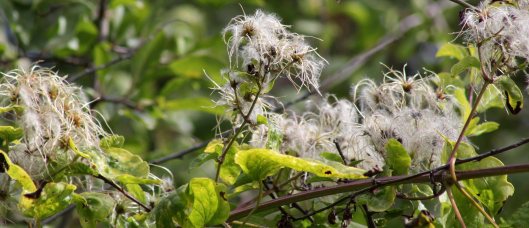
The joy of this plant is that you see it wherever you travel in Britain. See what I did there?
170922 Travellers joy (1)

Clematis vitalba is most commonly called Traveller’s-joy but you might also know it as Old-man’s-beard, Father Christmas, Smokewood or Woodbine. Its feathery white seed heads are its most distinctive feature, making it easy to recognise and identify, and this really is a plant that you’ll see draped over hedges and fences almost everywhere in Britain.

170922 Travellers joy (4)
170922 Travellers joy (3)

Yet SEWBReC, the South East Wales Biodiversity Records Centre, have revealed that Traveller’s-joy is not well recorded: they have less than 2000 records in their database. And so they have made this plant their species of the month for September. If you spot Traveller’s-joy this month (or next, or the month after), please make a point of recording it with your local records centre – almost every county in Britain has its own records centre where you can log your biological sightings and those of you based in south-east Wales can find out more about biological recording, and the species of the month, on SEWBReC’s website.

170922 Travellers joy (2)

Like Loading...

Bioblitzing again

03 Sunday Sep 2017

Posted by sconzani in fungi, insects, ladybird, nature

≈ Leave a comment

Tags

Amelia Trust Farm, bioblitz, biodiversity, biological diversity, biological recording

Ten days ago I spent the day bioblitzing with my friend Hilary at Amelia Trust Farm (with their permission, of course). Hilary volunteers there so was keen to see what we might discover around the grounds.

170903 Harvestman Dicranopalpus ramosus

The habitats were a mix of woodland, arable fields, and flower and vegetable gardens, though we kept to the various footpaths, only looked at the fields from the fence lines, and didn’t venture far into the vegie patch. As previously, Hilary surveyed the plants and I did everything else. For a late summer’s day, in a site full of noisy families, I thought my total of 59 species was respectable enough. Here are some of the things I spotted …

170903 7-spot ladybird
170903 Common European earwig
170903 Green shieldbug
170903 Honey bees
170903 Hoverfly Eristalis sp
170903 Nettle-tap moth
170903 Pantilius tunicatus
170903 Scorpion fly
170903 Small white

170903 Trametes versicolor Turkeytail

Like Loading...

Square-bashing: SS9073

02 Sunday Jul 2017

Posted by sconzani in fungi, insects, molluscs, nature, walks

≈ 2 Comments

Tags

biodiversity, biodiversity in Wales, biological diversity, biological recording, biological records, square-bashing

170702 Square-bashing SS9073 (1)

A few days ago I posted about my square-bashing adventure near Llanbeder, in Gwent. Hilary and I have now also square-bashed another under-biodiversity-recorded 1-km square, this time near St Brides Major in Glamorgan.

170702 Square-bashing SS9073 (2)

As the seagull flies we were within a kilometre of the sea and the geological substrate was very different, so the habitats we surveyed were more diverse. One public path led us down a heavily wooded driveway to an old house, another ran between the edge of that same woodland and fields sown with cereal crops (and there the hogweed was flowering which greatly improved my insect tally), and the third took us over paddocks of rough unimproved grassland, with patches of low rushes, all bordered by a wild old hedgerow.

170702 Square-bashing SS9073 (3)

Interestingly, this time Hilary’s plant list was about 20% lower than that from our previous square (though she still had around 80 species), whereas my list of everything else was about the same percentage higher (at around 100 species of insects, fungi and lichens, molluscs, etc).

170702 Banded burdock fly
170702 Bombus vestalis
170702 Cheilosia illustrata
170702 Chlorociboria sp Green elfcup
170702 Common marble moth
170702 Dark bush-cricket
170702 Fly
170702 fungi on cow dung Cheilymenia sp
170702 Horsefly
170702 Leptopterna dolabrata
170702 Small whites
170702 Snails and woodlice
Like Loading...

Square-bashing: ST3990

28 Wednesday Jun 2017

Posted by sconzani in fungi, insects, nature, walks

≈ 5 Comments

Tags

bioblitz, biodiversity, biodiversity in Wales, biological recording, biological records, SEWBReC, square-bashing

I spent last Friday square-bashing with my friend Hilary, and what a brilliant day we had.

170628 ST3990 square-bashing (1)

For the uninitiated, square-bashing consists of taking a square kilometre that has very few existing biological records and walking the roads, tracks and paths through that square to see what you can find. Each month, my local biodiversity records centre SEWBReC publishes the details of just such a square in the counties they cover, Glamorgan and Gwent, in the hope that keen folks like Hilary and I will rectify the lack of records.

170628 ST3990 square-bashing (2)

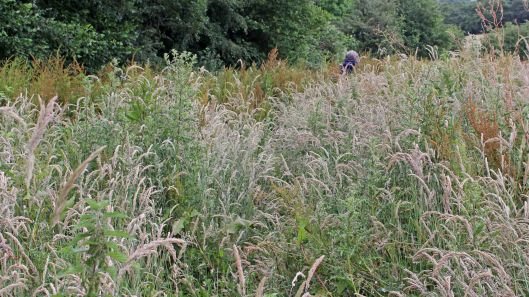
Although the term square-bashing is not meant to be taken literally, we did have to bash our way through one field in our square kilometre, where the public footpath was completely overgrown (spot Hilary in the photo below), but on the whole the countryside was beautiful, with rolling farmed fields, old narrow lanes and, the best part, an ancient holloway (more on that in a future post).

170628 ST3990 square-bashing (3)

Hilary’s something of a whizz when it comes to plants so she recorded those and I did everything else – insects, fungi, birds, you name it! As I’m not a whizz at anything, I mostly take lots of photos and then have to work out the IDs when I get home, which takes time but helps me learn. I have just a couple of outstanding queries but reckon my total will come to around 80 and Hilary has about 90 plants on her list, so it was a very good result indeed. Here are some of my finds – can you identify them?

170628 Beechmast candlesnuff Xylaria carpophila
170628 Common marble Celypha lacunana
170628 Cranefly Ptychoptera sp
170628 Eriophyes similis Gall mite
170628 Harlequin ladybird larva Harmonia axyridis
170628 Hawthorn shieldbug Acanthosoma haemorrhoidale
170628 Knot grass larva Acronicta rumicis
170628 Lagria hirta
170628 Meadow brown Maniola jurtina
170628 Pollen beetles Meligethes sp
170628 Snipe fly Rhagio tringarius
170628 Yellow dung fly Scathophaga stercoraria
Like Loading...

Holly leaf-miner

10 Saturday Dec 2016

Posted by sconzani in insects, nature, trees

≈ 5 Comments

Tags

biological recording, Holly, Holly leaf-miner, Phytomyza ilicis, SEWBReC

Following on from yesterday’s post where I (hopefully) sent you all on a quest to find the Holly parachute fungus, I thought I’d kill two biological records with one outing, and also get you to look for another species related specifically to holly.

161210-holly-leaf-miner-1

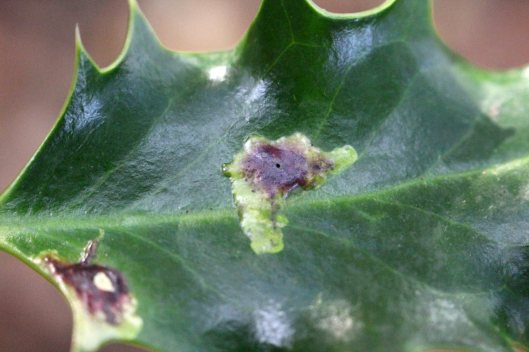
This is the Holly leaf-miner (Phytomyza ilicis), a small fly that lays its eggs inside the leaves of holly. ‘Inside’ may sound strange, but holly leaves are relatively thick and leathery so, once the eggs hatch, they make the perfect home for the fly’s larvae, which live out their lives feeding on the flesh of the leaves and making a little home for themselves in the process. Their feeding creates multi-coloured blotches on the leaves so, although you’ll probably never see the fly and probably not even the larvae (unless you slice open a leaf at the right time of year), you can always tell where they’ve been. Once they’ve eaten their fill, the larvae pupate inside their leafy homes, then open a small escape hole once their transformation is complete and fly away to start the process all over again.

161210-holly-leaf-miner-2
161210-holly-leaf-miner-3

Co-incidentally, the Holly leaf-miner is species of the month (really, two months – November and December) with SEWBReC, the South East Wales Biodiversity Records Centre. Like yesterday’s Holly parachute fungus, there are few biological records of the leaf-miner but it is almost certainly just under-recorded because, once you start looking for those tell-tale blotches, you quickly discover it’s almost everywhere. So, get looking and recording!

Like Loading...

Fungi Friday: Stump puffballs

28 Friday Oct 2016

Posted by sconzani in fungi, nature

≈ 4 Comments

Tags

biodiversity recording, biological recording, Lycoperdon pyriforme, SEWBReC, species of the month, Stump puffballs

I’m a dedicated wildlife recorder, inputting my sightings of flora and fauna into the database of my local records centre, SEWBReC (the South East Wales Biodiversity Records Centre). Each month the team at SEWBReC nominates a species that is poorly recorded in their system, in that hope that recorders like me will search high and low to help augment their records. The reason is that if record numbers are low, you can’t tell whether a species is endangered or just under-recorded, so it’s important to record even the most common things.

161027-stump-puffballs-1

The October species of the month is a case in point. The Stump puffball (Lycoperdon pyriforme) is really common throughout Britain, yet the SEWBReC database had only 167 records at the start of the month. Well, I can tell you it will have a whole lot more by the end of October, because I’ve seen them almost everywhere I go and I’ve been photographing and recording them all. It’s the only British puffball to grow on wood so it’s easy to identify, and it often grows in large colonies – as one fungi expert put it, it’s ‘the banana of the fungi world, its bunches create impressive vistas’.

161027-stump-puffballs-2
161027-stump-puffballs-3

For more on SEWBReC’s species of the month, see here. If you live in the area, or even if you’re just visiting, you can help by recording your sightings.

161027-stump-puffballs-4
161027-stump-puffballs-5
Like Loading...

An under-recorded square kilometre

07 Friday Oct 2016

Posted by sconzani in insects, nature

≈ 6 Comments

Tags

bioblitz, biodiversity, biodiversity in Wales, biological diversity, biological recording, biological records, SEWBReC

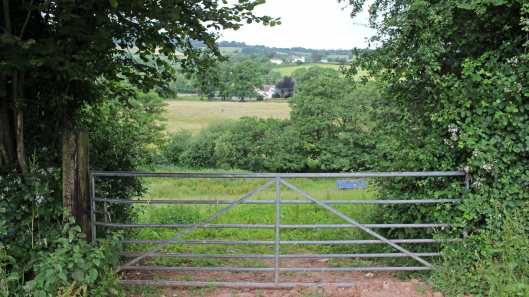
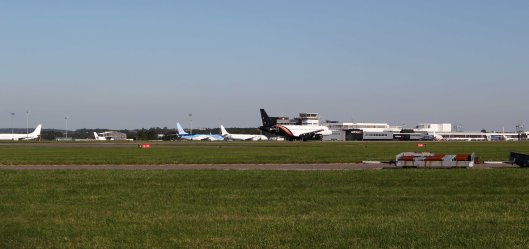
After our morning’s biodiversity recording session at Porthkerry and a rather scrummy pub lunch, our SEWBReC team took up the challenge of how many species we could discover in a one-kilometre square that borders Cardiff Airport, a square where only 15 species of anything had previously been recorded. Well, even a desert has more life in it than that, and we had fields and country lanes edged with hedgerows to explore so off we set.

161007-rhoose-bioblitz-2

Some of the hedgerows had recently been savagely trimmed and, though sunny, it was blowing a gale so conditions weren’t exactly perfect. But we are a dedicated team! We scanned and we scoured, we probed and we combed, we turned over and peered under, we inspected and we scrutinised. And at the end of two hours we had a preliminary list of 85 species, with some uncertainties to be verified, some ambiguities to be resolved and some experts to be consulted. What a thoroughly enjoyable, eminently satisfying day it was!

Each month SEWBReC provides maps and information about poorly recorded 1km squares in south east Wales, in the hope of filling in the gaps in their maps. If you live in the area, or even if you’re just visiting, you can help fill those gaps. See here for more information.

161007-rhoose-bioblitz-3
161007-rhoose-bioblitz-4
161007-rhoose-bioblitz-5
161007-rhoose-bioblitz-6
161007-rhoose-bioblitz-7
161007-rhoose-bioblitz-8
161007-rhoose-bioblitz-9
Like Loading...

Bioblitzing at Porthkerry Country Park

06 Thursday Oct 2016

Posted by sconzani in nature, parks

≈ 8 Comments

Tags

bioblitz, biodiversity, biological recording, biological recording centre, biological records, Mary Gillham Archive Project, Porthkerry Country Park, SEWBReC

As I volunteer on the Mary Gillham Archive Project, which is hosted by SEWBReC (the South East Wales Biodiversity Records Centre), I got invited along to SEWBReC’s staff outing yesterday. And what do records centre staff do for a staff outing? Why we go looking for more biodiversity records, of course! I was in my element, and it was so nice being with like-minded people who also spend a lot of time standing and staring at bushes and trees, and can take an hour to progress a hundred metres. For once, I wasn’t the ‘strange’ one!
161006-porthkerry-bioblitz-5161006-porthkerry-bioblitz-3

We spent the morning by the seaside at Porthkerry Country Park, on the south Wales coast near Barry, a first visit for me to this beautiful place, which ‘contains 220 acres of woodland and meadows in a sheltered valley that leads to a pebble beach and spectacular cliffs’. We barely scratched the surface, so I will certainly be heading back to explore further. Our list of species found currently stands at 93 but we have a few more to check so I feel sure we’ll push our total over the 100 mark before we’re finished. The sun shone on the recording team at Porthkerry!

161006-porthkerry-bioblitz-14
161006-porthkerry-bioblitz-7
161006-porthkerry-bioblitz-11
161006-porthkerry-bioblitz-8
161006-porthkerry-bioblitz-10
161006-porthkerry-bioblitz-4
161006-porthkerry-bioblitz-9
161006-porthkerry-bioblitz-12
161006-porthkerry-bioblitz-1
161006-porthkerry-bioblitz-13
161006-porthkerry-bioblitz-6
161006-porthkerry-bioblitz-2
Like Loading...

Bioblitzing Cwm Saerbren

27 Saturday Aug 2016

Posted by sconzani in birds, fungi, insects, nature, plants, wildflowers

≈ 5 Comments

Tags

bioblitz, biological diversity, biological recording, biological recording centre, Cwm Saerbren Woodland, Cwmsaerbren, SEWBReC

Each summer my local biological records centre, SEWBReC, runs a series of biological recording field days, partly to introduce members of the public to the world of biological recording, allowing them to rub shoulders with wildlife experts and learn species identification skills, and partly to record the biodiversity of particular areas. Last Thursday I went along to the field day-come-bioblitz at the Cwm Saerbren Woodland, adjacent to the small town of Treherbert at the top of the Rhondda Fawr Valley.

160827 Cwmsaerbren bioblitz (12)

This assumed unicorn was the star of the show!

Though the turnout from the locals was disappointing (not a single person!) and despite the sometimes heavy rain (a common feature up the Valleys), we had a great day. With the SEWBReC crew, a couple of guys from Natural Resources Wales, and a few of us volunteers from the Mary Gillham Archives Project, we stomped around the trails of Cwm Saerbren, recording all we saw. And, after meeting up back at the town to identify and write up our afternoon list and then filling up on hot chips from the local takeaway shop, we also got out with the bat recorder and had moth-attracting lights running to see what flying critters we might find. All up, once everything is IDed, I reckon our list will be well over 200 species. Not bad for a day’s work!

160827 Cwmsaerbren bioblitz (5)
160827 Cwmsaerbren bioblitz (17)
160827 Cwmsaerbren bioblitz (7)
160827 Cwmsaerbren bioblitz (11)
160827 Cwmsaerbren bioblitz (2)
160827 Cwmsaerbren bioblitz (8)
160827 Cwmsaerbren bioblitz (13)
160827 Cwmsaerbren bioblitz (16)
160827 Cwmsaerbren bioblitz (6)
160827 Cwmsaerbren bioblitz (9)
160827 Cwmsaerbren bioblitz (10)
160827 Cwmsaerbren bioblitz (4)
160827 Cwmsaerbren bioblitz (15)
160827 Cwmsaerbren bioblitz (1)
160827 Cwmsaerbren bioblitz (3)
Like Loading...

Long live Biological Diversity!

21 Saturday May 2016

Posted by sconzani in flowers, fungi, insects, nature, plants, wildflowers

≈ 5 Comments

Tags

biological diversity, biological recording, biological recording centre, International Bay for Biological Diversity

Tomorrow it will be 24 years since the Convention on Biological Diversity was adopted by the United Nations. To commemorate that momentous day back in 1992, 22 May is now celebrated as the International Day for Biological Diversity. Around the world, events of various kinds – from seminars, exhibitions and leaflets to more hands-on programmes of tree-planting – are organised to promote awareness of the importance of biodiversity, to spread the word that a high variety of plant and animal life is crucial in all habitats.

160521 biodiversity (10)

For my personal celebration, I visited a local nature reserve to see what species of plants, animals, insects, molluscs, etc I could find. And what a treasure trove there was waiting to be discovered! I’ve included some photos here to show you how diverse the area is but I haven’t yet identified everything I saw. I am slowly working my way through my 400 photos. And, as it’s extremely important to record what can be found around us, as a responsible Citizen Scientist, I will also be entering my records into the database of the local biological records centre.

So, here’s a challenge for you. Head out tomorrow, 22 May, and see what you can find in your local park, nature reserve, or even your own garden … and don’t forget to record what you see.

160521 biodiversity (1)
160521 biodiversity (2)
160521 biodiversity (9)
160521 biodiversity (3)
160521 biodiversity (4)
160521 biodiversity (5)
160521 biodiversity (11)
160521 biodiversity (6)
160521 biodiversity (12)
160521 biodiversity (7)
160521 biodiversity (13)
160521 biodiversity (8)
160521 biodiversity (14)
Like Loading...
← Older posts

About me

sconzani

sconzani

I'm a writer and photographer; researcher and blogger; birder and nature lover; countryside rambler and city strider; volunteer and biodiversity recorder.

View Full Profile →

Follow earthstar on WordPress.com

Enter your email address to follow this blog and receive notifications of new posts by email.

Recent blog posts

  • N is for nest December 19, 2025
  • M is for mite December 18, 2025
  • L is for lepidopteran lifers December 17, 2025
  • K is for Keeled skimmers December 16, 2025
  • J is for Jersey tiger December 15, 2025

From the archives

COPYRIGHT

Unless otherwise acknowledged, the text and photographs on this blog are my own and are subject to international copyright. Nothing may be downloaded or copied without my permission.

Fellow Earth Stars!

  • Unknown's avatar
  • Unknown's avatar
  • Unknown's avatar
  • Unknown's avatar
  • Unknown's avatar
  • Unknown's avatar
  • Unknown's avatar
  • Unknown's avatar
  • Unknown's avatar
  • Unknown's avatar
  • Unknown's avatar
  • Unknown's avatar
  • Unknown's avatar
  • Unknown's avatar
  • Unknown's avatar
  • Unknown's avatar
  • Unknown's avatar
  • Unknown's avatar
  • Unknown's avatar
  • Unknown's avatar
  • Unknown's avatar
  • Unknown's avatar
  • Unknown's avatar
  • Unknown's avatar
  • Unknown's avatar
  • Unknown's avatar
  • Unknown's avatar
  • Unknown's avatar
  • Unknown's avatar
  • Unknown's avatar
  • Unknown's avatar
  • Unknown's avatar
  • Unknown's avatar
  • Unknown's avatar
  • Unknown's avatar
  • Unknown's avatar
  • Unknown's avatar
  • Unknown's avatar
  • Unknown's avatar
  • Unknown's avatar
  • Unknown's avatar
  • Unknown's avatar
  • Unknown's avatar
  • Unknown's avatar
  • Unknown's avatar
  • Unknown's avatar
  • Unknown's avatar
  • Unknown's avatar
  • Unknown's avatar
  • Unknown's avatar

Blog at WordPress.com.

Privacy & Cookies: This site uses cookies. By continuing to use this website, you agree to their use.
To find out more, including how to control cookies, see here: Cookie Policy
  • Subscribe Subscribed
    • earthstar
    • Join 667 other subscribers
    • Already have a WordPress.com account? Log in now.
    • earthstar
    • Subscribe Subscribed
    • Sign up
    • Log in
    • Report this content
    • View site in Reader
    • Manage subscriptions
    • Collapse this bar
 

Loading Comments...
 

You must be logged in to post a comment.

    %d