• ABOUT
  • BIRDING 2018
  • Birding 2019
  • BLOG POSTS
  • Butterflies 2018
  • Resources

earthstar

~ a celebration of nature

earthstar

Tag Archives: Bombus terrestris

Staring at willows

21 Friday Mar 2025

Posted by sconzani in insects, spring, trees

≈ Leave a comment

Tags

Bombus hypnorum, Bombus terrestris, Brimstone, British butterflies, Buff-tailed bumblebee, butterflies feeding on willow flowers, insects feeding on willow flowers, insects on willow, Small tortoiseshell, Tree bumblebee, willow

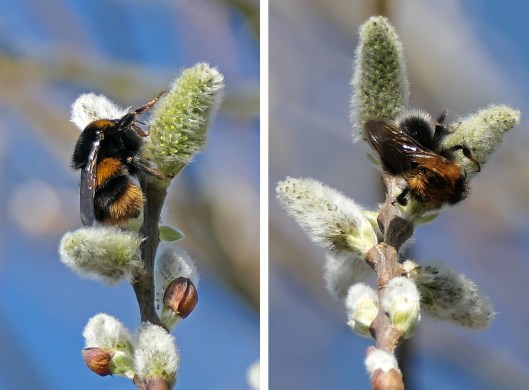
This is your occasional reminder, if you are interested in spotting flying insects, that it is a very good idea at this time of year, when the various willows (Salix species) are coming in to flower, to spend a little staring at these trees. That is partly how I came to find so many butterflies yesterday. Several of the Brimstones I saw, in particular the two females that were feeding up prior to egg-laying, and the beautiful Small tortoiseshell were all found initially on willow flowers.

The fluffy yellow flowers were also providing much needed sustenance for a variety of flies, for honey bees and hoverflies. Due to their larger size, I was also able to see at least two species of bumblebee, Buff-tailed (Bombus terrestris) (left below) and Tree bumblebee (Bombus hypnorum) (below right).
Like Loading...

Q is for queen

22 Sunday Dec 2024

Posted by sconzani in insects

≈ 2 Comments

Tags

Bombus terrestris, bumblebee, queen bumblebees

Q is a difficult letter in my annual countdown. Quercus, the Latin name for the mighty Oak tree, has featured in my two previous countdowns but this year I thought I’d pay homage to those majestic creatures, the queen bumblebees. They’ve featured several times in this year’s blogs (for example, A bumblebee and its mimic, 11 March, and Early bumblebee, 26 March) but, right now, they’ll mostly be hibernating. Though they do emerge during the winter months when the weather’s unseasonably warm and sunny, it’s not until ground temperatures begin to rise and the warmth of springtime becomes more constant that they will be encouraged to awaken, find a cosy burrow, and lay the eggs that will produce the next generation of beautiful bumblebees.

241222 q is for queen bombus terrestris

Like Loading...

A bumblebee and its mimic

11 Monday Mar 2024

Posted by sconzani in insects, spring

≈ Leave a comment

Tags

Blackthorn blossom, Bombus terrestris, British bumblebees, British hoverflies, Buff-tailed bumblebee, Criorhina ranunculi, Large bearfly

Though there was a cold nor’easterly wind blowing, occasional sunny periods brought out a few insects during my visit to Cardiff’s Grangemoor Park last Friday, and I was lucky enough to spot a couple of Buff-tailed bumblebee (Bombus terrestris) queens feeding on Blackthorn blossom.

240311 buff-tailed bumblebee

Even better, on one tree I found one of Britain’s larger hoverflies, one that mimics bumblebees, a Large bearfly (Criorhina ranunculi), one that can often be seen in early Spring on the blossom of willows, Blackthorn and Wild cherry. This hoverfly’s tail end can be white, orange or red in colour (this one’s was reddish); to see these variations, and his superb images of this hoverfly, check out Steven Falk’s Flikr album.

240311 Criorhina ranunculi

Like Loading...

Queen bumbles

26 Saturday Feb 2022

Posted by sconzani in insects, spring

≈ Leave a comment

Tags

Bombus terrestris, British bumblebees, Buff-tailed bumblebee, queen bumblebee

Not having been out walking for 12 days until yesterday means my first Springtime sightings are probably a bit behind many people’s. Still, it was an absolute delight yesterday to hear, three times, the buzzing of a bumblebee, and to watch this queen Buff-tailed bumblebee (Bombus terrestris) searching amongst the low vegetation for a place – perhaps the abandoned burrow of a vole or shrew – to create a nest for her first brood of the year.

220226 buff-tailed bumblebee

Like Loading...

260/366 Searching the scabious, 1

16 Wednesday Sep 2020

Posted by sconzani in insects, plants, wildflowers

≈ 3 Comments

Tags

bees on scabious, Bombus pascuorum, Bombus terrestris, British bees, British wildflowers, Buff-tailed bumblebee, Bull-headed furrow bee, Common carder bee, Devil's-bit scabious, Lasioglossum leucozonium, Lasioglossum zonulum, Megachile ligniseca, White-zoned furrow bee, Wood-carving leafcutter bee

In recent weeks, when the weather has been fine and the air relatively still, I’ve been spending time searching the Devil’s-bit scabious for bees. Not just any bees, but four scarce and endangered bees. This is part of Buglife’s ‘Searching for Scabious’ project, which

aims to improve our understanding of the distribution and conservation status of some of Wales’ rarest and most threatened solitary bees – the Large Scabious Mining Bee (Andrena hattorfiana) and its associated cuckoo, the Armed nomad bee (Nomada armata), and Small Scabious Mining Bee (Andrena marginata) and its cuckoo, the Silver-sided nomad bee (Nomada argentata).

I wasn’t familiar with these bees and am not very good at bee identification in general but Liam Olds, Buglife’s local conservation officer, has put together an excellent explainer video, which can be accessed on YouTube, so I thought I’d join the search.

Unfortunately, I haven’t managed to find any of the scarce bees at the two local sites where Devil’s-bit scabious grows in abundance (and neither has Liam, which was reassuring for me re my search skills but bad news for the bees). The bees I did find most commonly were the appropriately named Common carder (Bombus pascuorum) (below, left) and the Buff-tailed bumblebee (Bombus terrestris) (below, right).

200916 common carder
200916 buff-tailed bumble

Liam very kindly helped to identify the other small bees I found. These lovely little furrow bees are either the White-zoned furrow bee (Lasioglossum leucozonium) or the Bull-headed furrow bee (Lasioglossum zonulum) – the two species are too similar to tell them apart without closer examination.

200916 Lasioglossum leucozonium or zonulum (1)
200916 Lasioglossum leucozonium or zonulum (2)

I also found several of these more distinctive individuals, the Wood-carving leafcutter bee (Megachile ligniseca). You can find out more about them, and watch a little video of their nest-building skills, on the BWARS website. Meantime, I’m heading back to the scabious for another look.

200916 Megachile ligniseca (1)
200916 Megachile ligniseca (2)
Like Loading...

The return of the bumblebees

02 Saturday Apr 2016

Posted by sconzani in insects, nature

≈ 3 Comments

Tags

Bombus hypnorum, Bombus terrestris, Buff-tailed bumblebee, bumblebee, bumblebee mites, Tree bumblebee

As the Mary Kay Ash quote goes: ‘Aerodynamically, the bumblebee shouldn’t be able to fly but the bumblebee doesn’t know it so it goes on flying anyway.’ And flying they are, now that spring is here. The warmer weather brings the bumblebees – all queens – out of their long sleep, to begin the process of nest building and egg laying. In the past week I’ve seen several in flight and managed to get photos of two different species.

160402 Bombus hypnorum Tree bumblebee

Though it’s common in Europe and Asia, this Tree bumblebee (Bombus hypnorum) is not a British native. In fact, its ancestors only arrived in Britain in 2001. It has, however, made itself right at home and, as far as scientists can tell, is not damaging the native bee populations. It’s important we monitor its spread and population though, so please help by reporting your sightings to the Bees, Wasps and Ants Recording Society (BWARS).

160402 Bombus terrestris Buff-tailed bumblebee

The Buff-tailed bumblebee (Bombus terrestris) is often the first to be seen each year, emerging as early as February if the weather’s warm enough. Its nests, occupying old mouse and vole holes underground, can house as many as 500 individuals.

You will notice in my photo that this bumblebee has some hitchhikers. These are mites but please do not be concerned for this little creature. The mites are normal, they actually help keep bumblebee nests clean, and only in extreme cases do they affect the bumblebee’s health and welfare. You can read more here.

Like Loading...

About me

sconzani

sconzani

I'm a writer and photographer; researcher and blogger; birder and nature lover; countryside rambler and city strider; volunteer and biodiversity recorder.

View Full Profile →

Follow earthstar on WordPress.com

Enter your email address to follow this blog and receive notifications of new posts by email.

Recent blog posts

  • N is for nest December 19, 2025
  • M is for mite December 18, 2025
  • L is for lepidopteran lifers December 17, 2025
  • K is for Keeled skimmers December 16, 2025
  • J is for Jersey tiger December 15, 2025

From the archives

COPYRIGHT

Unless otherwise acknowledged, the text and photographs on this blog are my own and are subject to international copyright. Nothing may be downloaded or copied without my permission.

Fellow Earth Stars!

  • Unknown's avatar
  • Unknown's avatar
  • Unknown's avatar
  • Unknown's avatar
  • Unknown's avatar
  • Unknown's avatar
  • Unknown's avatar
  • Unknown's avatar
  • Unknown's avatar
  • Unknown's avatar
  • Unknown's avatar
  • Unknown's avatar
  • Unknown's avatar
  • Unknown's avatar
  • Unknown's avatar
  • Unknown's avatar
  • Unknown's avatar
  • Unknown's avatar
  • Unknown's avatar
  • Unknown's avatar
  • Unknown's avatar
  • Unknown's avatar
  • Unknown's avatar
  • Unknown's avatar
  • Unknown's avatar
  • Unknown's avatar
  • Unknown's avatar
  • Unknown's avatar
  • Unknown's avatar
  • Unknown's avatar
  • Unknown's avatar
  • Unknown's avatar
  • Unknown's avatar
  • Unknown's avatar
  • Unknown's avatar
  • Unknown's avatar
  • Unknown's avatar
  • Unknown's avatar
  • Unknown's avatar
  • Unknown's avatar
  • Unknown's avatar
  • Unknown's avatar
  • Unknown's avatar
  • Unknown's avatar
  • Unknown's avatar
  • Unknown's avatar
  • Unknown's avatar
  • Unknown's avatar
  • Unknown's avatar
  • Unknown's avatar

Blog at WordPress.com.

Privacy & Cookies: This site uses cookies. By continuing to use this website, you agree to their use.
To find out more, including how to control cookies, see here: Cookie Policy
  • Subscribe Subscribed
    • earthstar
    • Join 667 other subscribers
    • Already have a WordPress.com account? Log in now.
    • earthstar
    • Subscribe Subscribed
    • Sign up
    • Log in
    • Report this content
    • View site in Reader
    • Manage subscriptions
    • Collapse this bar
 

Loading Comments...
 

You must be logged in to post a comment.

    %d