• ABOUT
  • BIRDING 2018
  • Birding 2019
  • BLOG POSTS
  • Butterflies 2018
  • Resources

earthstar

~ a celebration of nature

earthstar

Tag Archives: British birds

When is a magpie not a magpie?

07 Saturday May 2016

Posted by sconzani in birds, nature

≈ 10 Comments

Tags

Australian magpie, birding, birdwatching, British birds, European magpie, Gymnorhina tibicen, Magpie, New Zealand birds, New Zealand magpie, Pica pica

What I grew up in New Zealand thinking of as a magpie is nothing like the magpies I see here in Wales, which is not really surprising as they are totally different species and the New Zealand bird is actually Australian. Confused?

European magpie (1)
European magpie (2)

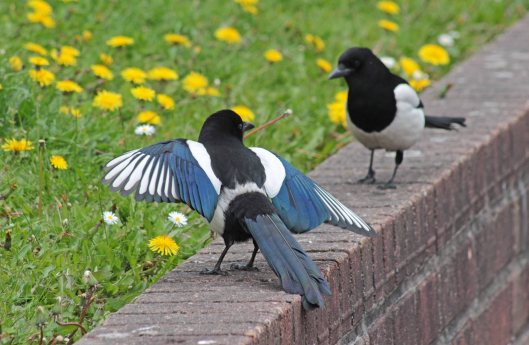
The bird that lives in Britain is the European magpie (Pica pica) (pictured above) and is a member of the corvid family, a relative of crows, rooks and jackdaws. The bird that lives in New Zealand is Gymnorhina tibicen, one of the nine species of Australian magpie (there were thought to be two Australian species in New Zealand but this is now in doubt).

New Zealand 1 magpie male
New Zealand 2 magpie male

The Australian birds are called magpies because of their physical resemblance to the European birds – it was quite common for British settlers to name birds, animals and plants after similar ones ‘at home’. Australian birds from Tasmania and Victoria were introduced into several areas of New Zealand in the 1860s and 1870s by local Acclimatisation Societies to control pasture pests like grass grubs, and their supposed importance to New Zealand agriculture was the reason they were afforded legal protection till 1951.

New Zealand 3 magpie female
New Zealand 4 magpie juvenile

The magpies in New Zealand can be very aggressive birds, occasionally attacking both animals and humans that stray too close to their nests during the breeding season, though their nests are usually built high up in tall trees so their attacks are, in fact, unwarranted.
Like Loading...

Gossamery goslings

03 Tuesday May 2016

Posted by sconzani in birds, nature, nature photography

≈ 6 Comments

Tags

birding, birdwatching, British birds, gosling, Greylag goose, Roath Park Lake

I’ve always thought Ryan Gosling was rather cute but, sorry Ryan, you pale in comparison to these little guys and gals.

160503 goslings (2)

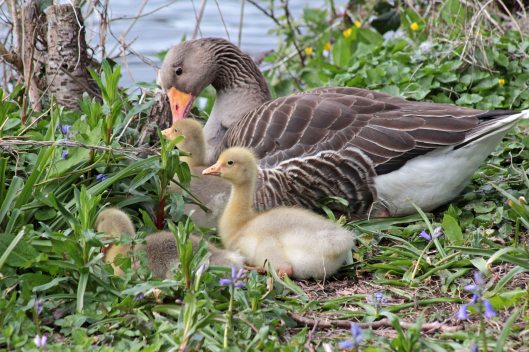
The Greylag geese (Anser anser) at Cardiff’s Roath Park Lake have produced at least three nests of goslings so far this spring, and they are the most delightful little creatures: awkward on their feet, quick to learn, well trained to stay close to mum and dad, playful little jokesters, fast growing, bundles of fluff.

160503 goslings (1)
160503 goslings (4)
160503 goslings (3)

160503 goslings (5)

Greylags usually lay between five and eight eggs, often in a large floating nest hidden amongst reeds, though at Roath Park they seem to nest under the vegetation on the small islands, where they’re protected from predatory Lesser black-backed gulls. Unlike many waterbirds, Mr and Mrs Greylag stay together to feed and guard their offspring, and the family will remain together until the adult birds are ready to mate again.

160503 goslings (6)160503 goslings (7)

160503 goslings (8)

Like Loading...

Magpies: sorrow or joy?

28 Thursday Apr 2016

Posted by sconzani in birds, nature

≈ 9 Comments

Tags

birding, birdwatching, British birds, Magpie, Pica pica

One for sorrow,
Two for joy,
Three for a girl,
Four for a boy,
Five for silver,
Six for gold,
Seven for a secret,
Never to be told.
Eight for a wish,
Nine for a kiss,
Ten for a bird,
You must not miss. 

So the modern version of the rhyme goes. The original version, first recorded in 1780, was a little more sinister – One for sorrow, Two for mirth, Three for a funeral, Four for birth, Five for heaven, Six for hell, Seven for the devil, his own self – reflecting the common perception of magpies as birds of ill omen.

160428 magpie (1)

The magpie, with the easiest-to-remember scientific name of Pica pica, is a member of the corvidae family which also includes jays and crows, ravens and jackdaws. One look at that strong beak shows the similarity. But these birds also have other things in common: they are intelligent, able to solve problems and have excellent memory. They have a strong sense of curiosity, are sociable and are brilliant mimics. Many people think of magpies as black and white but, of course, they’re not. As soon as the sunshine strikes their back, wing and tail feathers, you can see what a gorgeous bluish sheen they feathers have.

 160428 magpie (3)

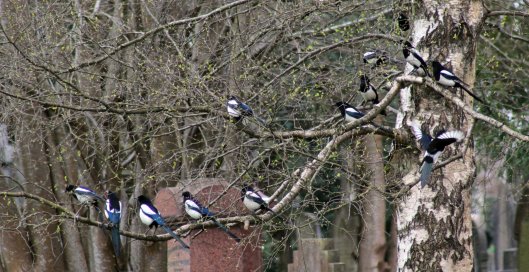
My question is: what does it mean when you see 12 magpies together?

160428 magpie (2)

Like Loading...

A birder’s bliss

25 Monday Apr 2016

Posted by sconzani in birds, nature, parks

≈ 6 Comments

Tags

birding, birdwatching, Blackcap, Blue tit, British birds, chaffinch, Cosmeston Lakes Country Park, Great tit, jackdaw, robin, Woodpigeon

We’ve seen some of the landscape at Cosmeston Lakes Country Park; we’ve checked out the prime lakefront real estate; and we’ve been tit-elated by some of its small birds. Now, here’s what was on Nature’s menu last Wednesday.

160425 blackcap

The absolute highlight of the day was seeing my first Blackcap, and not just one, but five in total, at different times, in different locations, including a female (she wears a brown cap). I was well pleased with that!

160425 tits

After a quiet birding day last time I visited, I was delighted to see more of my favourites this time: a robin was feeding its fledgling; the great and blue tits were demanding food; chaffinches and wood pigeons were getting tucked in to seed left by others; two buzzards were gliding overhead, looking for lunch; a jackdaw was collecting nest-making materials.

160425 wood pigeon
160425 robins
160425 jackdaw
160425 chaffinch

As well as these and many other birds, there was a wonderful assortment of butterflies and bees feasting on the lesser celandine and wild violets flowering along the path edges. There were occasional clumps of bluebells and wafts of wild garlic flowers, and it was a gloriously warm spring day. A man I met during my wandering told me I looked happy, and so I was, doing what I love most – being with nature.

Like Loading...

In nesting news …

23 Saturday Apr 2016

Posted by sconzani in birds, nature, nature photography, spring

≈ 6 Comments

Tags

birding, birdwatching, British birds, chicks, Coot, Great Crested Grebe, Mute swan, nesting, nesting birds

I checked out the nesting neighbourhood again a couple of days ago so here’s the latest family news.

160423 grebe

At the original three-nest site: the Mute swans appear to have abandoned their nest, which was empty – maybe they just weren’t ready for parenthood. The Great crested grebe that had chicks but lost them was still sitting on her second nest, and she was sitting tight again so I still don’t know what she’s sitting on.

160423 coot A (1)
160423 coot A (2)

The Coots that had three chicks in my last update now have just one chick remaining. The family has left the nest, though are still in the same general area. Both parents are actively feeding the little guy but, sadly, I’m not overly optimistic about its chances as there were a lot of gulls, flying overhead and perched on nearby lamp posts, just looking for the right scavenging opportunity.

160423 coot B

Nearby, at the other Great crested grebe nest, the grebe has been usurped by a Coot. Her partner was about and feeding her but she didn’t stand up so I have no egg update for her.

160423 coots C (1)
160423 coots C (2)
160423 coots C (3)
160423 coots C (4)

I recently learnt of another Coot nest, also nearby, and seeing that was the highlight of the afternoon. Six chicks, all well developed and seemingly ravenous, were frantically being fed by both parents. Very cleverly, the parents were keeping them sitting under a lip of concrete at the water’s edge, so they were quite well protected. Let’s hope they continue to thrive.

Like Loading...

News from the nesting neighbourhood

10 Sunday Apr 2016

Posted by sconzani in birds, nature

≈ 5 Comments

Tags

birding, birdwatching, British birds, Coot, Great Crested Grebe, Mute swan, nesting birds

160410 nesting neighbours (1)

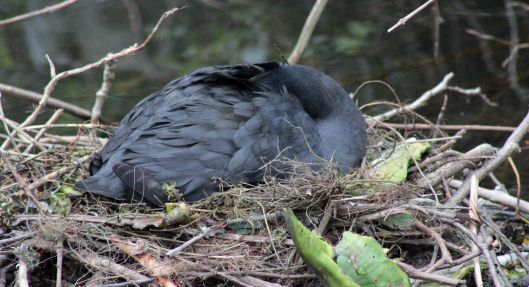
It might not look like much but this is Cardiff’s Nest Central! The white blob in the upper left of my photo is a Mute swan, happily ensconced on her nest platform and very well hidden from passing pedestrians. In the more open areas at the front, we have a Coot perched on top of her well-engineered pile of twigs and assorted rubbish and, at the right, a Great Crested Grebe, sitting on her rather more modest nest creation.

160410 nesting neighbours (2)

This is the Grebe pair’s second nesting attempt of the season – I was lucky enough to see the four eggs they produced first time around and, apparently, the eggs did hatch but the chicks were lost to a predator/s (possibly a large pike). It’s great to see they’re trying again.

160410 nesting neighbours (3)
160410 nesting neighbours (4)
160410 nesting neighbours (5)
160410 nesting neighbours (6)

The Coots have been more successful, at least so far, with two healthy looking, very cute chicks. I guess it helps to have a high nesting platform to keep the chicks out the water until they’re larger.

Please note: These photos are taken at a distance, using a long lens, and then cropped. This site is in a public place, with frequent foot traffic, but I still make sure my visits are brief. At this time of year, it is particularly important not to disturb nesting birds, and it is, in fact, a criminal offence to disturb birds on the Schedule 1 list (see link for more information). Please respect the birds.

Like Loading...

A collective noun for robins

01 Friday Apr 2016

Posted by sconzani in birds, nature, nature photography

≈ 13 Comments

Tags

birding, birdwatching, British birds, collective noun for robins, robin

There are so many robins around at the moment, gracing our gardens, parks and woodlands with their songs and territorial squabbles and bright bursts of cheery redness, that I couldn’t help but wonder what collective noun is used for the robin. So, I googled, and found two different lists, though both had many of the same words. The British Bird Lovers website says their list was chosen by members of their Facebook page, though I’m not sure when that occurred, and the Bird Guides website reports on a poll conducted by BTO and the Sunday Express in 2011, where members of the public gave their suggestions.

160401 robins (8)

This is the combined list, accompanied, of course, by lots of photos of cute robins because you can never have too many robins! Which name is your favourite?

a round of robins                a breast of robins            a blush of robins
a bobbin of robins              a carol of robins              a gift of robins
a reliant of robins                a riot of robins                a rouge of robins
a ruby of robins                  a rabble of robins            a red of robbins
a squabble of robins           a rash of robins               a hood of robins

160401 robins (1)
160401 robins (2)
160401 robins (3)
160401 robins (4)
160401 robins (5)
160401 robins (6)
160401 robins (7)
160401 robins (9)
Like Loading...

A tale of two goosanders

28 Monday Mar 2016

Posted by sconzani in birds, nature

≈ 4 Comments

Tags

birding, birdwatching, British birds, Goosander, Mergus merganser

160328 goosander (2)

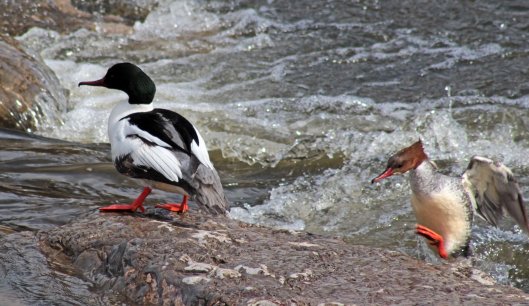
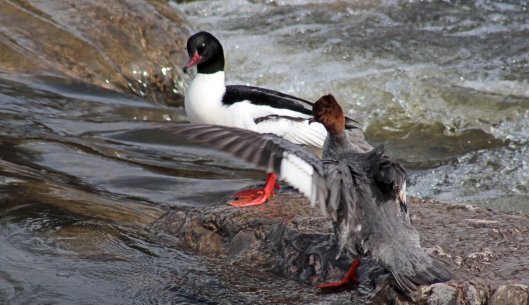
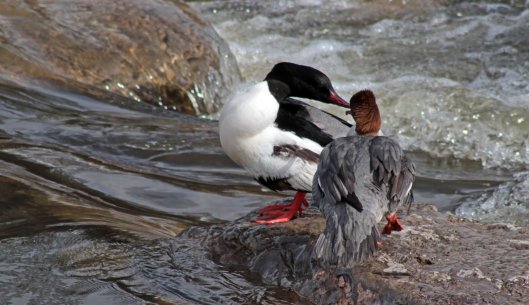
I watched a pair of goosanders (Mergus merganser) slowly making their way up one side of the River Taff today, frequently ducking their heads underwater in search of the fish, molluscs, crustaceans and amphibians that make up their diet. When they reached Blackweir, I expected them to drift back down the river but it seems they were determined to go further up steam.

160328 goosander (1)

That’s when it became apparent that the female can’t fly. Half of her right wing is missing. I doubt this is a birth defect and suspect a narrow escape from the mink that I have seen in recent weeks on the riverbanks in this vicinity.

160328 goosander (4)

The only way to cross the weir then was to walk as the flow of water, even though currently quite weak, was much too strong for swimming. The female had trouble getting out of the water up onto the rocks and then the concrete of the weir, but managed after a couple of tries. Her mate was very patient, and seemed very tender with her, touching her head with his beak, watching to see she was alright while also keeping a look out for danger. He would toddle a little way ahead, then turn and wait for her to catch up. Once he returned to her side as if to encourage her. It took perhaps 20 minutes but they made it and swam on up the river.

160328 goosander (5)

Trouble is, she is now very vulnerable to attack, especially from creatures like the mink but also from unleashed dogs (of which there are many in Cardiff). And the chances of these goosanders successfully breeding are also probably quite slim. My heart went out to these two little creatures, touched by the male’s gentleness with his disabled mate but saddened by their somewhat bleak future prospects.

160328 goosander (6)

Like Loading...

Juffits & fuffits & long-tailed chitterings

24 Thursday Mar 2016

Posted by sconzani in birds, nature, nature photography

≈ 8 Comments

Tags

birding, birds, birdwatching, British birds, long-tailed tit

160324 long tailed tit (1)

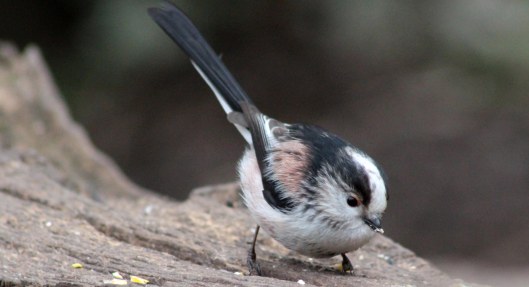
It’s taken me many months of following these little birds to get any half decent photographs. The Long-tailed tit (Aegithalos caudatus) rarely keeps still, spending most of its day with its extended family of 10 to 20 birds, flitting and fluttering through trees, shrubs and hedgerows, chattering all the way. In fact, that’s often how you first realise they’re about, by their very characteristic call, which the BTO website describes as ‘a sharp tsurp, repeated several times’.

160324 long tailed tit (2)

most of my photos are like these, of tits behind twigs in trees

They are probably the cutest of Britain’s small birds, like little bundles of fluff with tails too long for their bodies, and, judging by the long list of charming common names they have attracted, I’m not the only one who thinks they’re cute. These are just a selection from the list in Buczacki’s Flora Britannica: in Yorkshire, they’re known as ‘Bottle jugs’; in the Midlands, it’s the ‘bottle tom’, the ‘bottle tit’ and the ‘bum barrel’; in Warwickshire, the ‘buttermilk can’; in East Lothian, the ‘feather poke’ and the ‘fuffit’; in Warwickshire, the ‘hedge mumruffin’; in Nottinghamshire the ‘jack-in-a-bottle’ and the ‘juffit’; and in Shropshire and Worcestershire the ‘miller’s thumb’ and the ‘long-tailed chittering’.

160324 long tailed tit (3)

160324 long tailed tit (4)

Like Loading...

It’s World Sparrow Day!

20 Sunday Mar 2016

Posted by sconzani in birds, nature, nature photography

≈ 3 Comments

Tags

birding, birds, birdwatching, British birds, Cambodia sparrow, house sparrow, New Zealand sparrow, Red list, rufous-collared sparrow, sparrow, Tanzanian sparrow

I miss sparrows.

160320 sparrow (1)

In my homeland, New Zealand, they are probably the most common and well known bird, though the New Zealand sparrow is not a native – it was introduced there several times between 1866 and 1871, and has clearly made itself at home. Sparrows were also familiar birds during the time I lived in Peru and in Cambodia but, here in Wales, I seldom see them, because, in recent years, the humble house sparrow (Passer domesticus domesticus) has undergone a huge decline in Britain. And I do mean huge – the British Trust for Ornithology website reports that the population has declined by 71% since 1977, possibly due to loss of habitat but also to a decline in the insects adult birds feed their young. The house sparrow is now on Britain’s red list, as a bird of the highest conservation concern.

160320 sparrow (2)

Around the world there are 26 species of house sparrow, native to Europe, Asia and north-west Africa. There are also American sparrows (from a separate family, the Emberizidae) and birds with similar names, like the Java sparrow (also a different family, the Estrildidae). Still, the world would be much the poorer if it lost the lovely British house sparrow, so it is gratifying to know that various wildlife organisations are working to improve its situation and increase its population. Today, let’s celebrate the humble sparrow!

160320 sparrow nz (1)

female (left) and male (right) New Zealand sparrows

160320 sparrow cambodia (1)

a sparrow in Cambodia

160320 sparrow tanzania & rufous-collared peru

left, a sparrow in Tanzania (far too busy gathering nest materials to pose for a photo), and, right, a rufous-collared sparrow in Peru

Like Loading...
← Older posts
Newer posts →

About me

sconzani

sconzani

I'm a writer and photographer; researcher and blogger; birder and nature lover; countryside rambler and city strider; volunteer and biodiversity recorder.

View Full Profile →

Follow earthstar on WordPress.com

Enter your email address to follow this blog and receive notifications of new posts by email.

Recent blog posts

  • First dragon of 2026 May 4, 2026
  • Lords-and-ladies May 3, 2026
  • The Fox and the crow May 2, 2026
  • More Green tigers May 1, 2026
  • Cute cootlet April 30, 2026

From the archives

COPYRIGHT

Unless otherwise acknowledged, the text and photographs on this blog are my own and are subject to international copyright. Nothing may be downloaded or copied without my permission.

Fellow Earth Stars!

  • Unknown's avatar
  • Unknown's avatar
  • Unknown's avatar
  • Unknown's avatar
  • Unknown's avatar
  • Unknown's avatar
  • Unknown's avatar
  • Unknown's avatar
  • Unknown's avatar
  • Unknown's avatar
  • Unknown's avatar
  • Unknown's avatar
  • Unknown's avatar
  • Unknown's avatar
  • Unknown's avatar
  • Unknown's avatar
  • Unknown's avatar
  • Unknown's avatar
  • Unknown's avatar
  • Unknown's avatar
  • Unknown's avatar
  • Unknown's avatar
  • Unknown's avatar
  • Unknown's avatar
  • Unknown's avatar
  • Unknown's avatar
  • Unknown's avatar
  • Unknown's avatar
  • Unknown's avatar
  • Unknown's avatar
  • Unknown's avatar
  • Unknown's avatar
  • Unknown's avatar
  • Unknown's avatar
  • Unknown's avatar
  • Unknown's avatar
  • Unknown's avatar
  • Unknown's avatar
  • Unknown's avatar
  • Unknown's avatar
  • Unknown's avatar
  • Unknown's avatar
  • Unknown's avatar
  • Unknown's avatar
  • Unknown's avatar
  • Unknown's avatar
  • Unknown's avatar
  • Unknown's avatar
  • Unknown's avatar
  • Unknown's avatar

Blog at WordPress.com.

Privacy & Cookies: This site uses cookies. By continuing to use this website, you agree to their use.
To find out more, including how to control cookies, see here: Cookie Policy
  • Subscribe Subscribed
    • earthstar
    • Join 643 other subscribers
    • Already have a WordPress.com account? Log in now.
    • earthstar
    • Subscribe Subscribed
    • Sign up
    • Log in
    • Report this content
    • View site in Reader
    • Manage subscriptions
    • Collapse this bar

Loading Comments...

You must be logged in to post a comment.

    %d