• ABOUT
  • BIRDING 2018
  • Birding 2019
  • BLOG POSTS
  • Butterflies 2018
  • Resources

earthstar

~ a celebration of nature

earthstar

Tag Archives: British butterflies

192/365 Essex skippers

11 Thursday Jul 2019

Posted by sconzani in 365DaysWildin2019, insects, nature

≈ 2 Comments

Tags

#365DaysWild, British butterflies, butterflies, butterfly, Essex skipper, skipper identification

Tuesday was the first time I have knowingly seen and photographed Essex skippers. I visited a location where there’s been a colony in previous years so my chances were high but I knew they were tricksy little butterflies to identify – the only photo I have of one was taken two years ago in a different place and I didn’t realise what it was till I checked it more carefully a year later.

190711 essex skipper (1)

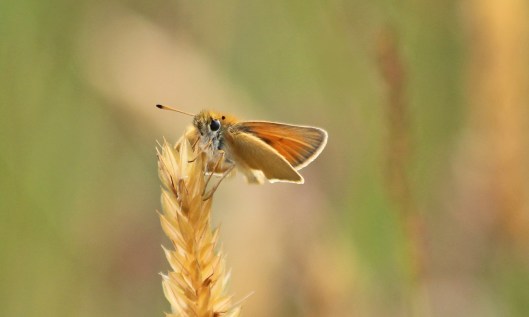
You see, the Essex looks superficially very similar to the Small skipper. They’re the same size, the same general colour and can be found in the same habitats. The defining feature for a novice like me is the tips of the butterfly’s antennae – in the Essex skipper these are black, both on top and below. And therein lies the difficulty! Because you just try seeing the colour on the underside of the antennae of very small butterflies that spend most of their time skilfully weaving their way in and around tall grasses in a meadow full of similar butterflies. It ain’t easy!

190711 essex skipper (2)

Still, it was a pleasant day, the meadow was full of lovely wildflowers, and I was surrounded by butterflies of several types and sizes – what could be nicer? It was really just a matter of time and patience, and eventually I had two definite sightings. One very cute little Essex even decided to pose for me, repeatedly settling on grass stems so I could get the front-on photos that I needed to be sure of its identity.
190711 essex skipper (3)

Like Loading...

189/365 ‘A confetti of scent scales’

08 Monday Jul 2019

Posted by sconzani in insects, nature

≈ 4 Comments

Tags

androconial scales, British butterflies, butterflies, butterfly anatomy, butterfly courtship, Large skipper, pheromones, sex brands, Silver-washed fritillary, Small skipper

The observant among you may have noticed silvery looking lines on the veins of the Silver-washed fritillary in yesterday’s post – those are its sex brands. In these particular frits, the males have four such brands, two on each top upper wing. The brands contain androconial scales, special scented scales that are used during courtship to attract females. As the Woodland Trust website explains, Silver-washed fritillary ‘courtship is an aerobatic spectacular: the female flies in a straight line while the male loops the loop around her, before showering her in a confetti of scent scales’.

190708 silver-washed fritillary

Silver-washed fritillaries are not the only butterflies to have sex brands: they can also be found, for example, in Large and Small skippers (below left and right, respectively). The Learn about Butterflies website (which has a much more detailed explanation for those who are interested in the nitty gritty of butterfly anatomy) explains, the dark diagonal marks on the skippers’ wings

are composed of hundreds of androconial scales. These disseminate pheromones that can be detected by females during courtship. As the male ages the strength of his pheromones diminishes, thus by analysing the strength of the pheromones a female can assess the age and virility of a potential mate.

190708 male Large skipper
190708 male Small skipper

The more I find out about butterflies, the more fascinated I become.

Like Loading...

188/365 Silver-washed fritillary

07 Sunday Jul 2019

Posted by sconzani in 365DaysWildin2019, insects, nature

≈ 2 Comments

Tags

#365DaysWild, British butterflies, butterflies, butterfly, fritillaries, Silver-washed fritillary

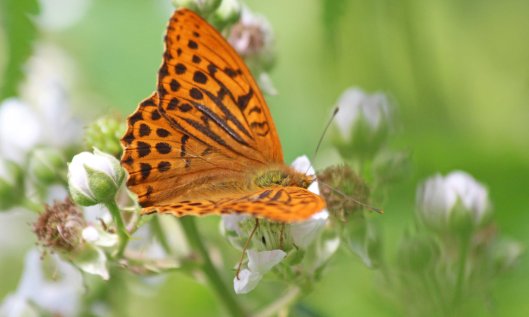
As well as the endangered High brown fritillaries and their cousins the Dark greens, Friday’s butterflying day out also turned up a couple of these beauties, the equally glorious members of the family, the Silver-washed fritillaries (Argynnis paphia).

190707 silver-washed fritillary (1)

If you’re wondering how an orange-and-black-patterned butterfly got the name silver-washed, it’s because the underside of its wings are streaked silver. Unfortunately, my photos don’t show that very clearly … next time.

190707 silver-washed fritillary (2)

Like Loading...

187/365 Most threatened butterfly

06 Saturday Jul 2019

Posted by sconzani in 365DaysWildin2019, insects, nature

≈ 5 Comments

Tags

#365DaysWild, Britain's most threatened butterfly, British butterflies, butterflies, fritillaries, High brown fritillary

190706 High brown fritillary (1)

I had the very great privilege yesterday of spending time with some of Britain’s most threatened butterflies, in the only location in Wales where they can be found. These are the High brown fritillaries (Argynnis adippe), which, despite their large robust appearance, have declined by almost 80% since the 1970s and are now the subject of ongoing conservation efforts by the staff of Butterfly Conservation and their dedicated and hard-working team of volunteers.

190706 High brown fritillary (4)

It was one of their long-term volunteers, Richard, who willingly gave his time yesterday to show me around the site, to explain all about the work they’re doing to save this butterfly from extinction, and to show me how he surveys a transect to monitor their population. Brush cutting, bracken bashing, surveying, visitor management, tour guiding, newsletter writing – and he’s been doing all this since 1995! I simply can’t thank him enough.

190706 High brown fritillary (2)

And as for the High browns – what glorious creatures they are! There was one particular area, a wide bowl of head-high bracken, where we were treated to wonderful sightings. The males mostly raced past at high speed, frantically following the trail of an enticing female, and sometimes bounced around each other in their quest for dominance and territory. At other times, they wafted gracefully around the bracken tops, offering perfect close views when they stopped to nectar on bramble and thistle flowers; they even floated over to check out the human intruders in their space.

190706 High brown fritillary (3)

The High brown fritillary can be difficult to tell apart from the Dark green fritillary, both of which share this particular location – it’s all about the size of the third dot on their upper wings and the presence or absence of reddish markings on their under-wings but you do need clear views to see these differences. I think I’d cracked it by the end of the day but the best thing, the most wonderful thing was just being there amongst them. Bliss!

Like Loading...

181/365 An aberrant Meadow brown

30 Sunday Jun 2019

Posted by sconzani in 365DaysWildin2019, insects, nature

≈ 2 Comments

Tags

#365DaysWild, aberrant butterfly, aberrant Meadow brown, British butterflies, butterflies, butterfly, Cosmeston, Cosmeston Lakes Country Park, Meadow Brown, pathological aberration

I feel like I should be apologising for featuring butterflies three days in a row but this little butterfly is so interesting that I just had to share it. There are a ton of Meadow browns flitting around the wildflower fields at Cosmeston right now and they mostly look like this – or, at least, the females do.

190630 Meadow brown normal female

So, I think you can see why the butterfly in this next photo caught my eye. Unfortunately, I wasn’t able to get a really clear shot of it, as it kept flying further into the flowers and I didn’t want to trample them, but you get the idea. Thanks to a tweet from UK Butterflies, I now know “This aberration is referred to as ‘pathological’, where wing scales fail to pigment – thought to be caused by some type of damage (physical or chemical) to the pupa. Asymmetrical examples are known too where only 1 wing is affected.” Isn’t it fascinating?

190630 Meadow brown aberrant female

Like Loading...

180/365 Butterflying in Somerset, part II

29 Saturday Jun 2019

Posted by sconzani in 365DaysWildin2019, insects, nature, wildflowers

≈ 2 Comments

Tags

British butterflies, butterflies, butterfly, butterflying, Collard Hill, Large blue, Large blue butterfly, Marbled white, Wild thyme

Scenario: Three friends go seeking rare butterflies across the border in England.

190629 Collard Hill view

Second location: Collard Hill, in Somerset. A hot walk up the steep hill for more incredible views across picturesque Somerset. And we weren’t far from the legendary Glastonbury Tor.

190629 Glastonbury Tor

Support act: Marbled white. My first sightings of these little beauties for the year, and we saw several flitting back and forth above the long grass.

190629 marbled white

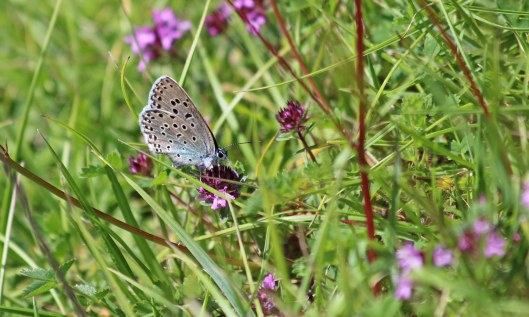
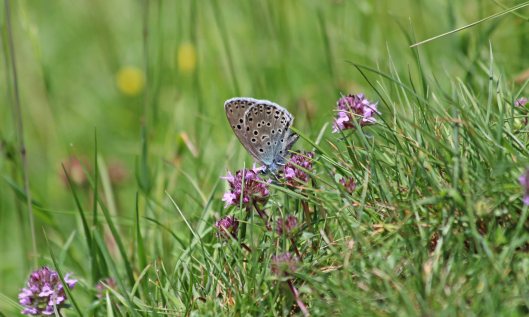
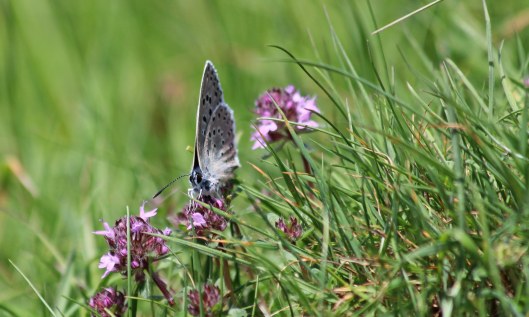
Star attraction: Large blue. Incredibly, this butterfly was declared extinct in Britain in the 1970s but was reintroduced from Sweden to Green Down, a Somerset Wildlife Trust site, in 1992. Since then the butterflies have mostly thrived (though they are affected by weather, habitat and ant conditions – for more on that, check out the National Trust Large blue blog) and they’ve been reintroduced to several other areas, including this site at Collard Hill.

190629 large blue (2)

During our visit, it was very windy at the top and very hot in the lee of the hill, not ideal conditions for seeing the butterflies but, after following the animal tracks back and forth across the hillside, we finally had good sightings of three Large blues on their favourite food plant, Wild thyme. One female was even ovipositing, which bodes well for the coming years.

190629 large blue (3)

It was amazing to see both these Large blues and, earlier in the day, the Heath fritillaries, both lifers for me, and I want to say a huge thank you to Gareth and Alan for letting me join their butterflying expedition. It was a truly magical day!

190629 large blue (4)

Like Loading...

179/365 Butterflying in Somerset, part I

28 Friday Jun 2019

Posted by sconzani in 365DaysWildin2019, insects, nature

≈ 5 Comments

Tags

British butterflies, butterflies, butterfly, butterflying, Exmoor ponies, Green hairstreak, Haddon Hill, Heath fritillary

Scenario: Three friends go seeking rare butterflies across the border in England.

190628 Haddon Hill views

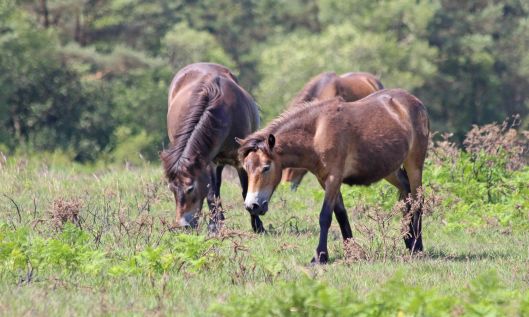
First location: Haddon Hill, in Somerset, offering superb views across the surrounding countryside and grazed by Exmoor ponies.

190628 exmoor ponies

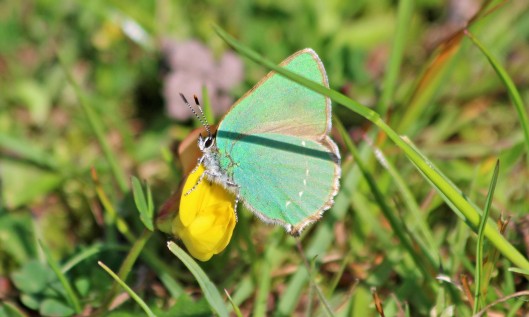
Support act: A Green hairstreak. This was a superb spot by Alan almost as soon as we crossed the stile into the reserve, as this gorgeous little butterfly was incredibly well camouflaged sitting on the grass.

190628 green hairstreak

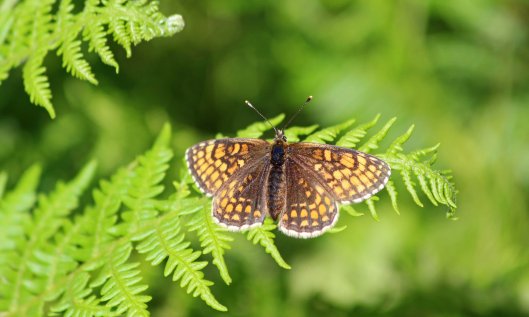
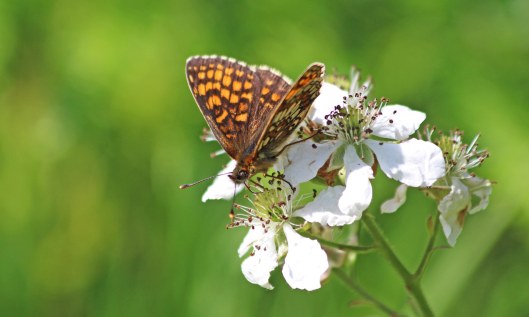
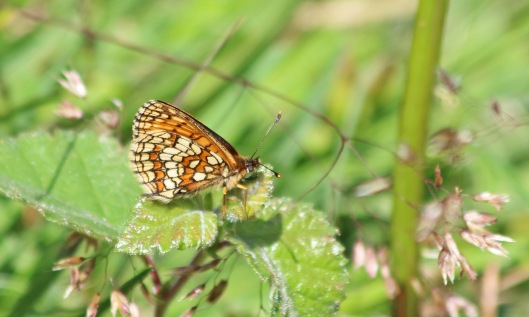
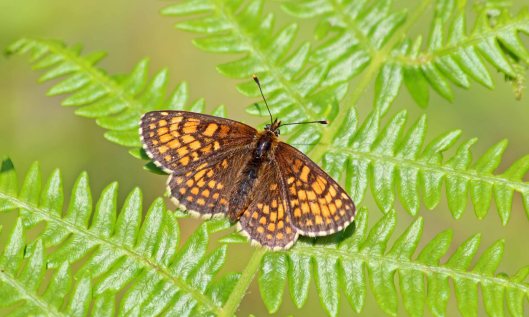
Star attraction: Heath fritillary. What a cracking little butterfly this is, with its elaborate orange and dark brown upperwing markings, and its equally lovely and intricate underwings. Sadly, this is a rare butterfly in Britain these days but it is being helped along by the sterling efforts of Butterfly Conservation and others. Luckily, at this site, Heath fritillaries are very numerous – we must’ve seen at least 25, and they were literally fluttering in the bushes and brambles all around us. One even landed briefly on my hand – an incredibly special moment.

190628 heath fritillary (1)190628 heath fritillary (2)190628 heath fritillary (3)190628 heath fritillary (4)190628 heath fritillary (5)

Like Loading...

172/365 Flitillaries

21 Friday Jun 2019

Posted by sconzani in 365DaysWildin2019, insects, nature

≈ 2 Comments

Tags

#365DaysWild, Aberbargoed Grasslands, British butterflies, butterflies, butterfly, fritillaries, Small Pearl-bordered Fritillary, Summer solstice

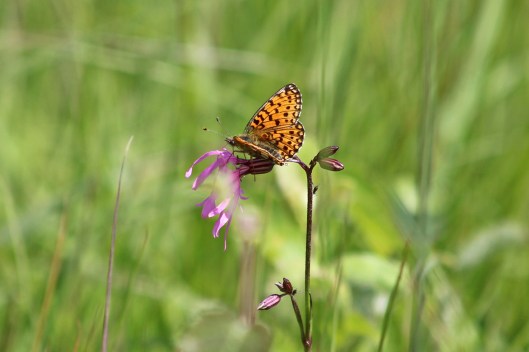
My mis-spelling of the word fritillaries is deliberate – the darn things never keep still. They’re either constantly flitting from place to place at a great rate of knots or, when they do settle, they either disappear into the long grass so you can’t find them or they perch on a flower to refuel but never stop flapping their wings for a moment.

190621 small pearl-bordered fritillary (1)

Those are my excuses for the Small pearl-bordered fritillaries in today’s photos being out of focus and/or obscured by blades of grass!

190621 small pearl-bordered fritillary (2)

Still, I spent a glorious few hours with them, and their cousins the Marsh fritillaries, at Aberbargoed Grasslands National Nature Reserve. A little patience was required, as huge menacing clouds kept rolling over but, in the gaps between, when the sun came out, so did the butterflies.

190621 small pearl-bordered fritillary (3)

It was a magical way to spend the summer solstice!

190621 small pearl-bordered fritillary (4)

Like Loading...

168/365 From pristine to tatty

17 Monday Jun 2019

Posted by sconzani in 365DaysWildin2019, insects, nature

≈ 4 Comments

Tags

#365DaysWild, British butterflies, butterflies, butterfly, Common blue, Common blue butterfly, Small copper

Butterflies have a hard life. Having to weave their way through a maze of wildflowers and long grasses, squabbling with other butterflies, taking evasive manoeuvres to avoid being eaten, these all take their toll on creatures that are not very robust to begin with.

190617 small copper

During today’s stroll around Cosmeston, I discovered a stunning, pristine Small copper, presumably newly emerged, one of their second brood for the year, but I also saw a very tatty looking Common blue, its wings frayed around the edges, its colour very faded, its life almost over. Yet it was battling on into a strong headwind, not giving up. There’s a lesson there, I think.

190617 common blue

Like Loading...

160/365 Spoilt for choice

09 Sunday Jun 2019

Posted by sconzani in 365DaysWildin2019, insects, nature

≈ 4 Comments

Tags

#365DaysWild, Black-tailed skimmer, British butterflies, British dragonflies, butterfly, Clouded yellow, Cosmeston, Cosmeston Lakes Country Park, dragonfly

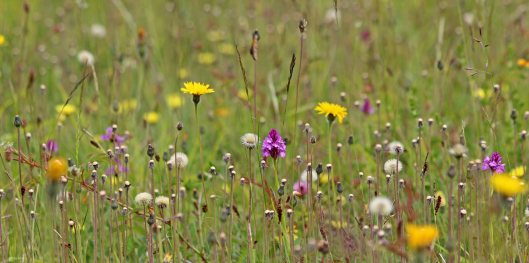
I may have got rather wet during my walk around the east and west paddocks at Cosmeston this morning but it was worth it, as I wandered through an abundance of gorgeous orchids and other colourful wildflowers, spied numerous small insects munching on leaves, was charmed by the fluttering butterflies and meandering moths, and entertained by the myriad fledglings flitting through trees and bushes, harassing their parents for food.

190609 Cosmeston wildflowers

I was wondering which of these delights might be today’s blog subject, when I spotted a bright yellow ‘something’ flying across the field in front of me. I quickly followed and, luckily, it settled on the ground so I was able to get photos. It was a Clouded yellow, a butterfly I’ve only seen half a dozen times before, a migrant to Britain which may well have been blown in by yesterday’s wild weather. Blog sorted: ‘On the wings of the storm II’, I thought, and continued my walk.

190609 Clouded yellow

Then, just as I was nearing the top of the east paddock and about to head homewards, I made another chance discovery, a cracking dragonfly, a Black-tailed skimmer, another creature that I don’t see all that often. So, being spoilt for choice today, I thought I would share that with you as well.

190609 Black-tailed skimmer

Like Loading...
← Older posts
Newer posts →

About me

sconzani

sconzani

I'm a writer and photographer; researcher and blogger; birder and nature lover; countryside rambler and city strider; volunteer and biodiversity recorder.

View Full Profile →

Follow earthstar on WordPress.com

Enter your email address to follow this blog and receive notifications of new posts by email.

Recent blog posts

  • Lily beetle April 8, 2026
  • First bee-flies April 7, 2026
  • Bloody-nosed beetle April 6, 2026
  • Gorse and its weevil April 5, 2026
  • Chiffchaffs chiffchaffing April 4, 2026

From the archives

COPYRIGHT

Unless otherwise acknowledged, the text and photographs on this blog are my own and are subject to international copyright. Nothing may be downloaded or copied without my permission.

Fellow Earth Stars!

  • Unknown's avatar
  • Unknown's avatar
  • Unknown's avatar
  • Unknown's avatar
  • Unknown's avatar
  • Unknown's avatar
  • Unknown's avatar
  • Unknown's avatar
  • Unknown's avatar
  • Unknown's avatar
  • Unknown's avatar
  • Unknown's avatar
  • Unknown's avatar
  • Unknown's avatar
  • Unknown's avatar
  • Unknown's avatar
  • Unknown's avatar
  • Unknown's avatar
  • Unknown's avatar
  • Unknown's avatar
  • Unknown's avatar
  • Unknown's avatar
  • Unknown's avatar
  • Unknown's avatar
  • Unknown's avatar
  • Unknown's avatar
  • Unknown's avatar
  • Unknown's avatar
  • Unknown's avatar
  • Unknown's avatar
  • Unknown's avatar
  • Unknown's avatar
  • Unknown's avatar
  • Unknown's avatar
  • Unknown's avatar
  • Unknown's avatar
  • Unknown's avatar
  • Unknown's avatar
  • Unknown's avatar
  • Unknown's avatar
  • Unknown's avatar
  • Unknown's avatar
  • Unknown's avatar
  • Unknown's avatar
  • Unknown's avatar
  • Unknown's avatar
  • Unknown's avatar
  • Unknown's avatar
  • Unknown's avatar
  • Unknown's avatar

Blog at WordPress.com.

Privacy & Cookies: This site uses cookies. By continuing to use this website, you agree to their use.
To find out more, including how to control cookies, see here: Cookie Policy
  • Subscribe Subscribed
    • earthstar
    • Join 642 other subscribers
    • Already have a WordPress.com account? Log in now.
    • earthstar
    • Subscribe Subscribed
    • Sign up
    • Log in
    • Report this content
    • View site in Reader
    • Manage subscriptions
    • Collapse this bar
 

Loading Comments...
 

You must be logged in to post a comment.

    %d