• ABOUT
  • BIRDING 2018
  • Birding 2019
  • BLOG POSTS
  • Butterflies 2018
  • Resources

earthstar

~ a celebration of nature

earthstar

Tag Archives: British dragonflies

November at Cosmeston

02 Saturday Dec 2017

Posted by sconzani in autumn, insects, nature, parks

≈ Leave a comment

Tags

British dragonflies, Common Darter, Cosmeston Lakes Country Park, flies, fly, hoverfly, Mary Gillham Archive Project

I’ve only had a couple of visits to Cosmeston Lakes Country Park this month because my volunteer work on the Mary Gillham Archive Project has been taking up a bit more time as we try to get as much as possible done before the project effectively finishes at Christmas – though, having said that, I did spend four hours at Cosmeston last Friday trying to replicate, for the project website, photos Mary had taken in the early days of the park. These are a couple of those: Mary’s photo of the west lake in September 1987 on the left, and my photo from the same spot thirty years later on the right.

171202 Cosmeston west lake Sep 1987
171202 Cosmeston west lake Nov 2017

But I digress … apart from the berry-eating visitors, the Redwings and the Mistle thrushes, and finally managing to grab a couple of half-decent photographs of a Green woodpecker, I haven’t found anything particularly noteworthy bird-wise at Cosmeston during November. I have, however, been impressed by the numbers of insects still around, despite the fact that it has been noticeably colder, with daytime highs in the low teens and several overnight frosts.

171202 common darter (1)
171202 common darter (2)
171202 common darter (3)
171202 bumblebee

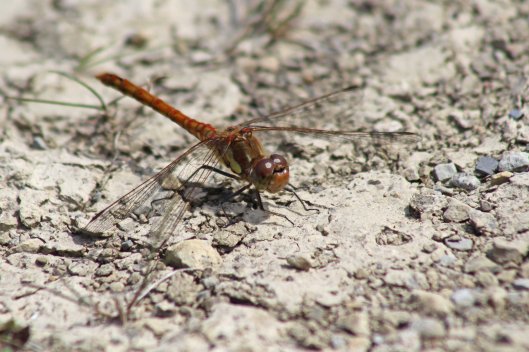
On 5 November, the ‘fireworks’ at Cosmeston were these lovely little Common darters. In an area shaded from the cool westerly wind but warmed by the bright sun, each had claimed itself a fencepost to bask on. And, nearby, a lone bumblebee looked like it wanted to snuggle for warmth into this seed-head ‘duvet’ of Old man’s beard (Clematis vitalba).

171202 fly (1)
171202 fly (2)
171202 hoverfly

On 24 November, though my focus was on finding the exact spots where Mary had taken her photos, I did still have one eye on the wildlife and noticed quite a lot of flies about. Like the dragonflies of two weeks earlier, these two flies and one hoverfly were favouring sheltered spots on wood to make the most of the sunshine.

Like Loading...

Dragons at Lavernock

27 Sunday Aug 2017

Posted by sconzani in insects, nature, parks

≈ 2 Comments

Tags

British dragonflies, Broad-bodied Chaser, Common Darter, dragonflies, dragonfly ovipositing, Emperor dragonfly, Lavernock Nature Reserve

There were some cracking dragonflies scooting around the pond at Lavernock Nature Reserve yesterday.

170827 Common darter male
170827 Common darter female

Both the male and the female Common darters posed very obligingly for me.

170827 Emperor male

The male Emperor kept busy patrolling the pond and indulging in occasional rapid trysts with a female. Judging by his tattered wings, he’s notched up quite a few trysts in recent days / weeks. He only stopped once, and then very briefly, so this photo doesn’t really do him justice.

170827 Emperor female

The female Emperor was then kept busy laying eggs at various spots all around the pond edges. A woman’s work is never done!

170827 Broad-bodied chaser male

The star of the show was this gorgeous male Broad-bodied chaser. Apparently, this is very late in the season for them, and he was looking pristine, so perhaps he had only recently hatched. Whatever his story, he was a stunning sight.

Like Loading...

Three Aeshnidae

09 Wednesday Aug 2017

Posted by sconzani in insects, nature

≈ Leave a comment

Tags

Aeshna cyanea, Aeshna mixta, Aeshnidae, Anax imperator, British dragonflies, dragonflies, dragonfly, Emperor dragonfly, Migrant hawker, Southern hawker

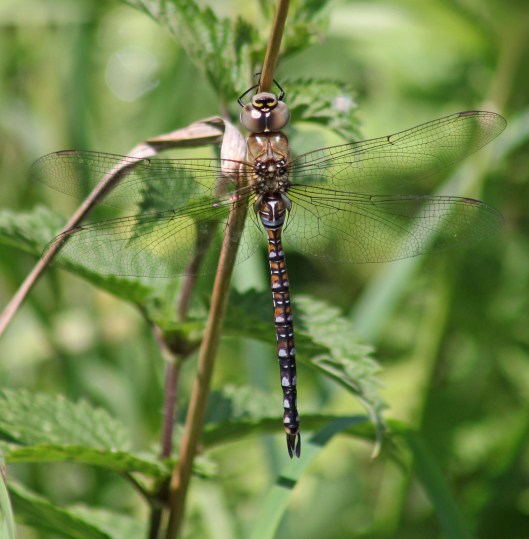
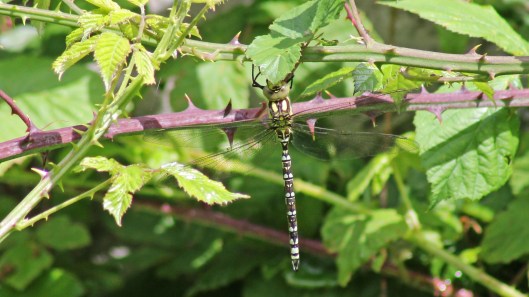
The Aeshnidae are one of the five families of dragonflies to be found in Britain, and the family is made up of twelve Emperors and Hawkers. In the past week I have been privileged to see three members of the family during my local walks.

170809 Southern hawker
170809 Migrant hawker

The Southern hawker (Aeshna cyanea) (above left) is relatively common in Wales. In Aderyn, the national biodiversity recording database, there are 3312 records of Southern Hawker sightings and these are spread across 225 of the 275 10-kilometre grid squares that divide up Wales.

If the recorded numbers are anything to go by, the Migrant hawker (Aeshna mixta) (above right) is half as common as the Southern, with 1662 records in 143 grid squares, and its coverage across Wales is more spasmodic. This was only my second sighting of this slightly smaller Hawker but then I have only been living in Wales two years so my personal statistics aren’t really relevant.

170809 Emperor

This last creature is the most recorded of the Aeshnidae, with 4098 records in 221 of Wales’s grid squares, but, rather than reflecting how common it is, that may be because it’s one of the easiest dragonflies to identify because it’s the biggest. This is the Emperor (Anax imperator). I often get buzzed by these stunning creatures hawking over fields of wildflowers when I’m out walking – and they sound like a small helicopter approaching! – but I rarely get lucky enough to see them perched so I was particularly chuffed to get this photo.

Like Loading...

Migrant hawker

02 Wednesday Aug 2017

Posted by sconzani in insects, nature

≈ 4 Comments

Tags

Aeshna mixta, British dragonflies, dragonflies, dragonfly, Migrant hawker

This is my very first Migrant Hawker dragonfly (Aeshna mixta) – isn’t she a beauty?

170802 Migrant hawker

Before the 1940s, these dragonflies visited Britain but didn’t breed here – hence the name ‘Migrant’ – but they have since become established and are gradually increasing their range northwards. They’re described as small to medium size dragonflies but, at around 63mm long, I think they’re quite big, and this one was certainly quite prominent as she hawked for food along a hedgerow, the nearest standing water probably 500 metres away as the dragon flies. Migrant hawkers have a later flying season than many other dragon- and damselflies, usually ranging from August to October, so there’s plenty of time yet to spot one flying along a hedgerow or woodland edge near you. And I’ll be keeping an eye out for the male of the species.

Like Loading...

Happy hour

25 Tuesday Jul 2017

Posted by sconzani in insects, nature

≈ 9 Comments

Tags

British dragonflies, Broad-bodied Chaser, dragonflies, dragonfly, female Broad-bodied Chaser, Lavernock Nature Reserve, Libellula depressa, Odonata

170725 Broad-bodied chaser (1)

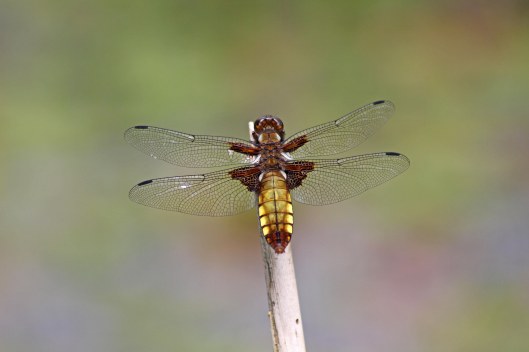
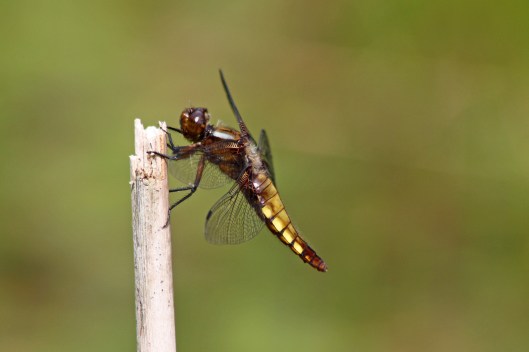
These stunning female Broad-bodied chasers (Libellula depressa) were at the pond at Lavernock Nature Reserve today. Watching them fly, perch, and lay their eggs was an hour very well spent. Bliss!

170725 Broad-bodied chaser (2)

Like Loading...

The Butterfly bush

24 Monday Jul 2017

Posted by sconzani in flowers, insects, nature

≈ Leave a comment

Tags

British butterflies, British dragonflies, Buddleia, Buddleja davidii, butterflies, Butterfly bush, Comma, dragonfly, Penarth Rail Trail, Red Admiral, Southern hawker

Buddleja davidii is not called the Butterfly bush for nothing.

170724 Buddleja & butterfly (1)

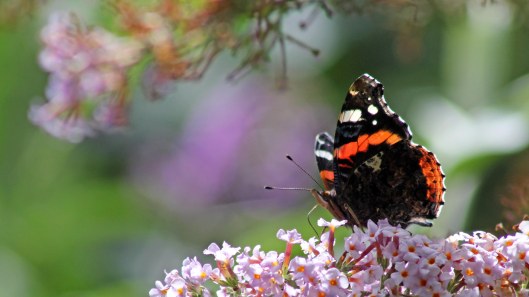
Running through the town where I live there’s a rail trail – the path of a former railway line that was closed to rail traffic back in the 60s and is now a wonderful walking and cycling trail, lined with trees, shrubs and wildflowers. At one point along the trail, there’s a group of several Buddleja bushes that have now reached small tree height and are currently covered in their gorgeous lilacy purplish flowers. When I walked past today, they were alive with butterflies: I counted at least nine Red admirals, three Commas, two Speckled woods and a selection of Whites.

170724 Buddleja & butterfly (2)
170724 Buddleja & butterfly (3)
170724 Buddleja & butterfly (4)
170724 Buddleja & butterfly (5)
170724 Buddleja & butterfly (6)
170724 Buddleja & butterfly (7)
170724 Buddleja & butterfly (8)

An added bonus was a Southern hawker dragonfly that was also patrolling the area. Just brilliant!

170724 Southern hawker

Like Loading...

Not so Common darters

20 Thursday Jul 2017

Posted by sconzani in insects, nature

≈ 8 Comments

Tags

British dragonflies, Common Darter, dragonflies, dragonfly, National Dragonfly Week, Sympetrum striolatum

170720 Common darter (1)

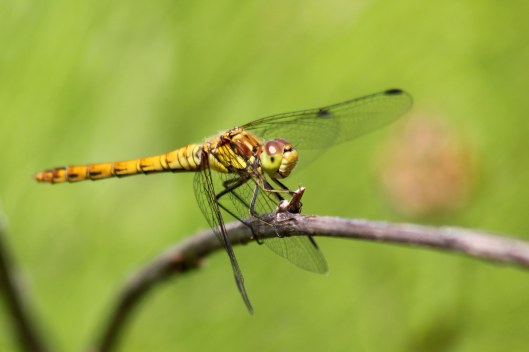
I haven’t been seeing a lot of dragonflies this year – probably just me not going to the right places, rather than an actual scarcity – but I have seen two Common darters (Sympetrum striolatum) in the past week. Although I blogged about these beauties around this time last year, I thought I’d share these latest images to celebrate National Dragonfly Week, which is happening right now.

170720 Common darter (2)

I had a bit of luck this week as I finally managed to photograph one of these lovely creatures in flight. It’s not the sharpest of shots but I’ll take it.

170720 Common darter (3)

Like Loading...

The skimmers

24 Saturday Jun 2017

Posted by sconzani in insects, nature

≈ 4 Comments

Tags

Black-tailed skimmer, British dragonflies, dragonflies, dragonfly, Keeled skimmer, Orthetrum cancellatum, Orthetrum coerulescens

When the birds disappear behind the leaves of the trees during the summer months, my eye turns to the other creatures that delight and amaze with their aerial displays, and the dragonflies are some of the most impressive. In recent weeks I’ve seen my first Skimmers.

170624 Keeled skimmer

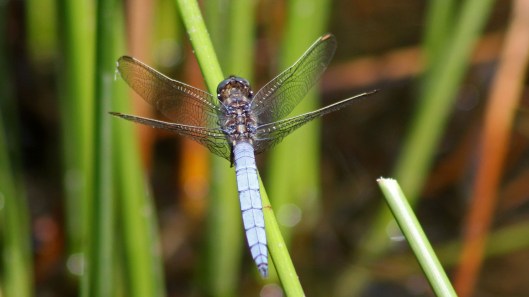
Keeled skimmer (Orthetrum coerulescens)
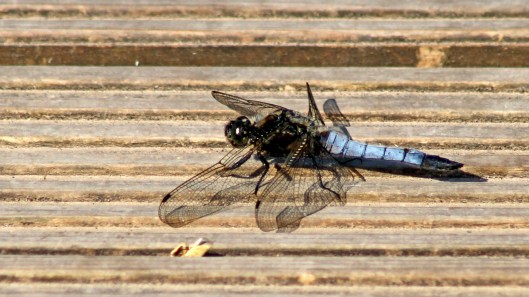
I was on a walk with my bird club buddies in the hills above Swansea this week when I saw my first Keeled skimmer. It was flitting back and forth quite restlessly in a boggy reed-filled area, perching on the reeds and other vegetation but only for short periods, so I was lucky to get some reasonable photos. I love the brilliant blue colour, called pruinescence, which is actually a covering of wax particles and which can be rubbed off during mating or if the dragonfly accidentally rubs against vegetation. Keeled skimmers are mostly found in western Britain and fly from June through to September.

170624 Black-tailed skimmer

Black-tailed skimmer (Orthetrum cancellatum)
Though very similar in appearance to the Keeled skimmer, the Black-tailed skimmer has, as its name implies, a darker end to its abdomen, and it’s much more common, as it’s happy to live around any pond, lake or stream, rather than the acidic moorland that the Keeled skimmer prefers. Though it is more common in southern parts of Britain, it has gradually been extending its range northwards, and its flight period is a little longer than its keeled cousin, being on the wing sometimes as early as late April right through to October if conditions are mild enough.

170624 Keeled skimmer (2)
170624 Black-tailed Skimmer (2)
Like Loading...

Chasing the chasers

04 Sunday Jun 2017

Posted by sconzani in insects, nature, nature photography

≈ 6 Comments

Tags

British dragonflies, Broad-bodied Chaser, dragonfly, Libellula depressa

It’s dragonfly time!

170604 Broad-bodied chasers (1)

Just when the birds disappear behind the trees’ leafy boughs, the dragonflies emerge to take their place in Nature’s line-up of masterly aviators.

170604 Broad-bodied chasers (2)

Earlier this week I spent over 30 minutes watching these magnificent Broad-bodied chasers (Libellula depressa), two males circling and defending their territories from each other, keeping watch from their favourite perches, mating with two females, and those females then depositing their eggs amongst the water plants. It was magical!

170604 Broad-bodied chasers (3)

Like Loading...
Newer posts →

About me

sconzani

sconzani

I'm a writer and photographer; researcher and blogger; birder and nature lover; countryside rambler and city strider; volunteer and biodiversity recorder.

View Full Profile →

Follow earthstar on WordPress.com

Enter your email address to follow this blog and receive notifications of new posts by email.

Recent blog posts

  • Little owl March 31, 2026
  • Distant seabirds March 30, 2026
  • Thrift March 29, 2026
  • The day of the Wheatears March 28, 2026
  • Cetti’s warblers March 27, 2026

From the archives

COPYRIGHT

Unless otherwise acknowledged, the text and photographs on this blog are my own and are subject to international copyright. Nothing may be downloaded or copied without my permission.

Fellow Earth Stars!

  • Unknown's avatar
  • Unknown's avatar
  • Unknown's avatar
  • Unknown's avatar
  • Unknown's avatar
  • Unknown's avatar
  • Unknown's avatar
  • Unknown's avatar
  • Unknown's avatar
  • Unknown's avatar
  • Unknown's avatar
  • Unknown's avatar
  • Unknown's avatar
  • Unknown's avatar
  • Unknown's avatar
  • Unknown's avatar
  • Unknown's avatar
  • Unknown's avatar
  • Unknown's avatar
  • Unknown's avatar
  • Unknown's avatar
  • Unknown's avatar
  • Unknown's avatar
  • Unknown's avatar
  • Unknown's avatar
  • Unknown's avatar
  • Unknown's avatar
  • Unknown's avatar
  • Unknown's avatar
  • Unknown's avatar
  • Unknown's avatar
  • Unknown's avatar
  • Unknown's avatar
  • Unknown's avatar
  • Unknown's avatar
  • Unknown's avatar
  • Unknown's avatar
  • Unknown's avatar
  • Unknown's avatar
  • Unknown's avatar
  • Unknown's avatar
  • Unknown's avatar
  • Unknown's avatar
  • Unknown's avatar
  • Unknown's avatar
  • Unknown's avatar
  • Unknown's avatar
  • Unknown's avatar
  • Unknown's avatar
  • Unknown's avatar

Blog at WordPress.com.

Privacy & Cookies: This site uses cookies. By continuing to use this website, you agree to their use.
To find out more, including how to control cookies, see here: Cookie Policy
  • Subscribe Subscribed
    • earthstar
    • Join 642 other subscribers
    • Already have a WordPress.com account? Log in now.
    • earthstar
    • Subscribe Subscribed
    • Sign up
    • Log in
    • Report this content
    • View site in Reader
    • Manage subscriptions
    • Collapse this bar
 

Loading Comments...
 

You must be logged in to post a comment.

    %d