• ABOUT
  • BIRDING 2018
  • Birding 2019
  • BLOG POSTS
  • Butterflies 2018
  • Resources

earthstar

~ a celebration of nature

earthstar

Tag Archives: British moths

165/365 Coming soon …

14 Friday Jun 2019

Posted by sconzani in 365DaysWildin2019, insects, nature

≈ 3 Comments

Tags

#365DaysWild, British moths, Burnet moth, caterpillar to moth, Five-spot burnet, metamorphosis, Six-spot burnet, Zygaena filipendulae, Zygaena lonicerae

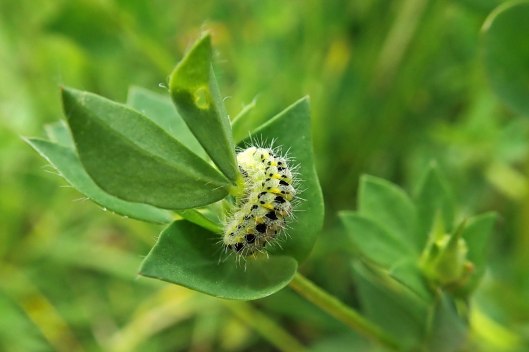
First, the caterpillar. Now I know this is a bit like the chicken and egg debate – which came first? – but my sequence is chronological for 2019. This is the caterpillar / larva of a Burnet moth, most likely a Six-spot Burnet (Zygaena filipendulae), as they’re the species I’ve seen at this site in previous years. I only found out this week that they over-winter as caterpillars, and they’re now enjoying a final munch before beginning their transformation.
Second, the pupa. Some of the munchers have already begun their metamorphosis into moths. This week I’ve spotted quite a number of the papery cocoons they spin to house their pupae while they go through this process.

190614 Burnet moth cocoon

Third, the moth. In previous years, the Six-spots have begun to appear around the beginning of July but the weather conditions can have an effect on their emergence. So, eyes peeled for the appearance of these gorgeous creatures in a meadow near you very soon!

190614 Six-spot Burnet moth

p.s. And if, by some chance, it’s actually a Five spot Burnet (Zygaena lonicerae), then it will look like this – you just have to count the dots!

190614 Five-spot Burnet moth

Like Loading...

158/365 Latticed heath

07 Friday Jun 2019

Posted by sconzani in 365DaysWildin2019, insects, nature

≈ 2 Comments

Tags

British moths, Chiasmia clathrata, Cosmeston Lakes Country Park, day-flying moth, Grangemoor Park, Hamadryad Park, Latticed heath, Lavernock Nature Reserve, moth, moths

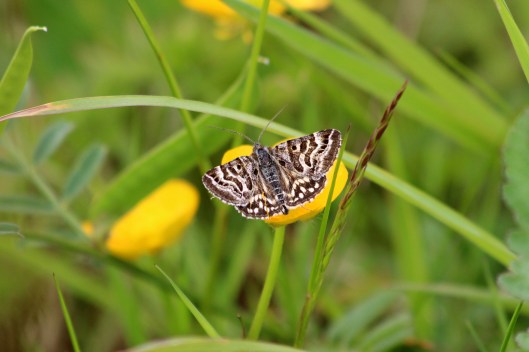
This is one of my favourite moths, a Latticed heath (Chiasmia clathrata, from the Greek chiasma, meaning formed like a cross, and clathrum, meaning lattice or grate, a reference to the lovely interlaced and criss-crossing patterns on its wings).

190607 lattice heath (1)

As well as flying in the night time, the Latticed heath also flies by day, which is how I’m able to see them, though they’re very good at hiding in amongst the long grass and wildflowers. I saw my first for 2019 on 23 May at Cosmeston, and I’ve since seen them at most of my regular haunts, Grangemoor and Hamadryad Parks in Cardiff, and Lavernock Nature Reserve.

190607 lattice heath (2)
190607 lattice heath (3)

It’s a smallish moth, with a wingspan between 20 and 25mm, and can be found around clovers and trefoils and lucerne, which are the plants its caterpillars feed on. The first adults can be seen in May and June, and then there’s a second generation that flies in August and September.

190607 lattice heath (4)

Like Loading...

151/365 Leptastic

31 Friday May 2019

Posted by sconzani in 365DaysWildin2019, insects, nature

≈ 2 Comments

Tags

#365DaysWild, British butterflies, British moths, Brown argus, butterflies, Cosmeston Lakes Country Park, Grangemoor Park, Large skipper, Latticed heath, Mother Shipton, moths

I’ve had a lucky week with my Lepidoptera sightings – that’s moths and butterflies, for those who didn’t know – and the week’s not over yet. As well as the Narrow-bordered Bee Hawk-moth on Monday and the Burnet Companions on Tuesday, yesterday I found my first (three) Large Skipper butterflies for the year at Cosmeston.

190531 large skipper (1)190531 large skipper (2)

And, today, my wander around Grangemoor Park was something of a Lep-fest, with the first (five) Mother Shipton moths I’ve seen in 2019.

190531 mother shipton (1)190531 mother shipton (2)

And I spotted a nice Latticed Heath moth trying to hide in the grass.

190531 latticed heath

And, then, just as I was about to head for home, I noticed something small flitting about along a side path, went to investigate and found two Brown Argus butterflies, which I have seen already this year but not in Wales. You can see why I named this blog ‘leptastic’!

190531 brown argus (1)190531 brown argus (2)

Like Loading...

148/365 The one that got away

28 Tuesday May 2019

Posted by sconzani in 365DaysWildin2019, insects, nature

≈ 3 Comments

Tags

#365DaysWild, Bird’s-foot trefoil, British moths, Burnet companion, Cosmeston, Cosmeston Lakes Country Park, moth, moths

I mentioned in yesterday’s post about the amazing Narrow-bordered Bee Hawk-moth that I had actually been trying to re-find a Burnet Companion moth when I spotted the Hawk-moth. Well, today I got the one that got away yesterday – not the actual moth, as today I was at Cosmeston not Lavernock, and not just one but three Burnet Companions appeared for my camera today.

190528 burnet companion (1)

I felt a bit sad for the first one I saw (below left). Either it hadn’t developed properly in its pupa or something had happened to it since hatching, as its wings appeared damaged and it didn’t seem able to fly.

190528 burnet companion (2)
190528 burnet companion (3)

But the other two were flitting merrily from flower to flower, drinking in as much Bird’s-foot trefoil nectar as their tiny tongues could manage. And not only do they have lovely markings on the top side of their wings but they’re a wonderful buttery yellow underneath as well (above right).

190528 burnet companion (4)

Like Loading...

147/365 Narrow-bordered Bee Hawk-moth

27 Monday May 2019

Posted by sconzani in 365DaysWildin2019, insects, nature

≈ 11 Comments

Tags

#365DaysWild, British moths, Hemaris tityus, Lavernock Nature Reserve, moth, moths, Narrow-bordered Bee Hawk-moth, rare moth

I had a heart-stopping few moments at Lavernock Nature Reserve this afternoon. I’d just taken a rubbish photo of my first Burnet Companion moth of the year but it had flitted off and I was trying to re-find it when I spotted this beauty … and I couldn’t believe what I was seeing. It’s a Narrow-bordered Bee Hawk-moth (Hemaris tityus) and it’s something of a rarity here in south Wales.

190527 narrow-bordered bee hawk-moth (1)

According to Aderyn, Wales’s Biodiversity and Information Reporting Database, this species has not been recorded anywhere near my area for more than 50 years, yet they seem to be having a good year in 2019: George, from our local Butterfly Conservation branch, tells me this special moth has been seen in three new sites in south Wales so far this year. Long may this trend continue!

190527 narrow-bordered bee hawk-moth (2)

Like Loading...

61/365 From food to frass

02 Saturday Mar 2019

Posted by sconzani in 365DaysWildin2019, insects, nature, plants, wildflowers

≈ 2 Comments

Tags

#365DaysWild, Alexanders, Angle shades caterpillar, Angle shades larvae, Angle shades moth, British moths, British wildflowers, Phlogophora meticulosa

First I noticed the frass (that’s pooh, to most of us). Then I thought ‘Something fairly big must be in these Alexanders’ flower heads somewhere’. And, sure enough, with a little gentle pulling aside of leaves and flowers, I found the frass creator, very well camouflaged by its light green colouring. And then I thought, ‘There might be more’. And, sure enough, I found three caterpillars on three different plants, and frass on several more plants. These are the larvae of the Angle Shades moth (Phlogophora meticulosa). I thought it seemed rather early for them but my local Butterfly Conservation expert George tells me you can find them pretty much any time of year. 

OLYMPUS DIGITAL CAMERA
Like Loading...

Looking daggers at me?

09 Tuesday Oct 2018

Posted by sconzani in autumn, insects, nature

≈ 2 Comments

Tags

British moths, caterpillars, dagger moths, Grey dagger, Grey dagger caterpillar, Grey dagger larva, moth larvae

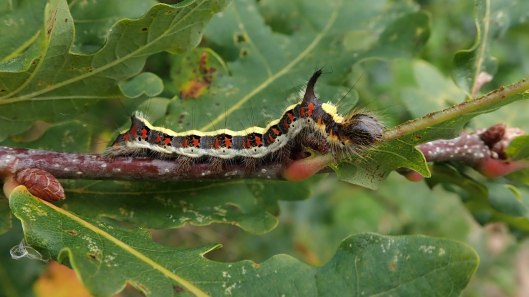
Yesterday, when I was checking out some local Oak trees for leaf mines, I came across this vibrant character. It turns out this is the larva of the Grey dagger moth (Acronicta psi), a very colourful creature when compared with its parent (you can see images on the UK Moths website here).

181009 grey dagger (1)

The larvae are about from July through to November and can be found on a wide variety of food plants. They are much easier to identify than their parents: the Grey dagger is almost identical to the Dark dagger moth and an examination of their genitals is required to tell them apart. I’m so glad I found the caterpillar not the moth – and I don’t really think it was looking daggers at me!

181009 grey dagger (2)

Like Loading...

Wild word: cocoon

29 Wednesday Aug 2018

Posted by sconzani in insects, nature

≈ 5 Comments

Tags

#WildWords, 5-spot Burnet, 6-spot Burnet, British moths, Burnet moth cocoon, cocoon, Five-spot Burnet moth, moth cocoon, Six-spot Burnet moth, wild words

Cocoon: Noun; A silky case spun by the larvae of many insects for protection as pupae (Oxford Dictionary).
The cocoons in my photos are those of Burnet moths, both 5-spot (below left) and 6-spot (below right): you can’t tell the difference in the cocoons from the outside – I just know which moths were present in the locations where I took my photos.

180828 5-spot burnet moth
180828 6-spot burnet moth

After hatching from their eggs, the caterpillars/larvae of both moths feed on plants from the pea family; the 6-spot burnet is particularly partial to Common bird’s-foot trefoil, which is why I see a lot of these moths at Cosmeston.

180828 occupied 5-spot pupa
180828 occupied 6-spot pupa

When they’re ready to pupate, the caterpillars find themselves a suitable location, often high up on a sturdy grass stem (though I have seen them on other plants), and spin an oval-shaped cocoon. The cocoons pictured above are still occupied by caterpillars in the throes of metamorphosing into moths, a process which takes about two weeks.

180828 empty cocoon (2)
180828 empty cocoon (1)

These are the empty cocoons that remain once the adult moths have emerged (with the remains of the larvae’s pupae cases poking out the tops). The cocoons are quite sturdy: their yellowish-white papery structures often seem to last for a month or more after the adults have departed or even until the grasses themselves collapse with the coming of the wild winds and chilly days of autumn.

Like Loading...

Common purple & gold

20 Monday Aug 2018

Posted by sconzani in insects, nature

≈ Leave a comment

Tags

British moths, Common purple & gold, Cosmeston, Cosmeston Lakes Country Park, moth, moths, Pyrausta purpuralis, UK moths

Every step I take across the west paddock at Cosmeston seems to send at least two tiny beige-looking insects flicking off in different directions in front of me. At first, I think they might be grasshoppers or crickets, springing quickly out of the way of my trampling feet but no – these creatures are not making straight leaps, they are fluttering and flying. They’re not easy to follow – as soon as they touch the ground they seem to disappear so I have to focus intently to follow each flight and then approach very slowly to discover what they are.

180820 Pyrausta purpuralis (1)

It turns out they’re not beige at all – they’re a quite striking combination of maroon and yellow, hence their common name, Common purple & gold. This is Pyrausta purpuralis, not to be confused with Pyrausta aurata, a very similar moth of the same family (see more here).

180820 Pyrausta purpuralis (4)
180820 Pyrausta purpuralis (5)

180820 Pyrausta purpuralis (2)

With a wingspan of just 20mm, this moth really is tiny but it’s relatively common throughout Britain, particularly on chalky downs and dry grasslands. The moths I’m seeing now in such abundance are the second brood of the year and fly, both during the day and at night, from July to August. I saw their parents during May and June, though they didn’t seem as plentiful. Perhaps this is a moth species that has enjoyed our hot dry weather this summer.

180820 Pyrausta purpuralis (3)

Like Loading...

Three in one day

04 Saturday Aug 2018

Posted by sconzani in insects, nature

≈ Leave a comment

Tags

British moths, Jersey tiger, Jersey tiger moth, Lavernock Nature Reserve, moths, tiger moth

Many of you probably knew that last Sunday 29 July was International Tiger Day but I’ll bet you didn’t know that Tuesday the 31st was Jersey Tiger Day!

180804 Jersey tiger (1)

Well, of course you didn’t because I just made that up. And why?

180804 Jersey tiger (2)

Because that was the day I saw my first Jersey Tiger moths for the year.

180804 Jersey tiger (3)

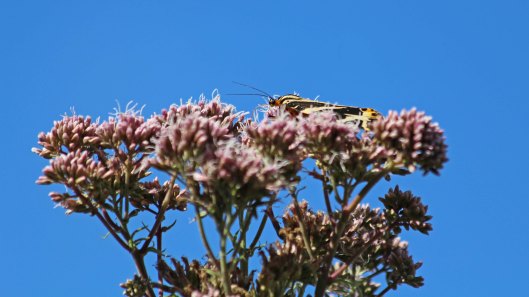
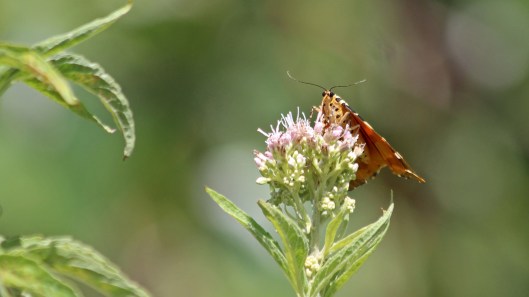
And I didn’t just see one – I saw three of these most gorgeous of moths.

180804 Jersey tiger (4)

Want to know why I was so delighted to see them? Read on …

Like Loading...
← Older posts
Newer posts →

About me

sconzani

sconzani

I'm a writer and photographer; researcher and blogger; birder and nature lover; countryside rambler and city strider; volunteer and biodiversity recorder.

View Full Profile →

Follow earthstar on WordPress.com

Enter your email address to follow this blog and receive notifications of new posts by email.

Recent blog posts

  • Cormorants, young and old March 12, 2026
  • Bay bunnies March 11, 2026
  • Beating the gloom March 10, 2026
  • No booming Bittern but … March 9, 2026
  • Danish scurvygrass March 8, 2026

From the archives

COPYRIGHT

Unless otherwise acknowledged, the text and photographs on this blog are my own and are subject to international copyright. Nothing may be downloaded or copied without my permission.

Fellow Earth Stars!

  • Unknown's avatar
  • Unknown's avatar
  • Unknown's avatar
  • Unknown's avatar
  • Unknown's avatar
  • Unknown's avatar
  • Unknown's avatar
  • Unknown's avatar
  • Unknown's avatar
  • Unknown's avatar
  • Unknown's avatar
  • Unknown's avatar
  • Unknown's avatar
  • Unknown's avatar
  • Unknown's avatar
  • Unknown's avatar
  • Unknown's avatar
  • Unknown's avatar
  • Unknown's avatar
  • Unknown's avatar
  • Unknown's avatar
  • Unknown's avatar
  • Unknown's avatar
  • Unknown's avatar
  • Unknown's avatar
  • Unknown's avatar
  • Unknown's avatar
  • Unknown's avatar
  • Unknown's avatar
  • Unknown's avatar
  • Unknown's avatar
  • Unknown's avatar
  • Unknown's avatar
  • Unknown's avatar
  • Unknown's avatar
  • Unknown's avatar
  • Unknown's avatar
  • Unknown's avatar
  • Unknown's avatar
  • Unknown's avatar
  • Unknown's avatar
  • Unknown's avatar
  • Unknown's avatar
  • Unknown's avatar
  • Unknown's avatar
  • Unknown's avatar
  • Unknown's avatar
  • Unknown's avatar
  • Unknown's avatar
  • Unknown's avatar

Blog at WordPress.com.

Privacy & Cookies: This site uses cookies. By continuing to use this website, you agree to their use.
To find out more, including how to control cookies, see here: Cookie Policy
  • Subscribe Subscribed
    • earthstar
    • Join 668 other subscribers
    • Already have a WordPress.com account? Log in now.
    • earthstar
    • Subscribe Subscribed
    • Sign up
    • Log in
    • Report this content
    • View site in Reader
    • Manage subscriptions
    • Collapse this bar
 

Loading Comments...
 

You must be logged in to post a comment.

    %d