• ABOUT
  • BIRDING 2018
  • Birding 2019
  • BLOG POSTS
  • Butterflies 2018
  • Resources

earthstar

~ a celebration of nature

earthstar

Tag Archives: British moths

T is for plume

31 Tuesday Oct 2023

Posted by sconzani in insects

≈ Leave a comment

Tags

Amblyptilia acanthadactyla, Beautiful plume, British moths, Common plume, Emmelina monodactyla, moth, plume moths

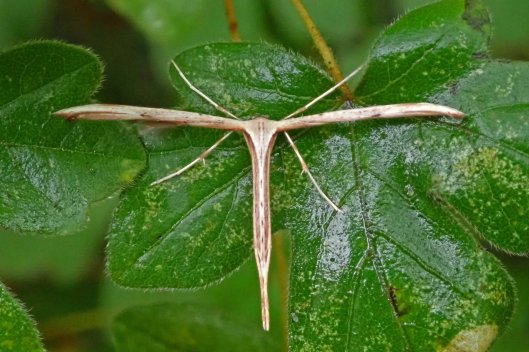
‘T is for plume’ may sound an odd title but it’s the T shape these moths make when they’re resting that makes them recognisable as plume moths, the Pterophorinae. And why plume? Well, when their wings are spread, the deep indentations look like feathers (the photos of a White plume on the UK Moths website show a beautiful example).

231031 common plume

Common plume (Emmelina monodactyla)
As you’d expect from its name, this pretty moth is quite common – in fact, I’ve seen several in the last few weeks.

231031 Beautiful plume

Beautiful plume (Amblyptilia acanthadactyla)
Though this moth can be confused with another that’s very similar (Brindled plume, Amblyptilia punctidactyla), the reddish-brown hue confirms it as a Beautiful plume.

Like Loading...

A Vapourer cocoon

13 Friday Oct 2023

Posted by sconzani in insects

≈ Leave a comment

Tags

British moths, moth cocoon, Orgyia antiqua, Vapourer, Vapourer cocoon, Vapourer larva

Here’s an intriguing find I made when doing a little leaf-turning during yesterday’s rather damp local meander – a hairy cocoon on willow.

231013 vapourer cocoon

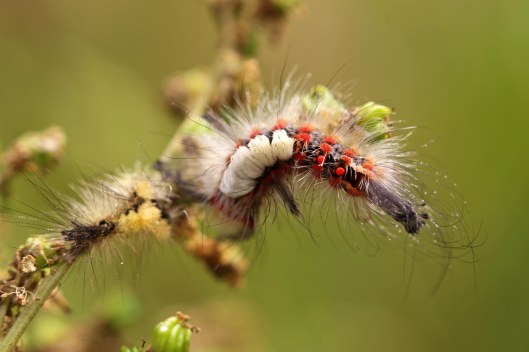
From looking at the yellow and black hairs contained within the silk, I thought perhaps this might have been created by a Pale tussock moth. Fortunately, Andy, one of the moth-ers I follow on Twitter, recognised this cocoon and was able to correct my identification. This was, in fact, created by a Vapourer moth larva (Orgyia antiqua) – below is one I photographed a few years back (it had just shed its skin, the remnants of which can be seen to the left of the caterpillar).

231013 vapourer larva

I’ve not yet seen an adult Vapourer but they are a particularly interesting species, as the female is virtually wingless – you can read more and see some images on the UK Moths website. Andy also introduced me to the Lepiform e.V. website, which, though it is in German, can still be searched using a moth’s scientific name and has an excellent and comprehensive range of images for each species, including larval stages, cocoons, pupae, etc.

Like Loading...

Leafmines: Lyonetia prunifoliella

09 Monday Oct 2023

Posted by sconzani in insects, leaves, trees

≈ Leave a comment

Tags

British leafmines, British moths, leaf mines, leafmines on Blackthorn, leafmining moth larvae, leafmining moths, Lyonetia prunifoliella

For over 100 years, the lovely little micro moth Lyonetia prunifoliella was thought to be extinct in the UK until it was rediscovered in the 2000s in southern England. It took a while to spread across the country but was found new to Wales, near Holyhead, last autumn and, soon afterwards, found here in south Wales, at Kenfig National Nature Reserve, though just one larval mine was found despite much searching by Butterfly Conservation’s senior moth ecologist George Tordoff.
231009 lyonetia prunifoliella (1)

This year, though, George says, it’s really taken off in south Wales: he’s found it in various Cardiff parks and at Lavernock Nature Reserve. When I heard this news last Sunday, 1 October, I immediately decided to go searching, focussing in particular on the suckering growth of Blackthorn (Prunus spinosa), the tree this moth appears to favour locally for its larval leafmines (though it is known to use other roseaceous trees elsewhere).

231009 lyonetia prunifoliella (2)

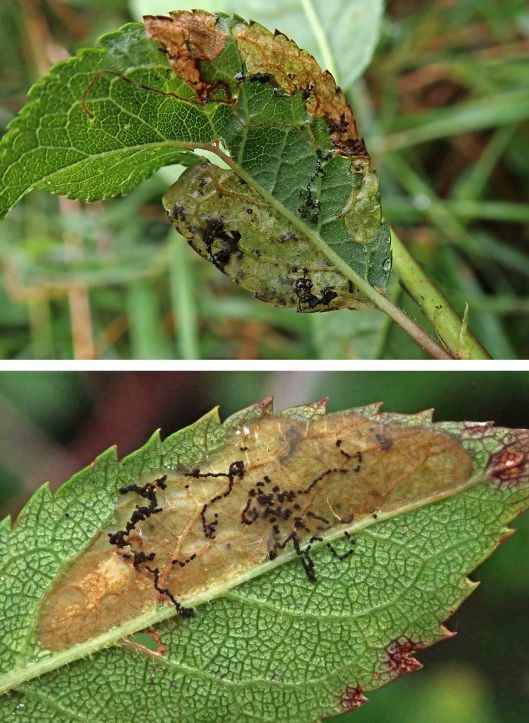
Last Monday I found Lyonetia prunifoliella mines immediately at the first place I looked, and have since found it at six locations in my surrounding area, sometimes in abundance, other times just one or two mines, despite a plentiful supply of young Blackthorn leaves. The mines are relatively easy to identify, as the larvae eject their frass from the mines in a ‘string of black pearls’, a rather poetic description from someone on Twitter but easy to remember. (The photographs above show the upper and under sides of the same leaf, with the larva apparent above and its frass ejected below.)
231009 lyonetia prunifoliella (3)

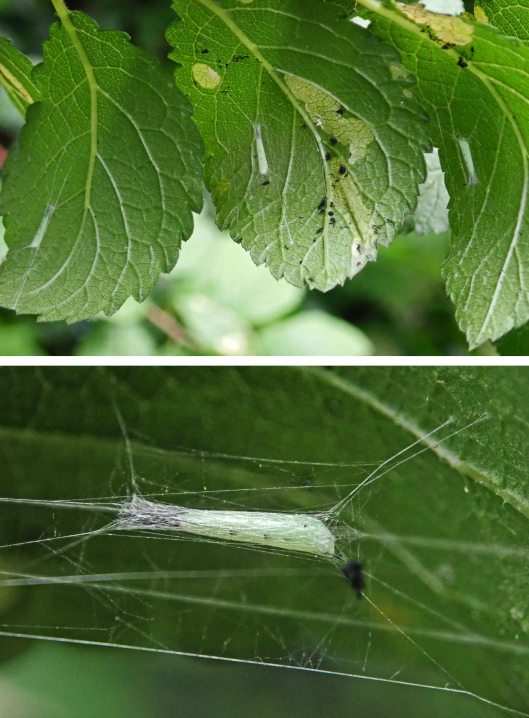
Although most mines I’ve seen have been empty (this moth overwinters as an adult), a few have held larvae, and I was particularly delighted last Thursday to find a group of five cocoons, strung like hammocks on the underside of leaves with silk produced by the larvae before they pupate. I’ve yet to see an adult moth but will definitely share that exciting moment when it happens.

Like Loading...

Box tree moth

14 Thursday Sep 2023

Posted by sconzani in insects, plants

≈ Leave a comment

Tags

Box sp, Box tree moth, British moths, Buxus sp, Cydalima perspectalis

The gardeners amongst you will not welcome the sight of this moth in your vicinity, at least not if you grow any species of Box (Buxus) in your garden, as its larvae eat the leaves of Box and cover the plant in a webbing like thick cobweb. This is the appropriately named Box tree moth (Cydalima perspectalis), a native of east Asia that established itself in Europe and hopped across the Channel to Britain in 2007. From the Aderyn biodiversity records database, the first Welsh sightings were recorded in 2016 and, in the seven years since then, a further 260 records have been added to the database, with most sightings along the coast of south Wales and a smattering across the top of north Wales.

Like Loading...

That tongue!

15 Tuesday Aug 2023

Posted by sconzani in insects

≈ 2 Comments

Tags

#MothsMatter, British moths, Hummingbird hawk-moth, moth, Red valerian

In a recent post (Moths matter, 4 August), I included photographs of a stationary Hummingbird hawk-moth that had flown past me before going to ground on the path in front of me. This week, during a walk along the embankment footpath where the River Ely flows in to Cardiff Bay, I watched spellbound as another of these magical moths hovered, feeding from Red valerian flowers, right in front me. I took rather a lot of photos, clicking almost continuously, hoping I was getting some in focus. This, I think, is the best of those images, and one I’m very pleased with. And, yes, that tongue!

230815 hummingbird hawk-moth

Like Loading...

Moths matter

04 Friday Aug 2023

Posted by sconzani in insects

≈ Leave a comment

Tags

#MothsMatter, Autographa gamma, British moths, Burnet companion, Chiasmia clathrata, Euclidia glyphica, Hummingbird hawk-moth, Large Yellow Underwing, Latticed heath, Macroglossum stellatarum, moth, Noctua pronuba, Silver Y, Six-spot burnet, Zygaena filipendulae

Some recent mothy goodness …

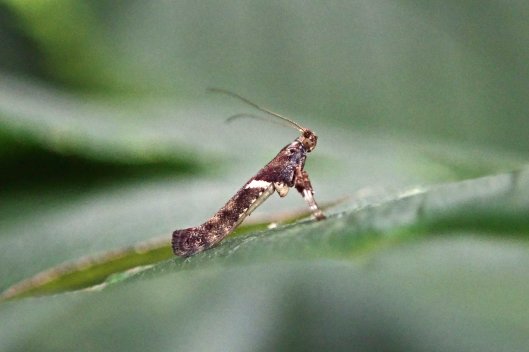
230804 1 Caloptilia semifascia

First, the micro moth Caloptilia semifascia, which I found perched on a leaf during a local meander and which, miraculously, stayed still for some photos.

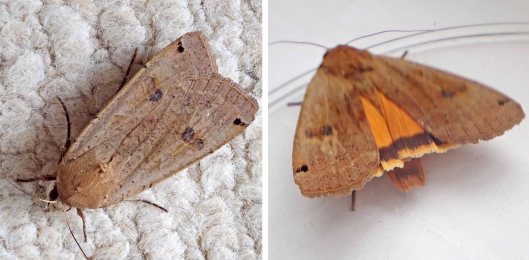
230804 2 large yellow underwing

I grabbed the rain parka I’d left drying on the back of a chair and this beauty flew up. Either I’d brought it home from the previous day’s walk or it had flown in an open window during the night. Whichever it was, this Large yellow underwing (Noctua pronuba) was a welcome visitor.

230804 3 6-spot burnet

I always enjoy watching the Five- and Six-spot burnets during the summer months. This is one of the latter (Zygaena filipendulae).

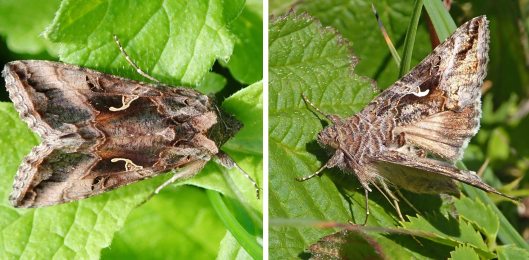
230804 4 silver y

Most of the Silver Ys (Autographa gamma) I see are constantly fluttering about in the long grass but these two were much more cooperative.

230804 5 burnet companion

Burnet companions (Euclidia glyphica) are also frequently camera shy but I got lucky with this beauty that was more intent on feeding than on the lurking photographer.

230804 6 humming-bird hawk-moth

Hummingbird hawk-moths (Macroglossum stellatarum) are most often seem hovering in front of flowers, their long tongues seeking out the tasty nectar within, but this one whizzed past during a recent walk then, luckily for me, settled on the path in front of me.

230804 7 latticed heath

This lovely is another summertime treat. Last but certainly not least, a Latticed heath (Chiasmia clathrata).

Like Loading...

Poplar hawk-moth larva

18 Tuesday Jul 2023

Posted by sconzani in insects, trees

≈ 2 Comments

Tags

British moths, caterpillar on Poplar, Laothoe populi, moth caterpillar, Poplar, Poplar hawk-moth, Poplar hawk-moth larva

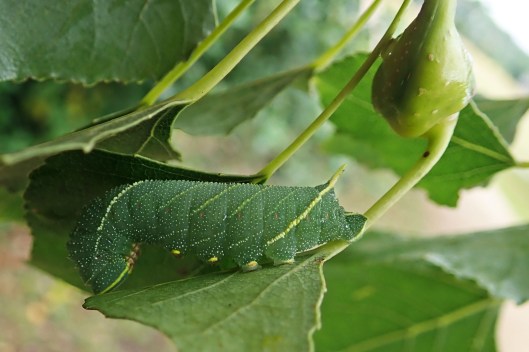
The leaf-staring story I related yesterday didn’t end with me seeing my first Poplar spiral galls – oh no! There was a bonus sighting that was much more exciting. Lurking behind one of the leaves I turned to more easily photograph a gall was this caterpillar, the larva of a Poplar hawk-moth (Laothoe populi). What a magnificent beast it was!

230718 hawk-moth poplar

Like Loading...

Scarlet tiger moths

12 Wednesday Jul 2023

Posted by sconzani in insects

≈ 1 Comment

Tags

British moths, moth, Scarlet tiger moth, tiger moth

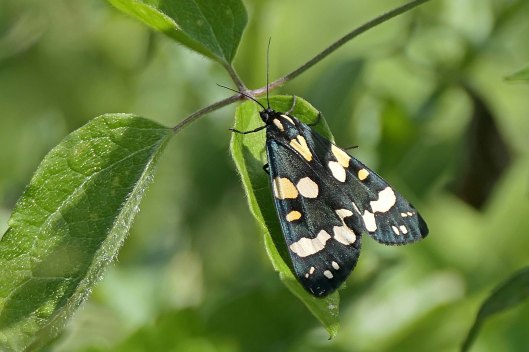
When you read the words ‘tiger moth’, you probably think plane, after the flying machines engineered by Geoffrey de Havilland (the first of these was designed with foldable wings, so as to fit into a small space – hence the name moth]. I hadn’t realised until I read up about him that de Havilland designed lots of planes, with variations of the moth name – no surprise then to read he was apparently an enthusiastic lepidopterist.

230713 scarlet tiger (1)

However, I digress. In this blog, the tiger moths are actually moths not planes, Scarlet tiger moths – in fact, the two Scarlet tigers seen during last week’s perambulations. The Scarlet tiger is the tiger moth I see most often, though it is only one of six tiger moths regularly seen in the UK – the others are Ruby, Wood, Garden, Cream-spot and Jersey tiger.

230713 scarlet tiger (2)

Like Loading...

The tiniest moth

07 Friday Jul 2023

Posted by sconzani in insects

≈ Leave a comment

Tags

Batia lunaris, British moths, Lesser tawny tubic, moth, tiny moth

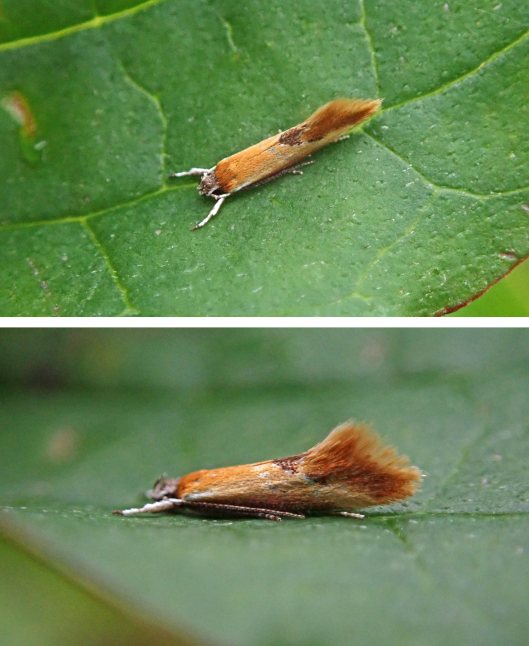
At first I thought this was just a scrap of dried leaf or something similar, but then I looked more closely and could see that the two white bits sticking out one end were in fact tiny legs. It was a moth, a Lesser tawny tubic (Batia lunaris), hands down the smallest moth I’ve ever seen.

230707 Batia lunaris (1)

According to the UK Moths website, it has a wingspan of 7-10mm, is present throughout England (it doesn’t mention the rest of the UK but, obviously, it’s here in Wales!), and can generally be found in woodland areas – if you can find it at all, that is. I’m so glad I decided to check it out rather than ignore it.

230707 Batia lunaris (2)

Like Loading...

Leafmines: Mompha terminella

26 Monday Jun 2023

Posted by sconzani in insects, plants, wildflowers

≈ Leave a comment

Tags

British moths, Enchanter's nightshade, leafmines on Enchanter's nightshade, leafmining moths, Mompha terminella, moth larvae in leaf mines

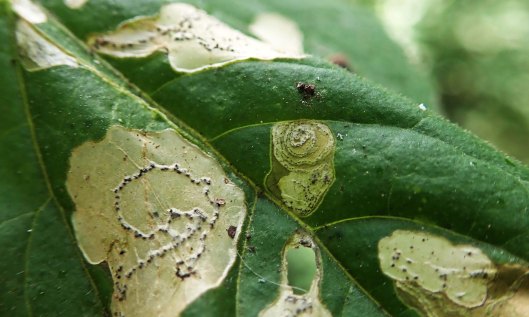
Just look at all these leafmines on Enchanter’s nightshade (Circaea lutetiana); you can hardly see the leaves for the mines.

230626 mompha terminella (1)

Back in July 2021, I blogged about these mines, made by the larvae of the tiny moth Mompha langiella, in Leafmines: Enchanter’s nightshade but, when I was looking at these nightshade plants on Wednesday, I noticed one that looked different – the mine started as a spiralling gallery before widening out into a blotch. This was later confirmed as the larval mine of Mompha terminella, another tiny moth whose adult form can be seen on the UK Moths website. The mines are usually seen between August and September but, as with many things this year, this larva was active much earlier than usual.

230626 mompha terminella (3)

Like Loading...
← Older posts
Newer posts →

About me

sconzani

sconzani

I'm a writer and photographer; researcher and blogger; birder and nature lover; countryside rambler and city strider; volunteer and biodiversity recorder.

View Full Profile →

Follow earthstar on WordPress.com

Enter your email address to follow this blog and receive notifications of new posts by email.

Recent blog posts

  • Our celebrity Redshank February 19, 2026
  • My first moth of the year February 18, 2026
  • Three Common sandpipers February 17, 2026
  • Beetle: Athous bicolor February 16, 2026
  • Crocus flower power February 15, 2026

From the archives

COPYRIGHT

Unless otherwise acknowledged, the text and photographs on this blog are my own and are subject to international copyright. Nothing may be downloaded or copied without my permission.

Fellow Earth Stars!

  • Unknown's avatar
  • Unknown's avatar
  • Unknown's avatar
  • Unknown's avatar
  • Unknown's avatar
  • Unknown's avatar
  • Unknown's avatar
  • Unknown's avatar
  • Unknown's avatar
  • Unknown's avatar
  • Unknown's avatar
  • Unknown's avatar
  • Unknown's avatar
  • Unknown's avatar
  • Unknown's avatar
  • Unknown's avatar
  • Unknown's avatar
  • Unknown's avatar
  • Unknown's avatar
  • Unknown's avatar
  • Unknown's avatar
  • Unknown's avatar
  • Unknown's avatar
  • Unknown's avatar
  • Unknown's avatar
  • Unknown's avatar
  • Unknown's avatar
  • Unknown's avatar
  • Unknown's avatar
  • Unknown's avatar
  • Unknown's avatar
  • Unknown's avatar
  • Unknown's avatar
  • Unknown's avatar
  • Unknown's avatar
  • Unknown's avatar
  • Unknown's avatar
  • Unknown's avatar
  • Unknown's avatar
  • Unknown's avatar
  • Unknown's avatar
  • Unknown's avatar
  • Unknown's avatar
  • Unknown's avatar
  • Unknown's avatar
  • Unknown's avatar
  • Unknown's avatar
  • Unknown's avatar
  • Unknown's avatar
  • Unknown's avatar

Blog at WordPress.com.

Privacy & Cookies: This site uses cookies. By continuing to use this website, you agree to their use.
To find out more, including how to control cookies, see here: Cookie Policy
  • Subscribe Subscribed
    • earthstar
    • Join 670 other subscribers
    • Already have a WordPress.com account? Log in now.
    • earthstar
    • Subscribe Subscribed
    • Sign up
    • Log in
    • Report this content
    • View site in Reader
    • Manage subscriptions
    • Collapse this bar
 

Loading Comments...
 

You must be logged in to post a comment.

    %d