• ABOUT
  • BIRDING 2018
  • Birding 2019
  • BLOG POSTS
  • Butterflies 2018
  • Resources

earthstar

~ a celebration of nature

earthstar

Tag Archives: Bute Park

I’m following a tree: September 2018

09 Sunday Sep 2018

Posted by sconzani in leaves, nature, parks, trees

≈ 9 Comments

Tags

Acer mono, Acer pictum, Bute Park, I'm following a tree, tree following

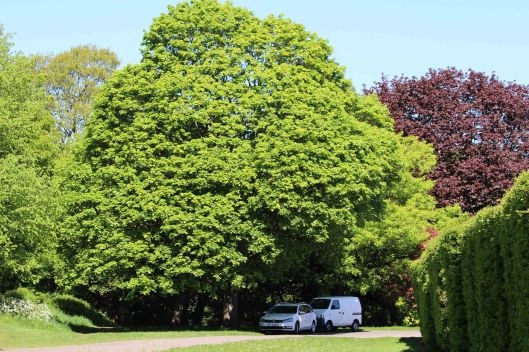
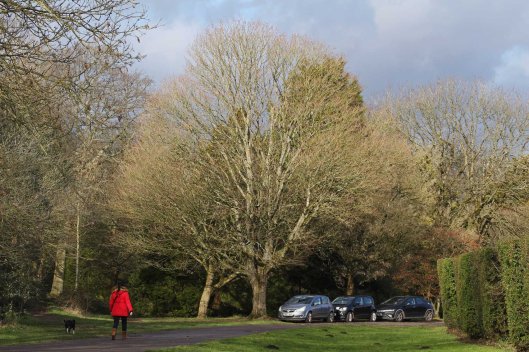
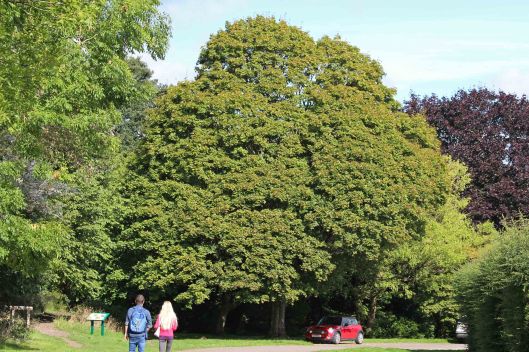
I expected my tree, this magnificent Acer pictum aka Acer mono, to be looking a little autumnal when I visited it in Cardiff’s Bute Park on Friday, but no.

180909 acer mono (1)

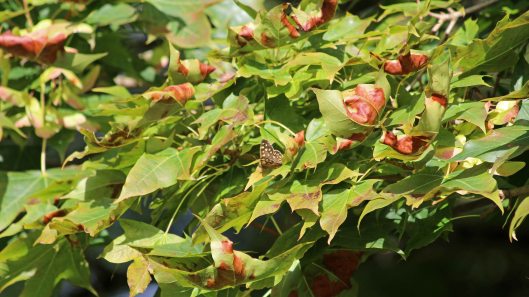
There were leaves that almost looked burnt, were dry and curling up, but that looked more like a hangover from the several weeks of drought and high temperatures we had in July and August, rather than the slow changing of colour you’d expect to see during autumn.

180909 acer mono (2)

Spot the Speckled wood butterfly perched high in the canopy – one of two I saw up there.

180909 acer mono (3)

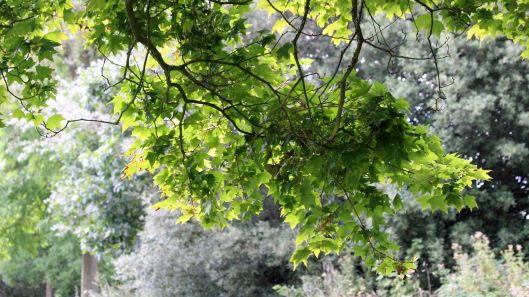
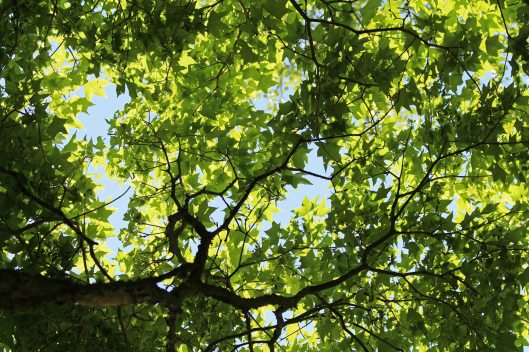
Most of the foliage was still looking lush and vibrant and very green.

180909 acer mono (4)
180909 acer mono (5)

180909 acer mono (6)

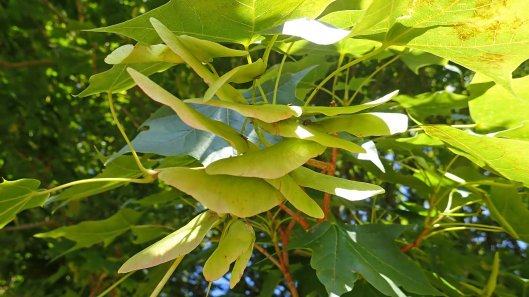
Though a few lay scattered beneath the tree, most of its seeds were also still attached. I brought a couple of seed pods home, thinking to look at the seeds inside them. It wasn’t until I checked them later that I realised all the seeds had burst out of their pods. Next time …

180909 acer mono (7)
180909 acer mono (8)
Like Loading...

I’m following a tree: July 2018

08 Sunday Jul 2018

Posted by sconzani in nature, parks, trees

≈ 5 Comments

Tags

#treefollowing, Acer mono, Acer pictum, Bute Park, I'm following a tree

I paid a visit to Mono, my tree, yesterday and was slightly surprised but much relieved to see it didn’t appear to be suffering any ill effects from the continued heatwave and drought we’re having here in south Wales and, indeed, throughout much of Britain. I guess the tree has very deep roots and will also benefit from the shelter of the trees around it.

180708 tree following (1).jpg

I was certainly enjoying the shelter its canopy afforded me from the fierce sunshine.

180708 tree following (4)
180708 tree following (3)

And looking up into its branches, I noticed my tree now has seeds, which means I obviously missed its flowering. Apparently, the greenish-yellow flowers appear in April-May in upright clusters.

180708 tree following (2)

180708 tree following (5).jpg

The seeds – actually called samaras – are really winged nuts, of the type that are commonly found on ash and maple trees. Mono’s are between 2 and 3cm long, inclusive of the wing, and are greenish in colour when still hanging on the tree, though those seeds that have already dropped off have dried to a light brown, with their wing-like structure clearly visible. All the better to spread those seeds on the wind when the time is right!

180708 tree following (6).jpg

Like Loading...

A sunbathing Blackbird

07 Saturday Jul 2018

Posted by sconzani in birds, nature

≈ 4 Comments

Tags

bird behaviour, bird sunbathing, birding, birdwatching, blackbird, British birds, Bute Park, sunbathing bird

180707 sunbathing blackbird (3)

I spotted this Blackbird during a wander along the woodland trail in Cardiff’s Bute Park today, and it was concentrating so hard on its sunbathing that it didn’t notice me at first.

180707 sunbathing blackbird (1)

The sun was fierce, which I think accounts for the bird sitting with its mouth open, trying to cool itself down. As for the sunbathing itself, here’s the explanation from the British Trust for Ornithology website:

‘Sunbathing’ is used by some birds as part of their routine feather maintenance and is most commonly seen … in Blackbirds and Robins. The birds invariably adopt a posture in which the body feathers are fluffed up and one or both wings are held out from the body, with feathers spread. It is thought that using the sun in this way does two things. It both helps the preen oil to spread across the feathers and drives parasites out from within the plumage. Some of these parasites feed on the feathers themselves and all are highly specialised, with many only found on a single species of bird.

 180707 sunbathing blackbird (2)

Like Loading...

Ravishing rhoddies

18 Friday May 2018

Posted by sconzani in flowers, nature, parks

≈ Leave a comment

Tags

#FloralFriday, Bute Park, language of flowers, rhoddies, rhododendron

180518 rhododendrons (1)

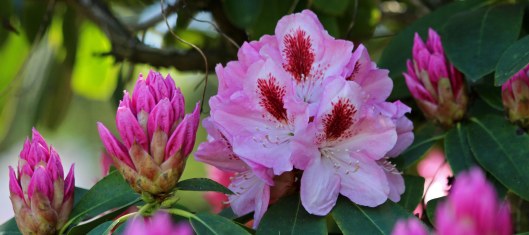
Did you know that in the Victorian era, when flowers were used to convey not-so-hidden meanings, the rhododendron symbolised danger? I really can’t imagine why, except perhaps the danger of being stung by a bee if you put your face too close to the rhoddies’ extravagant blossoms. These beautiful blooms entranced me during a wander through Cardiff’s Bute Park on Monday.

180518 rhododendrons (2)
OLYMPUS DIGITAL CAMERA
180518 rhododendrons (7)
OLYMPUS DIGITAL CAMERA
180518 rhododendrons (10)
Like Loading...

I’m following a tree: April 2018

14 Monday May 2018

Posted by sconzani in nature, trees

≈ 3 Comments

Tags

#treefollowing, Acer mono, Acer pictum, Bute Park, I'm following a tree, tree following

What a difference a month makes!

180514 Acer pictum (1)

With a friend visiting for a week and then a week away on a birding trip, I hadn’t managed to visit Mono, my tree, until the very end of the month. In the few short weeks since my last visit, encouraged by some brilliantly fine weather and a definite rise in daytime temperatures, Mono’s buds have burst open to reveal her splendid summer foliage.

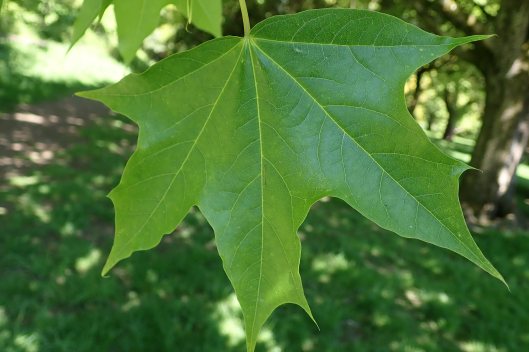
upper side of leaf

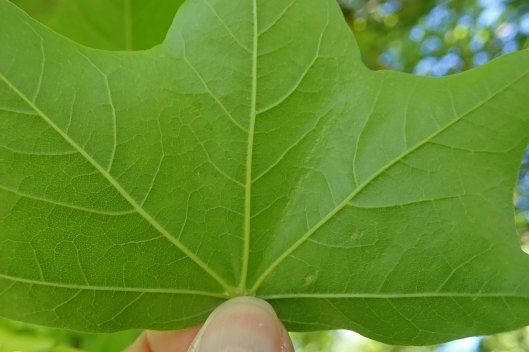
lower side of leaf

The scientific description for her leaves is as follows:

leaves depressed-orbicular; 7-15cm wide, deeply to rather shallowly 5- to 7-lobed, cordate to somewhat truncate at base, usually glabrous on upper side, short-pubescent to glabrous except for the axillary tufts of hairs beneath, the lobes deltoid to lanceolate, entire or with few coarse teeth, acuminate and awn-tipped, the petioles 4-12cm long, glabrous to short-pubescent.

I shall attempt to translate: the leaves are roughly circular, if somewhat heart-shaped, and range in size from 7 to 15 cm across. They are smooth on top, though sometimes have short hairs on the underside. Each leaf has between 5 and 7 projections that are roughly triangular and shaped a bit like the head of a lance. The edges of the leaves can be smooth or slightly jagged, like the teeth of a saw, and the stalk that joins the leaf to the stem ranges from 4 to 12 cms long, is sometimes smooth, sometimes a bit hairy.

OLYMPUS DIGITAL CAMERA

The upshot is that Mono, my tree, an Acer pictum aka Acer mono, is looking absolutely stunning in her lush and vibrant new foliage!

OLYMPUS DIGITAL CAMERA

180514 Acer pictum (2)

Like Loading...

I’m following a tree: March 2018

12 Thursday Apr 2018

Posted by sconzani in autumn, nature, trees

≈ 7 Comments

Tags

#treefollowing, Acer mono, Acer pictum, autumn colour, Bute Park, I'm following a tree, tree following

I think, like much of Britain’s flora and fauna (and its human population), my tree is suffering from the late arrival of warmer spring weather as not much has changed with it during March: the leaf buds haven’t developed much further, no leaves have burst open, and it’s still looking very skeletal. Warmer temperatures are forecast for next week so, fingers crossed, that gives everything a kick-start.

In the meantime, I thought I would give you a little taste of the delights to come later in the year. While I don’t have any photos of my tree in summer green, I do have a photo, taken in October 2015, of this incredible Acer pictum (Acer mono) resplendent in its glorious autumn finery. Something to look forward to, for sure!

180412 Acer pictum in autumn

Like Loading...

I’m following a tree: February 2018

13 Tuesday Mar 2018

Posted by sconzani in nature, parks, trees

≈ 9 Comments

Tags

Acer mono, Acer pictum, Bute Park, I'm following a tree, Mono maple, tree following

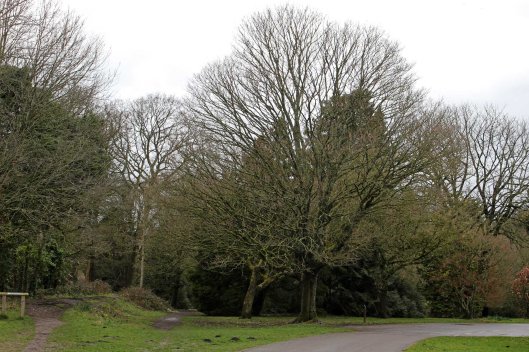
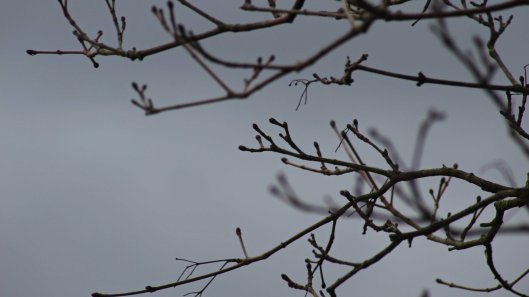
I went to visit Mono, my tree, an Acer pictum, twice during February, both times on grey wintery rainy days so it’s not looking at its most attractive in my photos. But that did mean I wasn’t distracted by its foliage and instead had a good look at the tree’s structure.
180313 acer pictum (1)

As you can see, Mono has its roots firmly planted in the ground. It stands right next to a tarmac roadway but, luckily, that is only used by park vehicles and employees, and their driving and parking nearby doesn’t appear to have affected the tree. At the moment the grass around its base is somewhat sparse but that may change as the weather warms.

180313 acer pictum (2)
180313 acer pictum (3)

180313 acer pictum (4)

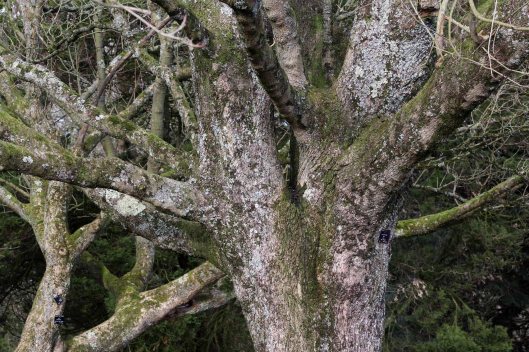
Mono’s trunk is thick and solid. It’s difficult to see the trunk’s texture as most of the surface is covered in lichens, mosses, ferns and liverworts – I’ll look at those in more detail in a future monthly post. The trunk is straight to about four feet, perhaps more, then, rather than maintain a single main trunk, it branches out into a multitude of thick and thin trunks, branches, and twigs.

180313 acer pictum (5)
180313 acer pictum (6)
180313 acer pictum (7)
180313 acer pictum (8)

I’m not sure what the smallest twiglets are that you can in these photos – perhaps the remnants of last year’s flowers / fruit. We shall have to wait and see. There are no leaves yet, though the buds are thick, with a slightly purplish hue, and look near to bursting.
180313 acer pictum (9)

180313 acer pictum (10)
180313 acer pictum (11)

Mono is, I think, a favourite of the local birds, of which there are many. While I was surveying the tree and taking my photos, a Robin serenaded me loudly – though, in truth, it was more likely to be advertising itself to any potential lady friends and announcing to all and sundry that this was its territory / tree. A Goldcrest was also dotting about, foraging for the tiniest of insects – these little birds are never still, hence my lousy photo of it.

180313 acer pictum (13)
180313 acer pictum (12)

After a recent blast of extreme cold and snow, the weather now seems to be warming towards spring so it will be interesting to see what changes March will bring to my beautiful tree.

Like Loading...

I’m following a tree: January 2018

08 Thursday Feb 2018

Posted by sconzani in nature, trees

≈ 11 Comments

Tags

#treefollowing, Acer mono, Acer pictum, Bute Park, Korean maple, Mono maple, Painted maple, tree following

If I hadn’t decided to keep the title of my 2018 tree-following blogs fairly simple, I would probably have titled this post ‘The mysterious case of the tree with the confused identity’!

The tag on the tree, which is growing in Cardiff’s Bute Park, names it Mono maple (Acer mono). That seems fairly straight forward but, when I checked it on the Cardiff Parks website, I found it labelled Painted maple (with Mono as an alternative) and its scientific name listed as Acer pictum. So then I looked the tree up in the Cardiff Council Horticultural Database, where its common name is given as Korean maple and its scientific name as Acer pictum (a.k.a. Acer mono). So then I went to The Plant List, which is meant to be the definitive list: there I was informed that Acer pictum is the accepted name and Acer mono is a synonym.

180208 Mono maple (1)

And then, after a bit more searching, I found an extremely helpful blog post from the JC Raulston Arboretum at North Carolina State University, where they use the common name Painted maple and explain its scientific name as follows:

It was first described in western literature by the Swedish botanist Karl von Thunberg in 1784 but was widely known as Acer mono after it was introduced to the west in the 1880s. Its name continues to cause confusion with some authorities using A. pictum to cover the entire species while other botanists break it down into several subspecies including A. pictum subsp. mono.

180208 Mono maple (2)
180208 Mono maple (3)

And, in response to a question from a reader:

… many taxonomists disagree on the name of this maple. According to van Gelderen, they should all be Acer mono since he contends that Acer pictum is an invalid name. In any case, there is much disagreement over whether they constitute different varieties or subspecies or are just part of a large very variable species. A. p. subsp. pictum has short hairs on the back side of the leaf, while A. p. subsp. mono has no hairs on the abaxial surface.

180208 Mono maple (4)

As even the experts can’t agree, for the twelve months that I will be following this magnificent tree, I am simple going to call it Mono. More next month …

Why not join the tree following community. You can find out more here.

Like Loading...

Signs of spring: snowdrops

21 Sunday Jan 2018

Posted by sconzani in flowers, nature, plants, seasons, spring, wildflowers

≈ 6 Comments

Tags

Bute Park, signs of spring, snowdrop, spring flowers

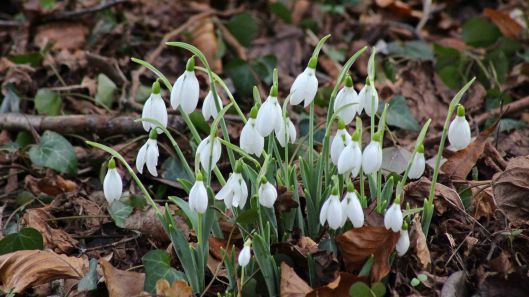
During my walk in Bute Park a few days ago, I saw my first signs of spring. And, though I love winter – as I love each of the seasons for the differences they offer – still, it is always heart-warming, when the days are short and cold and often grey, to see small signs, like these snowdrops, of the earth’s re-awakening.

180121 snowdrops

Like Loading...

Twitching a Firecrest

20 Saturday Jan 2018

Posted by sconzani in birds, nature, parks

≈ 2 Comments

Tags

birding, birdwatching, British birds, Bute Park, Firecrest, Regulus ignicapillus

I don’t consider myself a twitcher – by which I mean one of those obsessives who cares only about adding ticks to lists and accumulating huge numbers of bird sightings and will travel long distances at word of a sighting to get them – but I have set myself a personal challenge of seeing 200 species of birds in Britain in 2018 if at all possible. So, when a relatively scarce bird happens to be seen in a Cardiff park, and that park is a favourite place of mine for a walk, then, of course, I’m going to go for a look.

180120 Firecrest (1)
180120 Firecrest (2)

The bird is a Firecrest (Regulus ignicapillus), cousin to the Goldcrest I blogged about a couple of days ago, only ever so slightly bigger and an equally elusive little bush flitter that is currently enjoying the bushes alongside the River Taff in Bute Park. It was first sighted by a local birder, further up the Taff, on 4 January, and I did go looking then. I couldn’t find in that day – but I did enjoy a delightful walk along the riverside trail.

180120 Firecrest (5)

Then, on 11 January, the bird – presumably the same one, as they are not very common hereabouts – was spotted further down the river, almost in the heart of Cardiff, by a local RSPB staffer out for a lunchtime run. On Thursday I went for a look and was really lucky to meet two other birders who already had the bird in their sights (when I passed by again later, on my way to the train after a long walk in the park, the bird had temporarily disappeared so I was really glad I’d seen it earlier). Typically, this little Firecrest wasn’t still for an instant and the bushes it favoured meant the light was not great for photographs but it was a real treat to see and to watch its insect-catching antics.

180120 Firecrest (3)
180120 Firecrest (4)
Like Loading...
← Older posts
Newer posts →

About me

sconzani

sconzani

I'm a writer and photographer; researcher and blogger; birder and nature lover; countryside rambler and city strider; volunteer and biodiversity recorder.

View Full Profile →

Follow earthstar on WordPress.com

Enter your email address to follow this blog and receive notifications of new posts by email.

Recent blog posts

  • M is for mite December 18, 2025
  • L is for lepidopteran lifers December 17, 2025
  • K is for Keeled skimmers December 16, 2025
  • J is for Jersey tiger December 15, 2025
  • I is for Ichneumon December 14, 2025

From the archives

COPYRIGHT

Unless otherwise acknowledged, the text and photographs on this blog are my own and are subject to international copyright. Nothing may be downloaded or copied without my permission.

Fellow Earth Stars!

  • Unknown's avatar
  • Unknown's avatar
  • Unknown's avatar
  • Unknown's avatar
  • Unknown's avatar
  • Unknown's avatar
  • Unknown's avatar
  • Unknown's avatar
  • Unknown's avatar
  • Unknown's avatar
  • Unknown's avatar
  • Unknown's avatar
  • Unknown's avatar
  • Unknown's avatar
  • Unknown's avatar
  • Unknown's avatar
  • Unknown's avatar
  • Unknown's avatar
  • Unknown's avatar
  • Unknown's avatar
  • Unknown's avatar
  • Unknown's avatar
  • Unknown's avatar
  • Unknown's avatar
  • Unknown's avatar
  • Unknown's avatar
  • Unknown's avatar
  • Unknown's avatar
  • Unknown's avatar
  • Unknown's avatar
  • Unknown's avatar
  • Unknown's avatar
  • Unknown's avatar
  • Unknown's avatar
  • Unknown's avatar
  • Unknown's avatar
  • Unknown's avatar
  • Unknown's avatar
  • Unknown's avatar
  • Unknown's avatar
  • Unknown's avatar
  • Unknown's avatar
  • Unknown's avatar
  • Unknown's avatar
  • Unknown's avatar
  • Unknown's avatar
  • Unknown's avatar
  • Unknown's avatar
  • Unknown's avatar
  • Unknown's avatar

Blog at WordPress.com.

Privacy & Cookies: This site uses cookies. By continuing to use this website, you agree to their use.
To find out more, including how to control cookies, see here: Cookie Policy
  • Subscribe Subscribed
    • earthstar
    • Join 667 other subscribers
    • Already have a WordPress.com account? Log in now.
    • earthstar
    • Subscribe Subscribed
    • Sign up
    • Log in
    • Report this content
    • View site in Reader
    • Manage subscriptions
    • Collapse this bar
 

Loading Comments...
 

You must be logged in to post a comment.

    %d