• ABOUT
  • BIRDING 2018
  • Birding 2019
  • BLOG POSTS
  • Butterflies 2018
  • Resources

earthstar

~ a celebration of nature

earthstar

Tag Archives: butterfly

Large whites and parasitism, part 2

24 Tuesday Jun 2025

Posted by sconzani in insects

≈ Leave a comment

Tags

British butterflies, butterfly, butterfly pupae, Large white butterfly, Large white pupae, parasitic wasp, Pteromalus puparum, wasp parasitising Large white pupae, White butterfly pupal parasitoid wasp

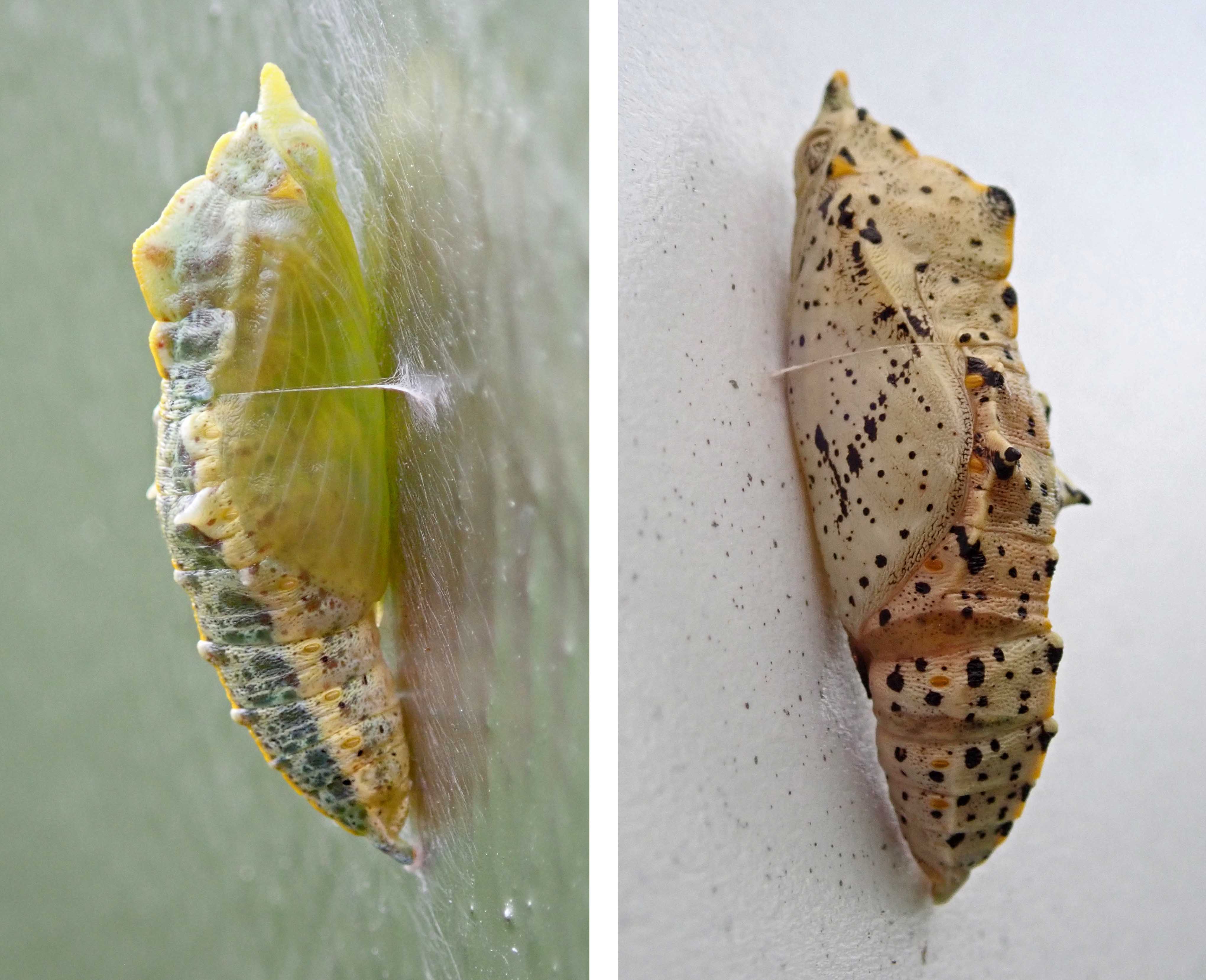
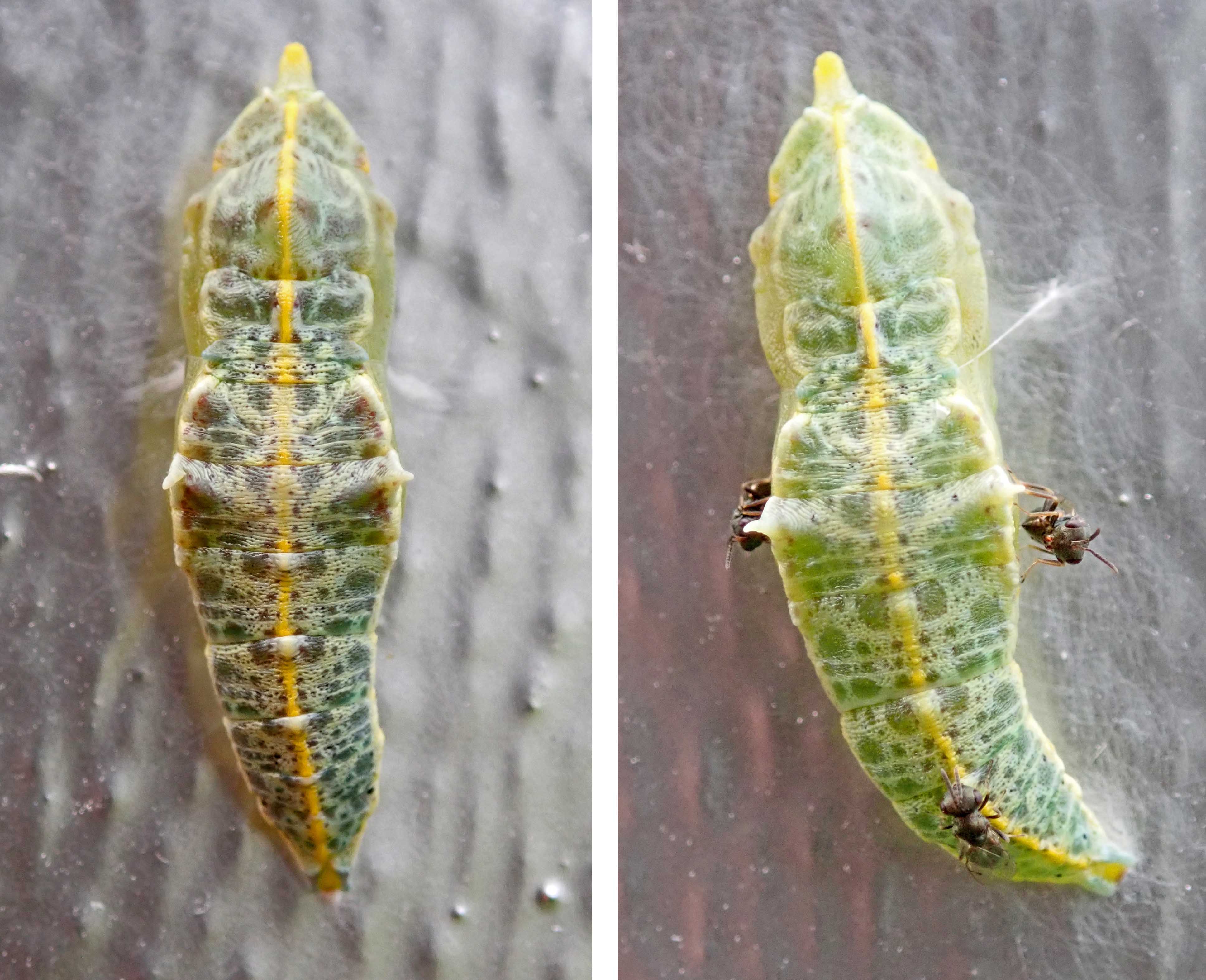
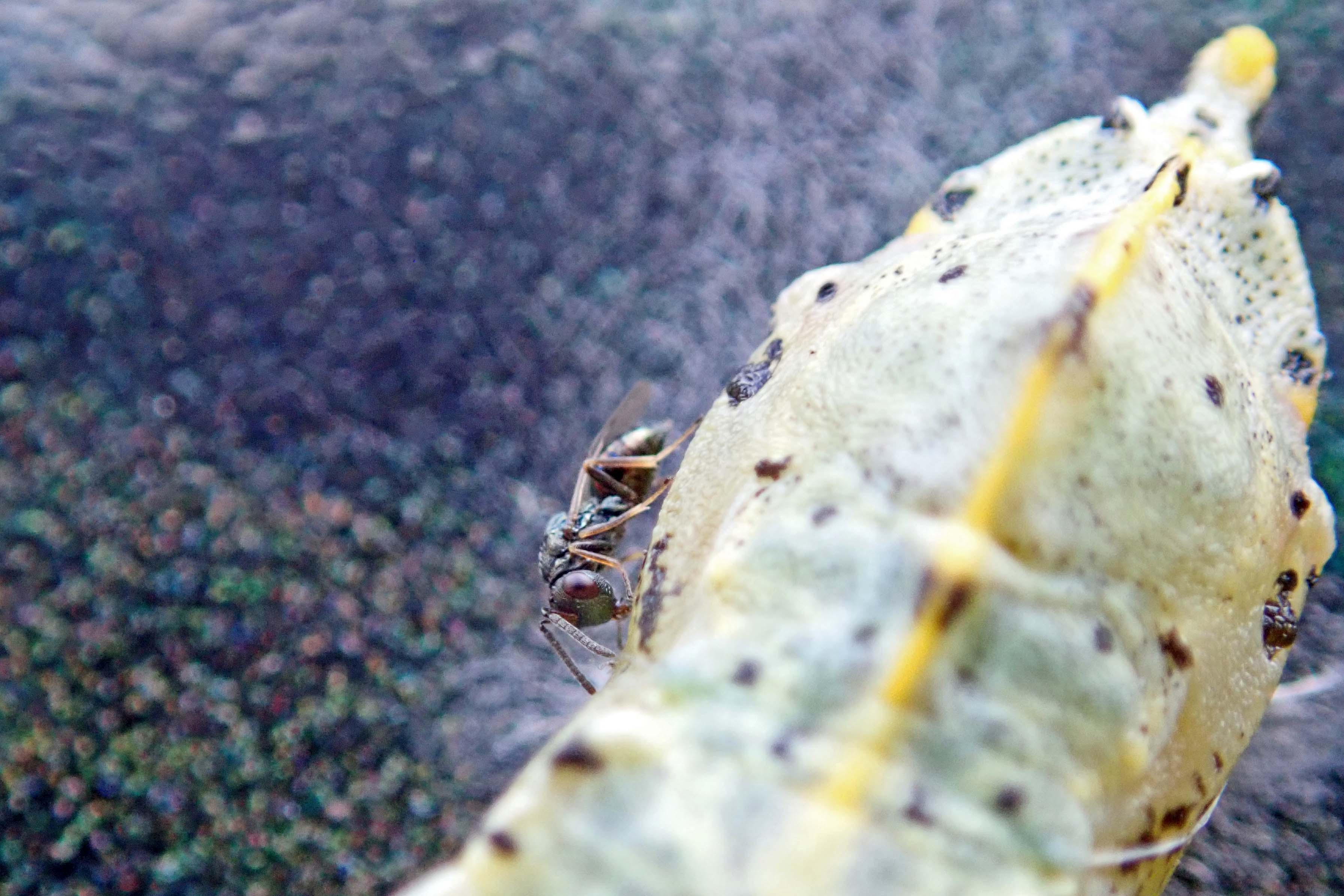
A week after my sighting of Large white butterfly larvae that had been parasitised by wasps (see yesterday’s blog post) I returned to the same location to see what might have changed during that time and was surprised to see six pupae, beautiful sculptural objects whose markings varied depending on how long it was since they had pupated. These can’t have been the parasitised larvae I don’t think, so there must have been a large number of larvae munching unnoticed in the grassy area below the signage they were on.

This time, as well as these pupae, a few parasitised larvae and a few caterpillars that looked normal but may still have had wasp larvae in their bodies, there was a new species of parasitic wasp in residence. They looked completely different to the wasp I’d seen the previous week and, rather than the larvae, these tiny wasps were all congregating around the Large white pupae.

As usual, I took a lot of photos and, when I got home, set about researching the possibilities. This time, my guide book offered no assistance but googling produced one probable answer. There exists a wasp that is actually named the White butterfly pupal parasitoid wasp, scientific name Pteromalus puparum, which seems the likely culprit, though this hasn’t yet been confirmed by any experts. I’m intending to revisit the site to see what’s happened while I’ve been away on my little holiday.

Like Loading...

The Marbled white and the Skylark

21 Saturday Jun 2025

Posted by sconzani in birds, insects

≈ 4 Comments

Tags

birding, birdwatching, British birds, British butterflies, butterflies in Tout Quarry, butterfly, Isle of Portland butterflies, Marbled white, Skylark, Tout Quarry

Today’s blog title puts me in mind of one of Aesop’s fables. I’m sure there was one where the butterfly was tired and asked the bird if it could ride on its back but the bird ended up eating it? Just kidding! Before I sign off from my blogs about my Weymouth trip I just wanted to share two more random moments …

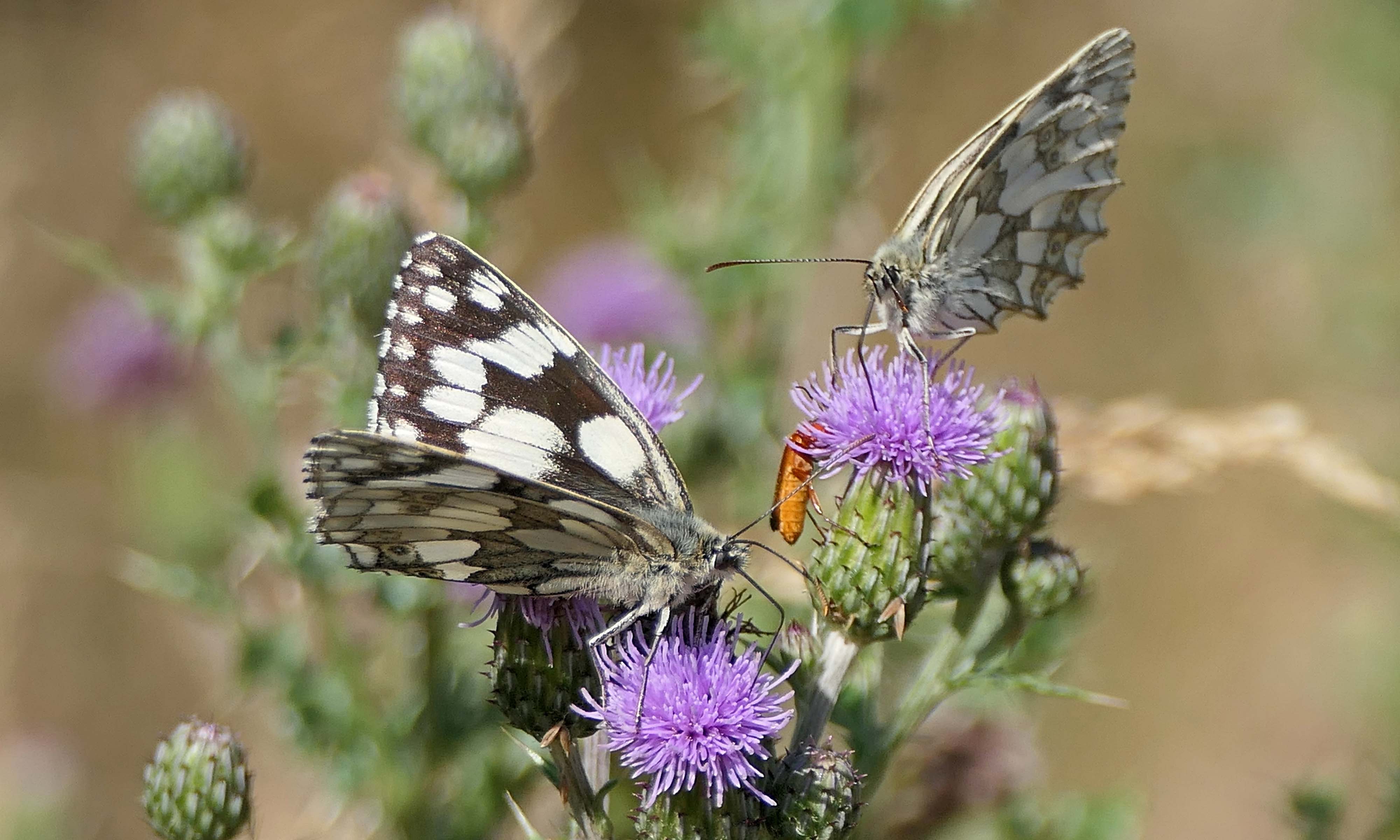
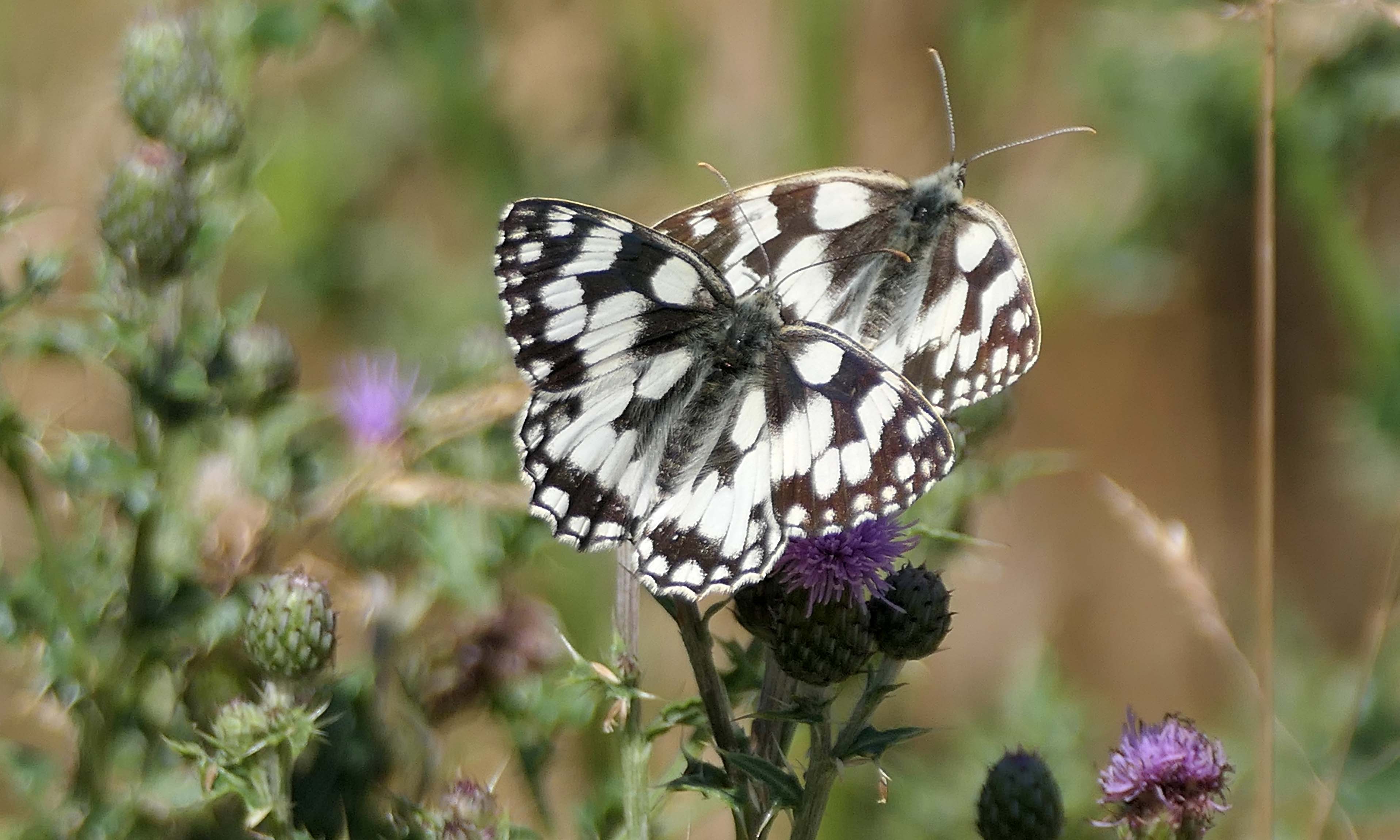
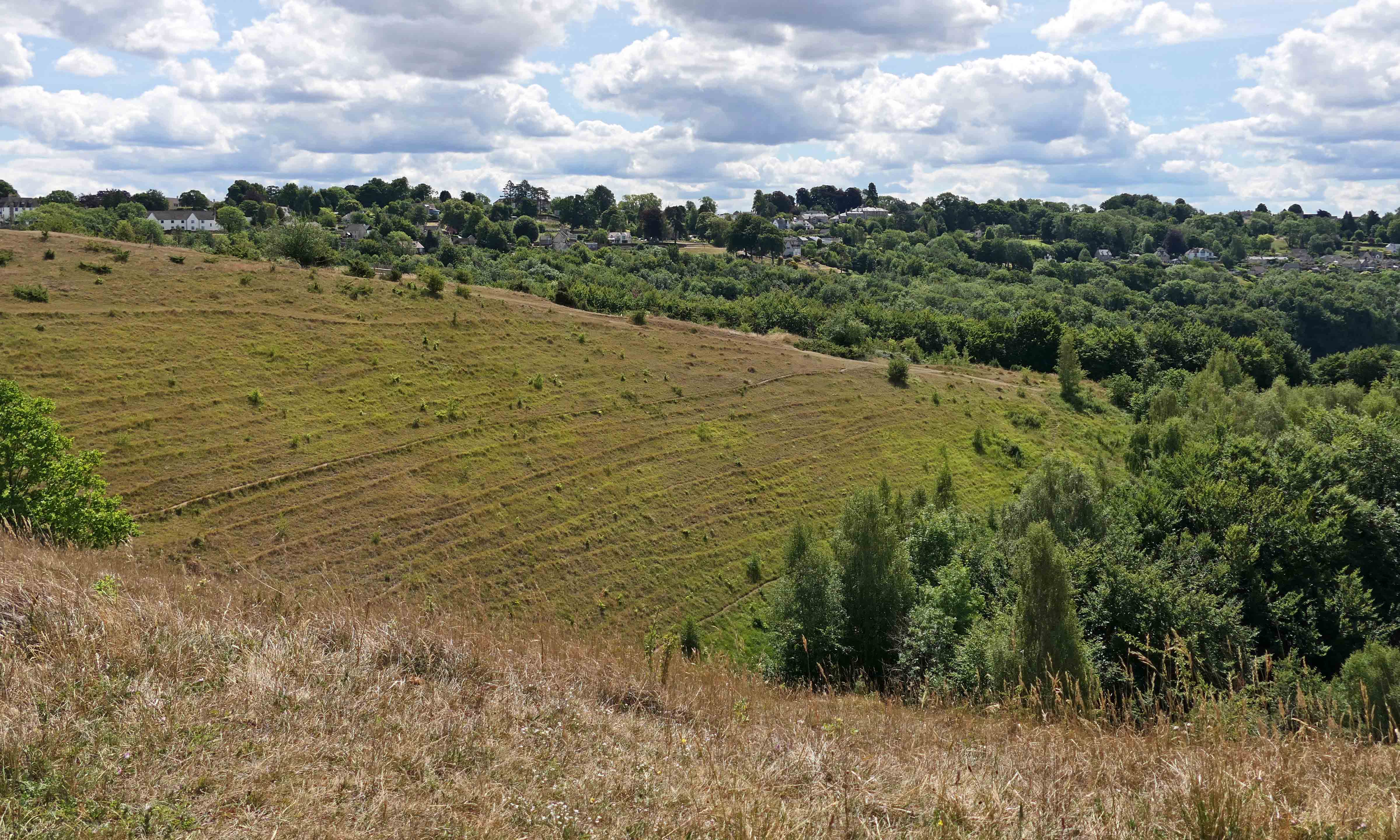
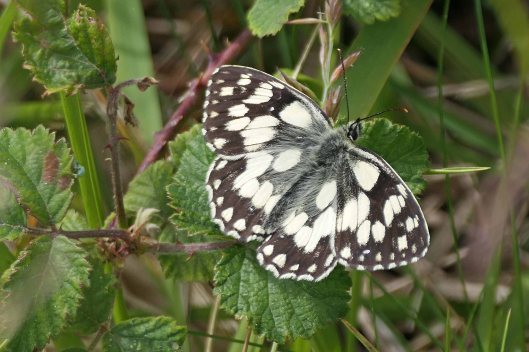
The Marbled white butterfly (Melanargia galathea), though common in many parts of Britain, is rarely seen in my part of coastal south Wales, so it was a special treat to see three on the wing in Weymouth. The first was a distant blur in a field in the Wildlife Trust reserve Lorton Meadows, an area that looked like it would have good potential for butterflies and wildflowers if it wasn’t for the excessive number of off-lead dogs being allowed to roam everywhere, even into the one dragonfly pond. Fortunately, Portland’s Tout Quarry came up trumps again, and I saw two more Marbled whites there, including this obliging beauty.

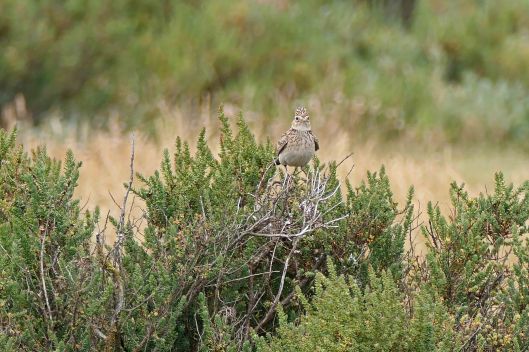
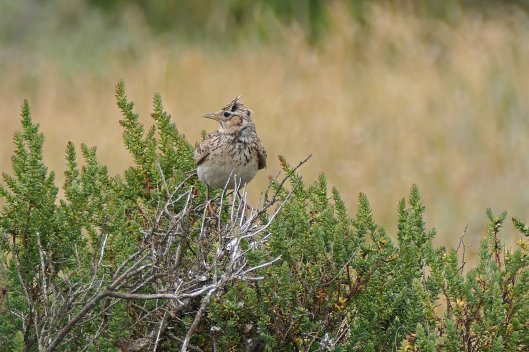
Seeing this stunning Skylark up close was another of this trip’s special moments. I was walking back from Portland to Weymouth and had almost reached the information centre at Chesil Beach when I heard Skylark song in front of me. I searched the sky for a couple of minutes before realising that the bird was, in fact, sitting on a bush adjacent to the track directly ahead of me.

Such a singing spot seemed odd but I wondered if there might be a nest in the scrubby area I was walking through and so this male was trying to distract me from going near that. Though I had never intended to move off the path, its tactic certainly focused my attention, and I grabbed a few photos before walking onward.

Like Loading...

Lifer: Lulworth skipper

16 Monday Jun 2025

Posted by sconzani in insects

≈ 2 Comments

Tags

British butterflies, British skippers, butterfly, Isle of Portland butterflies, Lulworth skipper, summer butterflies, Thymelicus acteon, Tout Quarry

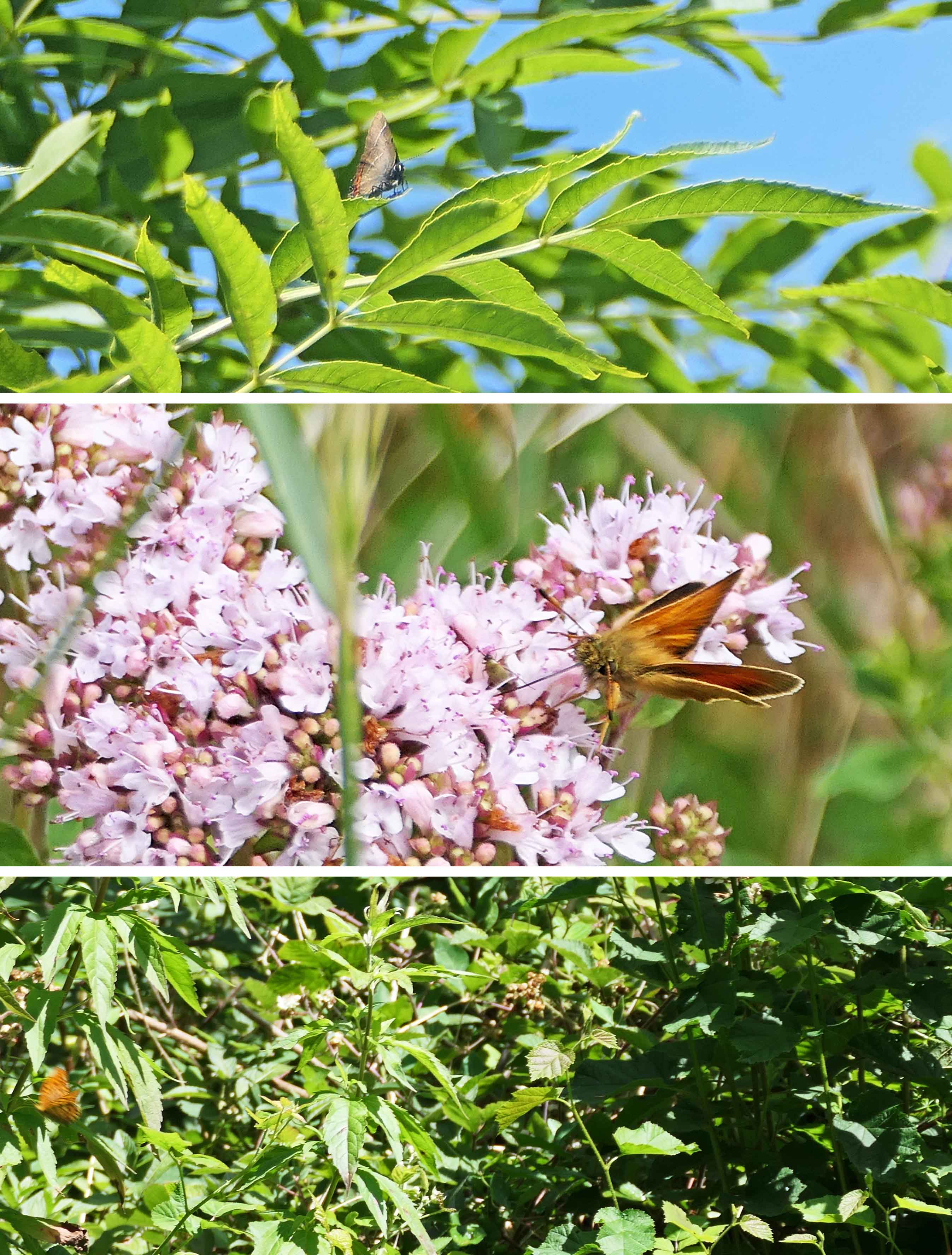
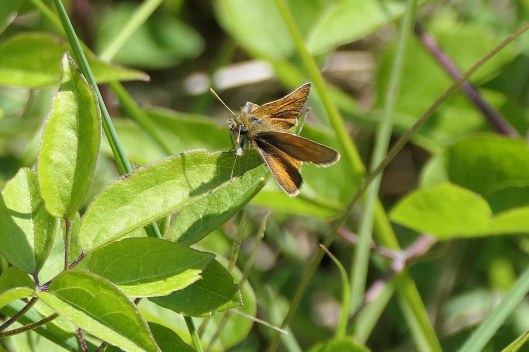
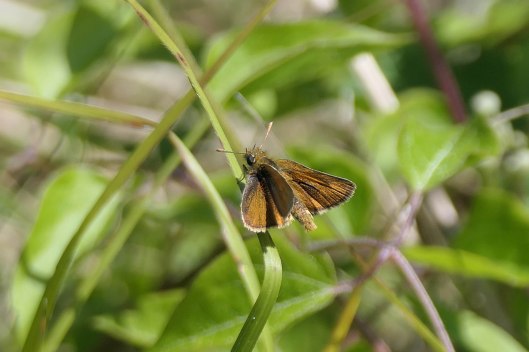
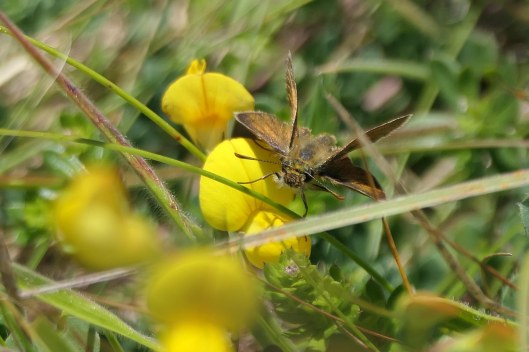
This was another new-to-me butterfly, the Lulworth skipper (Thymelicus acteon), and this was the butterfly that I really hoped to see during my visit to Weymouth. Clearly, I was not disappointed.

This was another find in the sculpture park that is Tout Quarry on the Isle of Portland, and I saw my first Lulworth skipper almost as soon as I arrived. At first glance, they could easily be mistaken for Small skippers, but Lulworths are slightly smaller and generally darker, often turning an olive-brown colour as they age. The females also have a series of golden marks that form a notable circle on their wings, though that didn’t help me. As is common amongst butterfly species, the males emerge first, and I saw no females.

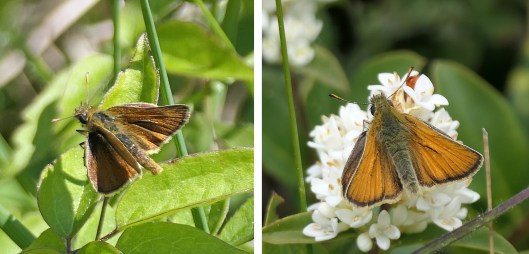
However, by sheer good luck, I also spotted my first Small skipper of the year as I explored Tout Quarry, which proved a very good comparison for the Lulworths I was seeing. I’ve included a photo of the two species below; this is not precise as to their size relationship but does, hopefully, give some idea of their colour differences (Lulworth on the left, Small skipper on the right).

The Lulworth skipper is named after the Dorset town of Lulworth, where it was first found in 1832. Though these butterflies have expended their range a little in the intervening 190 years, they are still only found in locations along the south Dorset coast. I had expected to have to catch a bus to Lulworth until I read the butterflies could be found on Portland, and I booked my little break away as soon as I heard they were on the wing. So, it was a real treat to find them so quickly and easily, and then to spend perhaps 90 minutes in the quarry, enjoying all the butterfly species, the local plants, and, yes, I did also look at the stone sculptures.

Like Loading...

Lifer: Silver-studded blue

14 Saturday Jun 2025

Posted by sconzani in insects

≈ Leave a comment

Tags

British butterflies, butterfly, Dorset butterflies, Isle of Portland butterflies, Plebejus argus, Silver-studded blue, Tout Quarry

I’ve just returned from four wonderful nights in Weymouth, on England’s south coast, my days full of walking and wildlife. I may see a lot of wildlife where I live but part of the reason for my recent house move was so that I could afford to have a few short breaks away to explore new areas and see different wildlife while I still have the energy and mobility to do that, and also while being as low-carbon as possible in the process, of course, so travelling by train and/or bus and with a lot of walking as well. So, there will be a few blogs in the next week or so, covering some of the things I saw while away.

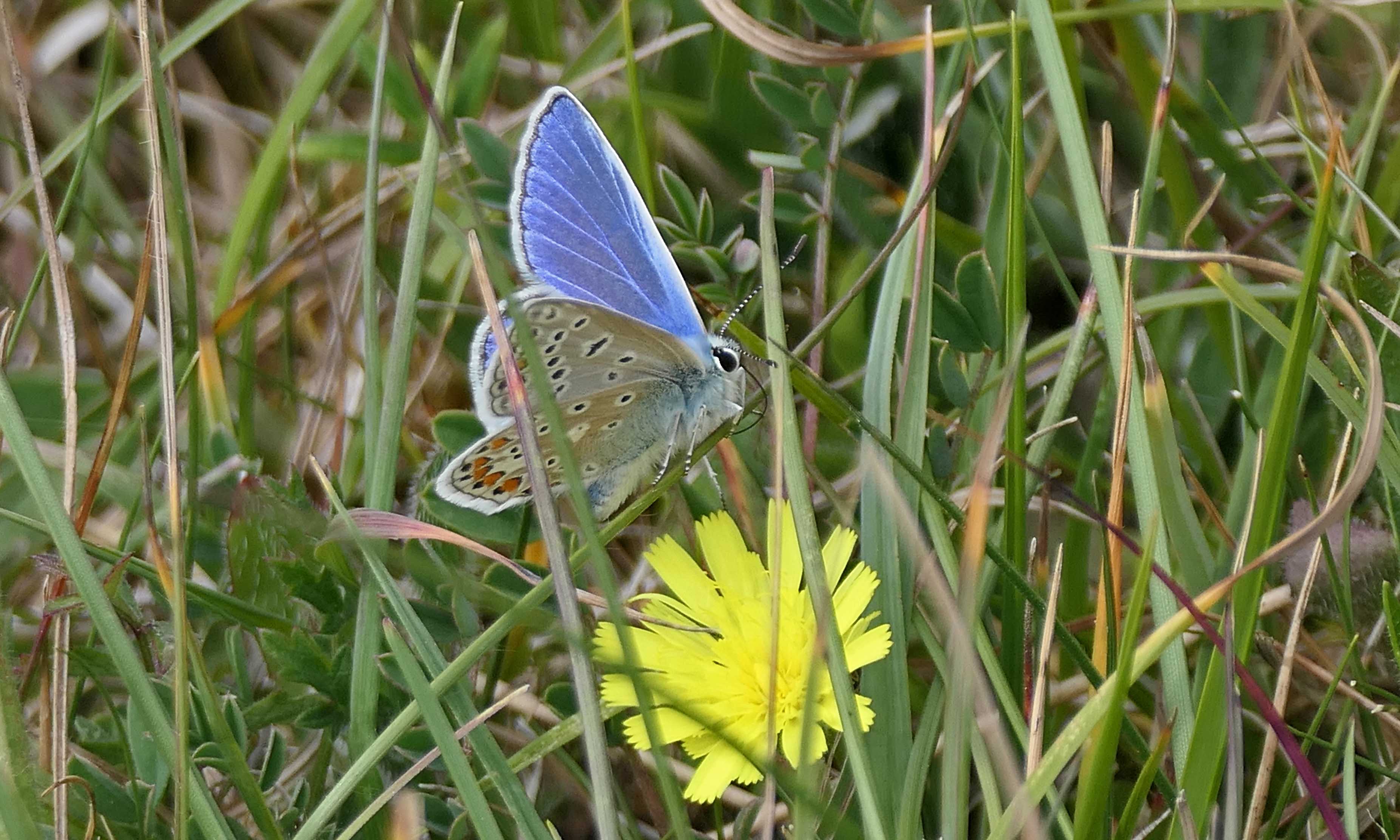
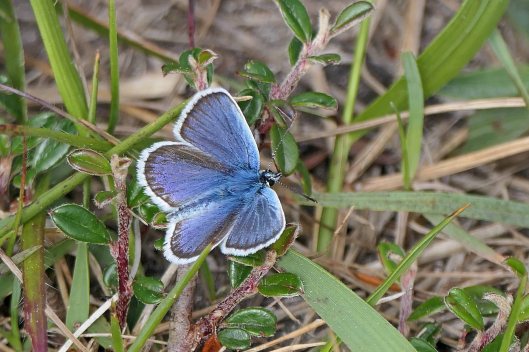
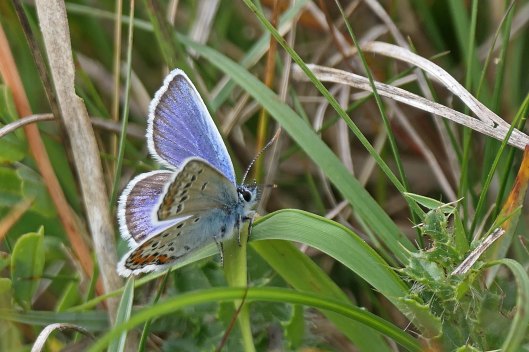
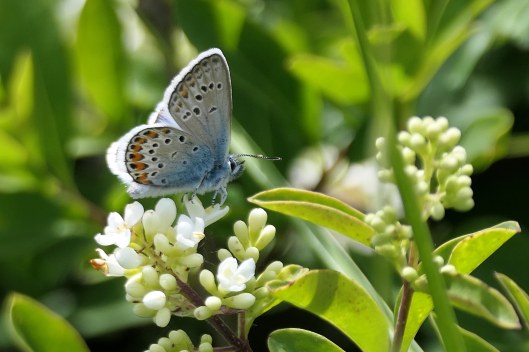
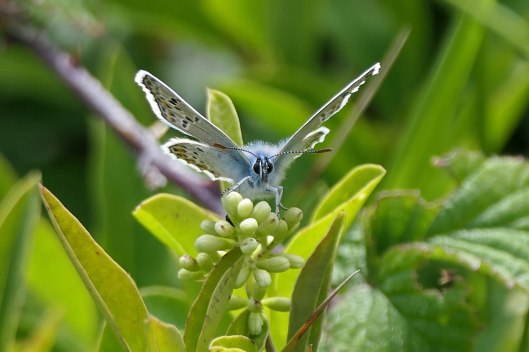
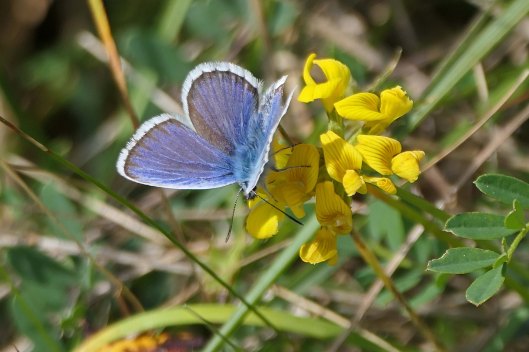
First up, in an old disused quarry on the Isle of Portland, were my first ever Silver-studded blue butterflies (Plebejus argus). The ‘silver-studded’ part of the name comes from the way the light is reflected off the light blue scales on the underside of the adults’ hindwings, making them shimmer like silver. And the ‘argus‘ epithet in its scientific name is a nod to the multi-eyed shepherd of Greek mythology, a reference to the spots on the undersides of the wings.

Silver-studded blues are rare and only seen in a few isolated areas around the southern coast of England, in Pembrokeshire and around the Great Orme in Wales, and in a couple of coastal locations in Norfolk and Suffolk. From those locations, you can perhaps guess that they prefer heathland, sand-dune systems and limestone grassland, in particular sheltered sunny spots where their companions, the black Lasius ant species, thrive. As is seen in several butterfly species, ants provide the butterflies with protection from insect predators throughout their life cycle.

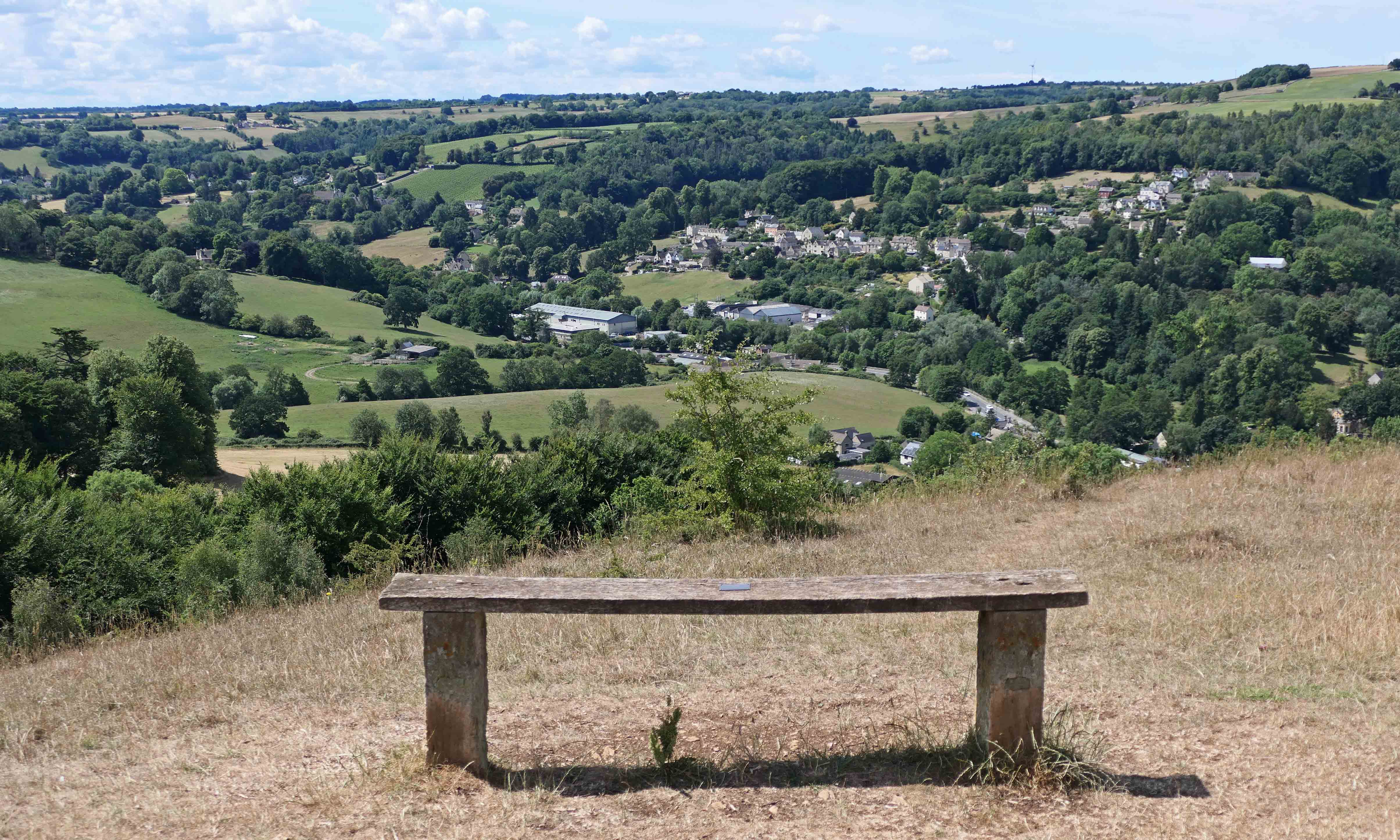
Tout quarry provides the perfect environment for the Silver-studded blues. Quarrying has hollowed out large areas of ground, making it a sun trap and leaving stony areas where specialist wildflower species have managed to seed and flourish, though the vegetation does have to be managed to ensure the more aggressive plant species don’t overwhelm large areas of ground.

I was extremely lucky with the timing of my trip as these butterflies had only just emerged in the few days prior to my arrival, and that’s why I only saw the vibrant blue male butterflies; the females are brown on both the upper- and undersides of their wings. To see them is the perfect incentive for a return trip!

Like Loading...

Grassland pearls

07 Saturday Jun 2025

Posted by sconzani in insects

≈ Leave a comment

Tags

Aberbargoed Grasslands, Boloria selene, British butterflies, British fritillaries, butterfly, fritillaries, fritillary butterflies, Small Pearl-bordered Fritillary

Wednesday’s weather wasn’t the best for trying to find butterflies – a constant westerly wind was keeping the temperatures low even when the sun did manage to peak out from behind the constant parade of big clouds rolling through, but my friend Shar’s optimism proved well founded.

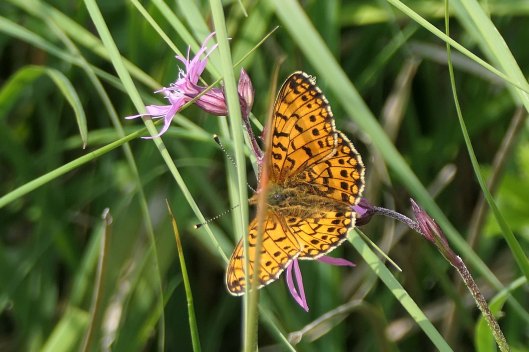
Though even her sharp eyes didn’t manage to spot any Marsh fritillaries (as they seem to have emerged early everywhere this year, we were probably too late for them at this site), we did find a few gorgeous Small pearl-bordered fritillaries (Boloria selene), the species I was really hoping to see that day. Initially, we thought we had two but on checking my photos at home later, I realised from the wing markings that we’d actually seen three.

As usual, we were conducting our butterfly hunt in the habitat most favoured by these fritillaries, the damp grasslands of the Aberbargoed Grasslands National Nature Reserve, where the butterflies particularly enjoy flowers like common violets and bluebells, Marsh thistles and Ragged robin. The reserve is also home to a large population of orchids, both Common and Heath spotted-orchids, as well as Cross-leaved heath, Tormentil, Devil’s-bit scabious and Knapweed, amongst other wildflower species, making a wander around its fields a pleasure even when you don’t see very many butterflies.

Like Loading...

A skipper surprise

23 Friday May 2025

Posted by sconzani in insects

≈ Leave a comment

Tags

British butterflies, butterfly, early emergence, Large skipper, skipper butterflies

You could’ve knocked me over with the draft from a butterfly’s wing when this gorgeous creature flitted up from the foliage to greet me as I walked the coastal path on Tuesday. Large skippers don’t usually appear locally until early June but our lengthy spell of warm dry weather is having a very obvious effect on insect emergence times this year.

Like Loading...

Refuelling

15 Thursday May 2025

Posted by sconzani in insects, spring

≈ Leave a comment

Tags

Brimstone, Brimstone and Red campion, British butterflies, butterfly, Red campion

I feel a bit like these beautiful Brimstones, needing to refuel to restore my energy after yesterday’s house move. My surroundings are still chaotic but I made sure to get out for a short time today because walking in Nature is how I heal, how I find peace amongst the madness, how I refuel my mind and my spirit.

The image above shows a female Brimstone, which is paler than the more yellowy male in the photo below. Red campion was their flower of choice this day.

Like Loading...

A feast for the eyes

09 Friday May 2025

Posted by sconzani in insects

≈ Leave a comment

Tags

British butterflies, butterfly, fritillary butterflies, Marsh fritillary

This was the truly magical sight that awaited me when I arrived at Lavernock Nature Reserve last Tuesday morning.

As I walked the footpaths across the fields, more Marsh fritillaries than I’ve ever seen before were flitting up briefly from their perches before settling back down again in the grass.

I’d heard last Sunday that the first fritillaries of the year had been spotted, which is around 10 days earlier than any previous year. That seems to be the norm with butterflies this year, with our warmer than usual and very dry Spring weather.

These Marsh fritillaries were illegally introduced to Lavernock back in 2022, a practice that seems to be increasing across Britain. Whether they will continue to thrive is unknown but, in the meantime, and despite the manner of their arrival and their unknown provenance, they are certainly a joy to behold.

Like Loading...

Butterfly catch up

02 Friday May 2025

Posted by sconzani in insects, spring

≈ 2 Comments

Tags

British butterflies, butterfly, Common blue, Common blue butterfly, Dingy Skipper, Large white, Small copper, Spring colour

Just as it’s always magical to see my first butterfly of the year, so is it just as special each time I see the first of each new species. These are the four most recent beauties that have made me smile.

On 25 April my first Large white of 2025 flitted along the footpath next to me, sipped on a Dandelion, then settled on a Bramble leaf long enough for me to photograph.

The next butterfly species to appear for me locally, on 27 April, was this lovely Dingy skipper at an unexpected location – a bonus!

The last few days of hotter than usual temperatures have presumably triggered the early emergence of some species. This stunning male Common blue popped up on 28 April, five days earlier than my previous earliest date.

And, this very morning, eight days earlier than I’ve ever seen one before, I caught a flash of brilliant orange and there sat this gorgeous Small copper, always a treat to see.

Like Loading...

In long-term decline

24 Thursday Apr 2025

Posted by sconzani in insects

≈ Leave a comment

Tags

British butterflies, butterfly, declining butterfly populations, Green-veined white, Green-veined white butterfly, Pieris napi

The UK Butterfly Monitoring Scheme recently released its latest report on how our butterflies are faring, and, for the majority of the 58 British butterfly species, the news is not good.

The latest butterfly to emerge in my locale has been the Green-veined white (Pieris napi), which is described by the UKBMS as ‘stable’ but I’m not sure I’d agree with their definition of stable when these are the statistics they list:

Status since 1976 is Stable with a change of -23.1% since monitoring began for this species.
Status over the last 20 years is Stable with a change of -20.8%
Status over the last 10 years is Stable with a change of -35.7%

In fact, on social media, the Head of Science at Butterfly Conservation wrote: ‘One of the big shocks of last year’s UK Butterfly Monitoring Scheme results was that, after its worst year on record in 2024 and a run of six below average years, Green-veined White (Pieris napi) is now in long-term decline.’ This seems a far better summary of the situation. So far, I’ve only seen these two Green-veined whites this year; fingers crossed I manage to see more.

Like Loading...
← Older posts
Newer posts →

About me

sconzani

sconzani

I'm a writer and photographer; researcher and blogger; birder and nature lover; countryside rambler and city strider; volunteer and biodiversity recorder.

View Full Profile →

Follow earthstar on WordPress.com

Enter your email address to follow this blog and receive notifications of new posts by email.

Recent blog posts

  • M is for mite December 18, 2025
  • L is for lepidopteran lifers December 17, 2025
  • K is for Keeled skimmers December 16, 2025
  • J is for Jersey tiger December 15, 2025
  • I is for Ichneumon December 14, 2025

From the archives

COPYRIGHT

Unless otherwise acknowledged, the text and photographs on this blog are my own and are subject to international copyright. Nothing may be downloaded or copied without my permission.

Fellow Earth Stars!

  • Unknown's avatar
  • Unknown's avatar
  • Unknown's avatar
  • Unknown's avatar
  • Unknown's avatar
  • Unknown's avatar
  • Unknown's avatar
  • Unknown's avatar
  • Unknown's avatar
  • Unknown's avatar
  • Unknown's avatar
  • Unknown's avatar
  • Unknown's avatar
  • Unknown's avatar
  • Unknown's avatar
  • Unknown's avatar
  • Unknown's avatar
  • Unknown's avatar
  • Unknown's avatar
  • Unknown's avatar
  • Unknown's avatar
  • Unknown's avatar
  • Unknown's avatar
  • Unknown's avatar
  • Unknown's avatar
  • Unknown's avatar
  • Unknown's avatar
  • Unknown's avatar
  • Unknown's avatar
  • Unknown's avatar
  • Unknown's avatar
  • Unknown's avatar
  • Unknown's avatar
  • Unknown's avatar
  • Unknown's avatar
  • Unknown's avatar
  • Unknown's avatar
  • Unknown's avatar
  • Unknown's avatar
  • Unknown's avatar
  • Unknown's avatar
  • Unknown's avatar
  • Unknown's avatar
  • Unknown's avatar
  • Unknown's avatar
  • Unknown's avatar
  • Unknown's avatar
  • Unknown's avatar
  • Unknown's avatar
  • Unknown's avatar

Blog at WordPress.com.

Privacy & Cookies: This site uses cookies. By continuing to use this website, you agree to their use.
To find out more, including how to control cookies, see here: Cookie Policy
  • Subscribe Subscribed
    • earthstar
    • Join 667 other subscribers
    • Already have a WordPress.com account? Log in now.
    • earthstar
    • Subscribe Subscribed
    • Sign up
    • Log in
    • Report this content
    • View site in Reader
    • Manage subscriptions
    • Collapse this bar
 

Loading Comments...
 

You must be logged in to post a comment.

    %d