• ABOUT
  • BIRDING 2018
  • Birding 2019
  • BLOG POSTS
  • Butterflies 2018
  • Resources

earthstar

~ a celebration of nature

earthstar

Tag Archives: butterfly

Orange-tips

27 Sunday May 2018

Posted by sconzani in insects, nature

≈ Leave a comment

Tags

Anthocharis cardamines, British butterflies, butterfly, Orange-tip, Orange-tip butterfly

The various white butterflies can be difficult to tell apart but the Orange-tips (Anthocharis cardamines) are a little easier to spot. The male sports the orange tips on its wings that give the species its common name and which are, according to the UK Butterflies website, caused by an accumulation of the mustard oils that were ingested when it was a caterpillar.

180527 Orange-tip male

The female Orange-tip doesn’t have those bright wing tips but she does share with the male the equally characteristic mottled green pattern on her underwings.

180527 Orange-tip female.jpg

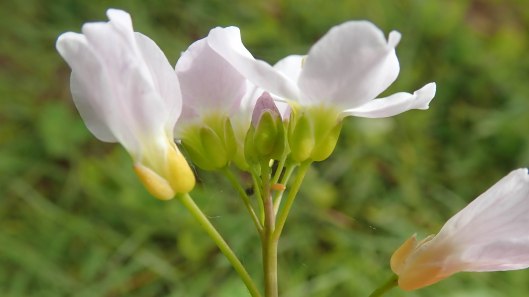
The female lays a single egg – the caterpillars will devour other eggs and fellow caterpillars given the chance, hence the single egg – on one of the preferred larval food plants, their favourites being Cuckooflower (Cardamine pratensis) and Garlic Mustard (Alliaria petiolata). Eggs are white when first laid, changing to orange as they near maturity, a process that takes a week or two.

Newly laid white egg
Maturing orange egg
Maturing orange egg

180527 Orange-tip egg (3)

I haven’t yet found a caterpillar but, in the next week or so, I will be re-checking the places where I found these eggs. If you want to read more about Orange-tips, you can check the Butterfly Conservation website here.

Like Loading...

Wild word: aposematism

25 Wednesday Apr 2018

Posted by sconzani in insects, nature

≈ Leave a comment

Tags

#WildWords, aposematism, butterfly, Peacock, Peacock butterfly, warning coloration, warning patterns, wild words

Aposematism: noun; from the Greek ἀπό apo meaning ‘away’ and σῆμα sema meaning ‘sign’; a term developed in the 19th century, reputedly by Edward Bagnall Poulton (a British evolutionary biologist), for the bright colorations or conspicuous markings that creatures use to warn or repel predators. Typical examples are things like bright yellow frogs or orange-and-black-striped caterpillars, whose colours serve as a warning to potential predators that they taste bad or might even be poisonous, and, butterflies, like the Peacock shown here, with big bold eye-type markings that make them look larger than they really are.

180425 Aposematism Peacock butterfly

Like Loading...

Leps at Combefield Quarry

24 Tuesday Oct 2017

Posted by sconzani in insects, nature

≈ Leave a comment

Tags

British butterflies, butterflies, butterfly, Clouded yellow, Colias croceus, Colias croceus f. helice, Combefield Quarry, Comma, Peacock, Red Admiral

171024 Combefield Quarry

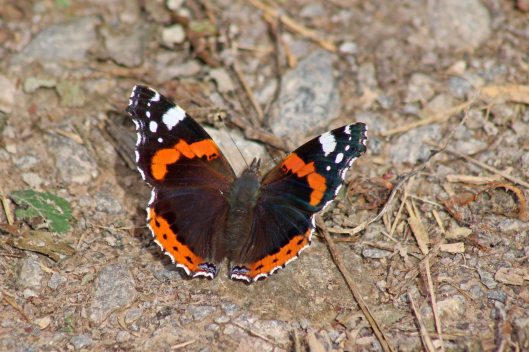
We went for a wander around Combefield Quarry in Portland looking for birds but found butterflies instead. And very nice butterflies they were too, especially considering we are now half way through autumn. There were two Peacocks, a Comma, Speckled woods and Red admirals …

171024 Peacock (1)

171024 Comma
171024 Red admiral

And the icing on the cake was not one but two Clouded yellows (Colias croceus). But wait there’s more … I’ve been told that the paler of these Clouded yellows may well be the helice variety (Colias croceus f. helice), which is something of a rarity. So, we were privileged indeed with our Lepidoptera sightings that day.

171024 Clouded Yellow f. helice
171024 Clouded yellow
Like Loading...

Autumn migration: Red admiral

21 Thursday Sep 2017

Posted by sconzani in insects, nature

≈ 2 Comments

Tags

autumn migration, British butterflies, butterflies, butterflies on migration, butterfly, migrating butterflies, Red Admirable, Red Admiral

170921 Red admiral (3)
170921 Red admiral (1)

During my walk along the coastal path near Penarth earlier this week, I saw more than 20 Red admiral butterflies. Now, it may be that they had gathered in such large numbers in that particular location because the ivy flowers had recently opened and they fancied drinking deeply of their nectar (as did a huge number of bees and hoverflies) but it may also be that they were heading south on their autumn migration to southern Europe and north Africa.

170921 Red admiral (4)

The Red admiral (Vanessa atalanta) was once known as the Red admirable – a bit of a mouthful, which is probably why the name changed – and has a surprisingly ominous history. In Bugs Britannica Richard Mabey reviews the evidence, in various texts and old paintings, and concludes that the Red admiral was once thought to represent sin or temptation:

The flickering band of scarlet on the butterfly’s forewings, vivid against a dark, smoky background, suggests the flames of a smithy – hence its French name, le Vulcain, after Vulcan, the blacksmith of the Gods. But, to Christians, it also suggested the flames of Hell … This surprisingly hellish image of the Red admiral was gradually forgotten during the Enlightenment, when artists started to draw butterflies for their own sake. But perhaps the story of a ‘red butterfly’ said to have been hunted in the north of England and the Borders as a witch is an echo of a previous, more sinister characterisation.

How anyone could imagine something as beautiful as this harmless butterfly could be so malevolent is beyond me!

170921 Red admiral (2)

Like Loading...

Shaped like a fallen leaf

19 Tuesday Sep 2017

Posted by sconzani in insects, nature

≈ 5 Comments

Tags

British butterflies, butterflies, butterflies that hibernate, butterfly, Comma, Comma butterfly, Polygonia c-album

170919 Comma (1)

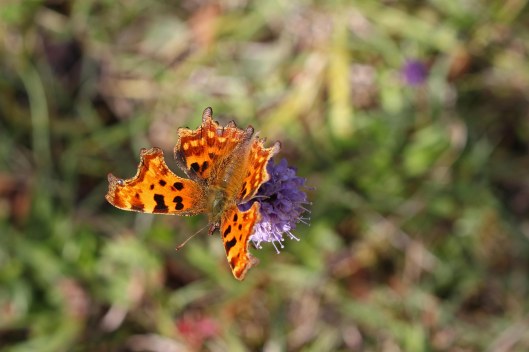
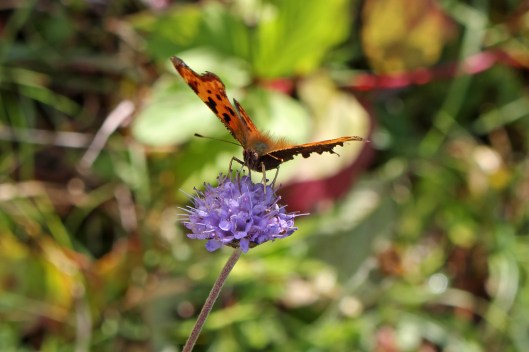
In Fauna Britannica, Stefan Buczacki describes this butterfly’s ragged outline as being the ‘shape of a fallen leaf’ and its colours, too, are quite autumnal. This is the most grammatically correct of Britain’s butterflies, the Comma, Polygonia c-album.

170919 Comma (2)170919 Comma (3)

Though I have no personal experience of this, the Comma is, apparently, one of the three butterflies most likely to be found hibernating in sheds and outhouses – the other two are the Small tortoiseshell and the Peacock. Adult Commas can usually be seen flying between March and September so maybe these ones I’ve seen recently were having their last feeds before looking for a cosy spot to snooze away the cold months of winter. If I had a shed, they’d be most welcome.

170919 Comma (4)

Like Loading...

Small tortoiseshells

13 Wednesday Sep 2017

Posted by sconzani in insects, nature

≈ 4 Comments

Tags

Aglais urticae, British butterflies, butterflies, butterfly, Small tortoiseshell

I’ve just realised that I haven’t shared any photos of Small tortoiseshells (Aglais urticae) this year – how very remiss of me!

170913 Small tortoiseshell (3)

My excuse is that I’ve hardly seen any and, now that I’ve checked my photos, I’ve also realised that I’ve only seen them on three occasions this summer, the first on 21 August and the most recent on the 27th (though on that last date, at Aberthaw, when I was out with my bird group, a total of fifteen were seen).

170913 Small tortoiseshell (1)

It’s still a worry though, as the population of Small tortoiseshells has plummeted in recent years, down 73% since the 1970s according to the Butterfly Conservation website. Speculation about the reasons for such a severe decline vary from pollution and climate change to predation by the grubs of a parasitic fly that’s popped over from Europe and made itself at home, especially in southern Britain. I hope my few sightings this year are not the norm but somehow I doubt it.

170913 Small tortoiseshell (2)

Like Loading...

Butterfly bliss!

20 Sunday Aug 2017

Posted by sconzani in insects, nature

≈ 7 Comments

Tags

British butterflies, butterflies, butterfly, Lycaena phlaeas, Small copper

It’s three weeks since I caught a fleeting glimpse – and shot some very shaky photos – of my first-ever Small copper butterfly (Lycaena phlaeas), and I’ve been keeping an eye out for them wherever I go ever since. Ten days ago, I saw another, briefly, but a man came walking along the path and scared it away just as I was lining up for better images. Then, four days ago, another of these little beauties popped up on a flower right in front of me at Cosmeston and I got some reasonable, though not sharp photos – the wind was howling across the field that day.

170820 Small Copper Cosmeston (1)
170820 Small Copper Cosmeston (2)
170820 Small Copper Cosmeston (3)

And, finally, two days ago, when I was revisiting one of my former haunts, the glorious old meadows near Llanishen Reservoir, I saw first two, then another one Small copper, and these were so busy feasting and ‘interacting’ that I was able to watch them for ages. Butterfly bliss!

170820 Small copper Llanishen (1)
170820 Small copper Llanishen (2)
170820 Small copper Llanishen (3)

170820 Small copper Llanishen (4)

Like Loading...

Clouded yellows

16 Wednesday Aug 2017

Posted by sconzani in insects, nature

≈ 7 Comments

Tags

British butterflies, butterflies, butterfly, Clouded yellow, Colias croceus, Lavernock Nature Reserve

Some days are just good days! On the same day that I finally caught up with the Spotted flycatchers at Cosmeston, I also saw my first Clouded yellow butterflies, and I’d been chasing those for a couple of weeks as well.

170816 Clouded yellow (2)

Colias croceus is primarily an immigrant – it has occasionally been known to overwinter but is usually killed by the cold and damp of British winters – and flies in for the summer months from southern Europe and north Africa. Way back in 1947, there was a huge migration, with numbers estimated at 36,000, but most years the numbers are much less, and this year very few of my butterfly-watching friends have seen any. So, I count myself very privileged indeed to have seen two at Lavernock Nature Reserve last Sunday.

170816 Clouded yellow (3)
170816 Clouded yellow (1)
Like Loading...

A riot of butterflies

06 Sunday Aug 2017

Posted by sconzani in insects, nature, nature photography

≈ 2 Comments

Tags

British butterflies, butterflies, butterfly, Common blue, Meadow Brown, Painted Lady, Red Admiral, Vanessa cardui

The Painted lady (Vanessa cardui) is supposed to be quite a common butterfly but I’d only seen two this year until this morning’s butterfly fest at Cardiff Bay, in a tucked-away spot full of Buddleja, Ragwort, Hemp agrimony and other assorted wildflowers.

170806 Painted lady (3)
170806 Painted lady (2)
170806 Painted lady (1)
170806 Painted lady (4)

The nectar bonanza was being licked up by four Painted ladies, two Red admirals, one Small white, two Meadow browns, and two Common blues. What a riot of colour they made!

170806 Common blue (2)
170806 Common blue (1)
170806 Red admiral
170806 Meadow brown
Like Loading...

A 10 lepidoptera day!

12 Wednesday Jul 2017

Posted by sconzani in insects, nature

≈ 4 Comments

Tags

British butterflies, butterflies, butterfly, Comma, Common blue, Gatekeeper, Large skipper, Meadow Brown, Ringlet, Six-spot burnet, Small skipper, Small white, Speckled wood

It’s Monday. I’ve had a meeting about a forthcoming fungi presentation, followed by a busy morning on the computer and feel I need a blast of fresh air so decide to do one of my local walk circuits, taking in one side of Cardiff Bay and Penarth Marina. And I’m so glad I do ’cause the air is alive with butterflies and moths. They are common enough species but I am amazed and delighted to see such a variety and so many in just a 2-hour walk.

There are Comma (Polygonia c-album), Common blue (Polyommatus icarus), Gatekeeper (Pyronia tithonus), Large skipper (Ochlodes sylvanus), Meadow brown (Maniola jurtina), Ringlet (Aphantopus hyperantus), Six-spot burnet (Zygaena filipendulae), Small skipper (Thymelicus sylvestris), Small white (Pieris rapae), and Speckled wood (Pararge aegeri). This is my idea of heaven!

This slideshow requires JavaScript.

Like Loading...
← Older posts
Newer posts →

About me

sconzani

sconzani

I'm a writer and photographer; researcher and blogger; birder and nature lover; countryside rambler and city strider; volunteer and biodiversity recorder.

View Full Profile →

Follow earthstar on WordPress.com

Enter your email address to follow this blog and receive notifications of new posts by email.

Recent blog posts

  • Beating the gloom March 10, 2026
  • No booming Bittern but … March 9, 2026
  • Danish scurvygrass March 8, 2026
  • Four weeks early March 7, 2026
  • Three shieldbug species March 6, 2026

From the archives

COPYRIGHT

Unless otherwise acknowledged, the text and photographs on this blog are my own and are subject to international copyright. Nothing may be downloaded or copied without my permission.

Fellow Earth Stars!

  • Unknown's avatar
  • Unknown's avatar
  • Unknown's avatar
  • Unknown's avatar
  • Unknown's avatar
  • Unknown's avatar
  • Unknown's avatar
  • Unknown's avatar
  • Unknown's avatar
  • Unknown's avatar
  • Unknown's avatar
  • Unknown's avatar
  • Unknown's avatar
  • Unknown's avatar
  • Unknown's avatar
  • Unknown's avatar
  • Unknown's avatar
  • Unknown's avatar
  • Unknown's avatar
  • Unknown's avatar
  • Unknown's avatar
  • Unknown's avatar
  • Unknown's avatar
  • Unknown's avatar
  • Unknown's avatar
  • Unknown's avatar
  • Unknown's avatar
  • Unknown's avatar
  • Unknown's avatar
  • Unknown's avatar
  • Unknown's avatar
  • Unknown's avatar
  • Unknown's avatar
  • Unknown's avatar
  • Unknown's avatar
  • Unknown's avatar
  • Unknown's avatar
  • Unknown's avatar
  • Unknown's avatar
  • Unknown's avatar
  • Unknown's avatar
  • Unknown's avatar
  • Unknown's avatar
  • Unknown's avatar
  • Unknown's avatar
  • Unknown's avatar
  • Unknown's avatar
  • Unknown's avatar
  • Unknown's avatar
  • Unknown's avatar

Blog at WordPress.com.

Privacy & Cookies: This site uses cookies. By continuing to use this website, you agree to their use.
To find out more, including how to control cookies, see here: Cookie Policy
  • Subscribe Subscribed
    • earthstar
    • Join 668 other subscribers
    • Already have a WordPress.com account? Log in now.
    • earthstar
    • Subscribe Subscribed
    • Sign up
    • Log in
    • Report this content
    • View site in Reader
    • Manage subscriptions
    • Collapse this bar
 

Loading Comments...
 

You must be logged in to post a comment.

    %d