• ABOUT
  • BIRDING 2018
  • Birding 2019
  • BLOG POSTS
  • Butterflies 2018
  • Resources

earthstar

~ a celebration of nature

earthstar

Tag Archives: butterfly

Don’t try and tell me butterflies all look the same!

05 Monday Jun 2017

Posted by sconzani in insects, nature

≈ 4 Comments

Tags

British butterflies, butterflies, butterfly, Pararge aegeria, Speckled wood

These are just 3 of the 14 Speckled woods (Pararge aegeria) I encountered during a recent walk along my local coastal path, and just look at how different their faces are. They were all very obliging when it came to taking their portraits, or perhaps the way I was slowly moving my camera from side to side as I approached had momentarily mesmerised them.

170608 Speckled wood (1)
170608 Speckled wood (3)

My butterfly expert friend George says: ‘These fresh ones may be those which overwintered as larvae and are now just emerging, whereas those out earlier in the spring would have overwintered as pupae. It’s the only British butterfly which regularly overwinters in two different life history stages’. Thanks for the info, George.

170608 Speckled wood (2)

Like Loading...

A bumper day for butterflies, and a moth

13 Saturday May 2017

Posted by sconzani in insects, nature, parks

≈ Leave a comment

Tags

Aglais io, Brimstone, British butterflies, British moth, butterflies, butterfly, Common blue, Cyclophora annularia, Dingy Skipper, Erynnis tages, Gonepteryx rhamni, moth, Pararge aegeria, Peacock, Polyommatus icarus, Speckled wood, The Mocha

Blue skies, warm temperatures, wildflowers in bloom – what more could a butterfly want? Not much it seems as they were out in force at Cosmeston Lakes Country Park and I spent several happy hours following them around, trying to get photographs but also just intrigued by their flight patterns, the food plants they were choosing and their general behaviour. The Whites, large and small, eluded my lens, as did several Orange-tips and one Red Admiral but I did manage to snap these six.

170513 (1) Brimstone
170513 (2) Common blue
170513 (3) Peacock

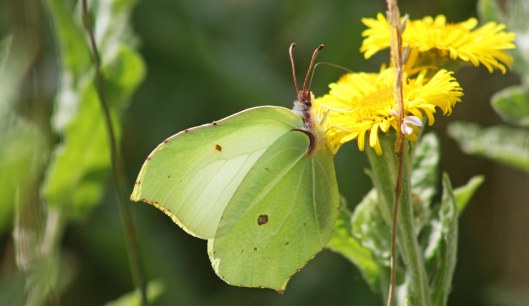
The first is a Brimstone butterfly (Gonepteryx rhamni), not to be confused with the moth of the same name. I saw two flying together, land together and then the male heading purposefully towards the female. Turns out though that her spreading her wings and raising her abdomen in the air was not a ‘come hither’ signal but rather the opposite. She was indicating that she had already mated and was rebuffing the male. I saw several Common blues (Polyommatus icarus), also easily confused with other very similar small blue butterflies. They are so vibrant! And seeing a Peacock (Aglais io) is always a treat, though this one was looking a little battered.

170513 (4) Speckled wood
170513 (5) Dingy skipper
170513 (6) Mocha moth

Speckled woods (Pararge aegeria) seem to be the butterflies I see most often wherever I go but I love their pretty dappling of brown and cream. The next was a new one for me and I saw two of them – it’s a Dingy Skipper (Erynnis tages), a butterfly whose caterpillars feed on Bird’s-foot trefoil so it’s often found on the short impoverished grasslands of former coal tips, rubbish tips and quarries. I’ve just learnt that it’s called Dingy because ‘it loses scales alarmingly as it get older so looks, well, dingy’ (thanks, Steven). The last is not a butterfly but a moth and rather a special moth, The Mocha (Cyclophora annularia). This moth is nationally scarce but more frequent in the woodlands of southern Britain so I was well pleased with this sighting.

Like Loading...

World wildlife Wednesday: Cambodian butterflies

28 Wednesday Dec 2016

Posted by sconzani in insects, nature

≈ 3 Comments

Tags

Banteay Srey Butterfly Centre, butterfly, butterfly conservation, Cambodia, Cambodian butterflies, forest conservation

As today is the winter solstice I thought it would be nice to celebrate  world wildlife Wednesday in sunnier warmer climes. So, let’s head to Cambodia where, although this is the cool dry season – their equivalent of winter – temperatures are still averaging in the very pleasant mid-20-degree-Celsius range. And let’s pay a visit to the Banteay Srey Butterfly Centre, about 25 kilometres north of Siem Reap.

161221-cambodia-common-mime-1

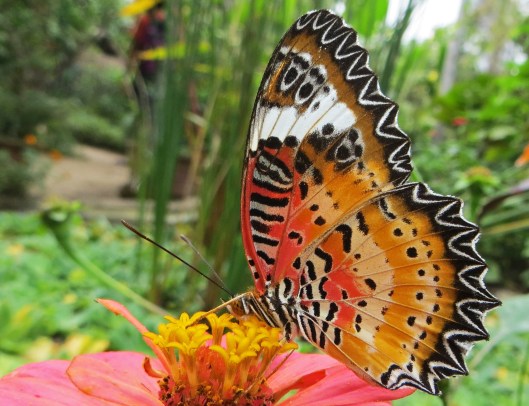
Not only does it have a large netted garden full of tropical flowers with hundreds of butterflies fluttering around, it also has a butterfly breeding programme. Egg-covered leaves are collected from the garden each day and stored in plastic tubs in a small propagation area. Once hatched the caterpillars, ranging in colour from the camouflaging pale greens to the bright red and black stripes of warning, are fed on their favourite plants until its time for their pupation. The butterflies, when they emerge, are equally varied, some vibrant reds and oranges, others plain black and white but intricately patterned, some large, others small and delicate. All are native to Cambodia.

161221-cambodia-leopard-lacewing-1

The friendly centre guides provide a short guided tour, sharing their knowledge of the different species and explaining the life cycle and peculiarities of each species. By training Cambodian people who reside near forested areas to farm butterflies, and employing locals as staff, the butterfly centre benefits local impoverished communities, encourages the preservation of native forests, and helps to conserve the native butterflies – a win, win situation!

151221-cambodia-common-evening-brown
161221-cambodia-caterpillar
161221-cambodia-common-birdwing
161221-cambodia-common-mime-2
161221-cambodia-leopard-lacewing-2
161221-cambodia-yellow-moth
Like Loading...

Bye bye butterflies

29 Thursday Sep 2016

Posted by sconzani in autumn, insects, nature

≈ 7 Comments

Tags

Brimstone butterfly, British butterflies, butterfly, Gatekeeper, Gonepteryx rhamni, Pyronia tithonus, Red Admiral, Vanessa atalanta

Though I love many things about the coming of autumn, it is also a time when many other things I love disappear for the year. The butterflies are one of those things. Gone now are the gorgeous Gatekeepers (Pyronia tithonus) that kept me company during my frequent wanders around my local cemetery.

160929-gatekeeper-1
160929-gatekeeper-2

Gone too is the pale, subtle beauty of the Brimstone (Gonepteryx rhamni). Though I searched for more, I saw only one this year, at the Parc Slip Nature Reserve.

160929-brimstone

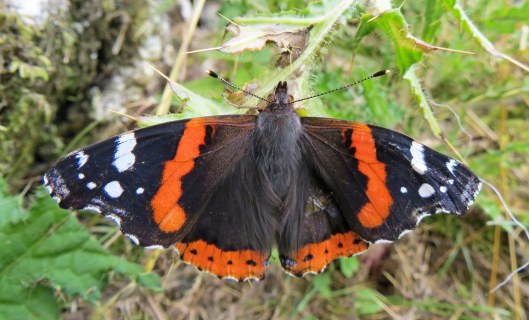
I have noticed, over the past couple of weeks, a little resurgence of Red Admirals (Vanessa atalanta), as they feast on the ivy flowers that are just beginning to bloom here in Cardiff and are providing a late season banquet for bees, hoverflies and butterflies. All too soon, these creatures will also fade away, hopefully to come again in the springtime when the temperatures begin to rise and the days to lengthen.

160929-red-admiral

Like Loading...

Brown is the new black

16 Saturday Jul 2016

Posted by sconzani in insects, nature

≈ 9 Comments

Tags

Aphantopus hyperantus, butterflies, butterfly, Cathays Cemetery, Maniola jurtina, Meadow Brown, Ringlet

160716 Meadow Brown (1)

The two butterflies I see most often at the moment are fifty shades of brown and, when flying, very difficult to tell apart. Both enjoy the sheltered areas of tall grass and wildflowers in the conservation areas of Cathays Cemetery and, on a sunny day, I might see a combined total of perhaps thirty. Both are difficult to photograph as they rarely keep still long enough for me to reach them, let alone get focused shots, and they often settle down low in areas of long grass so, even at my most stealthy, I can seldom step through the greenery without disturbing them.

160716 ringlet (1)
160716 ringlet (2)

The Ringlet (Aphantopus hyperantus) is not a Shirley Temple lookalike – its common name comes from the series of little ring markings on its hind wings. One of the advantages of being brown is that it is more easily able to warm itself up so can still be seen flying on overcast days. Common throughout Britain (except for the northernmost parts of Scotland), it tends to live in colonies, sometimes numbering up to several thousand individuals – what a sight that would be!

160716 Meadow Brown (2)
160716 Meadow Brown (3)

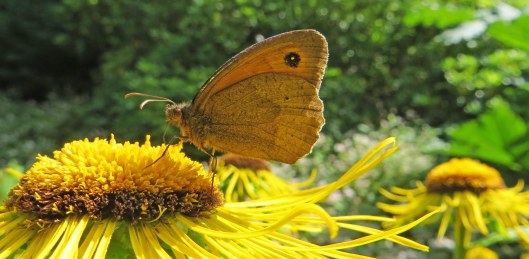
As its name suggests, the Meadow Brown (Maniola jurtina) is brown and lives in meadows, and it’s one of the most common, widespread and least endangered of British butterflies. There are, in fact, four separate sub-species, differentiated by location and extremely subtle variations in markings but I’m not going to venture in to that level of specialisation (there’s a wealth of information on the UK Butterflies website if you’re tempted).

Like Loading...

It’s a Comma!

11 Monday Jul 2016

Posted by sconzani in insects, nature

≈ 8 Comments

Tags

butterfly, Comma, Comma butterfly, Comma butterfly pupa, Polygonia c-album, pupa

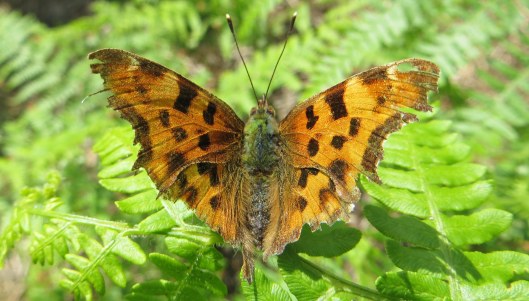
I’d seen the stunning Comma butterfly (Polygonia c-album) before, when I lived in Cheshire for 6 months, but this was my first in Wales and the first for 2016. And, surprisingly for a butterfly that can be quite skittish, it was very amenable to photography, fluttering off and coming back to a nearby leaf and changing its pose so I could get a variety of shots – a born model!

160711 Comma (1)

Named for the small white comma-shaped mark on the underside of its wings, the Comma is a resilient species. The main food plant for its caterpillars used to be the hops used in brewing beer so the butterfly’s numbers dwindled perilously when hop farming declined in the 1800s. For some reason, the Comma has changed its larval food plant to the Common nettle so, since the 1960s, both its numbers and the extent of its range have increased dramatically. It’s a born survivor!

160711 Comma (2)
160711 Comma (3)

You can just see the little white comma on the underwide of the wing in the photo above left. On the right is the pupa – a beautifully textured structure, with small silver highlights. And below is a rather battered-looking older specimen, seen when I lived in Cheshire.

160711 Comma (4)

Like Loading...

Aye, aye, skipper!

05 Tuesday Jul 2016

Posted by sconzani in insects, nature

≈ 4 Comments

Tags

butterflies, butterfly, Large skipper, Ochlodes sylvanus, Small skipper, Thymelicus sylvestris

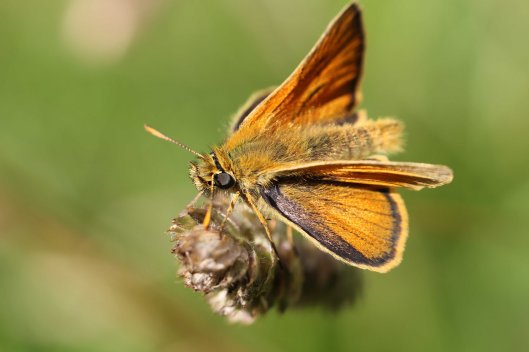
A couple of weeks ago I posted about several recent butterfly sightings, including one of the Large skipper (Ochlodes sylvanus). Today we have my first 2016 sighting of a Small skipper (a completely separate species, Thymelicus sylvestris), which I was lucky enough to see and photograph at the cemetery last Sunday. It’s often difficult to tell the Large (below, left) and Small (below, right) apart when they’re flying but, in these photos, you can clearly see the differences in the markings on their upper wings. The colours of both skippers remind me of golden amber, especially when the sunshine touches them.

160705 Large Skipper
160705 Small skipper (1)

Apparently, the Small skipper’s eggs usually hatch in late summer, after which the wee caterpillars overwinter within the grass stalk where their eggs were originally laid. Come spring, they spin themselves a little grass shelter that helps protect them from predators, initially only popping out at night to feed but emerging more often during the day as they grow larger. They pupate in May and June, before appearing, often in large numbers, as beautiful butterflies in July. My Small skipper was true to form, basking on grass in the warm sunshine, allowing me to get lots of lovely photos.

160705 Small skipper (3)160705 Small skipper (2)

Like Loading...

Fluttering butterflies, no.2

24 Friday Jun 2016

Posted by sconzani in insects, nature

≈ 7 Comments

Tags

Anthocharis cardamines, British butterflies, butterfly, Celastrina argiolus, Common blue butterfly, Holly blue butterfly, Large skipper butterfly, Ochlodes sylvanus, Orange-tip butterfly, Polyommatus icarus

Though summer is well underway here in Britain, I’m not seeing a huge number of butterflies. Here are some I have seen fluttering by in recent weeks.

160624 Common Blue

There are several small blue butterflies in Britain and they can be difficult to tell apart but the Common blue (Polyommatus icarus) is, as its name implies, the most common. As is often the way with wildlife, the males are bright blue, whereas the females can be quite a drab brown.

160624 Holly blue

The Holly blue (Celastrina argiolus) looks quite similar to the Common Blue, especially in flight. The trick to identifying it is in the small black dots on the underwings. It is also the blue butterfly that emerges first from its winter hibernation so look for it near holly plants in early spring, then fluttering about ivy in the summertime.

160624 Orange tip

If this is an Orange-tip butterfly (Anthocharis cardamines), where’s the orange colour? Turns out this is a female and only the males have bright orange wing tips. Still, she’s a very pretty little thing, even if she did seem a bit shy and hid her head behind a leaf.

160624 Large Skipper

Though it’s called the Large skipper (Ochlodes sylvanus), this butterfly is relatively small, its wingspan just a couple of millimetres more than the Small skipper, so you need to look for the mottled brown markings on its upper wings to tell the two apart.

Like Loading...

Fluttering butterflies, no.1

26 Tuesday Apr 2016

Posted by sconzani in insects, nature, nature photography

≈ 14 Comments

Tags

Aglais io, butterflies, butterfly, Cabbage white, Pararge aegeria, Peacock, Pieris rapae, Small white, Speckled wood

‘The butterfly counts not months but moments, and has time enough,’ wrote Bengali Nobel Laureate Rabindranath Tagore – perhaps a lesson for us all.

The first butterflies of spring-summer 2016 have now begun fluttering around me when I’m out walking. Like the bees and the hoverflies, I find they add an extra dimension to my wanderings, a whisper of magic, a hint of fairies …

Small White male Pieris rapae Bute 100416

The Small white (Pieris rapae) was the first butterfly I saw, a couple of weeks ago, during a walk around Cardiff Bay, but it eluded my attempts to photograph it. Both this and the Large white are known as the ‘Cabbage Whites’ for the damage their caterpillars do to the cabbage and other vegetable plants; I have childhood memories of my father regularly checking the undersides of his cabbage leaves and cursing those caterpillars! Though this butterfly has been known to fly as far as 100 miles in its lifetime, it couldn’t fly to New Zealand – in the days before strict agricultural border controls, it was accidentally introduced there, to Australia and to North America.

Peacock Aglais io Cosmeston 200416
Peacock Ty Rhiw

What a glorious creature the Peacock butterfly is and how lovely it looks on this blackthorn blossom, though this Peacock has seen better days; it’s a little faded and has parts of its wings missing. Aglais io gets its common name, obviously, from the unmistakable ‘eyes’ on its wings, so reminiscent of a peacock’s spectacular tail, but its underwings are quite the opposite, dark and easily mistaken for dead leaves in a woodland setting.

Speckled wood Cathays Cem 240416 (4)
Speckled wood Pararge aegeria Penarth railtrail 200416

The Speckled Wood (Pararge aegeria) is the butterfly I’ve seen most often in the past couple of weeks, in the woodlands of Cosmeston and Bute Park and also in tree-filled Cathays Cemetery, where the two shown together above charmed me with their delicate spiralling dance. Is it love or the love of the chase, I wonder?

Like Loading...
Newer posts →

About me

sconzani

sconzani

I'm a writer and photographer; researcher and blogger; birder and nature lover; countryside rambler and city strider; volunteer and biodiversity recorder.

View Full Profile →

Follow earthstar on WordPress.com

Enter your email address to follow this blog and receive notifications of new posts by email.

Recent blog posts

  • Beating the gloom March 10, 2026
  • No booming Bittern but … March 9, 2026
  • Danish scurvygrass March 8, 2026
  • Four weeks early March 7, 2026
  • Three shieldbug species March 6, 2026

From the archives

COPYRIGHT

Unless otherwise acknowledged, the text and photographs on this blog are my own and are subject to international copyright. Nothing may be downloaded or copied without my permission.

Fellow Earth Stars!

  • Unknown's avatar
  • Unknown's avatar
  • Unknown's avatar
  • Unknown's avatar
  • Unknown's avatar
  • Unknown's avatar
  • Unknown's avatar
  • Unknown's avatar
  • Unknown's avatar
  • Unknown's avatar
  • Unknown's avatar
  • Unknown's avatar
  • Unknown's avatar
  • Unknown's avatar
  • Unknown's avatar
  • Unknown's avatar
  • Unknown's avatar
  • Unknown's avatar
  • Unknown's avatar
  • Unknown's avatar
  • Unknown's avatar
  • Unknown's avatar
  • Unknown's avatar
  • Unknown's avatar
  • Unknown's avatar
  • Unknown's avatar
  • Unknown's avatar
  • Unknown's avatar
  • Unknown's avatar
  • Unknown's avatar
  • Unknown's avatar
  • Unknown's avatar
  • Unknown's avatar
  • Unknown's avatar
  • Unknown's avatar
  • Unknown's avatar
  • Unknown's avatar
  • Unknown's avatar
  • Unknown's avatar
  • Unknown's avatar
  • Unknown's avatar
  • Unknown's avatar
  • Unknown's avatar
  • Unknown's avatar
  • Unknown's avatar
  • Unknown's avatar
  • Unknown's avatar
  • Unknown's avatar
  • Unknown's avatar
  • Unknown's avatar

Blog at WordPress.com.

Privacy & Cookies: This site uses cookies. By continuing to use this website, you agree to their use.
To find out more, including how to control cookies, see here: Cookie Policy
  • Subscribe Subscribed
    • earthstar
    • Join 668 other subscribers
    • Already have a WordPress.com account? Log in now.
    • earthstar
    • Subscribe Subscribed
    • Sign up
    • Log in
    • Report this content
    • View site in Reader
    • Manage subscriptions
    • Collapse this bar
 

Loading Comments...
 

You must be logged in to post a comment.

    %d