• ABOUT
  • BIRDING 2018
  • Birding 2019
  • BLOG POSTS
  • Butterflies 2018
  • Resources

earthstar

~ a celebration of nature

earthstar

Tag Archives: Cosmeston Lakes Country Park

November at Cosmeston

02 Saturday Dec 2017

Posted by sconzani in autumn, insects, nature, parks

≈ Leave a comment

Tags

British dragonflies, Common Darter, Cosmeston Lakes Country Park, flies, fly, hoverfly, Mary Gillham Archive Project

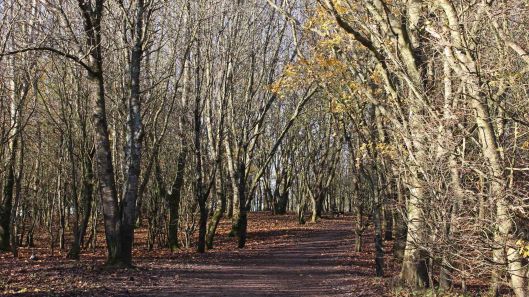
I’ve only had a couple of visits to Cosmeston Lakes Country Park this month because my volunteer work on the Mary Gillham Archive Project has been taking up a bit more time as we try to get as much as possible done before the project effectively finishes at Christmas – though, having said that, I did spend four hours at Cosmeston last Friday trying to replicate, for the project website, photos Mary had taken in the early days of the park. These are a couple of those: Mary’s photo of the west lake in September 1987 on the left, and my photo from the same spot thirty years later on the right.

171202 Cosmeston west lake Sep 1987
171202 Cosmeston west lake Nov 2017

But I digress … apart from the berry-eating visitors, the Redwings and the Mistle thrushes, and finally managing to grab a couple of half-decent photographs of a Green woodpecker, I haven’t found anything particularly noteworthy bird-wise at Cosmeston during November. I have, however, been impressed by the numbers of insects still around, despite the fact that it has been noticeably colder, with daytime highs in the low teens and several overnight frosts.

171202 common darter (1)
171202 common darter (2)
171202 common darter (3)
171202 bumblebee

On 5 November, the ‘fireworks’ at Cosmeston were these lovely little Common darters. In an area shaded from the cool westerly wind but warmed by the bright sun, each had claimed itself a fencepost to bask on. And, nearby, a lone bumblebee looked like it wanted to snuggle for warmth into this seed-head ‘duvet’ of Old man’s beard (Clematis vitalba).

171202 fly (1)
171202 fly (2)
171202 hoverfly

On 24 November, though my focus was on finding the exact spots where Mary had taken her photos, I did still have one eye on the wildlife and noticed quite a lot of flies about. Like the dragonflies of two weeks earlier, these two flies and one hoverfly were favouring sheltered spots on wood to make the most of the sunshine.

Like Loading...

Through a hedge, quietly

27 Monday Nov 2017

Posted by sconzani in birds, nature

≈ 7 Comments

Tags

birding, birdwatching, British birds, Cosmeston Lakes Country Park, Green woodpecker, Picus viridis, woodpecker

171127 Green woodpecker (1)

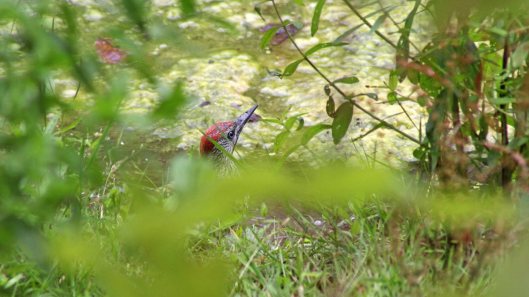
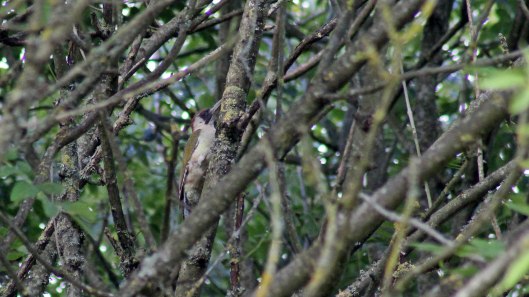
My usual view of the Green woodpecker (Picus viridis) is a flash of its bright red Mohawk, bright green body and bright yellow rump as it rockets rapidly away from me. They are notoriously nervous birds and, as they usually feed on wide open expanses of grass – all the better to spot the dreaded photographer trying to creep up on them, they easily spot my clumsy attempts at stalking, and fly off at the drop of an ant. So, the few photos I’d managed to get were with my long lens on full zoom, with, invariably, the bird partly obscured by branches, twigs or long grass.

171127 Green woodpecker (3)

Until last Friday that is…. I was enjoying a wander at Cosmeston, when, having already unsuccessfully stalked one bird, I spotted another in a different field. This time, this woodpecker was completely occupied with poking in the damp soil for ants, and I was on a footpath behind a hedge. I moved to the grassy verge, took care not to step on anything that might crack or rustle, and kept my head down. If the bird looked up, I froze until it got back to its digging. There weren’t many gaps in the hedge so I still couldn’t get very clear or very close shots but I am still ridiculously pleased to have got these couple.

171127 Green woodpecker (4)171127 Green woodpecker (5)

Like Loading...

Autumn migration: Stonechats

15 Sunday Oct 2017

Posted by sconzani in autumn, birds, nature

≈ Leave a comment

Tags

autumn, autumn migration, birding, birdwatching, Cardiff Bay Wetland Reserve, Cosmeston Lakes Country Park, Grangemoor Park, migrant birds, Saxicola torquata, Stonechat

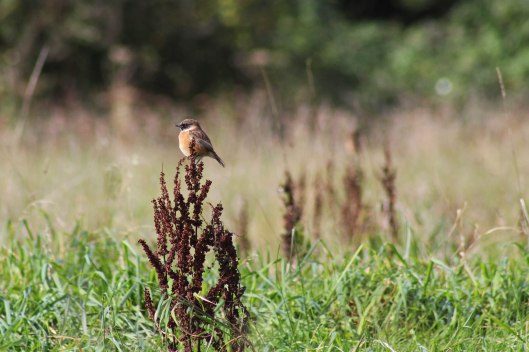
Meet the Stonechat (Saxicola torquata), the bird whose song sounds like two pebbles being rapped together, hence its common name.

171015 Stonechat (4)

These little birds, about the size of your average Robin, usually live a little north of where I live in south Wales, preferring the plantations of conifers that grow in the Welsh valleys and the heathland of the Brecon Beacons. But, come the cooler temperatures of autumn they begin to move south to over-winter in slightly warmer climes.

171015 Stonechat (3)

I saw my first local bird at the Cardiff Bay Wetland Reserve on 17 September, a pair at Cosmeston Lakes Country Park on 6 October, and then a solitary female at Grangemoor Park last Sunday, 8 October.

171015 Stonechat (1)

Stonechats are not always easy to spot, as they duck down amongst tall grass and wildflowers in their search for insects and seeds, and their colours act as good camouflage. But, luckily, they also have a habit of perching on the tops of those grasses and wildflowers and on low shrubs so they can keep an eye out for threats – and humans with cameras! – so I have managed to get a few distant photos.

171015 Stonechat (2)

Like Loading...

A mini challenge

09 Monday Oct 2017

Posted by sconzani in insects, nature

≈ 8 Comments

Tags

biodiversity, Cosmeston Lakes Country Park, flies, galls, leaf mines, Speckled wood, spiders, spotting insects

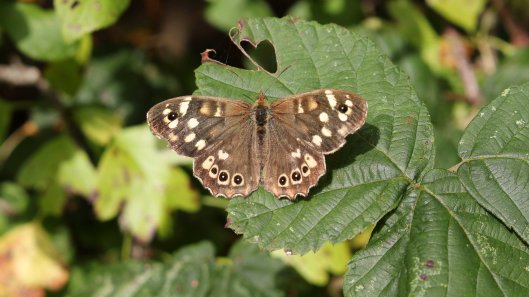
On Friday I went for a wander around one of my favourite local haunts, Cosmeston Lakes Country Park and, while there, I set myself a little challenge. How many critters could I find in one small area, perhaps no more than 2 metres square?

171008 mini challenge

My challenge wasn’t pre-planned: I had seen very little at this point on my walk and was thinking to myself that this was due to autumn and the cooler weather but, when I saw a Speckled wood butterfly at this particular spot – a bank covered with shrubs and small trees – I started wondering how much more there was that I simply wasn’t seeing. So, I stopped and looked harder. There was no poking under grasses or bushes, no sweeping or brushing to encourage movement, just focussing my eyes and ears to really see and hear.

171008 spider (1)
171008 spider (2)
171008 spider (3)

There were, in fact, three Speckled woods – I just hadn’t noticed the other two, plus three different species of spider (the Garden spider was lunching on another critter but it was partly consumed and too tiny to identify), one hoverfly, three species of flies, a gall on Bramble that would’ve been home to the larvae of the tiny gall wasp Diastrophus rubi, and a leaf mine, made by the larva of some unidentified mini-beast. And I’m absolutely sure I didn’t spot everything!

171008 mini challenge (1)
171008 mini challenge (2)
171008 mini challenge (3)
171008 mini challenge (4)
171008 mini challenge (5)
171008 mini challenge (6)
Like Loading...

When is a water-lily not a water-lily?

29 Friday Sep 2017

Posted by sconzani in flowers, nature, wildflowers

≈ 2 Comments

Tags

Cosmeston Lakes Country Park, Fringed water-lily, Nymphoides peltata, water lily

This pretty plant may look like a water-lily, it even has the words water lily in its name but it’s not actually a member of the water-lily family.

170929 Fringed waterlily (2)

This is the Fringed Water-lily (Nymphoides peltata) and its closest plant relation is the Bogbean (the fringed edges to its petals are a bit of a giveaway). It can be found in ponds (the one in my photo is in the dipping pond at Cosmeston Lakes Country Park), lakes and other watery places where the water is still or slow moving. Apparently, it is well established in the Leeds and Liverpool canal, and in much of south-east England, as well as in the East Anglian fens. It is also widely planted in ornamental ponds in parks and gardens, and snippets of those plants may account for its spread in the wild. The gardeners amongst you may know it as Yellow floating heart, which is such a charming name, I think.

170929 Fringed waterlily (4)
170929 Fringed waterlily (1)
170929 Fringed waterlily (5)
170929 Fringed waterlily (3)
Like Loading...

Smell a rat?

27 Wednesday Sep 2017

Posted by sconzani in animals, mammal, nature

≈ 10 Comments

Tags

British fauna, British mammals, brown rat, Cosmeston Lakes Country Park, rat, Rattus norvegicus

If you don’t like rats, look away now!

170927 Brown rat (4)

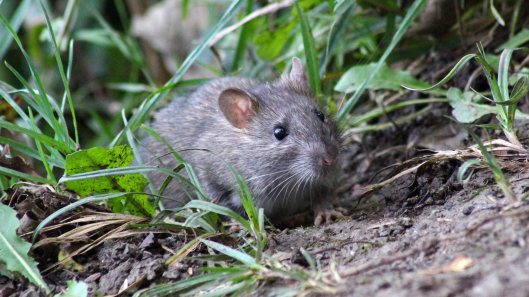
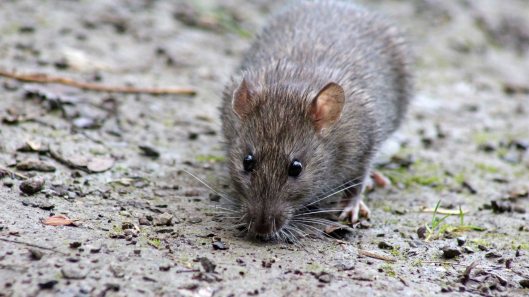
While I realise that a blog about rats might not appeal to everyone, I rarely get to see or write about mammals so, when these two rats came brazenly sniffing around for the seeds I was feeding to the birds at Cosmeston, I couldn’t resist taking photos. And once I have photos, a blog shall surely follow.

170927 Brown rat (1)
170927 Brown rat (2)
170927 Brown rat (3)

These are Brown rats (Rattus norvegicus), immigrants from central Asia that arrived in Britain around 1720. Of course, I don’t mean these two individuals arrived in 1720 – rats usually only live about a year in the wild – but their ancestors were sea-going rodents that just loved to sail the oceans wide and jumped ship wherever they docked. Nowadays, rats are more settled, and they’ll live almost anywhere – houses, gardens, parks, farmlands and farm buildings – you name it, there’s probably a rat in it somewhere.

170927 Brown rat (5)

They particularly like cereals – so, my bird seed would’ve gone down a treat – but they’ll eat pretty much anything, from small birds and their eggs to molluscs and food scraps. If you’re someone who hates these much-maligned creatures, remember that they too play an important part in the food chain, in particular as food for the owls and foxes that everyone loves.

Like Loading...

Wheatear

14 Thursday Sep 2017

Posted by sconzani in birds, nature, parks

≈ Leave a comment

Tags

autumn bird migration, birding, birdwatching, British birds, Cosmeston Lakes Country Park, migrating birds, Oenanthe oenanthe, Wheatear

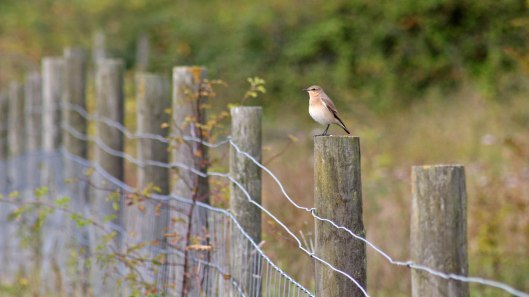
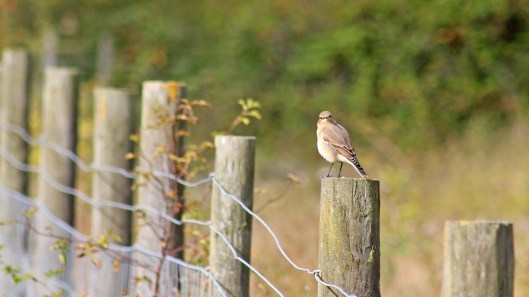
I went looking for Whinchat and Redstart but came home with Wheatear. I’m talking about birds, of course, and I didn’t actually bring the bird home, of course, just photos – and not particularly crisp photos at that, as the bird was perched on a fence post some distance away and I couldn’t get closer without spooking it. But what a lovely little bird it was!

170914 wheatear (1)

This was at Cosmeston, my local country park and nature reserve, which, as it sits very close to the Welsh coast adjacent to the Bristol Channel, is perfectly situated as a sort of springboard location for migrating birds – and the autumn bird migration is well and truly underway now. The Wheatear (Oenanthe oenanthe) breeds in upland areas of northern and western Britain but then, come the cooler days of late summer – early autumn, it wings its way south to spend the winter in central Africa.

170914 wheatear (3)
170914 wheatear (4)

The name Wheatear intrigued me so I consulted my trusty copy of Stefan Buczacki’s Fauna Britannica. It appears that many people assume, as I did, that the name comes from the bird’s tendency to consume ripening wheat. However, the etymology is older and seems to come from a Middle English word meaning ‘white arse’!

170914 wheatear (2)

Like Loading...

The everlasting thistle

18 Friday Aug 2017

Posted by sconzani in flowers, nature, wildflowers

≈ 5 Comments

Tags

British flora, British wildflowers, Carlina vulgaris, Carline thistle, Cosmeston Lakes Country Park, everlasting flower, Everlasting thistle, thistle

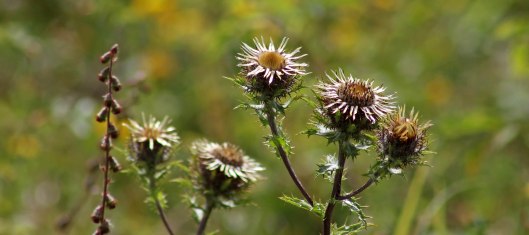
My new favourite flower resembles something you might find in a dried arrangement rather than a flower in full bloom but such is the look of the Carline thistle (Carlina vulgaris).

170818 Carline thistle (1)

It grows best on calcareous soils in Wales and England – they are thriving on the dry, stony grassland areas at Cosmeston Lakes Country Park. It’s spiny, as you would expect from a thistle, but is not a tall plant, probably no more than knee-height, and it sends up its spiky flower heads on solitary stems that have between 2 and 5 flowers on top.

170818 Carline thistle (2)
170818 Carline thistle (3)
170818 Carline thistle (4)

At first glance, you might think the flowers were dead but, if you look closer, you can see that they’re just like any other daisy-like flower, except for their brownish hues. When the sun touches them, they positively glow, and when the weather is cold and wet, they close up. The flowers can be seen from July through to September, after which they will dry out and often last right through the winter. I’m thinking that once they finish flowering, I might have to snaffle a couple to enjoy at home over the winter.

170818 Carline thistle (5)

Like Loading...

Chasing a Spotted Fly

15 Tuesday Aug 2017

Posted by sconzani in birds, nature

≈ 5 Comments

Tags

birding, birdwatching, British birds, Cosmeston Lakes Country Park, flycatcher, Muscicapa striata, Spotted flycatcher

There’s a local birdwatcher I follow on Twitter who always makes the most amazing sightings and I read his tweets – 6/8 ‘Spotted Flycatcher, 2 Garden Warblers, 40 Willow Warblers and 2 Tree Pipits’ and 8/8 ‘Grasshopper Warbler, 2 Spot Fly, Redstart, 2 Garden Warbler, 2 Lesser Whitethroat, 25 Willow Warbler, 2 Sedge Warbler’ – with great envy. These particular sightings were all at Cosmeston, one of my local country parks, so I decided to go looking for myself.

170815 Spotted flycatcher (1)

Spot the bird

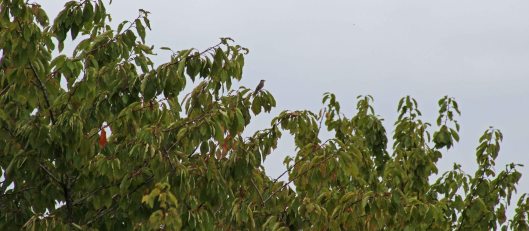
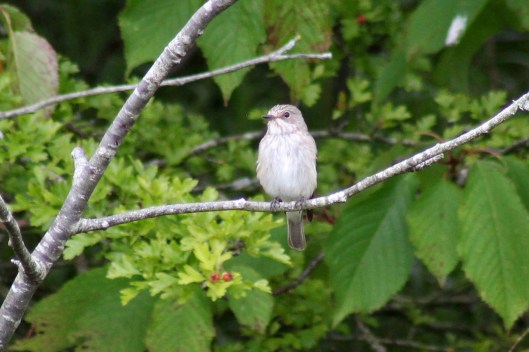
Warblers can be difficult to identify but I’d never seen a Spotted flycatcher (Muscicapa striata) so I made that my target. And it took me three visits and many many photographs of Chiffchaffs before I finally found them, by chance, not in the area where they’d been reported to be.

170815 Spotted flycatcher (4)

170815 Spotted flycatcher (2)
170815 Spotted flycatcher (5)

There were two birds and they were unmistakable as they were doing exactly what their name suggests, catching flies. From a perch in trees, they sat scanning the surrounding air space, then flying out quickly to grab their prey before returning to their perch to scoff it. Spotted flycatchers are migrants, arriving in Britain in April-May and then leaving again in September. It may be that these two birds were stocking up on food before heading off on their long journey to spend the winter in Africa. Intrigued? There’s an excellent article by the British Trust for Ornithology here.

170815 Spotted flycatcher (3)

Like Loading...

The almost inedible parsnip

11 Friday Aug 2017

Posted by sconzani in flowers, insects, nature, wildflowers

≈ Leave a comment

Tags

British flora, British wildflowers, Cosmeston Lakes Country Park, parsnip, Pastinaca sativa, umbellifers, Wild parsnip, wildflowers

While we’re on the subject of wild vegetables (see yesterday’s Wild carrot post), I must mention the other umbellifer that’s currently in full bloom, the Wild parsnip (Pastinaca sativa). Unlike the Wild carrot, the root of the Wild parsnip is, in fact, edible, though it’s described as hard and wiry so doesn’t sound worth the bother to me. I’ve also read that the sap of the plants can cause severe rashes and burns in some people so handling doesn’t seem advisable. And, anyway, who would want to deprive the insects of their tasty feast or spoil the glorious sight of a field of parsnip in full bloom?


170810 Wild parsnip (2)
170810 Wild parsnip (3)
170810 Wild parsnip (4)

The Wild parsnip is the ancestor of the cultivated parsnip, which is one of my favourite winter vegetables – roasted, in soup, stir-fried, yum! – and its culinary use probably dates from the early Middle Ages. The wild variety can be found growing, often in large groupings, on the chalky grasslands of southern England and Wales. In Cosmeston Lakes Country Park, one particular field is like a forest of yellow, some plants taller than my 168cm, and you can smell the scent of parsnips as you walk along the tracks through the field. Delicious!

170810 Wild parsnip (1)

Like Loading...
← Older posts
Newer posts →

About me

sconzani

sconzani

I'm a writer and photographer; researcher and blogger; birder and nature lover; countryside rambler and city strider; volunteer and biodiversity recorder.

View Full Profile →

Follow earthstar on WordPress.com

Enter your email address to follow this blog and receive notifications of new posts by email.

Recent blog posts

  • Lapwing February 23, 2026
  • Scallop shells February 22, 2026
  • Avocet February 21, 2026
  • First large spider February 20, 2026
  • Our celebrity Redshank February 19, 2026

From the archives

COPYRIGHT

Unless otherwise acknowledged, the text and photographs on this blog are my own and are subject to international copyright. Nothing may be downloaded or copied without my permission.

Fellow Earth Stars!

  • Unknown's avatar
  • Unknown's avatar
  • Unknown's avatar
  • Unknown's avatar
  • Unknown's avatar
  • Unknown's avatar
  • Unknown's avatar
  • Unknown's avatar
  • Unknown's avatar
  • Unknown's avatar
  • Unknown's avatar
  • Unknown's avatar
  • Unknown's avatar
  • Unknown's avatar
  • Unknown's avatar
  • Unknown's avatar
  • Unknown's avatar
  • Unknown's avatar
  • Unknown's avatar
  • Unknown's avatar
  • Unknown's avatar
  • Unknown's avatar
  • Unknown's avatar
  • Unknown's avatar
  • Unknown's avatar
  • Unknown's avatar
  • Unknown's avatar
  • Unknown's avatar
  • Unknown's avatar
  • Unknown's avatar
  • Unknown's avatar
  • Unknown's avatar
  • Unknown's avatar
  • Unknown's avatar
  • Unknown's avatar
  • Unknown's avatar
  • Unknown's avatar
  • Unknown's avatar
  • Unknown's avatar
  • Unknown's avatar
  • Unknown's avatar
  • Unknown's avatar
  • Unknown's avatar
  • Unknown's avatar
  • Unknown's avatar
  • Unknown's avatar
  • Unknown's avatar
  • Unknown's avatar
  • Unknown's avatar
  • Unknown's avatar

Blog at WordPress.com.

Privacy & Cookies: This site uses cookies. By continuing to use this website, you agree to their use.
To find out more, including how to control cookies, see here: Cookie Policy
  • Subscribe Subscribed
    • earthstar
    • Join 670 other subscribers
    • Already have a WordPress.com account? Log in now.
    • earthstar
    • Subscribe Subscribed
    • Sign up
    • Log in
    • Report this content
    • View site in Reader
    • Manage subscriptions
    • Collapse this bar
 

Loading Comments...
 

You must be logged in to post a comment.

    %d