• ABOUT
  • BIRDING 2018
  • Birding 2019
  • BLOG POSTS
  • Butterflies 2018
  • Resources

earthstar

~ a celebration of nature

earthstar

Tag Archives: galls

31/366 Empty pincushions

31 Friday Jan 2020

Posted by sconzani in insects, nature, plants

≈ 5 Comments

Tags

Bedeguar gall wasp, British galls, Diplolepis rosae, gall on dog-rose, gall wasps, galls, Robin's pincushion

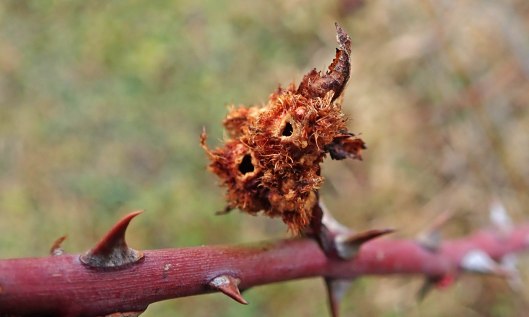
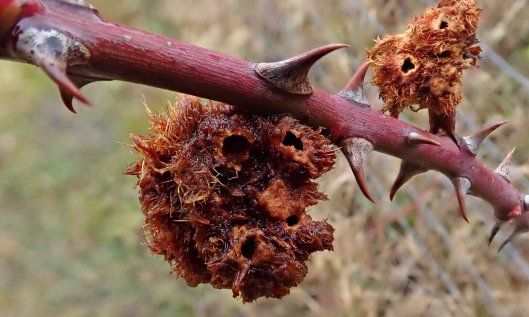
Robin’s pincushions are the amazing gall structures created on Dog roses by the larvae of Diplolepis rosae, the Bedeguar gall wasp.

200131 Robins pincushions (1)

I’ve seen the bright red galls many times during the summer months but I’ve not looked for them in the winter, so it was interesting today to find these and to see the very obvious holes where the adult wasps have hatched out. If it hadn’t been raining, I would have broken one off and brought it home for a closer look inside … maybe next week.

200131 Robins pincushions (2)

Like Loading...

252/365 Alder tongue

09 Monday Sep 2019

Posted by sconzani in 365DaysWildin2019, fungi, nature, trees

≈ 2 Comments

Tags

Alder, Alder tongue, British galls, Fungus-induced galls, galls, galls on Alder, Taphrina alni

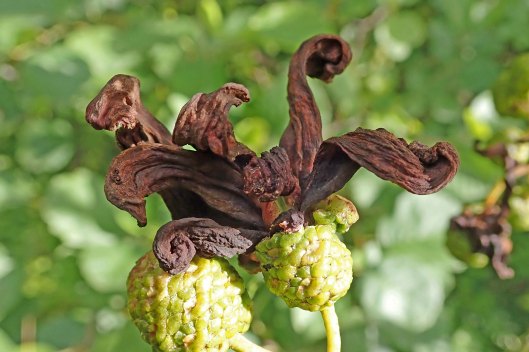
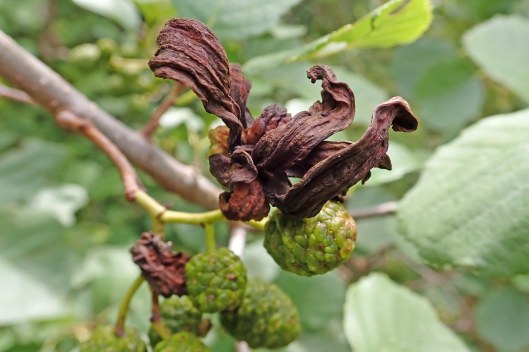
While sneaking up on a juvenile Green woodpecker at Cosmeston, I spotted these lovely examples of Alder tongue (Taphrina alni).

190909 alder tongue (1)

I’ve covered these intriguing galls in a previous blog post so, just briefly, they’re the result of a fungus that chemically alters its host. One of Nature’s oddities!

190909 alder tongue (2)

Like Loading...

226/365 Robin’s pincushion

14 Wednesday Aug 2019

Posted by sconzani in insects, nature, plants

≈ 4 Comments

Tags

Bedeguar wasp gall, Diplolepis rosae, Dog-rose gall, gall on dog-rose, gall wasps, galls, Robin's pincushion

190814 robin's pincushion

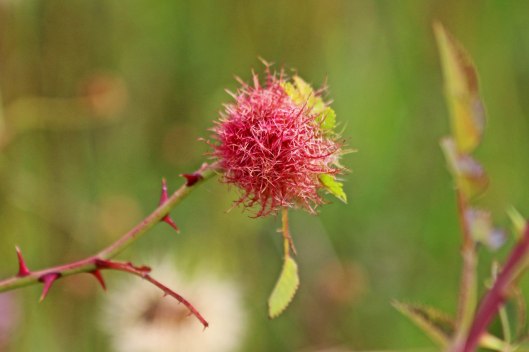
Commonly known as Robin’s pincushion and found growing on Dog roses, this is a gall, the spectacular creation of a group of larvae of the Bedeguar gall wasp (Diplolepis rosae).

Like Loading...

155/365 A good crop of apples

04 Tuesday Jun 2019

Posted by sconzani in 365DaysWildin2019, insects, nature, trees

≈ 2 Comments

Tags

Biorhiza pallida, gall wasps, galls, galls on oak trees, Oak apples, oak galls, Pedunculate Oak

190604 oak apples (1)

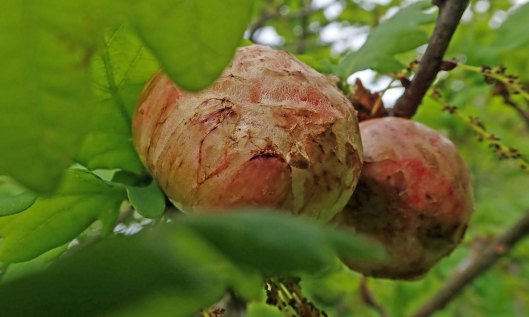
But you wouldn’t want to eat them! These are oak apples, the incredible creations of the larvae of the wasp Biorhiza pallida. By a magical process of chemical interaction, the larvae force the buds of the Pedunculate Oak to change and produce these galls, which the larvae call home until they’re ready to develop into their next stage of life.

190604 oak apples (2)
190604 oak apples (3)

A couple of the young oak trees in some fields near where I live are proving particularly attractive to these wasps so they have a bounty of apples growing on them this year. Yet another of Nature’s miracles!

190604 oak apples (4)

Like Loading...

Andricus kollari, maybe

14 Saturday Apr 2018

Posted by sconzani in insects, nature, trees

≈ 2 Comments

Tags

Andricus kollari, gall wasps, galls, galls on oak trees, Marble gall, oak galls, Oak Marble gall, oak tree

180414 Andricus kollari (3)

If you’re a regular around here, you may recall that in August 2017, I posted a mini-series of posts about some of the galls you can find on Oak trees, which included the Oak Marble gall (see the post here). You might also remember that in late October, I was excited to discover a creature had hatched out of one of my galls and I initially thought it was the gall causer, a minute wasp called Andricus kollari. It was not – turns out it was one of the 29 other species of hymenoptera (bees, wasp, ants and sawflies) that can also be found living in an Oak marble gall (more on that here) (and I never did identify it).

180414 Andricus kollari (1)
180414 Andricus kollari (5)

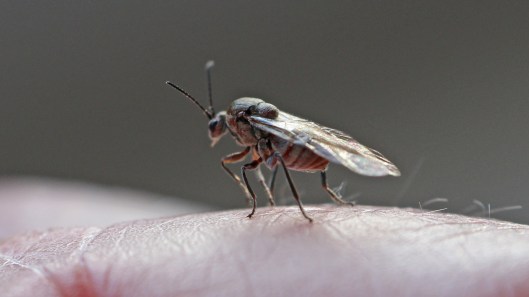
Well, this time, maybe, just maybe, I have seen the gall-causing wasp itself, A. kollari. A while ago, while out walking, I found a small Oak sapling that was absolutely covered in marble galls and, when I found one that had no holes in it, I couldn’t resist bringing it home. The tiny wasp you see in these photos recently hatched out of this gall and the size of the hole it made, plus comparisons with online photos, has led me to think that this time I may have seen the gall causer. I couldn’t be one hundred percent certain of my identification without killing the wasp and getting an expert to check it but I didn’t want to do that. And, of course, I could be totally wrong yet again. In the meantime, the wasp has been returned to the area where I found it so, weather permitting, it can continue its life cycle.

180414 Andricus kollari (2)
180414 Andricus kollari (4)
Like Loading...

A mini challenge

09 Monday Oct 2017

Posted by sconzani in insects, nature

≈ 8 Comments

Tags

biodiversity, Cosmeston Lakes Country Park, flies, galls, leaf mines, Speckled wood, spiders, spotting insects

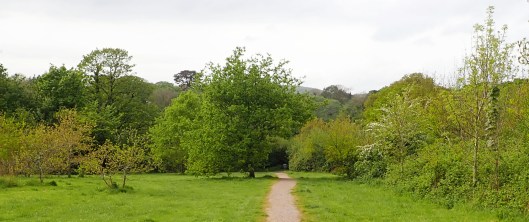
On Friday I went for a wander around one of my favourite local haunts, Cosmeston Lakes Country Park and, while there, I set myself a little challenge. How many critters could I find in one small area, perhaps no more than 2 metres square?

171008 mini challenge

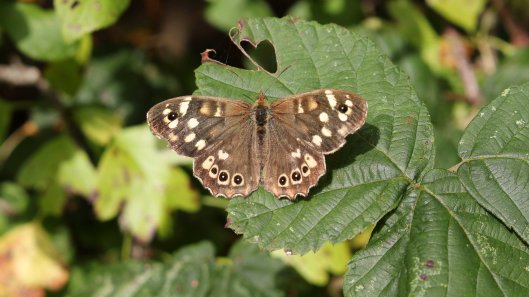
My challenge wasn’t pre-planned: I had seen very little at this point on my walk and was thinking to myself that this was due to autumn and the cooler weather but, when I saw a Speckled wood butterfly at this particular spot – a bank covered with shrubs and small trees – I started wondering how much more there was that I simply wasn’t seeing. So, I stopped and looked harder. There was no poking under grasses or bushes, no sweeping or brushing to encourage movement, just focussing my eyes and ears to really see and hear.

171008 spider (1)
171008 spider (2)
171008 spider (3)

There were, in fact, three Speckled woods – I just hadn’t noticed the other two, plus three different species of spider (the Garden spider was lunching on another critter but it was partly consumed and too tiny to identify), one hoverfly, three species of flies, a gall on Bramble that would’ve been home to the larvae of the tiny gall wasp Diastrophus rubi, and a leaf mine, made by the larva of some unidentified mini-beast. And I’m absolutely sure I didn’t spot everything!

171008 mini challenge (1)
171008 mini challenge (2)
171008 mini challenge (3)
171008 mini challenge (4)
171008 mini challenge (5)
171008 mini challenge (6)
Like Loading...

More galls, part 2

04 Wednesday Oct 2017

Posted by sconzani in insects, nature, plants

≈ 1 Comment

Tags

galls, Galls on Cirsium cardui, galls on Creeping thistle, Thistle gall fly, Urophora cardui

Following on from yesterday’s More galls, part 1 …

This second gall’s host is not a tree, it’s a thistle, Creeping thistle (Cirsium cardui) to be precise, and the gorgeous little fly that causes the gall is Urophora cardui, the Thistle gall fly, a member of the Tephritidae or fruit fly family. Interestingly, this fly has been introduced into Canada, from populations originating in Austria, Germany, France and Finland, in an attempt to control Creeping thistle, which is there called Canada thistle and is regarded as an invasive weed. The gall production initiated by the flies disrupts the development of flowers and also significantly reduces the vigour of the thistle by diverting nutrients into the gall.

171003 Urophora cardui Thistle gall fly (1)
171003 Urophora cardui Thistle gall fly (2)

In Britain, the adult Urophora cardui fly can be seen between May and September when, after mating, it lays its eggs on a nearby Creeping thistle. The larvae burrow into the thistle’s stem, often causing a single gall to develop to house several larvae. The larvae also pupate inside the gall, emerging as flies between June and October. I’ll be checking all the Creeping thistles I see for a glimpse of them.

Like Loading...

More galls, part 1

03 Tuesday Oct 2017

Posted by sconzani in insects, nature, plants, trees

≈ 4 Comments

Tags

Cecidomyia salicis-folii, gall flies, gall midges, gall on Salix caprea, gall on willow, galls, Iteomyia capraea

Today’s and tomorrow’s galls are not on the gall-beleaguered Oak tree and, for a change, they are not caused by wasps, as so many galls seem to be. These two galls are caused by tiny members of the enormous order of flies, the Diptera.

171003 Iteomyia capraea on Salix capraea (1)

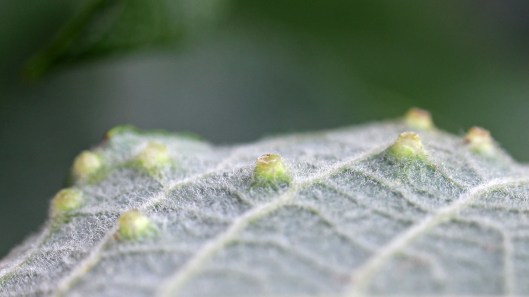
Today’s is Iteomyia capraea (sometimes known as Cecidomyia salicis-folii) (Cecidomyiidae is the family name for gall midges or gall flies). I think I would need better specs to actually see the midge that laid its eggs on this Goat willow (Salix caprea) leaf as it’s only 2-3mm long. Indeed, the galls themselves were pretty small (5-8mm), as you can see from the leafy picture below. When they hatch, the larvae of the midge feed within the leaf tissue causing the willow to develop a gall, sometimes on the midrib of the leaf, sometimes on a thick side vein. I’ve read one report that the larvae are white, another that they are an orange-red colour but I didn’t open up any of the galls for a look at the larva inside so I can’t confirm either report.

171003 Iteomyia capraea on Salix capraea (2)
171003 Iteomyia capraea on Salix capraea (3)

I’ve not been able to discover much about Iteomyia capraea. There are only 215 records showing in the NBN (National Biodiversity Network) database for the whole of Britain, 45 of which are in Wales, but I think that is more a reflection on the under-recording of galls that the rarity of the midge itself. Apparently, the species only breeds a single generation per year and they hibernate over winter in the soil underneath their host tree.

Like Loading...

One of Nature’s whodunnits

22 Thursday Sep 2016

Posted by sconzani in insects, nature, plants

≈ 6 Comments

Tags

galls, oak galls, observing nature, wasp

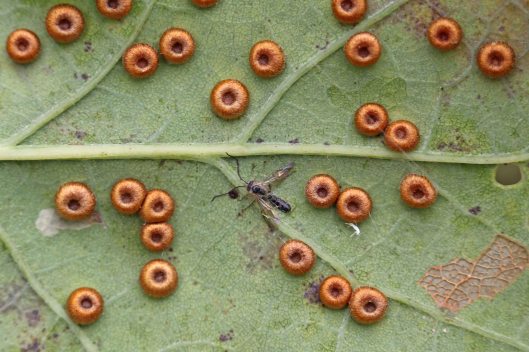
I sometimes get asked how I come up with enough ideas to post a blog every single day. This post goes some way to explaining how it works for me. I walk … a lot, and my camera is my constant companion, and I am by nature curious about … well, everything, really … and I’m also quite an observant person. So, for example, I went out for a wander around one of my local parks on Monday afternoon, thinking I would see if there were any fungi about, and also to get some photos of berries for a future blog. In the process of taking those photos, I noticed how many galls there were on this one particular oak tree so also took some photos of those … which then led me to check the neighbouring trees for galls. (If you’re not sure what galls are, there will now be a blog post on them as well!)

160922-whodunnit-1

When I got home and started going through my photos, this particular image really grabbed my attention because, for me, this is such a good example of one of Nature’s whodunnits. I look at this and my brain is immediately flooded with questions: how were these galls made? Why are they that shape? What is the creature that’s dead on the leaf? Is it a wasp? Did it make the galls? What killed it? It looks like it has white strands around it – a spider’s web or some kind of fungus? What created the bare patch where the leaf’s veins are showing? Was it the larvae of the wasp? What created the almost perfectly round hole in the leaf? Was that a leafcutter bee or something else? Was it the wasp? And what is the teeny weeny white thing? The shed skin of a larva perhaps?

160922-whodunnit-2
160922-whodunnit-3
160922-whodunnit

I don’t know the answers to any of these questions … yet. But, if I find out and if I can get more images related to the story, the result could be a blog or three from just this one photo. And so it goes on …

Like Loading...
Newer posts →

About me

sconzani

sconzani

I'm a writer and photographer; researcher and blogger; birder and nature lover; countryside rambler and city strider; volunteer and biodiversity recorder.

View Full Profile →

Follow earthstar on WordPress.com

Enter your email address to follow this blog and receive notifications of new posts by email.

Recent blog posts

  • M is for mite December 18, 2025
  • L is for lepidopteran lifers December 17, 2025
  • K is for Keeled skimmers December 16, 2025
  • J is for Jersey tiger December 15, 2025
  • I is for Ichneumon December 14, 2025

From the archives

COPYRIGHT

Unless otherwise acknowledged, the text and photographs on this blog are my own and are subject to international copyright. Nothing may be downloaded or copied without my permission.

Fellow Earth Stars!

  • Unknown's avatar
  • Unknown's avatar
  • Unknown's avatar
  • Unknown's avatar
  • Unknown's avatar
  • Unknown's avatar
  • Unknown's avatar
  • Unknown's avatar
  • Unknown's avatar
  • Unknown's avatar
  • Unknown's avatar
  • Unknown's avatar
  • Unknown's avatar
  • Unknown's avatar
  • Unknown's avatar
  • Unknown's avatar
  • Unknown's avatar
  • Unknown's avatar
  • Unknown's avatar
  • Unknown's avatar
  • Unknown's avatar
  • Unknown's avatar
  • Unknown's avatar
  • Unknown's avatar
  • Unknown's avatar
  • Unknown's avatar
  • Unknown's avatar
  • Unknown's avatar
  • Unknown's avatar
  • Unknown's avatar
  • Unknown's avatar
  • Unknown's avatar
  • Unknown's avatar
  • Unknown's avatar
  • Unknown's avatar
  • Unknown's avatar
  • Unknown's avatar
  • Unknown's avatar
  • Unknown's avatar
  • Unknown's avatar
  • Unknown's avatar
  • Unknown's avatar
  • Unknown's avatar
  • Unknown's avatar
  • Unknown's avatar
  • Unknown's avatar
  • Unknown's avatar
  • Unknown's avatar
  • Unknown's avatar
  • Unknown's avatar

Blog at WordPress.com.

Privacy & Cookies: This site uses cookies. By continuing to use this website, you agree to their use.
To find out more, including how to control cookies, see here: Cookie Policy
  • Subscribe Subscribed
    • earthstar
    • Join 667 other subscribers
    • Already have a WordPress.com account? Log in now.
    • earthstar
    • Subscribe Subscribed
    • Sign up
    • Log in
    • Report this content
    • View site in Reader
    • Manage subscriptions
    • Collapse this bar
 

Loading Comments...
 

You must be logged in to post a comment.

    %d