• ABOUT
  • BIRDING 2018
  • Birding 2019
  • BLOG POSTS
  • Butterflies 2018
  • Resources

earthstar

~ a celebration of nature

earthstar

Tag Archives: Goosander

A walk along the Taff

10 Monday Sep 2018

Posted by sconzani in autumn, birds, nature, parks, trees, walks, wildflowers

≈ Leave a comment

Tags

Bute Park, Carrion crow, Goosander, Green alkanet, Grey heron, Grey wagtail, Mallard, Mute swan, River Taff, riverside walk, Speckled wood, woodland trail

On Friday, after I’d paid a visit to the tree I’m following, I enjoyed a stroll along the trail in Cardiff’s Bute Park that meanders through mature woodland alongside the River Taff. Despite this summer’s drought conditions, the recent rains have revived the local trees and plants so everything was looking wonderfully lush and vibrant.

180910 Walk by the Taff (1)

A female Goosander sailing down river was a pleasant sight. Both males and females can often be seen on this part of the Taff from autumn through to spring.

180910 Walk by the Taff (2)

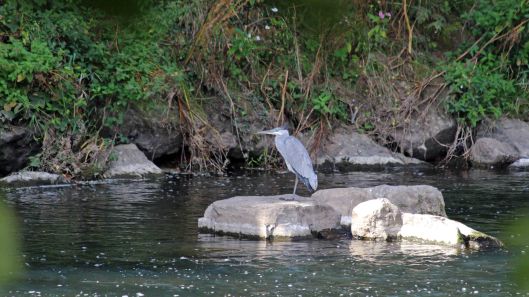
Near the far river bank, a Grey heron stood tall on one of the many exposed rocks and boulders. The river is quite low at the moment.
180910 Walk by the Taff (3)

There weren’t a lot of signs of autumn yet – only the leaves of the Horse chestnuts were yellowing and curling up and beginning to drop.

180910 Walk by the Taff (4)

A Speckled wood was well camouflaged on the woodland floor. There weren’t many butterflies around, just half a dozen Speckled woods and a few Small whites.

180910 Walk by the Taff (5)

A Mallard enjoyed a snooze near the river’s edge.

180910 Walk by the Taff (6)

I liked the colours and patterns of the pebbles and the occasionally blue sky reflected in the river water.

180910 Walk by the Taff (7)

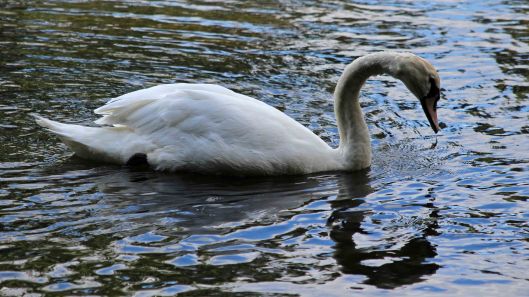
This was one of two Mute swans feeding.
180910 Walk by the Taff (8)

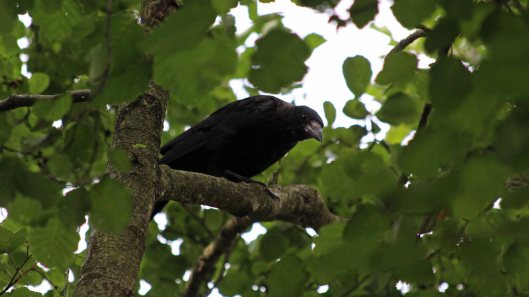
I’ve seen this particular Carrion crow many times before when I’ve walked this way. I know it’s the same crow, not because of how it looks but because it has virtually no voice. It tries to croak but hardly any sound comes out.
180910 Walk by the Taff (9)

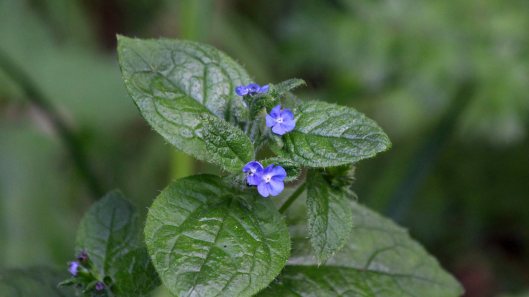
Most of the wildflowers have finished flowering but this Green alkanet was a pretty exception.
180910 Walk by the Taff (10)

Just a few hints of autumn showing here. I love how this path meanders through these magnificent trees.

180910 Walk by the Taff (11)

The woodland trail finishes just below Blackweir, where the current low water level means many rocks and boulders have been exposed. This was the perfect spot for a group of perhaps 20 Grey wagtails to fly-catch, and watching their aerial antics was the perfect end to my wander alongside the Taff.

180910 Walk by the Taff (12)

Like Loading...

Goosie, goosie, goosander

18 Sunday Feb 2018

Posted by sconzani in birds, nature

≈ 2 Comments

Tags

birding, birdwatching, British birds, Goosander, Merganser, Mergus merganser

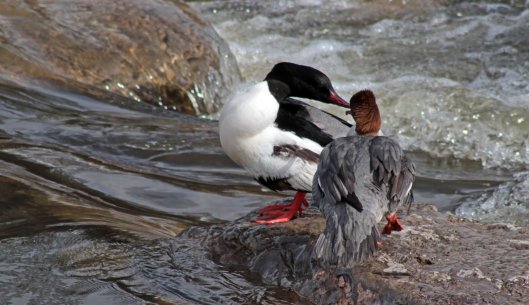
Officially Mergus merganser – the name merganser is a hybrid eighteenth-century word obtained from the Latin root merg-, meaning ‘diving’, and anser, meaning ‘goose’, this beautiful bird is the Goosander. It used to be known as the Common merganser, and I’ve noticed some birders still call it that – old habits…. The bird has a ton of other vernacular names, like, from Sussex, dun diver; green-headed goosander, harle, and jacksaw, in Yorkshire; land cormorant (in Dublin); in Shropshire, pied wigeon; and, in Orkney, rantock. And then there are the understandable references to that long serrated ‘all the better to catch fish with’ bill: sawbill, in Stirlingshire; sawneb, from Aberdeenshire; and, from Suffolk, sawyer.

180218 Goosander (1)

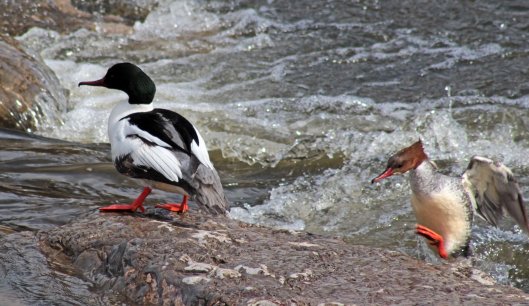
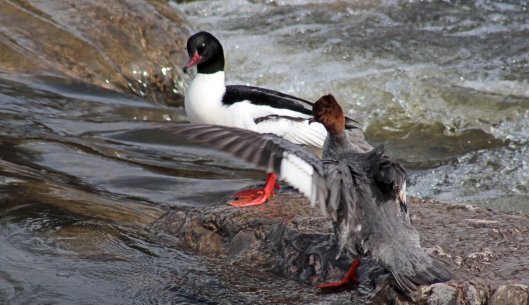
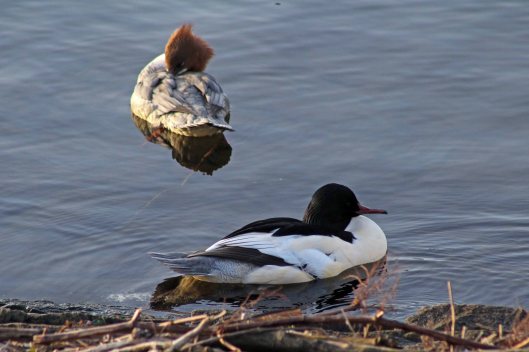
Female above, male below

Their fish-catching habit is why Goosanders have often been persecuted, particularly by the fishermen who think the birds are theirs for the catching. Fortunately, the bird’s population has, thus far, not suffered unduly from this persecution and, from 1871, the year they were first known to have bred in Britain, the Goosander has gradually colonised most of Scotland and spread through much of England and Wales.

Male
Male
Female
Female

Britain has another merganser, Mergus serrator, the Red-breasted merganser, and the two species can be hard to tell apart. But the main thing to note is location – Goosanders are mostly freshwater birds and can be seen year round on rivers and lakes in many parts of Britain, whereas Red-breasted mergansers, although equally at home in fresh- and salt-water locations, are mostly seen in the winter months in coastal areas.

180218 Goosander (4)
180218 Goosander (5)
Like Loading...

January on the Ely embankment

30 Tuesday Jan 2018

Posted by sconzani in birds, nature, walks

≈ 2 Comments

Tags

birding, birdwatching, British birds, Carrion crow, Ely embankment, Goosander, Grey wagtail, little grebe, Pied wagtail, Redshank, River Ely, Rock pipit, Turnstone

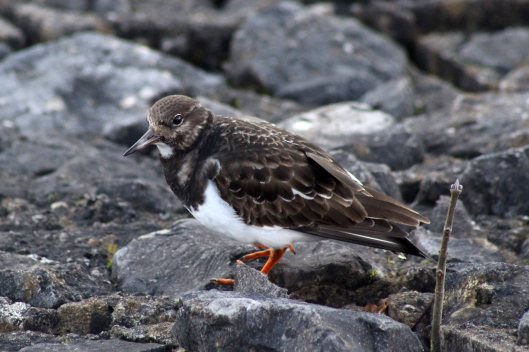
31 December 2017 I’m being a bit sneaky here as I managed to fit in one last walk along the embankment before the start of 2018 but after I’d written my December summary. So, on the last day of last year there were 5 Turnstones, 2 Redshanks, 2 Pied wagtails and 2 Grey wagtails, 1 Rock pipit and a couple of Crows.

180130 Ely embankment birds (1)
180130 Ely embankment birds (2)
180130 Ely embankment birds (3)
180130 Ely embankment birds (4)

1 January 2018 The very next day, New Year’s Day, I passed this way as part of a complete circuit of Cardiff Bay. It was a glorious blue-sky day but there were just 3 Turnstones present.

180130 Ely embankment birds (5)

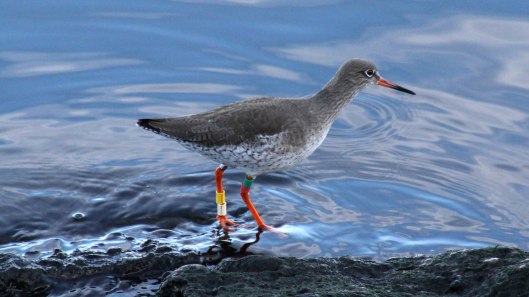
11 January This was another glorious day and another circuit of Cardiff Bay, though in the opposite direction. And it was a bumper day for the Ely embankment, with four Redshanks (including the ringed bird, shown above, which I’ve seen and written about previously), 6 Turnstones, 1 Pied and 4 Grey wagtails, and a Rock pipit.

180130 Ely embankment birds (6)
180130 Ely embankment birds (7)
180130 Ely embankment birds (8)

16 January With 40-mph winds blasting down from snow-covered areas further north, the air temperature was hovering below zero when I walked along the embankment late morning. I wasn’t surprised, then, to find very few birds around – a single Turnstone that was wandering along half way up the embankment (not wanting to put its feet in the chilly water?), which was good for me as it was closer for photos, and just two Grey wagtails. There weren’t many birds on the river either, just a couple of coots, one Great crested grebe and several Black-headed gulls looking hopefully in my direction.

180130 Ely embankment birds

20 January I didn’t get out till late afternoon as it had rained most of the day, so the light was going as I strolled along the embankment path. But I was pleasantly surprised to see a few birds: my friends the Grey wagtails never disappoint (two of those); just one Turnstone poking away amongst the stones; and two Redshanks, including my little buddy the colour-ringed bird. Floating along the river were a Little grebe, a Great crested grebe and a pair of Goosanders – the latter were scared away by a boat cruising by and flew off towards the other side of Cardiff Bay, where I had seen a pair a week or so previously – perhaps the same birds.

180130 Ely embankment birds (9)
180130 Ely embankment birds (10)
180130 Ely embankment birds (11)

25 January I detoured along the embankment on my return from a longer walk and was delighted to find six Turnstones (lovely to see so many), two Redshanks (but not my little ringed mate), two Grey and two Pied wagtails.

Like Loading...

A tale of two goosanders

28 Monday Mar 2016

Posted by sconzani in birds, nature

≈ 4 Comments

Tags

birding, birdwatching, British birds, Goosander, Mergus merganser

160328 goosander (2)

I watched a pair of goosanders (Mergus merganser) slowly making their way up one side of the River Taff today, frequently ducking their heads underwater in search of the fish, molluscs, crustaceans and amphibians that make up their diet. When they reached Blackweir, I expected them to drift back down the river but it seems they were determined to go further up steam.

160328 goosander (1)

That’s when it became apparent that the female can’t fly. Half of her right wing is missing. I doubt this is a birth defect and suspect a narrow escape from the mink that I have seen in recent weeks on the riverbanks in this vicinity.

160328 goosander (4)

The only way to cross the weir then was to walk as the flow of water, even though currently quite weak, was much too strong for swimming. The female had trouble getting out of the water up onto the rocks and then the concrete of the weir, but managed after a couple of tries. Her mate was very patient, and seemed very tender with her, touching her head with his beak, watching to see she was alright while also keeping a look out for danger. He would toddle a little way ahead, then turn and wait for her to catch up. Once he returned to her side as if to encourage her. It took perhaps 20 minutes but they made it and swam on up the river.

160328 goosander (5)

Trouble is, she is now very vulnerable to attack, especially from creatures like the mink but also from unleashed dogs (of which there are many in Cardiff). And the chances of these goosanders successfully breeding are also probably quite slim. My heart went out to these two little creatures, touched by the male’s gentleness with his disabled mate but saddened by their somewhat bleak future prospects.

160328 goosander (6)

Like Loading...
Newer posts →

About me

sconzani

sconzani

I'm a writer and photographer; researcher and blogger; birder and nature lover; countryside rambler and city strider; volunteer and biodiversity recorder.

View Full Profile →

Follow earthstar on WordPress.com

Enter your email address to follow this blog and receive notifications of new posts by email.

Recent blog posts

  • Weevil: Mecinus pyraster January 10, 2026
  • Red in beak and claw January 9, 2026
  • Who’s watching who? January 8, 2026
  • Springtail: Orchesella cincta January 7, 2026
  • A good year for Redwings January 6, 2026

From the archives

COPYRIGHT

Unless otherwise acknowledged, the text and photographs on this blog are my own and are subject to international copyright. Nothing may be downloaded or copied without my permission.

Fellow Earth Stars!

  • Unknown's avatar
  • Unknown's avatar
  • Unknown's avatar
  • Unknown's avatar
  • Unknown's avatar
  • Unknown's avatar
  • Unknown's avatar
  • Unknown's avatar
  • Unknown's avatar
  • Unknown's avatar
  • Unknown's avatar
  • Unknown's avatar
  • Unknown's avatar
  • Unknown's avatar
  • Unknown's avatar
  • Unknown's avatar
  • Unknown's avatar
  • Unknown's avatar
  • Unknown's avatar
  • Unknown's avatar
  • Unknown's avatar
  • Unknown's avatar
  • Unknown's avatar
  • Unknown's avatar
  • Unknown's avatar
  • Unknown's avatar
  • Unknown's avatar
  • Unknown's avatar
  • Unknown's avatar
  • Unknown's avatar
  • Unknown's avatar
  • Unknown's avatar
  • Unknown's avatar
  • Unknown's avatar
  • Unknown's avatar
  • Unknown's avatar
  • Unknown's avatar
  • Unknown's avatar
  • Unknown's avatar
  • Unknown's avatar
  • Unknown's avatar
  • Unknown's avatar
  • Unknown's avatar
  • Unknown's avatar
  • Unknown's avatar
  • Unknown's avatar
  • Unknown's avatar
  • Unknown's avatar
  • Unknown's avatar
  • Unknown's avatar

Blog at WordPress.com.

Privacy & Cookies: This site uses cookies. By continuing to use this website, you agree to their use.
To find out more, including how to control cookies, see here: Cookie Policy
  • Subscribe Subscribed
    • earthstar
    • Join 669 other subscribers
    • Already have a WordPress.com account? Log in now.
    • earthstar
    • Subscribe Subscribed
    • Sign up
    • Log in
    • Report this content
    • View site in Reader
    • Manage subscriptions
    • Collapse this bar
 

Loading Comments...
 

You must be logged in to post a comment.

    %d