• ABOUT
  • BIRDING 2018
  • Birding 2019
  • BLOG POSTS
  • Butterflies 2018
  • Resources

earthstar

~ a celebration of nature

earthstar

Tag Archives: hoverfly

The Chinooks of the hoverfly world

26 Sunday Aug 2018

Posted by sconzani in insects, nature

≈ 6 Comments

Tags

British hoverflies, Great pied hoverfly, Hornet mimic, hoverflies, hoverfly, Penarth Rail Trail, Volucella pellucens, Volucella species, Volucella zonaria

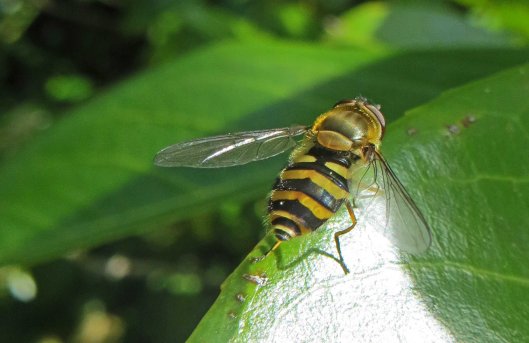
These are a couple of the Volucella species, the Chinooks of the hoverfly world and, if you live in the southern parts of Britain, they’ll be out there hovering along woodland paths and in local parks near you right now. Before you panic and get out your fly swat, these hoverflies may look a little menacing – and some of them even look a bit like Hornets – but, please rest assured, they are all completely harmless. And, if you take a little time for a closer look, you will soon see what incredibly handsome mini-beasties they are.

180826 Volucella zonaria (4) 

180826 Volucella zonaria (3)
180826 Volucella zonaria (2)
180826 Volucella zonaria (1)

With a wing length between 15 and 20mm, Volucella zonaria is the largest British hoverfly and is sometimes known as the Hornet mimic. (There is a very similar species called Volucella inanis but we don’t see them very often in south Wales.) Since arriving in Britain, on England’s south coast, in the 1930s, V. zonaria has made itself at home and has spread west and northwards. During July and August, I’ve seen several of these beauties at Lavernock Nature Reserve and along our local rail trail, a former railway line now a tree-lined foot- and cycling path.

180826 Volucella pellucens (1)

With its large size and black-and-white colouring, Volucella pellucens is a very distinctive hoverfly and easy to identify. You can see why it’s also known as the Great Pied hoverfly. When it’s not feasting on pollen and nectar, it can often be found defending its airspace by hovering around head height along paths and trails. If you stand still, it will sometimes approach to check you out but, once again, it will do you absolutely no harm and move out of your way when you carry on walking. 

180826 Volucella pellucens (2)
180826 Volucella pellucens (3)
180826 Volucella pellucens (4)
Like Loading...

November at Cosmeston

02 Saturday Dec 2017

Posted by sconzani in autumn, insects, nature, parks

≈ Leave a comment

Tags

British dragonflies, Common Darter, Cosmeston Lakes Country Park, flies, fly, hoverfly, Mary Gillham Archive Project

I’ve only had a couple of visits to Cosmeston Lakes Country Park this month because my volunteer work on the Mary Gillham Archive Project has been taking up a bit more time as we try to get as much as possible done before the project effectively finishes at Christmas – though, having said that, I did spend four hours at Cosmeston last Friday trying to replicate, for the project website, photos Mary had taken in the early days of the park. These are a couple of those: Mary’s photo of the west lake in September 1987 on the left, and my photo from the same spot thirty years later on the right.

171202 Cosmeston west lake Sep 1987
171202 Cosmeston west lake Nov 2017

But I digress … apart from the berry-eating visitors, the Redwings and the Mistle thrushes, and finally managing to grab a couple of half-decent photographs of a Green woodpecker, I haven’t found anything particularly noteworthy bird-wise at Cosmeston during November. I have, however, been impressed by the numbers of insects still around, despite the fact that it has been noticeably colder, with daytime highs in the low teens and several overnight frosts.

171202 common darter (1)
171202 common darter (2)
171202 common darter (3)
171202 bumblebee

On 5 November, the ‘fireworks’ at Cosmeston were these lovely little Common darters. In an area shaded from the cool westerly wind but warmed by the bright sun, each had claimed itself a fencepost to bask on. And, nearby, a lone bumblebee looked like it wanted to snuggle for warmth into this seed-head ‘duvet’ of Old man’s beard (Clematis vitalba).

171202 fly (1)
171202 fly (2)
171202 hoverfly

On 24 November, though my focus was on finding the exact spots where Mary had taken her photos, I did still have one eye on the wildlife and noticed quite a lot of flies about. Like the dragonflies of two weeks earlier, these two flies and one hoverfly were favouring sheltered spots on wood to make the most of the sunshine.

Like Loading...

A little hoverating

13 Thursday Jul 2017

Posted by sconzani in insects, nature

≈ 4 Comments

Tags

British hoverflies, hoverflies, hoverfly, Leucozona glaucia, Leucozona laternaria, Merodon equestris, Xylota segnis, Xylota sylvarum

I admit to not taking as many photos of hoverflies this year as last. This is partly due to an overwhelming fascination with everything, meaning I tend not to focus on one family for long (I’m sure this will pass once I’ve lived in Britain a few more years and have seen a lot of the more common species of everything), but also because the area where I now live has less hoverfly-friendly habitats. Still, I do photograph them when I see them, especially any newbies. Here are a few …

170713 Leucozona glaucia
170713 Leucozona laternaria

Leucozona glaucia and Leucozona laternaria
These are not hoverflies I see very often but they are quite distinctive and that makes them easy to identify, not something you can say about many invertebrates. They’re woodland species but can often be found grazing on the hogweed flowers that frequently grow along woodland rides and edges. The two species are almost identical, except for the colour of their front legs (not always easily seen) and their scutellum (much easier – that’s the half moon shaped bit on their backs between their wings). The scutellum is yellow in Leucozona glaucia (above left) and dark in L. laternaria (above right).

170713 Merodon equestris

Merodon equestris
This medium-sized hoverfly looks a lot like a bumblebee, but the shape of its head and its large eyes are easy ways to tell that it’s not. In their top-notch field guide Britain’s Hoverflies, Stuart Ball and Roger Morris note that Merodon equestris is ‘believed to have been introduced into Britain in daffodil bulbs imported from Europe around the end of the 19th century’. That’s because the larvae of this hoverfly develop inside bulbs and have a particular liking for daffodils.

170713 Xylota segnis
170713 Xylota sylvarum

Xylota segnis and Xylota sylvarum
These are just two of the seven members of the Xylota genus – I have yet to see the others. With their lanky legs, they look a bit like sawflies and they also prefer gathering pollen and honeydew from leaves rather than flowers, so they’re not your run-of-the-mill hoverflies. I find these quite difficult to tell apart but X. segnis has a black bottom (above left) whereas X. sylvarum’s is yellow (above right) (not easy to see when they’re resting and covering their bottoms with their wings, as in my photo).

Like Loading...

Checking out commas and dashes

01 Thursday Sep 2016

Posted by sconzani in insects, nature

≈ 4 Comments

Tags

Chrysotoxum bicinctum, Eupeodes corollae, Eupeodes luniger, hoverfly, Migrant hoverfly, Xanthogramma pedissequum

No, this is not a post about English grammar! I thought I would share more photos of hoverflies before they disappear for the year and it just so happens that today’s selection is not at all scientific – same genus, same habitats – they just all happen to be decorated with commas or dashes.

160901 Chrysotoxum bicinctum

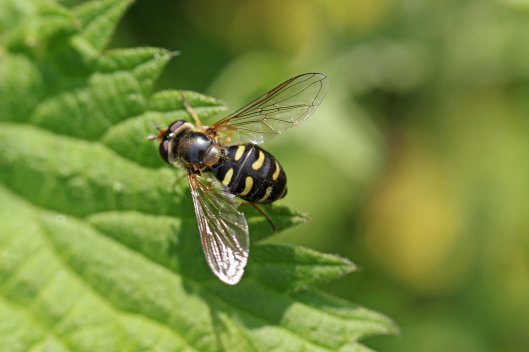
First up is Chrysotoxum bicinctum, with the two yellow stripes across its abdomen making it quite a distinctive hoverfly and also more easily identifiable than many. Its antennae are a little longer than most hoverflies so this little critter is really trying very hard to imitate a wasp … but without the sting. Usually found in grassy habitats with nearby trees and shrubs for shelter, Chrysotoxum bicinctum can be seen from May to September in most parts of Britain.

160901 Eupeodes corollae (a)
160901 Eupeodes corollae (b)

Also known as the Migrant hoverfly because, despite its small size, it is migrates across Europe and North Africa, Eupeodes corollae is rather a pretty little hoverfly. It can be a little tricky to ID as the males and females have different yellow markings and, to further confuse things, it is also very similar to Eupeodes luniger, up next. Interestingly, E. corollae has been used as way to control insects and aphids on fruit plantations and in greenhouses … but it turns out they ate more fruit than aphids!

160901 Eupeodes luniger

The difference between E. corollae and Eupeodes luniger is in those commas that adorn their abdomens. In E. corollae the markings extend to the edge of the abdomen, whereas in E. luniger they do not. That sounds an easy way to identify them but these hoverflies are not huge critters and it’s not always easy to see those edges. Eupeodes luniger is another migrating species that is known to fly long distances. In Britain they are mostly found in the southern counties.

160901 Xanthogramma pedissequum

Last but certainly not least is Xanthogramma pedissequum, another striking wasp mimic, with characteristic vertical stripes on its thorax and horizontal dashes on its abdomen. Though peaking in June and July, it can be seen in southern Britain from May through to September, in grassy places and along tracks and trails where there is some bare dirt. Presumably, this is because their larvae feed on the aphids found in ants’ nests so they are looking along those pathways for suitable egg-laying places.

Like Loading...

Camouflage

23 Tuesday Aug 2016

Posted by sconzani in insects, nature

≈ Leave a comment

Tags

Bindweed flower, camouflage, Crab spider, Eupeodes corollae, hoverfly, insect camouflage, Misumena vatia, sawfly larve

On the positive side … this Sawfly larva has its colour co-ordination working very well, though maybe needs to work on its choreography.

160823 camouflage (2)

On the negative side … or positive side, depending on whether you’re identifying with the Crab spider (probably Misumena vatia) using the large white Bindweed flower as its lair, or the spider’s victim, a hoverfly (probably Eupeodes corollae).

160823 camouflage (1)

Like Loading...

‘Dedicated Naturalist’: ‘brief but fleeting pleasure’

11 Thursday Aug 2016

Posted by sconzani in 'Dedicated Naturalist' Project, insects, nature

≈ Leave a comment

Tags

Eristalis arbustorum, Eristalis pertinax, Eristalis tenax, hoverfly

A snippet from my volunteer work on the ‘Dedicated Naturalist’ Project, helping to decipher and digitise, record and publicise the life’s work of naturalist extraordinaire, Dr Mary Gillham. This is the type of delightful insight we volunteers often discover when mining Mary’s copious archives for biological records. Never a dull moment and frequent chuckling make a volunteer’s work fun!
 160811 Eristalis pertinax

Eristalis tenax drone flies   MATING, presumably, on 10 July 1981. The larger female sitting on flower head – buddleja, hogweed, thistle, &c. Male, or up to four males, smaller but marked exactly the same, narrow yellow bands on black, hovering 2-3” above for often considerable while before darting momentarily down, sweeping a tail across hers and swooping away again. No wonder he has to hover so persistently to get his aim just right for the ‘brief but fleeting pleasure’. Only 1 male is accepted, she flying off almost at once.

160811 Eristalis arbustorum

My images are the same genus but not the same species as Mary’s though their behaviour is similar. The top image is Eristalis pertinax, a very common hoverfly in much of Britain, and the lower image depicts a female (left) and male (right) Eristalis arbustorum, in a situation similar to that Mary has described, with the male awaiting his chance to pounce.

For the full story about the Mary Gillham Archive Project, check out our website, and follow our progress on Facebook and on Twitter.

Like Loading...

Heavenly hoverflies

06 Saturday Aug 2016

Posted by sconzani in insects, nature

≈ 8 Comments

Tags

Cheilosia illustrata, hoverflies, hoverfly, Myathropa florea, Pellucid fly, Volucella inanis, Volucella pellucens, Volucella zonaria

It’s been ages since I shared any images of hoverflies, yet I photograph them almost every time I go wandering and the summer months are prime hover time, so let’s remedy my omission.

160806 Cheilosia illustrata

Cheilosia illustrata
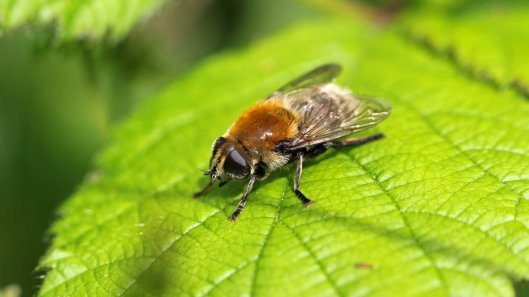
I’ve nicknamed this not-so-little hoverfly, Mr Scruffy, as it’s a bumblebee mimic and therefore rather furry, and oft times a little unkempt looking. It inhabits hedgerows and the shrubby edges of woodlands, and can frequently be seen feeding on the flowers of umbellifers – I see it most often on hogweed or sun-basking on nearby leaves.

160806 Myathropa florea

Myathropa florea
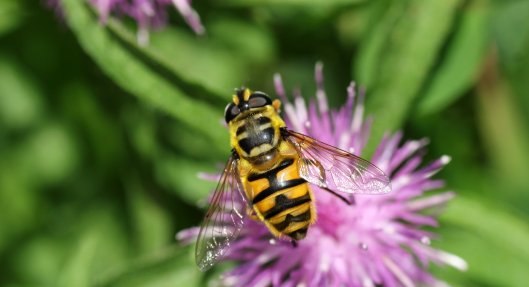
With its striking and often very vibrant pattern of yellow, orange and black markings, Myathropa florea is easily identifiable and, though it flies from May to October, it seems to be the hoverfly I’m seeing most often right now. Like Mr Scruffy, it enjoys feasting on the umbellifer flowers that grow along woodland edges. Can you see why it’s often called the Batman hoverfly?

160806 Volucella inanis (1)
160806 Volucella inanis (2)

Volucella inanis
Now we come to the big boys (and girls) of the hoverfly world. Volucella inanis and its very similar friend Volucella zonaria (below) are hornet mimics but don’t worry – with their vibrant colouring they may look like hornets, but they’re harmless. V. inanis was once localised around London but is gradually spreading throughout Britain.

160806 Volucella zonaria

Volucella zonaria
Volucella zonaria is a European hoverfly which, apparently, only got established in Britain in the 1940s. Since then it’s slowly been expanding its range, though I haven’t yet seen one in Wales. My photo was taken in Exeter in 2014, when I didn’t even know such things as hoverflies existed.

160806 Volucella pellucens

Volucella pellucens
Also known as the Pellucid Fly, Volucella pellucens is quite easy to recognise, as it has a distinctive broad white band across its body. It also favours umbellifer flowers and, though it can be seen right through till October, it’s almost past its peak season so get out and see if you can find one.

Like Loading...

The helicopters of the insect world

24 Tuesday May 2016

Posted by sconzani in insects, nature

≈ Leave a comment

Tags

Brachyopa, Epistrophe eligans, hoverfly, Portevinia maculata, Syrphus

My fascination with hoverflies continues, fuelled partly by their intriguing habit of hovering directly in front of me, as if checking out my human intrusion into their air space. Or maybe it’s just their curiosity. A friend told me to hold out my hand, palm down, for the little critters to use as a landing pad … and, you know, it actually works!

Here are four of my latest helicoptering friends.

160524 Epistrophe eligans Cathays Cem

My first newbie is Epistrophe eligans, discovered in Cathays Cemetery on 24 April. Their preferred habitat is sunny hedgerows and woodland edges, with a particular liking for Hawthorn and Blackthorn. Their yellow stripe patterns can vary a lot so I was grateful for the help of the experts on the UK Hoverflies Facebook group for an ID on this (and, in fact, on all my hoverflies).

160524 Syrphus ribesii Cathays Cem

Here’s another from Cathays Cemetery. It’s one of the Syrphus species, possibly ribesii, but it’s almost identical to Syrphus vitripennis and my photo doesn’t show enough detail to differentiate the two. This is one of Britain’s more common hoverflies so I hope to get a better photo eventually.

160524 Portevinia maculate Bute Park

I found this Portevinia maculata in Bute Park last week, flitting around in the Ramsons, its favourite plant. Its black and grey colouring make this an easy one to identify.

160524 Brachyopa sp forest farm

And last but not least, one of the Brachyopa species. At first, I didn’t realise this was a hoverfly, as its grey and brown colours are rather unusual, though they also make it easy to recognise … once you know what it is.

Like Loading...

Four more hoverflies

07 Thursday Apr 2016

Posted by sconzani in insects, nature, nature photography

≈ 8 Comments

Tags

Chequered hoverfly, Episyrphus balteatus, hoverfly, Long hoverfly, Marmalade hoverfly, Melanostoma scalare, Meliscaeva auricollis, Sphaerophoria scripta

Of the 250 different hoverfly species in Britain I now have photos of seven – just a wee way to go yet then. At least it’s still early in the season – hoverflies are normally around from March to November, and numbers tend to peak in the hottest months of summer. Here are my four new finds:

160407 Episyrphus balteatus cathays cem

Episyrphus balteatus
Rather deliciously called the Marmalade hoverfly, presumably not because it tastes good but because of the orange and black bands of colour on its upper abdomen. These give it a wasp-like appearance, which helps to deter predators but can scare people into thinking they’re a swarm of wasps when they group together. It’s the most common hoverfly in Britain, and large numbers also migrate here from Europe.

160407 Meliscaeva auricollis cathays cem

Meliscaeva auricollis
Like that previous one, I found this little guy enjoying the wood anemones at Cathays Cemetery. The cemetery has large numbers of mature trees, which is the perfect environment for Meliscaeva auricollis. This is one of the earliest hoverflies to wake from hibernation, sometimes appearing as early as January if the winter’s been mild.

160407 Melanostoma scalare  merthyr mawr

Melanostoma scalare
Though its name literally means ‘Laddered Black-mouth’, this little creature’s common name is the Chequered hoverfly and you can perhaps just make out the chequerboard pattern on its upper abdomen. I found this one  at Merthyr Mawr National Nature Reserve last weekend. It prefers open grassland, damp rather than dry, and is usually to be found flying and feeding close to ground level.

160407 Sphaerophoria scripta methyr mawr

Sphaerophoria scripta
This was another find from Merthyr Mawr. Its common name is the Long hoverfly, presumably because, as you can see in my photo, the body of the male extends past the end of the wings which is unusual in hoverflies. This critter is a prolific breeder, with the ability to complete a full life cycle (eggs to adult) in just 16 days, which means up to 9 generations can occur in one year. Amazing!

Like Loading...

Hoverflies: handsome and harmless

31 Thursday Mar 2016

Posted by sconzani in insects, nature, nature photography

≈ 3 Comments

Tags

Eristalis pertinax, Helophilus pendulus, hoverfly, Platycheirus albimanus, Tapered Drone Fly, The Footballer, The Sunfly, White-footed Hoverfly, Wood anemone

How is it that I am only just discovering hoverflies? Of course, I’ve seen them before, hovering silently over the garden bed and feeding on flower nectar, like the humming birds of the insect world, but I wasn’t aware of all their good qualities. For one thing, they’re clever – they mimic wasps and bees to deter predators, but they don’t sting. For another, because they feed on nectar and pollen, they’re excellent pollinators. And, for a third, many types of hoverfly larvae eat aphids and other plant-suckers so they’re every gardener’s friend and can potentially be used for biological control of those hugely damaging pests.

What I also discovered last weekend was that hoverflies love wood anemones and I found three species feasting on the beautiful drifts of plants currently flowering in my local cemetery. These are they – and I’m sure this is just the start of a beautiful new fascination!

Eristalis pertinax

Meet Eristalis pertinax, otherwise know as the Tapered Drone Fly. It’s a common sight throughout Britain, from March right through to November, and loves hedgerows and woodland trails.

Helophilus pendulus

As it’s a lover of fine sunny days, Helophilus pendulus is commonly known as The Sunfly, though some call it The Footballer because its stripy thorax resembles a team strip. Personally, I prefer its scientific name, which means ‘dangling marsh-lover’, a reference to its liking for watery places.

Platycheirus albimanus

And last and smallest for today is Platycheirus albimanus, the White-footed Hoverfly (though only the swelling on the front foot of the male is, in fact, pale). It’s another to be found throughout Britain, in gardens and hedgerows, from March to November.

Like Loading...
Newer posts →

About me

sconzani

sconzani

I'm a writer and photographer; researcher and blogger; birder and nature lover; countryside rambler and city strider; volunteer and biodiversity recorder.

View Full Profile →

Follow earthstar on WordPress.com

Enter your email address to follow this blog and receive notifications of new posts by email.

Recent blog posts

  • Bay bunnies March 11, 2026
  • Beating the gloom March 10, 2026
  • No booming Bittern but … March 9, 2026
  • Danish scurvygrass March 8, 2026
  • Four weeks early March 7, 2026

From the archives

COPYRIGHT

Unless otherwise acknowledged, the text and photographs on this blog are my own and are subject to international copyright. Nothing may be downloaded or copied without my permission.

Fellow Earth Stars!

  • Unknown's avatar
  • Unknown's avatar
  • Unknown's avatar
  • Unknown's avatar
  • Unknown's avatar
  • Unknown's avatar
  • Unknown's avatar
  • Unknown's avatar
  • Unknown's avatar
  • Unknown's avatar
  • Unknown's avatar
  • Unknown's avatar
  • Unknown's avatar
  • Unknown's avatar
  • Unknown's avatar
  • Unknown's avatar
  • Unknown's avatar
  • Unknown's avatar
  • Unknown's avatar
  • Unknown's avatar
  • Unknown's avatar
  • Unknown's avatar
  • Unknown's avatar
  • Unknown's avatar
  • Unknown's avatar
  • Unknown's avatar
  • Unknown's avatar
  • Unknown's avatar
  • Unknown's avatar
  • Unknown's avatar
  • Unknown's avatar
  • Unknown's avatar
  • Unknown's avatar
  • Unknown's avatar
  • Unknown's avatar
  • Unknown's avatar
  • Unknown's avatar
  • Unknown's avatar
  • Unknown's avatar
  • Unknown's avatar
  • Unknown's avatar
  • Unknown's avatar
  • Unknown's avatar
  • Unknown's avatar
  • Unknown's avatar
  • Unknown's avatar
  • Unknown's avatar
  • Unknown's avatar
  • Unknown's avatar
  • Unknown's avatar

Blog at WordPress.com.

Privacy & Cookies: This site uses cookies. By continuing to use this website, you agree to their use.
To find out more, including how to control cookies, see here: Cookie Policy
  • Subscribe Subscribed
    • earthstar
    • Join 668 other subscribers
    • Already have a WordPress.com account? Log in now.
    • earthstar
    • Subscribe Subscribed
    • Sign up
    • Log in
    • Report this content
    • View site in Reader
    • Manage subscriptions
    • Collapse this bar
 

Loading Comments...
 

You must be logged in to post a comment.

    %d