• ABOUT
  • BIRDING 2018
  • Birding 2019
  • BLOG POSTS
  • Butterflies 2018
  • Resources

earthstar

~ a celebration of nature

earthstar

Monthly Archives: August 2020

224/366 Burdock beasties

11 Tuesday Aug 2020

Posted by sconzani in insects, nature, plants, wildflowers

≈ 1 Comment

Tags

Arctium minus, Banded burdock fly, British insects, Common Green Shieldbug, Lesser burdock, Palomena prasina, Terellia tussilaginis

Lesser burdock (Arctium minus) seems to be having a good year as I’ve been finding lots of vigorous, flowering plants during my local walks, and they’re home to some interesting mini-beasties. One I always look for is the Banded burdock fly (Terellia tussilaginis), and it also seems to be thriving locally.

200811 lesser burdock (4)200811 lesser burdock (5)200811 lesser burdock (6)

And, on one particular clump of burdock, I found a bounty of Common green shieldbugs (Palomena prasina), as I’ve done before (see my previous post Keeping it in the family, from September 2017). Once again, these were a mix of juvenile stages, 3rd and 4th instars, I think.

200811 lesser burdock (1)
200811 lesser burdock (2)
200811 lesser burdock (3)

Of course, there are lots of other mini-beasties that also find Burdock flower nectar delicious – these two bees are just a couple of examples. What beasties have you seen on Burdock?

200811 lesser burdock (7)
200811 lesser burdock (8)
Like Loading...

223/366 Buzzard

10 Monday Aug 2020

Posted by sconzani in birds, nature

≈ Leave a comment

Tags

birding, birdwatching, British birds, Buzzard

I was walking along a field edge today, enjoying the peace and the pleasant breeze, when this beautiful creature flew into a tree right next to me.

200810 buzzard (1)

It wasn’t exactly an elegant landing – I think this was a young Buzzard, judging by its inexact flying skills and its call, and the bird hadn’t realised there was a human standing close by.

200810 buzzard (2)

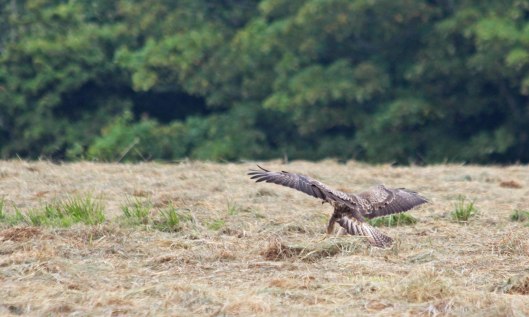
I managed to fire off a few quick photos before the bird flew out from the tree, across the field, and landed in the newly mown grass.

200810 buzzard (3)

It seemed to realise fairly quickly that sitting on the ground when people and their dog were approaching up the hill wasn’t exactly a smart idea, so it quickly took to the air again and found another, taller tree to perch in. Safety for the Buzzard, and a precious experience for me!

200810 buzzard (4)200810 buzzard (5)

Like Loading...

222/366 Damp feet

09 Sunday Aug 2020

Posted by sconzani in flowers, nature, plants, wildflowers

≈ 4 Comments

Tags

British wildflowers, Common restharrow, Marsh woundwort, Purple loosestrife, wildflower

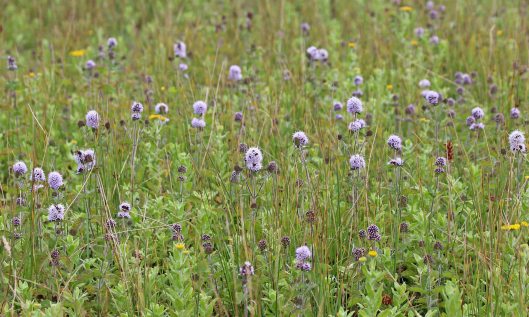
It’s Sunday – I think we need some wildflowers, and this week we have three plants that are all partial to living with damp feet, all with flowers in the pink-purple colour range.

200809 marsh woundwort (1)
200809 marsh woundwort (2)

200809 marsh woundwort (3)

Marsh woundwort (Stachys palustris)
As its common name implies, this wildflower thrives in locations where its roots can keep damp: near lakes and rivers, ponds and bogs. Its scientific name also refers to this: palustris means ‘of swamps’, while Stachys means ‘spike of flowers’, which is exactly what this lovely wildflower exhibits. And, of course, all the ‘woundworts’ were used extensively by herbalists, in this case, as an ointment to aid aching joints and as a dressing to help heal cuts and other wounds.

200809 purple loosestrife

Purple loosestrife (Lythrum salicaria)
Here’s another widespread plant of marshes and riversides, and that’s exactly where I found this example, alongside the River Ely in Cardiff. Unfortunately, I couldn’t get any closer for better photos of the individual flowers. In Flora Britannica, Richard Mabey gives this explanation for this plant’s intriguing name: ‘“Loose-strife” is a literal translation of the Greek name for the plants, which in classical times was believed to be so powerful “that if placed on the yoke of inharmonious oxen, [it] will restrain their quarrelling”.’

200809 mint (1)
200809 mint (2)
200809 mint (3)

200809 mint (4)

Water mint (Mentha aquatica)
And here’s another plant that prefers living with damp, not necessarily wet feet. Once again, this wildflower’s name tells the story: ‘Water’ and ‘aquatica’; and you only have to rub the leaves to release the delicious minty aroma, which is so refreshing. Insects love it too, as you can see from the hoverfly, butterfly and bee in the photos above.

Like Loading...

221/366 Multitudinous chattering

08 Saturday Aug 2020

Posted by sconzani in birds, nature

≈ Leave a comment

Tags

birding, birdwatching, British birds, juvenile Swallows, Swallow

We saw the swallows gathering in the sky
And in the osier-aisle we heard them noise …

200808 swallows (1)200808 swallows (2)

The pilgrims of the year waxed very loud
In multitudinous chattering.
~  George Meredith, Modern Love, sonnet xlvii

200808 swallows (3)200808 swallows (4)

Like Loading...

220/366 Second brood

07 Friday Aug 2020

Posted by sconzani in insects, nature

≈ 1 Comment

Tags

British butterflies, butterfly, Dingy Skipper, second brood butterflies, second brood Dingy skipper

In 2019, when I began keeping records of all my sightings and focused seriously on searching for and recording butterflies, I saw my first local Dingy skipper on 30 April and my last on 10 June. This year, I spotted my first on 6 May and what I thought was the last on 26 May, a relatively short season.

200807 dingy skipper 24july

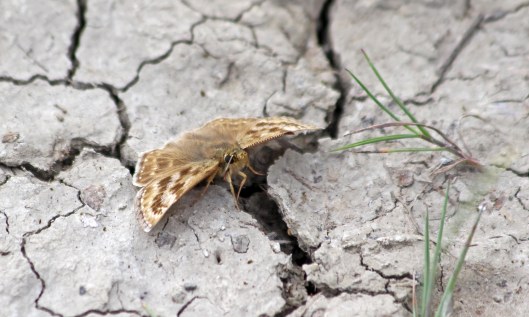
Then, remarkably, on 24 July, I saw a pristine, obviously newly emerged Dingy skipper, and I’ve seen two more this week, one on 4 August and another the following day. These are second brood butterflies, the product of the breeding of the butterflies seen in May.

200807 dingy skipper 4aug

In his brilliant book Life Cycles of British & Irish Butterflies, Peter Eeles write that ‘Good summers may … result in a partial second brood in southern England that emerges in late July and August (a second brood is the norm in Southern Europe), and this may become a more frequent and widespread phenomenon in Britain and Ireland with a changing climate’. It seems, here in south Wales, that phenomenon is already happening.

200807 dingy skipper 5aug

Like Loading...

219/366 Gull update

06 Thursday Aug 2020

Posted by sconzani in birds, nature

≈ 1 Comment

Tags

birding, birdwatching, British birds, gull fledgling, Lesser black-backed gull

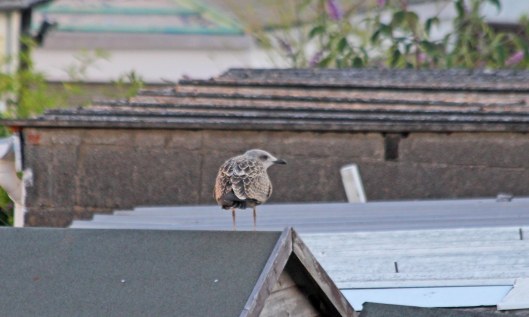
It’s two weeks today since junior Lesser black-backed gull flew the coop – or, in this case, the nest amongst the chimney pots, and I’m pleased to report that it seems to be thriving.

200806 lesser black-backed gull fledgling (1)

I’ve spotted it on neighbouring shed and house rooftops several times, and I’m sure it’s the same bird, as one or both of the adults sit on the nest site while junior screeches at them for food from somewhere nearby. It’s so nice to be able to report a success story.

200806 lesser black-backed gull fledgling (2)

Like Loading...

218/366 Vervain

05 Wednesday Aug 2020

Posted by sconzani in nature, plants, wildflowers

≈ Leave a comment

Tags

British wildflowers, Grangemoor Park, The Chief Herb, The Herb, Verbena officinalis, Vervain, wildflower

I’ve been trying, very slowly, to learn the names of more wildflowers so, when I couldn’t put a name to this plant at Grangemoor Park a couple of days ago, I made sure to take lots of photos of it. And today I found out this straggly, nondescript wildflower is not just any old plant, this is ‘The Herb’!

200805 vervain (1)

Vervain (Verbena officinalis) was so valued by herbalists in Anglo Saxon times that it was considered ‘The Chief Herb’, and was ‘a venerated plant, valued not just as a panacea (it was trumpeted as a cure for the plague in the Middle Ages) but as a magical charm, which could both protect against witches and demons and conjure up devilry of its own’ (Flora Britannica). 

200805 vervain (3)
200805 vervain (2)
Like Loading...

217/366 Lep larvae

04 Tuesday Aug 2020

Posted by sconzani in insects, nature

≈ 2 Comments

Tags

British butterflies, British moths, butterfly larvae, Cinnabar moth, Lepidoptera, moth larvae, Small tortoiseshell

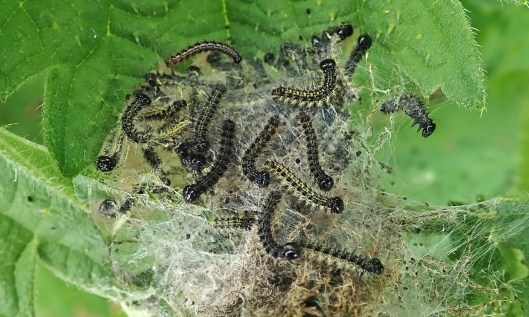
Last week we had a closer look at a couple of butterfly eggs; today we have some Lepidoptera larvae. First up, the caterpillars of the beautiful Small tortoiseshell butterfly, which has two generations of eggs and larvae each year – these will be second generation. The eggs are laid in batches and, when they hatch, the caterpillars stay together to create a communal web where they shelter when they’re not out basking in the sun or munching on nettles. The caterpillars go through five stages (instars) before pupating – these look to be 3rd instars.

200804 small tortoiseshell (1)

200804 small tortoiseshell (2)
200804 small tortoiseshell (3)

In total contrast to the Small tortoiseshell larvae, which are subtle and subdued in their colour and patterns, the larvae of the Cinnabar moth are vibrant, even flamboyant. Their bright orange and black stripes are designed to be seen, warning predators not to eat them as they are poisonous.

200804 cinnabar moth (1)200804 cinnabar moth (2)

Like Loading...

216/366 Red bartsia

03 Monday Aug 2020

Posted by sconzani in nature, plants, wildflowers

≈ 2 Comments

Tags

British wildflowers, Cosmeston Lakes Country Park, Odontites vernus, Red bartsia, wildflowers

Red bartsia (Odontites vernus) is an unobtrusive wildflower that I have tended to overlook until now but it’s very common in Cosmeston Lakes Country Park, one of my local haunts, so I thought I should take a closer look at it.

200803 red bartsia (1)

The Wildlife Trust website says Red bartsia can be found growing on low-fertility soils – places like waste ground, brownfield sites, along the edges of roads and railway tracks, and it survives in these more barren places because it’s semi-parasitic on the plants around it, tapping in to their root systems to gather extra nutrients.

200803 red bartsia (2)
200803 red bartsia (3)

Its scientific name is interesting: Odontites comes from Ancient Greek ὀδούς meaning tooth and apparently refers to the fact that Pliny the Elder used this plant to treat toothache; vernus refers to springtime, presumably when this plant comes to life for the year. It flowers for several months over the summer, providing a good nectar source for many species of bee and wasp.

200803 red bartsia (4)

Like Loading...

215/366 Mr Warty

02 Sunday Aug 2020

Posted by sconzani in amphibian, nature

≈ Leave a comment

Tags

British amphibians, Bufo bufo, Common toad, toad, warty skin

Or it might be Mrs Warty – I’m not sure how you tell the gender of a Common toad, and this one wasn’t hanging around to let me have a second look anyway. Those warts aren’t really warts, of course – they’re swellings above glands in the skin that can secrete a poisonous substance that acts as a defence mechanism.

200802 toad (1)

Though they’re not the most attractive of creatures, toads are, according to my Fauna Britannica, ‘highly intelligent, learn quickly and can be tamed, and they are extremely long-lived (40 years at least)’. Apparently, they also have ‘a marked homing instinct and will return to the same resting spot in some damp corner time after time’, so perhaps I need to go back for another look at this one.

200802 toad (2)

Like Loading...
← Older posts
Newer posts →

About me

sconzani

sconzani

I'm a writer and photographer; researcher and blogger; birder and nature lover; countryside rambler and city strider; volunteer and biodiversity recorder.

View Full Profile →

Follow earthstar on WordPress.com

Enter your email address to follow this blog and receive notifications of new posts by email.

Recent blog posts

  • Bearded tit!!! April 3, 2026
  • A Portland Bill Kestrel April 2, 2026
  • A proliferation of Peacocks April 1, 2026
  • Little owl March 31, 2026
  • Distant seabirds March 30, 2026

From the archives

COPYRIGHT

Unless otherwise acknowledged, the text and photographs on this blog are my own and are subject to international copyright. Nothing may be downloaded or copied without my permission.

Fellow Earth Stars!

  • Unknown's avatar
  • Unknown's avatar
  • Unknown's avatar
  • Unknown's avatar
  • Unknown's avatar
  • Unknown's avatar
  • Unknown's avatar
  • Unknown's avatar
  • Unknown's avatar
  • Unknown's avatar
  • Unknown's avatar
  • Unknown's avatar
  • Unknown's avatar
  • Unknown's avatar
  • Unknown's avatar
  • Unknown's avatar
  • Unknown's avatar
  • Unknown's avatar
  • Unknown's avatar
  • Unknown's avatar
  • Unknown's avatar
  • Unknown's avatar
  • Unknown's avatar
  • Unknown's avatar
  • Unknown's avatar
  • Unknown's avatar
  • Unknown's avatar
  • Unknown's avatar
  • Unknown's avatar
  • Unknown's avatar
  • Unknown's avatar
  • Unknown's avatar
  • Unknown's avatar
  • Unknown's avatar
  • Unknown's avatar
  • Unknown's avatar
  • Unknown's avatar
  • Unknown's avatar
  • Unknown's avatar
  • Unknown's avatar
  • Unknown's avatar
  • Unknown's avatar
  • Unknown's avatar
  • Unknown's avatar
  • Unknown's avatar
  • Unknown's avatar
  • Unknown's avatar
  • Unknown's avatar
  • Unknown's avatar
  • Unknown's avatar

Blog at WordPress.com.

Privacy & Cookies: This site uses cookies. By continuing to use this website, you agree to their use.
To find out more, including how to control cookies, see here: Cookie Policy
  • Subscribe Subscribed
    • earthstar
    • Join 642 other subscribers
    • Already have a WordPress.com account? Log in now.
    • earthstar
    • Subscribe Subscribed
    • Sign up
    • Log in
    • Report this content
    • View site in Reader
    • Manage subscriptions
    • Collapse this bar
 

Loading Comments...
 

You must be logged in to post a comment.

    %d