• ABOUT
  • BIRDING 2018
  • Birding 2019
  • BLOG POSTS
  • Butterflies 2018
  • Resources

earthstar

~ a celebration of nature

earthstar

Author Archives: sconzani

Mining bees

08 Tuesday Apr 2025

Posted by sconzani in insects, spring

≈ 4 Comments

Tags

Andrena species, Andrenidae, bees, British bees, mining bees, solitary bees

Mining bees, the Adrenidae, are notoriously difficult to identify I find, and, as my brain is already swimming with factors to consider when identifying spiders (and other life stuff that is happening in the background), I don’t have the mental capacity to tackle bees at the moment. Maybe they can be next year’s project.

In the meantime though, I can still appreciate how exceedingly cute they are, especially when they sit still for a few moments (which isn’t often) and allow me to get some close up photos (also not often).

Like Loading...

Spider: Larinioides cornutus

07 Monday Apr 2025

Posted by sconzani in spiders

≈ Leave a comment

Tags

British spiders, Larinioides cornutus, spider on Gorse

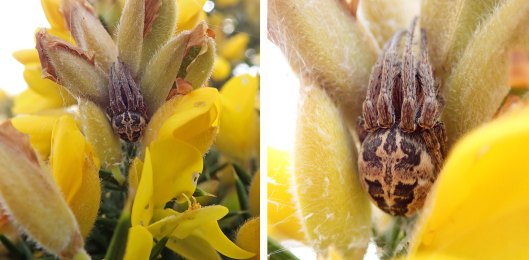
I was looking for weevils when I spotted these two spiders on the same Gorse bush at the Cardiff Bay Wetlands Reserve recently. (This was a bit freaky: I need both distance and reading glasses but don’t like bifocals so, when I’m out walking, I have to push my distance specs down my nose and get my head close to small things to see with my unspectacled eyes.)

I initially thought these two spiders were Agalematea redii but quickly realised I was wrong about the first one I found. It is, in fact, Larinioides cornutus, a species that prefers living on vegetation in damp places but can also be found on built structures in those areas. It’s common in the south of Britain, becoming less so the further north you travel. The Spider and Harvestman Recording Scheme website has a map and lots of interesting information.

And, though it looks different to my untrained eye, it turns out that the second spider is also Larinioides cornutus. The very helpful British Spiders social media person on Bluesky explained: ‘The second looks like Larinioides cornutus as well. Although the alpha form of Agelenatea redii has quite similar patterning, it has a noticeably smaller and rounder abdomen – one of those things that’s obvious when you meet it!’ I’m hoping I meet it a little more distantly than I did with the two shown here!

Like Loading...

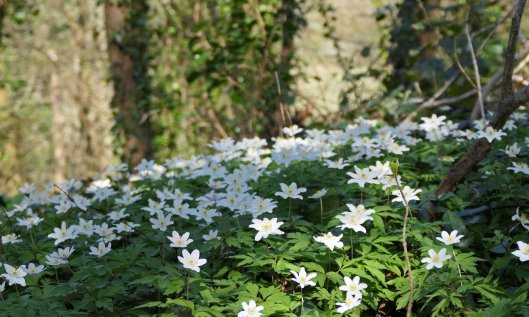
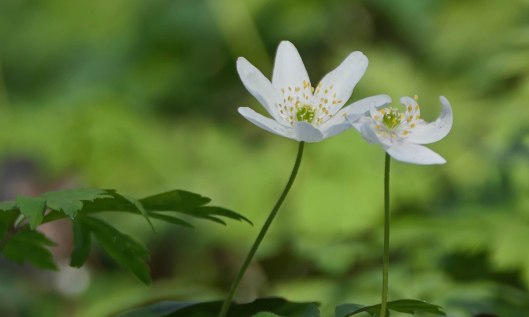
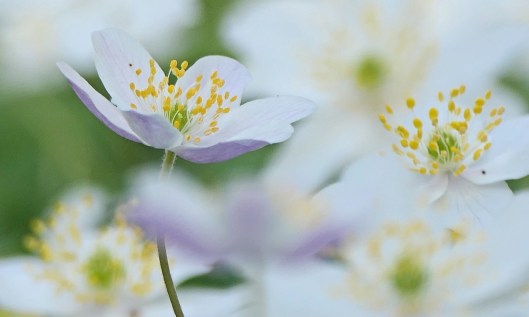
Pretty drooping weeping flowers

06 Sunday Apr 2025

Posted by sconzani in flowers, spring, wildflowers

≈ 2 Comments

Tags

British wildflowers, Spring colour, spring wildflowers, Wood anemone, woodland flowers

‘The Wood anemone’, a poem by John Clare (1793-1864)

The wood anemone through dead oak leaves
And in the thickest woods now blooms anew,

And where the green briar and the bramble weaves
Thick clumps o’green, anemones thicker grew,

And weeping flowers in thousands pearled in dew
People the woods and brakes, hid hollows there,

White, yellow and purple-hued the wide wood through.
What pretty drooping weeping flowers they are:

The clipt-frilled leaves, the slender stalk they bear
On which the drooping flower hangs weeping dew,

How beautiful through April time and May
The woods look, filled with wild anemone;

And every little spinney now looks gay
With flowers mid brushwood and the huge oak tree.

Like Loading...

Slug: Ambigolimax

05 Saturday Apr 2025

Posted by sconzani in molluscs

≈ Leave a comment

Tags

Ambigolimax, British molluscs, British slugs, slug

For some reason the national recorder for slugs thought I’d used a photo app to identify this slug, which I’ve never done. Maybe he just assumed everyone uses them these days, and, in this case, he was ‘afraid the photograph app which you have used has led you astray’. The truth is that I’d googled, and searched various online websites, and couldn’t work out what this slug was so had just recorded it as one of the Arion species. I even managed to get that wrong – turns out this is one of the Three-band slugs (though, I have to admit, I can only see two bands) and ‘At present we cannot tell which of the two species it is without dissection so it has to be recorded just as Ambigolimax‘. I’ll know for the future.

Like Loading...

Peacocks aplenty

04 Friday Apr 2025

Posted by sconzani in insects

≈ Leave a comment

Tags

Aglais io, British butterflies, butterfly, Peacock, Peacock butterfly

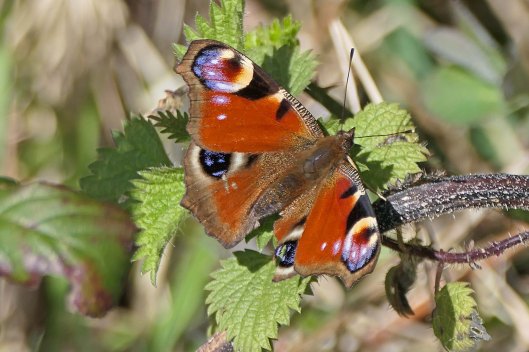
I didn’t see my first Peacock butterfly (Aglais io) of the year until 30 March, which is much later than usual – these are butterflies that overwinter as adults so can emerge from hibernation on warm sunny days even in winter. Now, just six days later, my count is up to eight, as we – and the butterflies – bask in a spell of unseasonally dry and warm spring weather.

I’ve discovered that, when I first see a new butterfly species each year, I have a tendency, a predilection, a need even to photograph every single one I see, as if taking their image makes them real – or perhaps it’s just my attempt to capture the heartfelt joy I feel at seeing butterflies on the wing, and relive that feeling when I’m looking at my photographs at home. After a few days, and having seen several, I begin to relax and focus more on taking better images – at least, I think the photograph below, taken today, is better than the earlier ones above.

Like Loading...

Finally, a Wheatear

03 Thursday Apr 2025

Posted by sconzani in birds, spring

≈ Leave a comment

Tags

birding, birdwatching, British birds, Cardiff Bay birding, migrating birds, spring migration, Wheatear

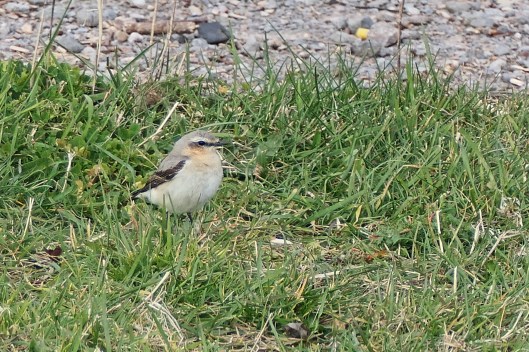
Maybe it’s because we’ve had a lot of fine clear weather and, rather than dropping down to rest in Cardiff Bay, they’ve continued their flights north. Maybe they just don’t like the look of the place, with the increasing numbers of people and out-of-control dogs. Whatever the reason, there’s been a notable absence of migrating Wheatears around the Bay this year, with just one bird noted a couple of days ago and then two, a male and a female, this morning. And that’s around two weeks later than usual – for three of the past four years, I’ve seen my first Wheatears on 20 March. Fortunately, I had already decided to walk around part of the Bay this morning so was there when I bumped in to the birder who’d just seen the male Wheatear, and here he is (the bird not the birder) …

Like Loading...

A new rookery

02 Wednesday Apr 2025

Posted by sconzani in birds, spring

≈ Leave a comment

Tags

birding, birdwatching, breeding Rooks, British birds, nesting Rooks, Rook, rookery

During the Springs of 2022 and 2023, birders throughout Wales volunteered their time to check suitable locations for rookeries, the multi-nest colonies where Rooks raise their young. The survey, organised by the Welsh Ornithological Society, was conducted to establish concrete information about the breeding population in Wales because Rooks are now red-listed, their numbers threatened by changing land use and human occupation, amongst other things.
I didn’t take part in the survey as one of my birding friends had already put his hand up for my local area and, as I don’t drive, getting around an alternative 2-square-kilometre tetrad would have proven difficult, but I did chat about where I’d seen Rooks with my friend. His searches of the local area only produced one rookery, which is well known locally and has been established for a very long time – the street where it’s located is called Rookery Lane!
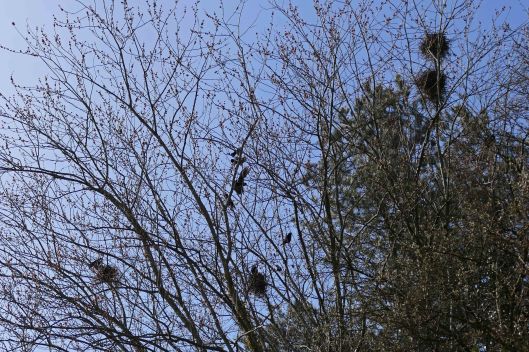
So, you can perhaps imagine my surprise and delight when, during Sunday’s local meander, I spotted a new rookery. It’s adjacent to a series of fields where horses graze and where I’ve often seen Rooks feeding – in fact, the photo and video I included in my post Rook pair-bonding behaviour, 18 February, were taken at that location. I think this new Rookery has only been established very recently, perhaps even this year, as it certainly wasn’t around in Spring 2023 when the survey took place, and I’ve never noticed it when I’ve walked that way previously.

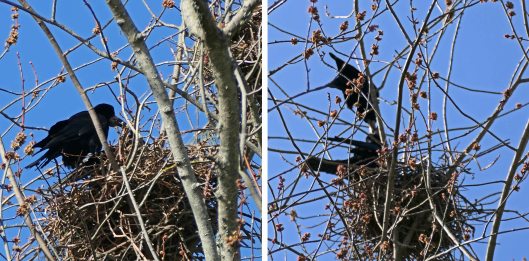
I counted just 5 nests, and at least 8 Rooks – others may have been off looking for food. Not being familiar with Rook breeding behaviour, I initially thought the adult birds were feeding well-grown young but I’ve since been informed that, as Rooks only begin breeding in March, this was more likely to be adults feeding their partners so they don’t have to leave the nest when they’re sitting on eggs or raising their young. I’ll certainly be keeping a close eye on these trees during the next couple of months, hoping to catch glimpses of any chicks as they grow and fledge.

Like Loading...

Speckled woods on the wing

01 Tuesday Apr 2025

Posted by sconzani in insects, nature, spring

≈ Leave a comment

Tags

British butterflies, butterfly, Speckled wood, spring butterflies, Spring colour, Wood argus

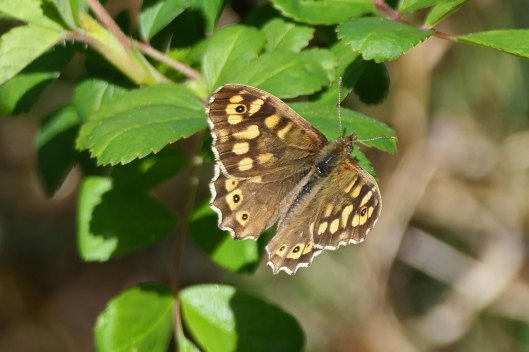
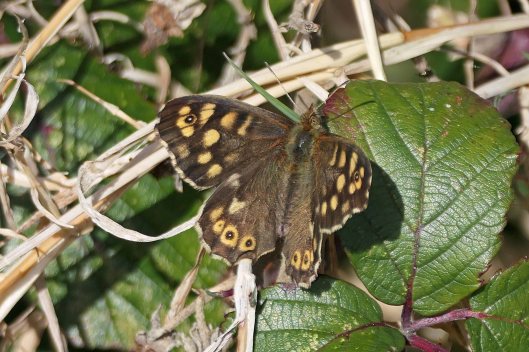
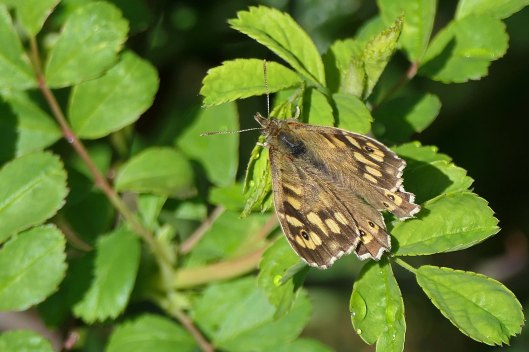
Sunday was a brilliant day for butterflies, with my first three Speckled woods of the year, each in a different location, all basking on hedgerows and flitting out to defend their territories as I passed by.

With its rich chocolately brown background colour mixed with small circular dollops of creamy yellow, it’s almost like a living crème egg … or is my imagination just being overly affected by the bombarding of pre-Easter advertisements?

My brilliant guide book, Life Cycles of British & Irish Butterflies, tells me that the Speckled wood was once called the Wood argus, the name Argus coming from the ‘many-eyed shepherd of Greek mythology’. That seems a very apt name for this beautiful creature.

Like Loading...

Spider: Zygiella x-notata

31 Monday Mar 2025

Posted by sconzani in spiders

≈ Leave a comment

Tags

British spiders, Missing sector orb weaver, Silver-sided sector spider, Zygiella x-notata

I mentioned in a post last week (Spider: Steatoda nobilis, 25 March) that I’d had confirmation of my identification of two recent spider finds on my local park railings; this is the second of those spiders, Zygiella x-notata, also known as the Silver-sided sector spider.

Though I didn’t see it, this orb weaver is most well known for a singular feature of its web – for some unknown reason it always misses out one sector when constructing its circular web (you can see a photo of this on Wikipedia here), and so another of its common names is Missing sector orb weaver.

According to my guide book, these spiders are often found in places occupied by humans, so houses, sheds, and other types of building, as well as amongst vegetation in urban areas, and they are widespread around the world. The individual I found was too busy consuming its prey to be concerned with web building but I will look out for that distinctive web during future checks of the park railings.

Like Loading...

Mad with joy

30 Sunday Mar 2025

Posted by sconzani in flowers, spring

≈ 3 Comments

Tags

British wildflowers, Spring colour, spring wildflowers, wildflowers

People from a planet without flowers would think we must be
mad with joy the whole time to have such things about us.
~ Iris Murdoch, from the novel A Fairly Honourable Defeat, Vintage, 1970

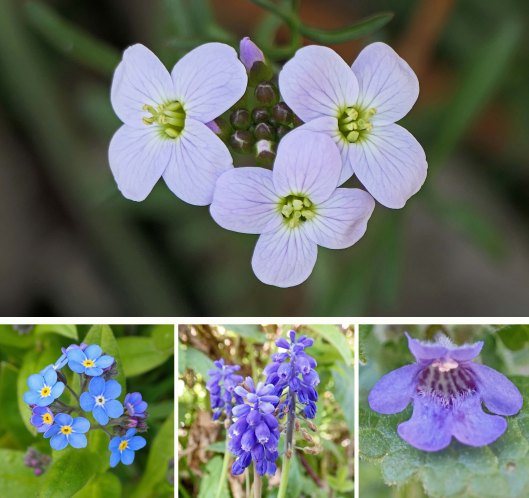
Mad as a hatter, me, as the Spring wildflowers begin to bloom. I hope you’re enjoying them too!


Like Loading...
← Older posts
Newer posts →

About me

sconzani

sconzani

I'm a writer and photographer; researcher and blogger; birder and nature lover; countryside rambler and city strider; volunteer and biodiversity recorder.

View Full Profile →

Follow earthstar on WordPress.com

Enter your email address to follow this blog and receive notifications of new posts by email.

Recent blog posts

  • Turtle bug March 23, 2026
  • Springtime invasives March 22, 2026
  • Singing Dunnocks March 21, 2026
  • New cat: Large yellow underwing March 20, 2026
  • Curious Coal tit March 19, 2026

From the archives

COPYRIGHT

Unless otherwise acknowledged, the text and photographs on this blog are my own and are subject to international copyright. Nothing may be downloaded or copied without my permission.

Fellow Earth Stars!

  • Unknown's avatar
  • Unknown's avatar
  • Unknown's avatar
  • Unknown's avatar
  • Unknown's avatar
  • Unknown's avatar
  • Unknown's avatar
  • Unknown's avatar
  • Unknown's avatar
  • Unknown's avatar
  • Unknown's avatar
  • Unknown's avatar
  • Unknown's avatar
  • Unknown's avatar
  • Unknown's avatar
  • Unknown's avatar
  • Unknown's avatar
  • Unknown's avatar
  • Unknown's avatar
  • Unknown's avatar
  • Unknown's avatar
  • Unknown's avatar
  • Unknown's avatar
  • Unknown's avatar
  • Unknown's avatar
  • Unknown's avatar
  • Unknown's avatar
  • Unknown's avatar
  • Unknown's avatar
  • Unknown's avatar
  • Unknown's avatar
  • Unknown's avatar
  • Unknown's avatar
  • Unknown's avatar
  • Unknown's avatar
  • Unknown's avatar
  • Unknown's avatar
  • Unknown's avatar
  • Unknown's avatar
  • Unknown's avatar
  • Unknown's avatar
  • Unknown's avatar
  • Unknown's avatar
  • Unknown's avatar
  • Unknown's avatar
  • Unknown's avatar
  • Unknown's avatar
  • Unknown's avatar
  • Unknown's avatar
  • Unknown's avatar

Blog at WordPress.com.

Privacy & Cookies: This site uses cookies. By continuing to use this website, you agree to their use.
To find out more, including how to control cookies, see here: Cookie Policy
  • Subscribe Subscribed
    • earthstar
    • Join 668 other subscribers
    • Already have a WordPress.com account? Log in now.
    • earthstar
    • Subscribe Subscribed
    • Sign up
    • Log in
    • Report this content
    • View site in Reader
    • Manage subscriptions
    • Collapse this bar
 

Loading Comments...
 

You must be logged in to post a comment.

    %d