119/365 Somebody’s got babies!
29 Monday Apr 2019
Posted in 365DaysWildin2019, birds, nature, spring
29 Monday Apr 2019
Posted in 365DaysWildin2019, birds, nature, spring
28 Sunday Apr 2019
Posted in 365DaysWildin2019, birds, nature, spring
Tags
baby birds, birding, birdwatching, British birds, Cosmeston, Cosmeston Lakes Country Park, Moorhen, Moorhen chicks
I’m delighted to report that the five Moorhen chicks that hatched in the dipping pond at Cosmeston on 1 April are all still alive and thriving. Their parents have obviously been doing a brilliant job of rearing and protecting them – no easy task when there are so many gulls at Cosmeston and a couple of local Buzzards that are always looking for an easy meal.
27 Saturday Apr 2019
Posted in 365DaysWildin2019, insects, nature, seaside

Storm Hannah has been making her presence felt since yesterday evening and, though the sun came out late morning, the wind is still blowing a gale. I headed down to Cardiff Bay to see if the storm had blown any interesting birds in but found nothing unusual – in fact, very few birds at all were braving the weather. So, I tootled along to the beach at the base of Penarth Head cliffs, where it was a little more sheltered, and there I found a new fossil – always a bonus! – and this cute little ground beetle plodding purposefully along amongst the detritus, not at all interested in having its photo taken.
26 Friday Apr 2019
Posted in 365DaysWildin2019, birds, nature, spring
Tags
birding, birdwatching, British birds, gull nesting among chimney pots, Lesser black-backed gull, nest building, nesting, urban gull nest
So this is what all yesterday’s gull screeching was about!
Mr Lesser black-backed gull was letting the neighbourhood know he had arrived and this was his territory so look out any other gull couples who thought they’d try to muscle in. And today Mr LBB and his mate were getting down to the serious business of nest building amongst the chimney pots across the back lane from my flat – or, at least, Ms LBB was – he just stood watching her do all the work. I do hope the nest goes ahead – what a thrill it would be to watch from my bedroom window as they raise their chicks!
25 Thursday Apr 2019
Posted in 365DaysWildin2019, birds, nature
The Lesser black-backed gulls mostly disappear during the winter months – I’m not sure where they go – but, come the Spring, they return, and they’re very good at making their presence felt. They often wake me very early in the morning, sometimes by jumping about on my roof, other times with their screeching calls. I’m hoping you can imagine the noise by looking at this series of photos.
24 Wednesday Apr 2019
Posted in 365DaysWildin2019, nature, plants, wildflowers
Tags
ale-hoof, blue flowers, Blue runner, British flora, British wildflowers, Glechoma hederacea, Ground ivy
Ground-ivy (Glechoma hederacea) is a type of dead-nettle, common in woodlands, lurking under hedgerows and scrambling over dampish spaces. Richard Mabey’s Flora Britannica tells me this pretty little plant was once known as blue runner because of its blue-ish flowers and its habit of spreading via overground runners. Another interesting titbit: ‘before hops became widely used in brewing, it was once one of the chief bittering agents in the making of beer’, which is why another of its common names is ale-hoof.
23 Tuesday Apr 2019
Posted in 365DaysWildin2019, birds, nature, seaside
Tags
#365DaysWild, Bar-tailed Godwit, birding, birdwatching, British birds, south Wales coastal path, Sully, Sully beach, Whimbrel
I caught the bus to Sully this morning, walked along to the western end of the bay, then retraced my steps and walked along the coastal path all the way back to Penarth, about 7½ miles in total. And it was superb, especially the stroll along Sully Bay. I’d timed my walk to be there just before high tide, as that often pushes the birds up closer to the path that runs along the top of the beach, and this was a high high tide so, with some stealthy sneaking along behind the trees, I managed to get really close to a flock of six Whimbrels.
And, to my delight, the Whimbrels had two Bar-tailed godwits with them. I’ve never managed to get so close to either species before so I was really chuffed. And, if you’re wondering why the godwits don’t look the same, the bird on the left (below) is a male in his summer breeding colours, while the bird on the right might be a juvenile or a non-breeding adult.
22 Monday Apr 2019
Posted in 365DaysWildin2019, insects, nature
Tags
#365DaysWild, British damselflies, Cosmeston, Cosmeston Lakes Country Park, damselflies, damselfly, Large Red damselfly, Pyrrhosoma nymphula
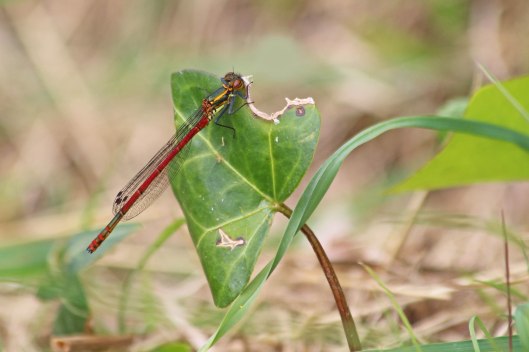
Our warm Easter weekend weather has certainly brought out the critters. Today I spotted my first damselfly of 2019, this lovely Large Red (Pyrrhosoma nymphula). Woot!

21 Sunday Apr 2019
Posted in 365DaysWildin2019, birds, nature
Tags
#365DaysWild, Acrocephalus scirpaceus, birding, birdwatching, British birds, British warblers, Cosmeston Lakes Country Park, Reed warbler
There are thirteen species of warbler that regularly breed in Britain and I find them some of the trickiest to identify as several are typically LBJs, little brown jobs.

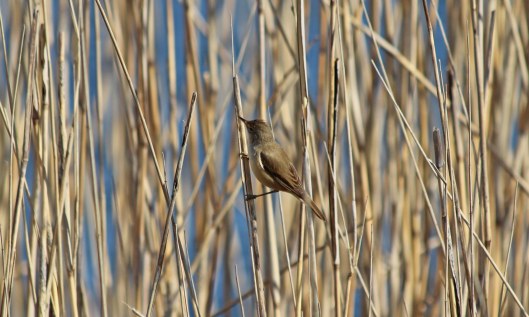
The Reed warbler (Acrocephalus scirpaceus) is, I think, one of the easier, partly because of its recognisable warble and partly because it lives up to its name by living almost exclusively in reeds.

But it’s an elusive little bird so I’ve never managed to get clear photos of it … until today, when this little beauty was so intent on finding food that I was able to watch it for over ten minutes. Just perfect!

20 Saturday Apr 2019
Posted in 365DaysWildin2019, flowers, nature, plants, spring
It doesn’t matter what name you call it by – Ramsons, Londoner’s lily or Wild garlic – it smells. Some people even find the smell overwhelming but I don’t mind it, and when you see Ramsons flowering en masse, they’re really very lovely.
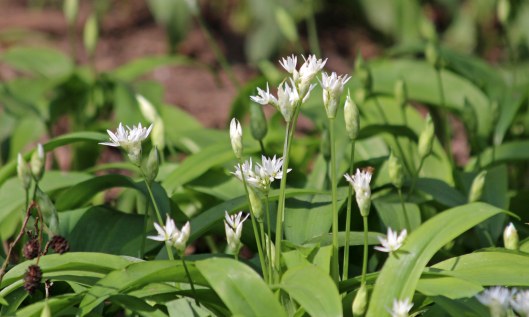
According to Richard Mabey in my ever-useful Flora Britannica, Ramsons were ‘unmistakable and abundant enough to figure in Old English place names’ and he gives the following examples: ‘Ramsey Island off Pembrokeshire; Ramsbottom, Lancashire; Ramsdell, Hampshire; Ramsholt, Suffolk; Ramshope, Northumberland; and Ramshorn, Staffordshire’.
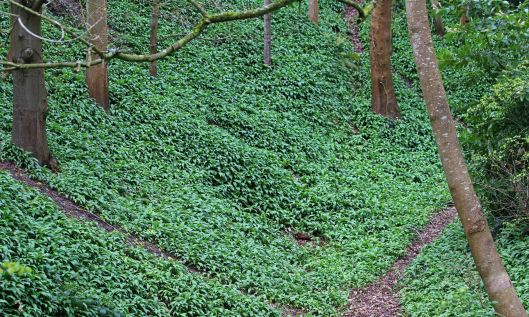
Here in Penarth, the banks of the stream that flows alongside Alexandra Park are carpeted with Ramsons at this time of year, and their growth is also lush in the wild gardens in Cardiff’s Roath Park and under the trees in Bute Park’s woodland trail. Get sniffing!

You must be logged in to post a comment.