• ABOUT
  • BIRDING 2018
  • Birding 2019
  • BLOG POSTS
  • Butterflies 2018
  • Resources

earthstar

~ a celebration of nature

earthstar

Category Archives: flowers

The inedible carrot

10 Thursday Aug 2017

Posted by sconzani in flowers, nature, wildflowers

≈ Leave a comment

Tags

British flora, British wildflowers, carrot, Daucus carota, umbel, umbellifer, Wild carrot, wildflowers

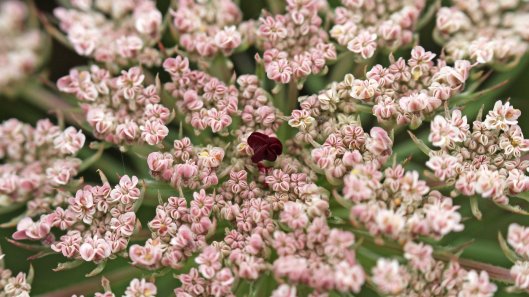
I’m finally starting to get a handle on the various umbellifers to be found in this land and the progression of their flowering through the seasons. Here in Wales, one of those currently in full flower is the Wild carrot (Daucus carota).
wild carrot (1)

Its leaves smell of the edible carrot but I’ve read that the roots of this wild variety are ‘thin and wiry and bear little resemblance to the thick, orange tap-roots of the cultivated vegetable’ so that firmly rules out any foraging! I also read, in my copy of Richard Mabey’s trusty Flora Britannica, that edible carrots ‘were developed from a distinct subspecies, ssp.sativa, probably native to the Mediterranean, and brought to Britain in the 15th century’. Fascinating!

wild carrot (3)
wild carrot (4)
wild carrot (5)
wild carrot (6)
wild carrot (7)

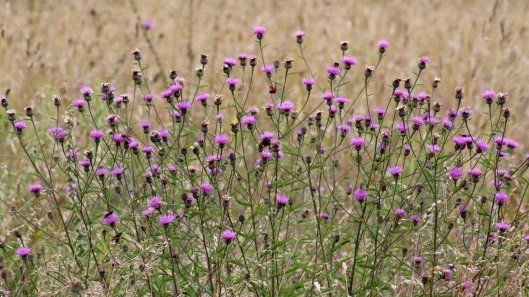
Meanwhile, the Wild carrots continue to grow straight and about 3 feet tall in my local wild places, to the delight of the hoverflies, sawflies, soldier beetles and other assorted insects that seem particularly to enjoy them. They have quite distinctive feathery leaves and often, but not always, a very tiny pinkish-red flower in the exact centre of their umbel. Also, when they’ve finished flowering, the umbels contract to a nest-like shape, which is why one of their common names is Bird’s-nest.

wild carrot (2)

Like Loading...

Pulling the little blossom threads

04 Friday Aug 2017

Posted by sconzani in flowers, nature, wildflowers

≈ 2 Comments

Tags

Centaurea nigra, Common knapweed, John Clare poem, John Clare poem May, knapweed, love divination game with knapweed

170804 Common Knapweed (1)

In days of old a love divination game would be played with the flowers of the Common knapweed (Centaurea nigra), as described here by English poet John Clare (1793 – 1864) in his poem ‘May’:

170804 Common Knapweed (3)
170804 Common Knapweed (4)

They pull the little blossom threads
From out the knapweeds button heads
And put the husk wi many a smile
In their white bosoms for awhile
Who if they guess aright the swain
That loves sweet fancys trys to gain
Tis said that ere its lain an hour
Twill blossom wi a second flower
And from her white breasts hankerchief
Bloom as they ne’er had lost a leaf

170804 Common Knapweed (5)
170804 Common Knapweed (6)

170804 Common Knapweed (2)

Like Loading...

A triumph of nature

28 Friday Jul 2017

Posted by sconzani in flowers, nature, parks, wildflowers

≈ Leave a comment

Tags

British flora, British native orchids, British orchids, Broad-leaved helleborine, Epipactis helleborine, orchid, terrestrial orchid

These Broad-leaved helleborines (Epipactis helleborine) are a little past their best but I just had to post about them, partly because I love all of Britain’s native orchids and partly because these are survivors. You would usually find these terrestrial orchids growing in clearings or along path edges in forests and woodlands but these particular plants are growing on the edges of a former rubbish tip, now urban park, in Cardiff. Despite humans dumping thousands of tons of rubbish on their habitat, then covering that over with imported rocks and soil, laying tarmac paths and planting cultivated plants like cotoneaster, these helleborines have somehow survived. The idea of that made my day!

170728 Broad-leaved helleborine (6)
170728 Broad-leaved helleborine (5)
170728 Broad-leaved helleborine (4)
170728 Broad-leaved helleborine (7)
170728 Broad-leaved helleborine (2)
170728 Broad-leaved helleborine (3)
170728 Broad-leaved helleborine (1)
Like Loading...

The Butterfly bush

24 Monday Jul 2017

Posted by sconzani in flowers, insects, nature

≈ Leave a comment

Tags

British butterflies, British dragonflies, Buddleia, Buddleja davidii, butterflies, Butterfly bush, Comma, dragonfly, Penarth Rail Trail, Red Admiral, Southern hawker

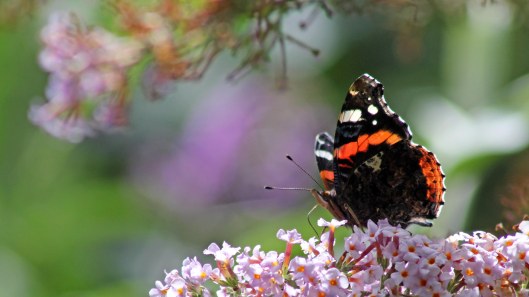
Buddleja davidii is not called the Butterfly bush for nothing.

170724 Buddleja & butterfly (1)

Running through the town where I live there’s a rail trail – the path of a former railway line that was closed to rail traffic back in the 60s and is now a wonderful walking and cycling trail, lined with trees, shrubs and wildflowers. At one point along the trail, there’s a group of several Buddleja bushes that have now reached small tree height and are currently covered in their gorgeous lilacy purplish flowers. When I walked past today, they were alive with butterflies: I counted at least nine Red admirals, three Commas, two Speckled woods and a selection of Whites.

170724 Buddleja & butterfly (2)
170724 Buddleja & butterfly (3)
170724 Buddleja & butterfly (4)
170724 Buddleja & butterfly (5)
170724 Buddleja & butterfly (6)
170724 Buddleja & butterfly (7)
170724 Buddleja & butterfly (8)

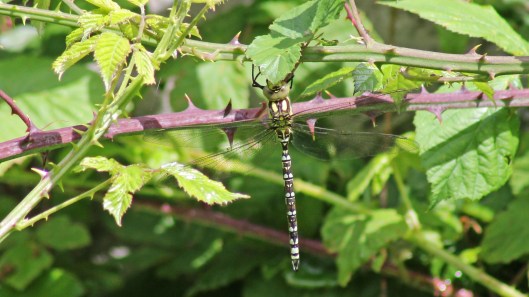
An added bonus was a Southern hawker dragonfly that was also patrolling the area. Just brilliant!

170724 Southern hawker

Like Loading...

The Pimpernels

21 Friday Jul 2017

Posted by sconzani in flowers, nature, plants, wildflowers

≈ 5 Comments

Tags

Anagallis arvensis, Anagallis arvensis ssp. foemina, Anagallis tenella, Blue pimpernel, Bog pimpernel, British flora, Lysimachia nemorum, pimpernel, Scarlet pimpernel, Yellow pimpernel

For Floral Friday this week I bring you the Pimpernels.

170721 Scarlet pimpernel

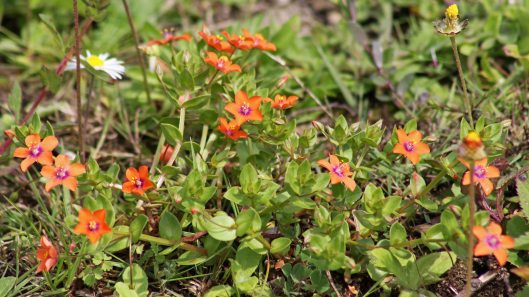
First, the pimpernel flower many of you will be familiar with, Scarlet pimpernel (Anagallis arvensis), also known as Old man’s weathervane and Poor man’s weatherglass due to its habit of shutting its petals when the weather becomes wet or dull. (I imagine they will be very firmly shut against today’s wind and rain!) The flower also functions as a timekeeper as it opens its petals around 8am and closes them at 2pm, even when the weather’s fine.

170721 Blue-flowered Scarlet pimpernel (1)
170721 Blue-flowered Scarlet pimpernel (2)

I only learned quite recently that the Scarlet has a subspecies, the Blue pimpernel (Anagallis arvensis ssp. foemina). This is supposedly quite rare and mostly found in southern England, though the one in my photographs is growing in my friend Hilary’s south Wales garden.

170721 Bog pimpernel

As its name suggests, the Bog pimpernel (Anagallis tenella) prefers watery places, marshy areas and soggy peat bogs. Its delicate pink flowers sprinkle the ground like petals under a blossoming cherry tree.

170721 Yellow pimpernel

There is also a yellow-flowered pimpernel – you guessed it, the Yellow pimpernel (Lysimachia nemorum) – that is commonly seen in established deciduous woodland and alongside shaded streams. Although it carries the name pimpernel, this lovely little plant is actually a separate genus and is more closely related to plants like Creeping-Jenny (Lysimachia nummularia) and Yellow loosestrife (L. vulgaris).

How many of these lovely pimpernels have you managed to see?

Like Loading...

A tale of three bindweeds

18 Tuesday Jul 2017

Posted by sconzani in flowers, nature, wildflowers

≈ 8 Comments

Tags

bindweed, Bindweed flower, British flora, British wildflowers, Field bindweed, Hedge bindweed, Large bindweed

170718 Bindweed (3)

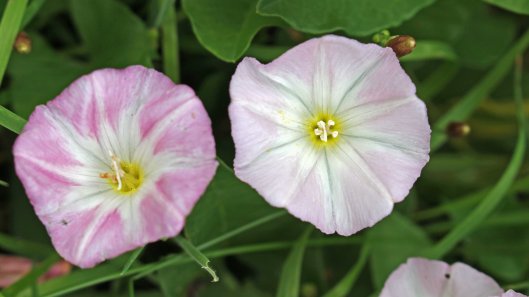
There are, in fact, five species of bindweed in Britain but I’ve only encountered three so far. One, the Field bindweed (Convolvulus arvensis) is, I think, the easiest to identify: it’s quite small, and its flowers are a delicate swirl of pink and white (as shown below).

170718 Field bindweed

Then there are the two bindweeds that have large white flowers, Hedge bindweed (Calystegia sepium) and the aptly named Large bindweed (Calystegia silvatica). To my untrained eye, these two look remarkably similar but I have recently learnt how to tell them apart so I thought I’d share that little snippet of knowledge. My wildflower key tells me that Hedge bindweed has an epicalyx of 2 bracteoles that don’t (or scarcely) overlap, whereas the Large bindweed has strongly inflated, overlapping bracteoles. Okay, so you might now be thinking, “Huh?” Well, the photos below show the difference: Hedge, left, and Large, right. Easy now, right?

170718 Bracteoles Hedge bindweed
170718 Bracteoles Large bindweed

Oh, and one more thing I found out while looking at all those bindweeds. The flowers often look like a little fairy has come along and snipped pretty patterns in their petals with miniature scissors. A fanciful idea I admit, but it’s almost true – these have been created by bees and other insects desperate to get at the sweet nectar inside so they cut their way into the flower bud before it opens.

170718 Bindweed (1)
170718 Bindweed (2)
Like Loading...

Purr-plish

07 Friday Jul 2017

Posted by sconzani in flowers, nature, wildflowers

≈ Leave a comment

Tags

#FloralFriday, British flora, British wildflowers, lilac flowers, pink wildflowers, purple flowers, wildflowers

For those of you who are not overly fond of yellow flowers – you know who you are! – I’ve been out and about looking for other hues, and the result this Floral Friday is a selection of blooms in shades of pink, lilac and purple. The flowers include Betony (Stachys officinalis), Bush vetch (Vicia sepium), Centaury (Centaurium erythraea), Devil’s-bit scabious (Succisa pratensis), Foxglove (Digitalis purpurea), Hedge woundwort (Stachys sylvatica), Herb-Robert (Geranium robertianum), Red clover (Trifolium pratense), Common restharrow (Ononis repens), Rosebay willowherb (Chamerion angustifolium), Tufted vetch (Vicia cracca) and a couple of thistley thingies. Enjoy!

170707 another thistle
170707 Betony
170707 Bush vetch
170707 Centaury
170707 Devil's-bit scabious
170707 Foxglove
170707 Hedge woundwort
170707 Herb-Robert
170707 Red clover
170707 Restharrow
170707 Rosebay willowherb
170707 thistle
170707 Tufted vetch
Like Loading...

National Meadows Day

01 Saturday Jul 2017

Posted by sconzani in flowers, insects, nature, parks, seaside, walks, wildflowers

≈ Leave a comment

Tags

Lavernock Point, Lavernock Reserve, National Meadows Day, Wildlife Trust for South & West Wales

170701 Lavernock Reserve (3)

Happy National Meadows Day!

170701 Lavernock Reserve (2)

I had a slightly premature celebration by joining a Wildlife Trust walk around Lavernock Reserve on the south Wales coast yesterday. It’s an interesting place that has only become a reserve relatively recently. Due to its prime coastal position, a gun battery was built here back in 1860s and added to during the Second World War – these now form a scheduled ancient monument.

170701 Lavernock Reserve (1)

The meadows sit upon a substrate of clay over Jurassic limestone and, thanks to the tremendous efforts of dedicated volunteers who work constantly to contain the invading scrub, the grasslands are home to many lovely plant, insect and animal species, as well as a succession of migrating birds in spring and autumn.

170701 7-spot ladybird
170701 Centaury
170701 Common red soldier beetle
170701 Common spotted orchid & Selfheal
170701 Large skipper
170701 Marmalade hoverfly
170701 Orange-spot piercer
170701 Plume moth
170701 Restharrow
170701 Ringlet
170701 Snipe fly
170701 Swollen-thighed beetle
Like Loading...

Yellow

23 Friday Jun 2017

Posted by sconzani in flowers, nature, wildflowers

≈ 4 Comments

Tags

Agrimonia eupatoria, Agrimony, Bird’s-foot trefoil, Blackstonia perfoliata, Dyer’s greenweed, Genista tinctoria, Lotus corniculata, Rhinanthus minor, wildflowers, Yellow rattle, yellow wildflowers, Yellow-wort

Yellow is the colour of the week as far as the wildflowers are concerned.

170623 Bird's-foot trefoil (1)

These are some I’ve seen: Bird’s-foot trefoil (Lotus corniculata), Yellow rattle (Rhinanthus minor), Agrimony (Agrimonia eupatoria), Dyer’s greenweed (Genista tinctoria), and Yellow-wort (Blackstonia perfoliata).

170623 Dyer's greenweed (1)
170623 Agrimony
170623 Yellow rattle
170623 Bird's-foot trefoil (2)
170623 Bird's-foot trefoil
170623 Dyer's greenweed
170623 Yellow-wort
170623 Agrimony (2)
Like Loading...

Waving the yellow flag

16 Friday Jun 2017

Posted by sconzani in flowers, nature, wildflowers

≈ 3 Comments

Tags

British flora, British native flowers, British wildflowers, Iris pseudacorus, Segg, Yellow flag iris, Yellow iris

The Yellow iris (Iris pseudacorus), also known as the Yellow flag iris, is really a spring bloomer but I’m still seeing some flowers in the damper boggy and waterside areas during my countryside wanders so I thought I’d share some photos of them before they all disappear for the summer.

170616 Yellow iris (3)

Of course, the wonderfully green, spear-like leaves don’t disappear and they are, in fact, where this plant got one of its common names, Segg. According to Richard Mabey’s Flora Britannica, Segg is a variant of sedge and is derived from the Anglo-Saxon word for a short sword, though I have also seen Segg spelt secg and the Oxford Dictionary says sedge came originally from the Old English word secg, which has Germanic origins and whence also came the Latin secare meaning ‘to cut’ – hence secateurs. Here endeth today’s lesson!

170616 Yellow iris (1)
170616 Yellow iris (2)
170616 Yellow iris (4)
Like Loading...
← Older posts
Newer posts →

About me

sconzani

sconzani

I'm a writer and photographer; researcher and blogger; birder and nature lover; countryside rambler and city strider; volunteer and biodiversity recorder.

View Full Profile →

Follow earthstar on WordPress.com

Enter your email address to follow this blog and receive notifications of new posts by email.

Recent blog posts

  • Singing from every tree top March 24, 2026
  • Turtle bug March 23, 2026
  • Springtime invasives March 22, 2026
  • Singing Dunnocks March 21, 2026
  • New cat: Large yellow underwing March 20, 2026

From the archives

COPYRIGHT

Unless otherwise acknowledged, the text and photographs on this blog are my own and are subject to international copyright. Nothing may be downloaded or copied without my permission.

Fellow Earth Stars!

  • Unknown's avatar
  • Unknown's avatar
  • Unknown's avatar
  • Unknown's avatar
  • Unknown's avatar
  • Unknown's avatar
  • Unknown's avatar
  • Unknown's avatar
  • Unknown's avatar
  • Unknown's avatar
  • Unknown's avatar
  • Unknown's avatar
  • Unknown's avatar
  • Unknown's avatar
  • Unknown's avatar
  • Unknown's avatar
  • Unknown's avatar
  • Unknown's avatar
  • Unknown's avatar
  • Unknown's avatar
  • Unknown's avatar
  • Unknown's avatar
  • Unknown's avatar
  • Unknown's avatar
  • Unknown's avatar
  • Unknown's avatar
  • Unknown's avatar
  • Unknown's avatar
  • Unknown's avatar
  • Unknown's avatar
  • Unknown's avatar
  • Unknown's avatar
  • Unknown's avatar
  • Unknown's avatar
  • Unknown's avatar
  • Unknown's avatar
  • Unknown's avatar
  • Unknown's avatar
  • Unknown's avatar
  • Unknown's avatar
  • Unknown's avatar
  • Unknown's avatar
  • Unknown's avatar
  • Unknown's avatar
  • Unknown's avatar
  • Unknown's avatar
  • Unknown's avatar
  • Unknown's avatar
  • Unknown's avatar
  • Unknown's avatar

Blog at WordPress.com.

Privacy & Cookies: This site uses cookies. By continuing to use this website, you agree to their use.
To find out more, including how to control cookies, see here: Cookie Policy
  • Subscribe Subscribed
    • earthstar
    • Join 642 other subscribers
    • Already have a WordPress.com account? Log in now.
    • earthstar
    • Subscribe Subscribed
    • Sign up
    • Log in
    • Report this content
    • View site in Reader
    • Manage subscriptions
    • Collapse this bar
 

Loading Comments...
 

You must be logged in to post a comment.

    %d