• ABOUT
  • BIRDING 2018
  • Birding 2019
  • BLOG POSTS
  • Butterflies 2018
  • Resources

earthstar

~ a celebration of nature

earthstar

Category Archives: insects

Life on a seepage

02 Thursday Mar 2023

Posted by sconzani in insects, molluscs

≈ Leave a comment

Tags

British snails, British sprngtails, Clausilia bidentata, life on a seepage, Monobella grassei, snail, springtail, stone seepage, Two-toothed door snail

On one side of a local railway station there is a huge stone embankment, perhaps 50 feet tall, that was probably constructed in the 1880s (the platforms were opened in 1888). I walked along the path next to this embankment a couple of days ago and couldn’t help but notice several areas where moisture was seeping from between the stone blocks. When I looked more closely at these seepages, I was amazed by how much life they were supporting – an intriguing habitat in miniature.
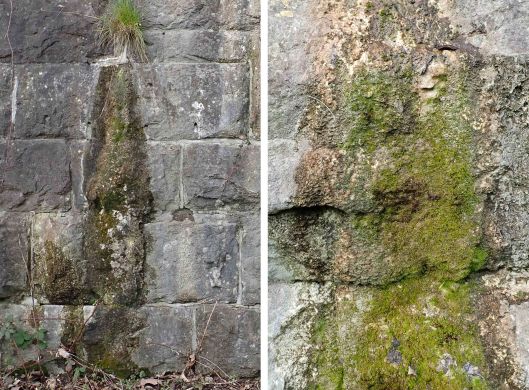
230302 seepage

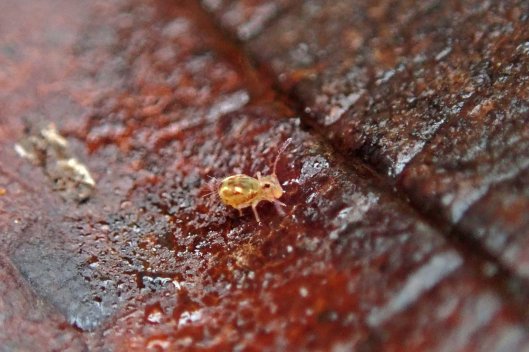
As well as a variety of mosses and lichens, I found four miniscule springtails, which I think are Monobella grassei, a new species for me, though my identification hasn’t yet been validated.
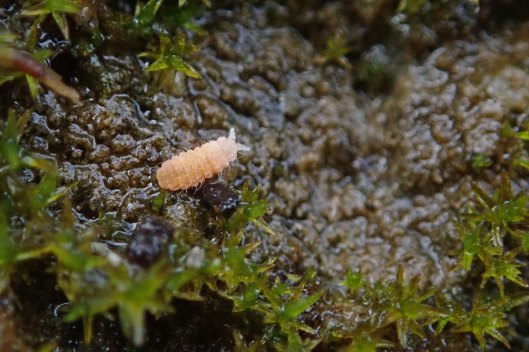
230302 Monobella grassei

There was also a stunning little snail, covered in grooves that are actually growth lines. Again, its identity has yet to be confirmed, but I think this is probably a Two-toothed door snail (Clausilia bidentata). The Naturespot website reports that it can often be found hiding in cracks in rocks and that it ’emerges in damp weather and at night and climbs high up on bare surfaces to graze on algae and lichens’, which is exactly what this one was doing.
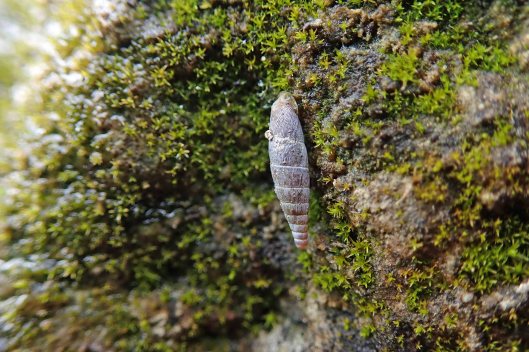
230302 clausiliidae species

Like Loading...

Comes the sun

27 Monday Feb 2023

Posted by sconzani in insects

≈ Leave a comment

Tags

British flies, Episyrphus balteatus, flies, hoverfly, Marmalade hoverfly

Comes the sun, come the flies! A sheltered south-facing ivy-covered wall with assorted small shrubs, wild plants and dense leaf litter below is their little bit of paradise. The first of these images shows my second hoverfly for the year, a Marmalade hoverfly (Episyrphus balteatus), the rest I don’t know, nor am I bothered to discover their identities – I was simply enjoying seeing little critters flitting about the vegetation again, and knowing that more, including my beloved butterflies, will soon follow.

230227 flies

Like Loading...

Gorse weevils and dung flies

22 Wednesday Feb 2023

Posted by sconzani in insects

≈ Leave a comment

Tags

British weevils, Dung fly, flowering Gorse, Gorse weevil, weevils on Gorse, Yellow dung fly

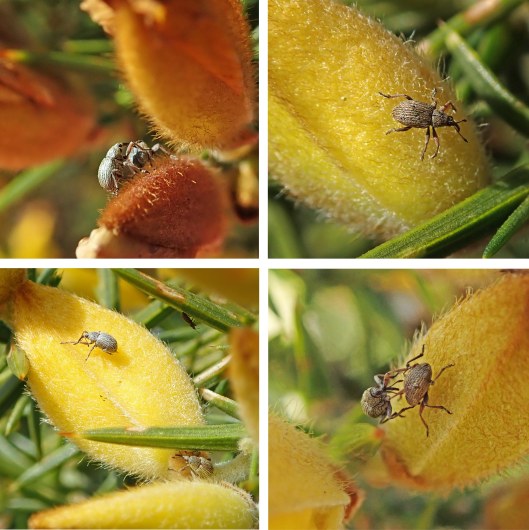
Last Sunday was very Spring-like, the sunshine warm on your back if you were out of the wind. Nature thought so too and I was delighted to see some insects out and about. Though my first butterfly of the year, a Brimstone, didn’t linger long enough for a photo, the abundance of Gorse weevils on the flowering Gorse bushes were much more obliging.

230222 gorse weevils

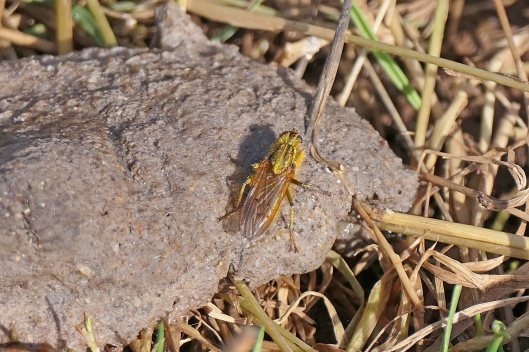
And, on a rather large splatter of dog poo, which the dog’s owner hadn’t bothered to pick up, Dung flies were out in good numbers. Which is probably one of the very few reasons I would ever want to look closely at dog poo.

230222 dung fly

Like Loading...

Galls: Phytoptus avellanae

20 Monday Feb 2023

Posted by sconzani in insects, trees

≈ 3 Comments

Tags

British galls, bud galls, gall mites, gall-causing mites, galls on Hazel, Hazel, mite galls, mites, Phytoptus avellanae

These are my latest gall finds, caused by the mite species Phytoptus avellanae, shown here on Hazel (Corylus avellana) though they can also affect the buds of Filbert (Corylus maxima). The feeding of the mites on the plant cells within the buds causes those buds to swell and multiply. You can see a comparison in my photo below, the mite-infected gall bud on the left, the normal bud on the right.

230220 gall Phytoptus avellanae (1)

The mites that cause these galls are tiny, so rarely seen, but the Dutch Bladmineerders website has some excellent photos showing them in minute detail. As with so many galls, they are thought to be widespread in Britain but are not well recorded. So, if you’re out and about enjoying a spring walk and spot some Hazel, do please cast an eye over the buds, and record any galls you see. Citizen scientists really do make a difference to our knowledge of the natural world around us.

230220 gall Phytoptus avellanae (2)

Like Loading...

Springtail and slime

17 Friday Feb 2023

Posted by sconzani in fungi, insects, leaves

≈ Leave a comment

Tags

British springtails, Dicyrtomina ornata, insects on Sycamore, leaf litter, slime, slime mould, slime on Sycamore leaf, springtail, Sycamore leaves

My most recent leaf-diving session in my favourite slimy Sycamore leaf spot turned up these two tiny treasures. This first is a miniscule springtail with a very hairy bottom which I think is Dicyrtomina ornata. There is another very similar springtail, Dicyrtomina saundersi, but that has distinct orange patches on its antennae and I’m not seeing that in my photos of this little critter.

230217 springtail

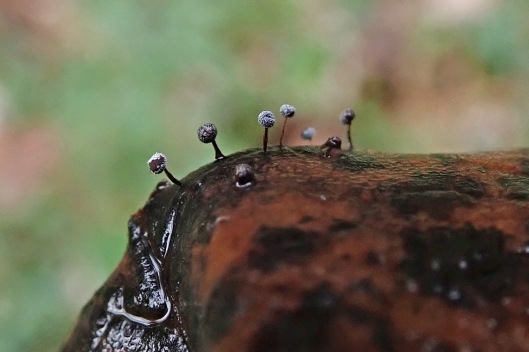
The second treasure was a lovely bit of slime, which may or may not be Metatrichia floriformis. Slime moulds can be tricky to identify accurately and I’m well out of practice.

230217 slime

Like Loading...

Leafmines: Phyllonorycter ulicicolella

13 Monday Feb 2023

Posted by sconzani in insects, plants

≈ 2 Comments

Tags

British leafminers, leafmines, leafmines on Gorse, leafmining moth larvae, moth larva, Phyllonorycter ulicicolella

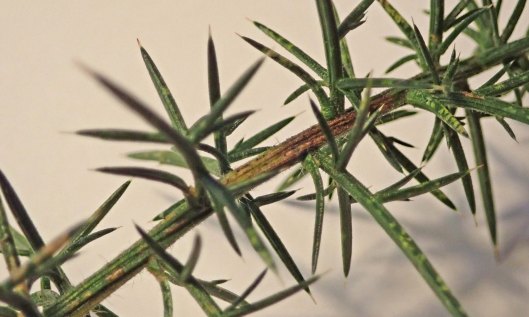
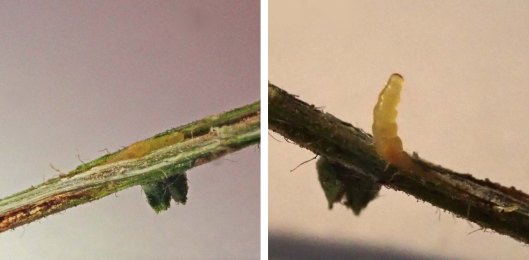
I have a new leafminer to share at last, the moth Phyllonorycter ulicicolella, which mines the stems and spines of Gorse plants. The British Leafminers website notes that this mine is rarely found, and I can certainly believe that. I’d had a look before at a few Gorse bushes but not found any mines, until a posting on Twitter by local Butterfly Conservation senior moth ecologist George led me to make a more serious effort. For me, finding new leafmines is often a matter of getting my eye in – once I’ve seen something, I find it much easier to find again. George directed me to a local Gorse bush where he’d recently found some mines – I didn’t actually check that bush but knew there were other bushes that had recently been flailed further along the same road, and bingo! The mine and larva pictured here came from a cut branch lying on the ground.

230213 phyllonorycter ulicicolella (1)

The larva is incredibly tiny – about 3mm when fully grown – so it was difficult to get clear photos. According to the UK Moths website, where you can see images of the attractive adult, this moth is ‘nationally scarce’, and can be ‘found in heathland and grassland in southern England and also northwest England’. I guess they need to update that now to include south Wales, thanks to George’s efforts in finding it locally, in various parts of Cardiff and the nearby town of Barry. I will also be continuing my search for the mines in my area.

230213 phyllonorycter ulicicolella (2)

Like Loading...

Galls: Taxomyia taxi

09 Thursday Feb 2023

Posted by sconzani in insects, trees

≈ Leave a comment

Tags

Artichoke gall, fly gall, galls, galls on Yew, insect galls, midge gall, Taxomyia taxi, Yew

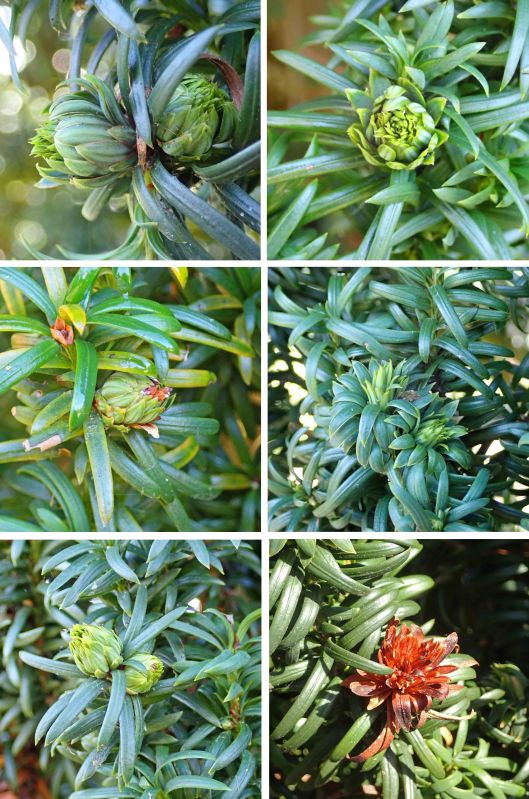
My Field Studies Council Guide to plant galls in Britain explains that the gall midge Taxomyia taxi actually causes two types of gall on Yew trees. The least common, which looks just like a swollen bud, completes its life cycle in one year – I’ve yet to find any of these. But I was very pleased earlier this week to locate several examples of the artichoke gall, in which the same midge completes a two-year life cycle. Eggs are laid in May/June, the larvae crawl in to a leaf bud and stay there, barely growing, until the following summer. At that point, they grow rapidly, over-winter again as larvae, before pupating and hatching the following May. I couldn’t find any explanation for the different life cycles.

230209 taxomyia taxi

Not wanting to kill the creatures inside, I haven’t opened up any of the galls I’ve found but, if you’re curious, as I was, about what’s inside the artichoke, the Plant Parasites of Europe website has some excellent images of the larva, the pupa and the adult fly.

Like Loading...

Fly larva: Phaonia species

06 Monday Feb 2023

Posted by sconzani in insects, leaves

≈ Leave a comment

Tags

fly larva, fly larva in leaf litter, insects in leaf litter, Phaonia fly larva, Phaonia sp

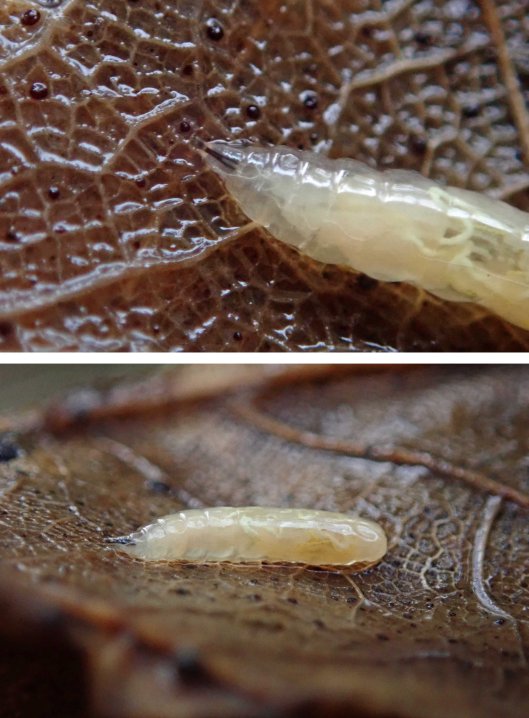
Another day, another fly larva from my riffling through the leaf litter.

230206 phaonia larva (1)

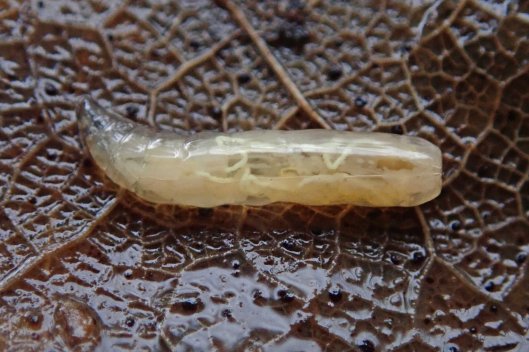
This was last Friday’s find, once again discovered amongst soggy Sycamore leaves. My go-to guy on Twitter tells me this is one of the Phaonia species of flies, and he wrote that this larva is ‘a ferocious predator that can be found throughout the winter in leaf litter. Goes after anything that it can pierce with its mouthparts.’ Beware ferocious fly larvae!

230206 phaonia larva (2)

Like Loading...

First hoverfly

03 Friday Feb 2023

Posted by sconzani in insects

≈ Leave a comment

Tags

British hoverflies, Eristalis pertinax, Eristalis tenax, hoverfly

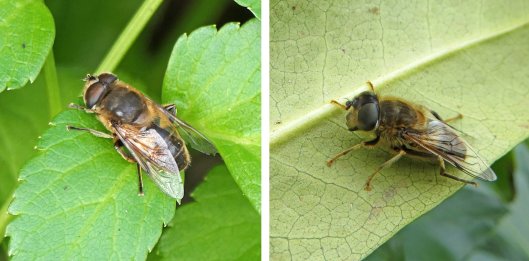
During Monday’s walk along the local section of the Wales Coastal Path, I spotted my first hoverfly of the year, and immediately got the identification wrong. It seems that every winter I forget the basics for these creatures and have to refresh my memory over and over again (old age, or hoverfly blindness?).

230203 eristalis tenax (1)

In my defence, these are two very similar species but it took a friendly follower on Twitter to remind me that, for the hoverfly I found, the ‘feet are darker than E.[Eristalis] pertinax and it has a bendy rear tibia and hairy bands on its eyes so this is Eristalis tenax‘. (The ‘foot’ is the final segment of the leg.) To remind me, and help you, I’ve included comparison photos below – Eristalis tenax, he of the darker front feet, is on the left, and Eristalis pertinax, with the pale feet, is on the right.

230203 eristalis tenax and pertinax (2)

Like Loading...

Woodlouse: Porcellio spinicornis

02 Thursday Feb 2023

Posted by sconzani in insects

≈ 2 Comments

Tags

British woodlice, Common striped woodlouse, Philoscia muscorum, Porcellio spinicornis, woodlice, woodlouse

I’ve been leaf diving again, just ten minutes spent picking up and thoroughly examining soggy Sycamore leaves during one of my local walks.

230202 Porcellio spinicornis

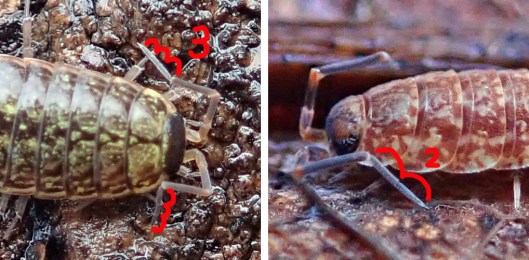
So well camouflaged was it that I almost missed this little mini-beastie, which I initially thought was a Common striped woodlouse (Philoscia muscorum) but, on closer inspection of its antennae, I now think must be Porcellio spinicornis. According to the Naturespot website, the distinguishing characteristic is the number of flagellal segments at the tip of the antennae: Porcellio spinicornis has two, while Philoscia muscorum has three. If I’d known this at the time, I would’ve taken better close-ups but I’ve tried to illustrate the differences below.

230202 woodlouse antennae

Like Loading...
← Older posts
Newer posts →

About me

sconzani

sconzani

I'm a writer and photographer; researcher and blogger; birder and nature lover; countryside rambler and city strider; volunteer and biodiversity recorder.

View Full Profile →

Follow earthstar on WordPress.com

Enter your email address to follow this blog and receive notifications of new posts by email.

Recent blog posts

  • First bee-flies April 7, 2026
  • Bloody-nosed beetle April 6, 2026
  • Gorse and its weevil April 5, 2026
  • Chiffchaffs chiffchaffing April 4, 2026
  • Bearded tit!!! April 3, 2026

From the archives

COPYRIGHT

Unless otherwise acknowledged, the text and photographs on this blog are my own and are subject to international copyright. Nothing may be downloaded or copied without my permission.

Fellow Earth Stars!

  • Unknown's avatar
  • Unknown's avatar
  • Unknown's avatar
  • Unknown's avatar
  • Unknown's avatar
  • Unknown's avatar
  • Unknown's avatar
  • Unknown's avatar
  • Unknown's avatar
  • Unknown's avatar
  • Unknown's avatar
  • Unknown's avatar
  • Unknown's avatar
  • Unknown's avatar
  • Unknown's avatar
  • Unknown's avatar
  • Unknown's avatar
  • Unknown's avatar
  • Unknown's avatar
  • Unknown's avatar
  • Unknown's avatar
  • Unknown's avatar
  • Unknown's avatar
  • Unknown's avatar
  • Unknown's avatar
  • Unknown's avatar
  • Unknown's avatar
  • Unknown's avatar
  • Unknown's avatar
  • Unknown's avatar
  • Unknown's avatar
  • Unknown's avatar
  • Unknown's avatar
  • Unknown's avatar
  • Unknown's avatar
  • Unknown's avatar
  • Unknown's avatar
  • Unknown's avatar
  • Unknown's avatar
  • Unknown's avatar
  • Unknown's avatar
  • Unknown's avatar
  • Unknown's avatar
  • Unknown's avatar
  • Unknown's avatar
  • Unknown's avatar
  • Unknown's avatar
  • Unknown's avatar
  • Unknown's avatar
  • Unknown's avatar

Blog at WordPress.com.

Privacy & Cookies: This site uses cookies. By continuing to use this website, you agree to their use.
To find out more, including how to control cookies, see here: Cookie Policy
  • Subscribe Subscribed
    • earthstar
    • Join 642 other subscribers
    • Already have a WordPress.com account? Log in now.
    • earthstar
    • Subscribe Subscribed
    • Sign up
    • Log in
    • Report this content
    • View site in Reader
    • Manage subscriptions
    • Collapse this bar
 

Loading Comments...
 

You must be logged in to post a comment.

    %d