• ABOUT
  • BIRDING 2018
  • Birding 2019
  • BLOG POSTS
  • Butterflies 2018
  • Resources

earthstar

~ a celebration of nature

earthstar

Category Archives: insects

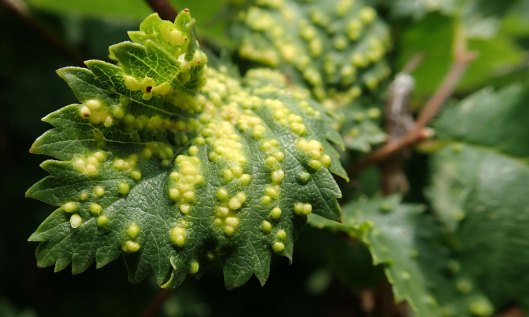
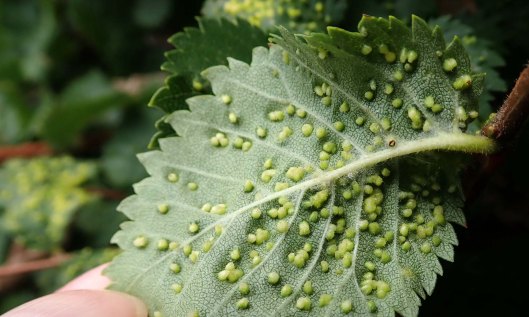
174/366 Mitey galls

22 Monday Jun 2020

Posted by sconzani in insects, leaves, nature, trees

≈ Leave a comment

Tags

Aceria campestricola, Aceria ulmicola, gall mites, galls, galls on elm, leaf galls

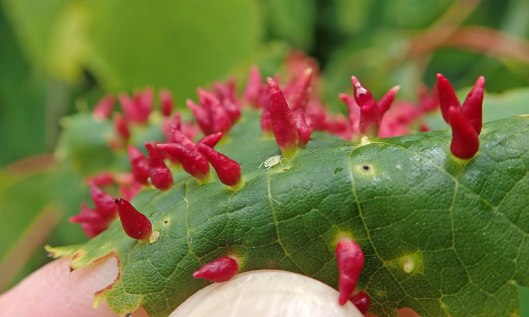
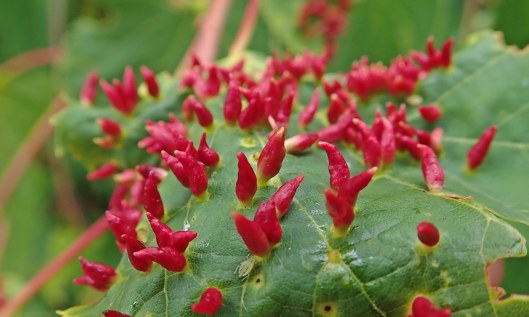
When walking along a narrow path between fields last week, I turned to face into the neighbouring hedgerow so that two other walkers could safely pass behind me. In so doing, I noticed these galls, which I think are Aceria campestricola (also known as Aceria ulmicola).

These growths betray the presence of the hundreds, perhaps thousands of the tiny mites that have caused these galls to form.

These particular galls can only be found on specific elm species, which in Britain include English elm and Small-leaved elm.

Like Loading...

170/366 Misc hoverflies

18 Thursday Jun 2020

Posted by sconzani in insects, nature

≈ 4 Comments

Tags

British hoverflies, Cheilosia illustrata, Chrysotoxum bicinctum, Episyrphus balteatus, Eupeodes corollae, Helophilus pendulus, hoverfly, Sphaerophoria scripta, Volucella pellucens, Xanthogramma pedissequum, Xylota species

Hoverflies seem particularly numerous this year … or maybe it’s just that I’ve been keeping more of an eye out for them. Here are some of the species I’ve clocked in the past couple of weeks. Looking through my photos again now, I’m struck by how diverse these lovely creatures are.

OLYMPUS DIGITAL CAMERA

Volucella bombylans: One of the bumblebee-mimicking hoverflies. This one was snoozing on a cool day, which is how I managed to get a nice close shot.

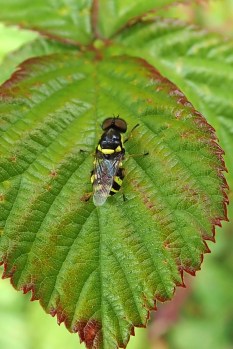
200618 chrysotoxum bicinctum

Chrysotoxum bicinctum: Its distinctive yellow bars make this hoverfly reasonably easy to identify.

OLYMPUS DIGITAL CAMERA

Episyrphus balteatus: Also known as the Marmalade hoverfly. Despite its small size, this species is known some years to migrate en masse to Britain from continental Europe.
OLYMPUS DIGITAL CAMERA

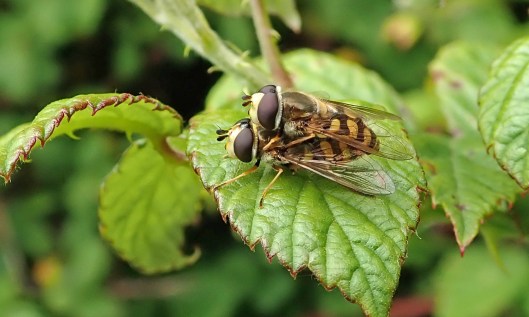
Eupeodes corollae: These two were otherwise occupied, which allowed me to get quite close to them.

OLYMPUS DIGITAL CAMERA

Helophilus pendulus: The ‘footballer’, because of the striped ‘footballers’ kit’ markings on its abdomen.

OLYMPUS DIGITAL CAMERA

Sphaerophoria scripta: Apparently, the yellow colouration is influenced by the temperature at which the larvae develop, so Spring-born individuals can be darker than those hatching later in the year.

OLYMPUS DIGITAL CAMERA

Volucella pellucens: One of Britain’s larger hoverflies; also known as the Great Pied hoverfly and the Pellucid fly.
200618 xanthogramma pedissequum

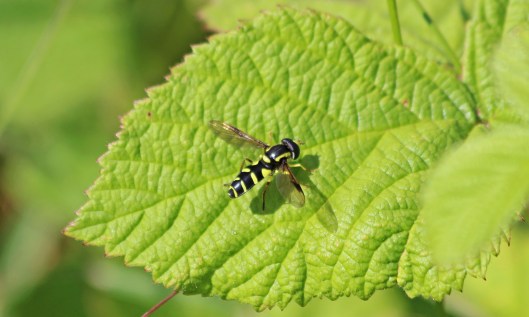
Xanthogramma pedissequum: This used to be easy to identify from its distinctive markings but, in 2012, the very similar Xanthogramma stackelbergi was added to the British list so now the thoracic markings need to be carefully checked to ensure the correct identification.

OLYMPUS DIGITAL CAMERA

Xylota species: I didn’t get good enough photos of this one to be able to work out whether this was X. segnis or X. sylvarum – you need very clear views of its hind tibia to work out which is which.

 

Like Loading...

168/366 Ringlets and a Small skipper

16 Tuesday Jun 2020

Posted by sconzani in insects, nature

≈ 4 Comments

Tags

British butterflies, butterfly, Ringlet, Small skipper

Yesterday was a day of two firsts, my first sightings of (several) Ringlet butterflies for this year (and at two different locations), and my first gorgeous Small skipper as well. Here they are …

200616 ringlet (1)200616 small skipper (2)

Like Loading...

167/377 Leaf eaters

15 Monday Jun 2020

Posted by sconzani in insects, leaves, nature

≈ 2 Comments

Tags

beetles on hogweed, British beetles, Celery leaf beetles, leaf beetles, Phaedon tumidulus

I don’t see many beetles, perhaps because I don’t spend enough time looking for them, but I could hardly miss these ones, because there were hundreds of them.

200615 celery leaf beetles (1)

I’m not entirely sure what they are and there are many species of leaf beetle that look very similar but, as these were munching on umbellifer leaves – possibly hogweed (I’m not good at identifying umbellifers either!), I think they might be Celery leaf beetles (Phaedon tumidulus).

200615 celery leaf beetles (2)
200615 celery leaf beetles (3)
200615 celery leaf beetles (4)
200615 celery leaf beetles (5)

As well as munching on the correct type of leaf, these beetles were about the right size (tiny, just 3-4mm), and, although they have lines of dimples on the elytron (the wing covers on the abdomen), they don’t have any on the centre of the pronotum (the thorax), which also fits with Phaedon tumidulus. However, I may have got the ID wrong, so do let me know in the comments box if you can positively identify these hungry creatures.

200615 celery leaf beetles (6)

Like Loading...

165/366 Major Rara

13 Saturday Jun 2020

Posted by sconzani in insects, nature

≈ 5 Comments

Tags

British soldier flies, Four-barred major, Oxycera rara, soldier fly

200612 Four-barred Major (1)

Thursday’s walk produced another new-to-me insect.

At first I thought it was a hoverfly I’d not seen before but, when I got home, checked my photos and then my hoverflies guide book, I realised I was mistaken, and this is, in fact, a Four-barred major (Oxycera rara), a tiny (7mm long) soldier fly.

The excellent Nature Spot website tells me these handsome little creatures are widespread in Britain, particularly in damp areas like wetlands and marshes.

200612 Four-barred Major (2)


Like Loading...

164/366 ‘Flowers that fly’

12 Friday Jun 2020

Posted by sconzani in insects, nature

≈ 4 Comments

Tags

British butterflies, butterfly, Comma, Green-veined white, Large skipper, Meadow Brown, Speckled wood

‘… flowers that fly and all but sing’
~  from ‘Blue-butterfly Day’, a poem by Robert Frost

These are some of the ‘flowers’ that have been flying around me this week, causing my heart to sing.

200612 comma

Comma, one of three seen on Tuesday’s walk

200612 green-veined white

Green-veined white

200612 large skipper

Large skipper, a butterfly with attitude

200612 meadow brown

Meadow brown, from a count of 54 in a single meadow

200612 speckled wood

Speckled wood

Like Loading...

161/366 Mite galls on Lime leaves

09 Tuesday Jun 2020

Posted by sconzani in insects, lichen, nature, trees

≈ 3 Comments

Tags

Eriophyes mites, gall mites, gall-causing mites, galls on Lime leaves, lime galls, Lime trees, mites

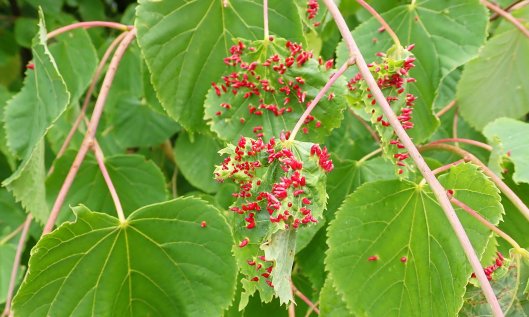
These stopped me in my tracks!

200609 lime gall mites (1)

I’d enjoyed a nice amble around a local park and was on my way home when I spotted these incredible galls and just had to stop for some photos. The galls are caused by tiny mites that spend the cool winter months huddling in cracks on the tree’s bark, then head out on to the leaves when they sprout in the springtime.

200609 lime gall mites (2)

The mites are leaf-sap suckers, and their sap sucking causes a chemical reaction in the leaf, which in turn prompts the leaf to produce these small, conical, hollow growths. The mites are incredibly tiny – less than 0.2mm long apparently – so they’re almost never seen, whereas their cosy gall homes can grow to 8mm long and, when they’re as bright as these ones were, are very obvious on the leaves.

200609 lime gall mites (3)
200609 lime gall mites (4)

I’m not sure which mites these are as I’m not sure which tree species this is. One mite species, Eriophyes tiliae, is the gall causer on Large-leaved lime trees (Tilia platyphyllos), Common limes (Tilia x europaea) and some hybrid Lime species, and another mite, Eriophyes lateannulatus, causes very similar galls on Small-leaved Limes (Tilia cordata) and hybrid Limes.

200609 lime gall mites (5)

Like Loading...

160/366 Peacocks in the nettles

08 Monday Jun 2020

Posted by sconzani in insects, nature

≈ 4 Comments

Tags

Aglais io, British butterflies, butterfly caterpillars, butterfly larvae, Peacock butterfly, Peacock butterfly larvae, Peacock caterpillars

’Tis the time of the larvae, in this case, the larvae of the Peacock butterfly (Aglais io).

200608 peacock caterpillars (1)

According to Life Cycles of British & Irish Butterflies, a female Peacock lays her eggs in batches of about 400 in the centre of a patch of nettles growing in a sheltered position that enjoys full sun. After about two weeks, the Peacock larvae/caterpillars hatch and begin their journey to adulthood.

200608 peacock caterpillars (3)
200608 peacock caterpillars (4)

As they munch on the nettles, they grow, and as they grow, they need to moult their skins. They do this four times, each stage known as an instar, before they pupate. The process takes about 30 days in total, and each of the five instars looks a little different.

200608 peacock caterpillars (2)

During last Friday’s walk, I was lucky enough to find big colonies of larvae in two different places, and both groups had larvae of the third, fourth and fifth instars, all feeding together. In the photo above, the brownish caterpillars are third instar, the darker caterpillars with spines and spots are fourth instar, and the large caterpillar on the right of the image is fifth instar.

200608 peacock caterpillars (5)

Not surprisingly, I got a few nettle stings getting these photos but it was worth it. As some of the largest caterpillars looked very close to pupation, I’ll revisit one of these sites this week to see if I can locate any pupas.

Like Loading...

159/366 Daisy power

07 Sunday Jun 2020

Posted by sconzani in flowers, insects, nature, wildflowers

≈ Leave a comment

Tags

British wildflowers, daisies, insects on Oxeye daisies, Oxeye daisy, wildflowers

I walk past this magnificent display of Oxeye daisies quite often, and it always makes me smile.

200607 ox-eye daisies (1)

It runs alongside a local footpath, behind a wire fence that borders a school playground, and transforms an ugly bank of earth, which prevents footpath walkers from seeing the children at play, into a stunning floral flourish.

200607 ox-eye daisies (2)

You might be forgiven for thinking the flowers look a bit ‘empty’ – where are all the insects that love feasting on these wildflowers? Well, though sunny, this was quite a windy day, with huge clouds scudding rapidly across the sky, changing bright warmth to grey coolness in the blink of an eye. But, when I looked closely in the more sheltered spots, the insects were there, sometimes more than I expected on a single flower head, sharing the nutrient power of these glorious daisies.

200607 ox-eye daisies (3)

Like Loading...

158/366 Britain’s most common butterfly

06 Saturday Jun 2020

Posted by sconzani in insects, nature

≈ 3 Comments

Tags

British butterflies, butterfly, Maniola jurtina, Maniola jurtina insularis, Meadow Brown

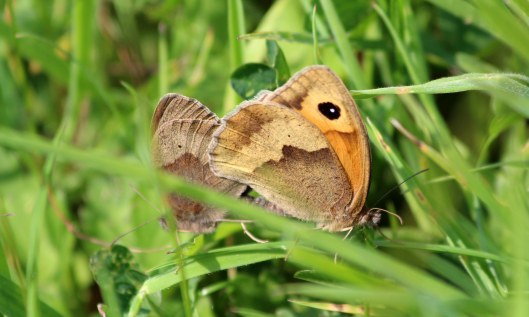
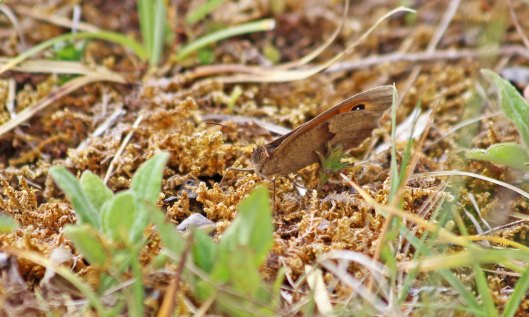
The latest butterfly species to grace the fields in my area is the Meadow brown (Maniola jurtina). I actually saw my first on Monday but it’s taken a few days to get even half decent photos as all the butterflies I’ve seen have either been flying frantically from place to place and/or hunkering down in the vegetation so effectively that they’ve been almost impossible to see.

200606 meadow brown (1)

In his fabulous publication Life Cycles of British & Irish Butterflies, Peter Eeles notes that, due to their colour differences, the male and female Meadow browns were once thought to be two separate species, the male named the ‘Brown Meadow Ey’d Butterfly’ and the female the ‘Golden Meadow Ey’d Butterfly’. In the photo below, the male is on the left, the female on the right.

200606 meadow brown (2)

Apparently, there are also colour variations in different parts of Britain, and scientists have officially identified these as four separate subspecies. The ones I see here in south Wales are Maniola jurtina insularis, which is the most widespread. Personally, I often have trouble simply telling male from female, and that’s something I’m going to try to improve during the next few months.

200606 meadow brown (3)

Like Loading...
← Older posts
Newer posts →

About me

sconzani

sconzani

I'm a writer and photographer; researcher and blogger; birder and nature lover; countryside rambler and city strider; volunteer and biodiversity recorder.

View Full Profile →

Follow earthstar on WordPress.com

Enter your email address to follow this blog and receive notifications of new posts by email.

Recent blog posts

  • In flower now April 12, 2026
  • A surprise Slow-worm April 11, 2026
  • My first Holly blue April 10, 2026
  • Alder flies April 9, 2026
  • Lily beetle April 8, 2026

From the archives

COPYRIGHT

Unless otherwise acknowledged, the text and photographs on this blog are my own and are subject to international copyright. Nothing may be downloaded or copied without my permission.

Fellow Earth Stars!

  • Unknown's avatar
  • Unknown's avatar
  • Unknown's avatar
  • Unknown's avatar
  • Unknown's avatar
  • Unknown's avatar
  • Unknown's avatar
  • Unknown's avatar
  • Unknown's avatar
  • Unknown's avatar
  • Unknown's avatar
  • Unknown's avatar
  • Unknown's avatar
  • Unknown's avatar
  • Unknown's avatar
  • Unknown's avatar
  • Unknown's avatar
  • Unknown's avatar
  • Unknown's avatar
  • Unknown's avatar
  • Unknown's avatar
  • Unknown's avatar
  • Unknown's avatar
  • Unknown's avatar
  • Unknown's avatar
  • Unknown's avatar
  • Unknown's avatar
  • Unknown's avatar
  • Unknown's avatar
  • Unknown's avatar
  • Unknown's avatar
  • Unknown's avatar
  • Unknown's avatar
  • Unknown's avatar
  • Unknown's avatar
  • Unknown's avatar
  • Unknown's avatar
  • Unknown's avatar
  • Unknown's avatar
  • Unknown's avatar
  • Unknown's avatar
  • Unknown's avatar
  • Unknown's avatar
  • Unknown's avatar
  • Unknown's avatar
  • Unknown's avatar
  • Unknown's avatar
  • Unknown's avatar
  • Unknown's avatar
  • Unknown's avatar

Blog at WordPress.com.

Privacy & Cookies: This site uses cookies. By continuing to use this website, you agree to their use.
To find out more, including how to control cookies, see here: Cookie Policy
  • Subscribe Subscribed
    • earthstar
    • Join 642 other subscribers
    • Already have a WordPress.com account? Log in now.
    • earthstar
    • Subscribe Subscribed
    • Sign up
    • Log in
    • Report this content
    • View site in Reader
    • Manage subscriptions
    • Collapse this bar
 

Loading Comments...
 

You must be logged in to post a comment.

    %d