• ABOUT
  • BIRDING 2018
  • Birding 2019
  • BLOG POSTS
  • Butterflies 2018
  • Resources

earthstar

~ a celebration of nature

earthstar

Category Archives: nature

Spurge laurel

19 Friday Jan 2018

Posted by sconzani in flowers, nature, plants, wildflowers

≈ 2 Comments

Tags

British flora, British native daphne, British native flowers, Daphne laureola, Spruge laurel, winter flowers

Spurge laurel is such an uninspiring name for this lovely British native, which I was surprised and delighted to find in full flower when I was walking the south Wales coastal path at Lavernock last weekend.

180119 Spurge laurel (2)

Any gardener will recognise this plant as a member of the Daphne family – its scientific name is Daphne laureola – and, not only does it flower from the middle of winter through spring and into early summer, it also has a delicious honey smell. It’s evergreen and prefers to have its roots in rich, shaded soil, growing best on the edge of woodlands on chalk or limestone.

180119 Spurge laurel (4)
180119 Spurge laurel (1)

I must add one note of caution, though: everything about this plant is poisonous to humans, from the sap (which can cause a nasty skin rash) to the black berries that appear in late summer. Luckily, the berry toxins do not appear to affect birds, and there are reports of robins and greenfinches enjoying an autumn feast.

180119 Spurge laurel (3)
180119 Spurge laurel (5)
Like Loading...

Britain’s smallest bird

18 Thursday Jan 2018

Posted by sconzani in birds, nature

≈ 12 Comments

Tags

birding, birdwatching, British birds, Goldcrest, Regulus regulus

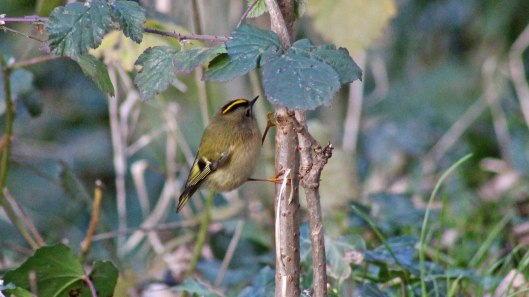
Weighing in at just 6 grams and measuring a miniscule 9cm from top of head to tip of tail, the Goldcrest (Regulus regulus) holds the title of Britain’s smallest bird. And it’s a cutie!

180118 goldcrest (1)

Though its overall plumage is a somewhat dull green, its distinguishing feature is the Mohawk-style stripe on the top of its head – it’s a vibrant yellow that’s easy to spot, and the stripe has an orange centre in male birds.

180118 goldcrest (3)

Goldcrests are most often found in coniferous woodland but they can also be found in urban settings. The birds in my photos were at Cosmeston Lakes Country Park (which is not primarily coniferous), along part of the south Wales coastal path (where there were no conifers to be seen) and in Cardiff’s Cathays Cemetery (where the wee bird was doing a grand job of cleaning up the old gravestones).

180118 goldcrest (2)

Goldcrests are completely insectivorous so are not able to feed from garden bird feeders, putting them at risk in very cold winters when there are no insects to be found. Fortunately, though, their numbers are stable, and their delightful antics can be enjoyed throughout Britain.

Like Loading...

Wild words: brake

17 Wednesday Jan 2018

Posted by sconzani in nature, trees

≈ 4 Comments

Tags

#WildWords, bracu, brake, meaning of brake, thicket

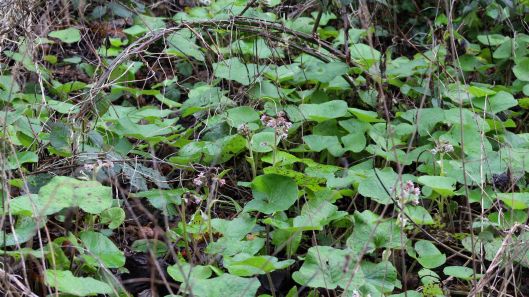
Brake is a word with several meanings. Aside from those to do with stopping, there are also these to do with the enviorment:
From the Oxford Dictionary: a botanical term for a thicket; from the old English bracu; first recorded in the plural in fearnbraca, meaning ‘thickets of fern’; related to the Middle Low German brake, which means ‘branch’ or ‘stump’.
The Merriam-Webster has a slightly different interpretation: a geographical term meaning rough or marshy land overgrown usually with one kind of plant, as in cedar brakes or coastal brakes.
The Collins Dictionary agrees with the Oxford: an area of dense undergrowth, shrubs, brushwood, etc., a thicket.

180117 brake

The word is often seen in English place names as, for example, in Boughton Brake (a forest in Nottinghamshire), Huxham Brake (a coniferous woodland in Devon), Stratfield Brake (a broadleaf woodland near Oxford, owned by the Woodland Trust), and Combe Brake (another Woodland Trust woodland, this one in Exmoor National Park).

Like Loading...

Leaf mine in Hart’s tongue

16 Tuesday Jan 2018

Posted by sconzani in insects, nature, plants

≈ 3 Comments

Tags

Agromyzidae, Chromatomyia scolopendri, Hart's tongue, leaf mine on Hart's tongue, leafminers, leafmines

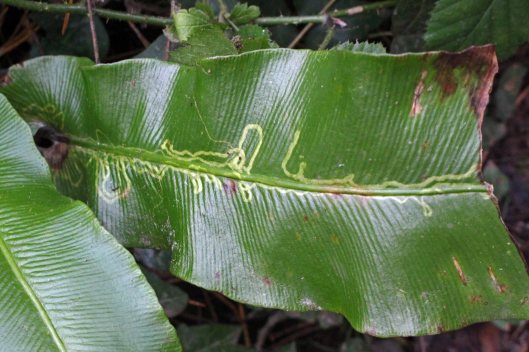
After my recent introductory post on leafminers, I thought I’d get the ball rolling with an example of a leaf mine I have actually been able to identify, as, fortunately for me, it is the only creature that creates a linear mine on the leaves of Hart’s tongue fern (Asplenium scolopendrium). The mines in my photographs were created by the larvae of a tiny fly, Chromatomyia scolopendri.

180116 Chromatomyia scolopendri (1)

As you can see, the larvae tends to mine along the midrib of the leaf but occasionally veers out towards the exterior before doubling back again. The mine is narrow and can be up to 10cms long, though I didn’t actually measure these ones. The larvae can be active any time from early spring through to autumn and they usually pupate in these mines.

180116 Chromatomyia scolopendri (2)

I found the mines on Christmas Eve, when I was on holiday in Somerset – they were at Ham Hill Country Park, near Yeovil. I’m not sure how common the little Chromatomyia scolopendri fly is, as there are 72 records showing in the Welsh Aderyn biodiversity database but only 38 records for the whole of Britain in the NBN Atlas (so where are all the Welsh records?). It’s also likely that leaf mines are under-recorded so the species may well be more common than these records suggest. Now that I know what to look for, I’ll be keeping an eye out for this one on my walks around south Wales.

Like Loading...

Yellow-legged gull

15 Monday Jan 2018

Posted by sconzani in birds, nature, winter

≈ 2 Comments

Tags

birding, birdwatching, British birds, gull identification, Larus michahellis, Yellow-legge gull 2w, Yellow-legged gull

Back in November, I thought I’d found my first Yellow-legged gull (Larus michahellis) – and it still might have been – though I’m really not convinced about it. But, this gull, the one pictured here, is absolutely, one-hundred-percent definitely a Yellow-legged gull … even though its legs are not yellow. Have I not written previously that gulls are tricksy?!

180115 Yellow-legged Gull 2w (1)

As you might guess from looking at it, this is not an adult gull. I’m reliably informed, by the expert birding friend who identified it for me, that this gull is in its second winter. My bird guide book tells me these gulls take four years to reach adult plumage so it’s half way there. Its age is the reason its legs are not yet yellow.

180115 Yellow-legged gull 2w (2)
180115 2nd winter Herring gull

One of the main keys to its identification is the colour of the feathers on its back: Yellow-legged gulls are about mid way between the light grey of Herring gulls and the darker grey of Lesser black-backeds. The two photos above show my Yellow-legged gull, on the left, and, on the right, a Herring gull of the same age. I can see the difference in the feather colour and, to my eye, the shape of the head and bill look slightly different but I’m not sure I’d be confident of IDing one of these gulls without expert help.

180115 Yellow-legged gull 2w (3)
180115 Yellow-legged gull 2w (4)

180115 Yellow-legged gull 2w (5)

Like Loading...

Winter walk around Cardiff Bay

14 Sunday Jan 2018

Posted by sconzani in birds, nature, walks

≈ 2 Comments

Tags

birding, birdwatching, British birds, Cardiff Bay, walk around Cardiff Bay

I haven’t tried using one of these Google maps for a blog post before – not sure I will again as they’re quite labour intensive (and this one is very simple!), but it’s good to try something different. If you’ve not seen one of these maps before, you can click on the little bird markers to see a photo and some text about the bird I spotted there, and the red line shows, very approximately, my walking route.

Like Loading...

Leafmines 101

13 Saturday Jan 2018

Posted by sconzani in insects, leaves, nature, plants, trees

≈ 5 Comments

Tags

British insects, homes of insect larvae, insect larvae in leaves, leaf mine, leafmine, leafminer, mines on leaves

Leafmines and their miners are a subject I started to look at last summer but I quickly discovered that, in order to identify the miner, you had to know the plant they were mining, so I needed to improve my botanical knowledge before I could go much further. That effort has begun, and is ongoing, so I will start to look again at the miners in the coming months.

180113 leafmines (1)
180113 leafmines (2)

Firstly though, in case you don’t know, leafmines are made by the larvae of various insects. The mines are their homes and their larders – as well as providing them with some degree of protection from predators, the larvae eat the tissue of the leaves they live within, thus creating their mines. The larvae can be the immature stages of various species of flies, sawflies or moths, and, apparently, some beetles also mine leaves.

180113 leafmines (3)
180113 leafmines (4)

If you look at a mine, you will often see a tiny hole at one end, which means the creature that made it has left the premises, to pupate or to being life as an adult. Sometimes, you can still see the larva within, and you can often also see the pooh (known as frass) it has left behind as it eats and tunnels.

180113 leafmines (5)
180113 leafmines (6)

The shapes of the mines can vary considerably, from long meandering or straight lines to roundish blotches, and these shapes, plus the placement of the mine within the leaf (some occupy just the upper or lower surface, some go right through) and the identity of the plant, are the main ways to determine which creature has made the mine.

**p.s. Since posting this, I’ve been told what I thought was a leaf mine on ivy (the photo on the right in the middle) is actually caused by a fungus, possibly Phoma hedericola, the most common leaf spot of ivy. I can see these leafmines are going to be even more tricky than I anticipated!

Like Loading...

Winter heliotrope

12 Friday Jan 2018

Posted by sconzani in flowers, nature, parks, plants

≈ Leave a comment

Tags

Alexandra Park, Dingle Park, non-native invasive plant, Petasites fragrans, Winter heliotrope, winter-flowering plant

Officially, Winter heliotrope (Petasites fragrans) is a non-native invasive; unofficially, I think it’s got a rather lovely flower, which is particularly nice to see in the dead of winter, and its vanilla smell is divine.

180112 winter heliotrope (4)

According to Mabey’s Flora Britannica, it was brought to Britain as a garden plant in 1806, and the GB non-native species secretariat website states that it was first recorded in 1835 – presumably they mean the first record of it straying outside the bounds of the gardens where it had been planted. Though native to the Mediterranean and North Africa, it’s made itself at home in Britain, where it favours roadside verges, woodland margins and rough grassland. It seems very adaptable: in my local area, it favours sloping banks, a sunny slope in Dingle Park and a very wet and shady, steeply sloping streamside in Alexandra Park.

180112 winter heliotrope (1)
180112 winter heliotrope (2)
180112 winter heliotrope (3)

It can be difficult to get rid of because it grows very readily from the smallest discarded stem, sending its ‘roots’ (actually underground stems called rhizomes) spreading horizontally in all directions. Sneaky!

180112 winter heliotrope (5)

Like Loading...

Bark

11 Thursday Jan 2018

Posted by sconzani in birds, insects, nature, trees

≈ Leave a comment

Tags

bark, bark of trees, Birch bark, properties of bark, Scots pine bark, Sessile oak bark, tree bark, treecreeper, uses of bark

The skin of a tree is an amazing thing but, rather than launch in to a scientific description of its various layers, I thought I’d share just a few examples of its incredible capabilities.

180111 tree bark (3)
180111 tree bark (4)
180111 tree bark (5)

The bark of the Birch tree (Betula sp.) contains good quantities of volatile oils, making it both waterproof and highly resistant to decay – the wood inside rots before the bark does.

The cracks and crevices in the bark of many tree species are great hidey holes for a wide range of small insects that make their homes there.

A good number of insects means a plentiful supply of food for birds like the Treecreeper whose beak can easily probe those hidey holes.

180111 tree bark (2)
180111 tree bark (1)
180111 tree bark (6)

The high levels of toxic tannins in the bark of the Sessile oak (Quercus petraea) help protect it from insects.

The bark of the Scots pine (Pinus sylvestris) is thick enough to protect it from the fires that would occasionally sweep through its forests in prehistoric times.

180111 tree bark (7)
180111 tree bark (8)
180111 tree bark (9)

Bark is also home to huge numbers of different lichen and moss species, many of which have adapted to life on the barks of specific trees.

Some animals eat bark – voles, deer and beavers, for example, and squirrels will strip the fibrous bark of certain trees to make their dreys warm and cosy.

The bark of some trees is fibrous enough to make rope and weave baskets.

180111 tree bark (10)
180111 tree bark (11)
180111 tree bark (12)
Like Loading...

Wild words: nemophilist

10 Wednesday Jan 2018

Posted by sconzani in nature, trees

≈ 4 Comments

Tags

#WildWords, forests, lover of forests, lover of trees, lover of woodlands, nemophilist, woodland

Nemophilist: A haunter of woods; one who loves forests and woodlands, their beauty and solitude. From the Ancient Greek νέμος nemos, meaning a wooded pasture or glade + φιλία philia, meaning loving.
This is me!
IMG_0075

Like Loading...
← Older posts
Newer posts →

About me

sconzani

sconzani

I'm a writer and photographer; researcher and blogger; birder and nature lover; countryside rambler and city strider; volunteer and biodiversity recorder.

View Full Profile →

Follow earthstar on WordPress.com

Enter your email address to follow this blog and receive notifications of new posts by email.

Recent blog posts

  • The return of the Willow warblers April 23, 2026
  • Bug: Harpocera thoracica April 22, 2026
  • A female Tawny April 21, 2026
  • NFY: Orange-tip April 20, 2026
  • All the yellows April 19, 2026

From the archives

COPYRIGHT

Unless otherwise acknowledged, the text and photographs on this blog are my own and are subject to international copyright. Nothing may be downloaded or copied without my permission.

Fellow Earth Stars!

  • Unknown's avatar
  • Unknown's avatar
  • Unknown's avatar
  • Unknown's avatar
  • Unknown's avatar
  • Unknown's avatar
  • Unknown's avatar
  • Unknown's avatar
  • Unknown's avatar
  • Unknown's avatar
  • Unknown's avatar
  • Unknown's avatar
  • Unknown's avatar
  • Unknown's avatar
  • Unknown's avatar
  • Unknown's avatar
  • Unknown's avatar
  • Unknown's avatar
  • Unknown's avatar
  • Unknown's avatar
  • Unknown's avatar
  • Unknown's avatar
  • Unknown's avatar
  • Unknown's avatar
  • Unknown's avatar
  • Unknown's avatar
  • Unknown's avatar
  • Unknown's avatar
  • Unknown's avatar
  • Unknown's avatar
  • Unknown's avatar
  • Unknown's avatar
  • Unknown's avatar
  • Unknown's avatar
  • Unknown's avatar
  • Unknown's avatar
  • Unknown's avatar
  • Unknown's avatar
  • Unknown's avatar
  • Unknown's avatar
  • Unknown's avatar
  • Unknown's avatar
  • Unknown's avatar
  • Unknown's avatar
  • Unknown's avatar
  • Unknown's avatar
  • Unknown's avatar
  • Unknown's avatar
  • Unknown's avatar
  • Unknown's avatar

Blog at WordPress.com.

Privacy & Cookies: This site uses cookies. By continuing to use this website, you agree to their use.
To find out more, including how to control cookies, see here: Cookie Policy
  • Subscribe Subscribed
    • earthstar
    • Join 642 other subscribers
    • Already have a WordPress.com account? Log in now.
    • earthstar
    • Subscribe Subscribed
    • Sign up
    • Log in
    • Report this content
    • View site in Reader
    • Manage subscriptions
    • Collapse this bar
 

Loading Comments...
 

You must be logged in to post a comment.

    %d