• ABOUT
  • BIRDING 2018
  • Birding 2019
  • BLOG POSTS
  • Butterflies 2018
  • Resources

earthstar

~ a celebration of nature

earthstar

Category Archives: nature

A heron learns to fish

18 Saturday Jun 2016

Posted by sconzani in birds, nature

≈ 12 Comments

Tags

birding, birdwatching, British birds, Grey heron, heron fishing

It must be hard being a young heron. When they’re still in the nest, their food comes via home delivery, courtesy of mum and dad, but once they’re fledged, what then? It’s not like they can go to school to learn how to fish. There’s no one to teach them stealth, no lessons in stillness or focus, no tutors to advise on the best way to sneak up on a fish or a frog. What if they have poor eyesight, or two left feet? What if their natural inclination is to blunder noisily through the shallows? The reality is it’s just practice, practice, practice, all day long.

160619 heron fishing (1)
160619 heron fishing (2)
160619 heron fishing (3)
160619 heron fishing (4)
160619 heron fishing (5)
160619 heron fishing (6)
160619 heron fishing (7)
160619 heron fishing (8)
160619 heron fishing (9)
160619 heron fishing (10)

Luckily, it seems practice really does make perfect.

160619 heron fishing (11)

Like Loading...

In the pink

17 Friday Jun 2016

Posted by sconzani in nature, wildflowers

≈ 6 Comments

Tags

pink flowers, pink wildflowers

A couple of weeks ago I seemed to be surrounded by yellow on my walks; now the pink wildflowers have taken over. For the most part, they’re softer on the eye, more delicate in shape, and range from the merest pink blush of the Common bistort to the almost purple of the Foxglove, the aptly named Digitalis purpurea. Some that I’ve noticed are Common bistort, Dog-rose, Foxglove, Grass vetchling, Herb Robert, Hedge woundwort, Ragged robin, Red campion, Red valerian, Red clover, the many and varied Geraniums, and, in my photos, a couple yet to be identified.

160617 pink wildflowers (1)
160617 pink wildflowers (2)
160617 pink wildflowers (3)
160617 pink wildflowers (4)
160617 pink wildflowers (5)
160617 pink wildflowers (6)
160617 pink wildflowers (7)
160617 pink wildflowers (8)
160617 pink wildflowers (9)
160617 pink wildflowers (10)
160617 pink wildflowers (11)
160617 pink wildflowers (12)
160617 pink wildflowers (13)
160617 pink wildflowers (14)
Like Loading...

Dryad’s Saddle

16 Thursday Jun 2016

Posted by sconzani in fungi, nature

≈ 10 Comments

Tags

dryad, Dryad's saddle, fungus, mushroom, Polyporus squamosus

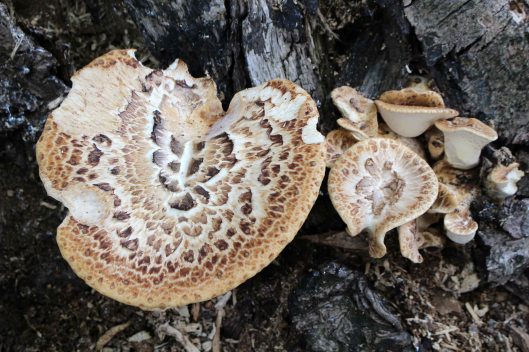
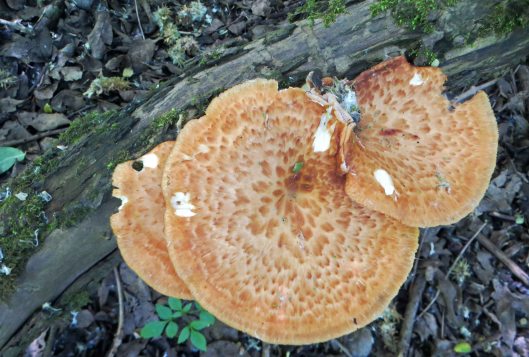
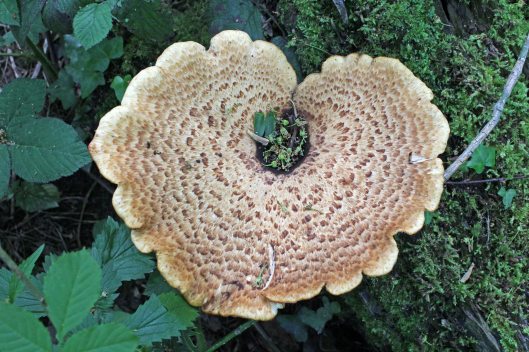
I used to think fungi only appeared in the autumn but I was wrong. I’ve found these three examples of Dryad’s Saddle (Polyporus squamosus) in the past two weeks at three different locations. It’s an edible fungus so I won’t disclose the locations, as the modern trend of foraging all edible fungi can also put some fungi in danger of being over-collected. I prefer just to take photos and leave the fungi to the critters that undoubtedly enjoy it.

160616 dryads saddle (1)

Another common name for this fungus is Pheasant’s back mushroom – as the name implies, the pretty brown colour patterns on the fungus are similar to those seen on the back of a pheasant. The scientific name also refers partly to this patterning (squamosus means scaly), and polyporus means ‘having many pores’ – this is not a gilled mushroom like those you buy at the supermarket; instead, it has a myriad of tiny tubes from which the spores are dispersed.

160616 dryads saddle (3)

The name Dryad’s saddle must have come from someone with a good imagination. In Greek mythology, dryads were tree spirits or nymphs, and the shape of some these fungi does indeed resemble a saddle so, perhaps, when we’re not looking, the dryads emerge from their trees for a gallop around the woodland!

160616 dryads saddle (2)

Like Loading...

The stork that brings the baby

15 Wednesday Jun 2016

Posted by sconzani in birds, nature

≈ Leave a comment

Tags

birding, birds in Morocco, birdwatching, Ciconia ciconia, European stork, Morocco, stork brings baby, storks in Morocco

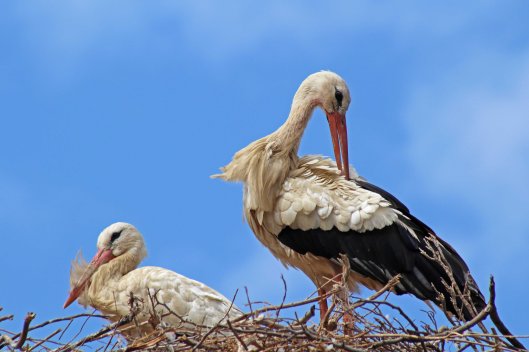
When you were young and you asked your parents where babies came from, did they give you that old faithful answer, ‘The stork brings them’? Well, these are those storks.

160615 storks (5)

This is the European stork (Ciconia ciconia), and it seems the baby-delivery myth may have arisen, originally in Germany, from the fact that storks are migratory birds, leaving Europe for around 9 months over the winter before returning to breed in the springtime. The birds also breed in North Africa, which is where my photos were taken, in Morocco in June 2014.

160615 storks (2)

Apparently, there is an old Berber myth that storks are actually humans who have been transformed into birds. In the Muslim religion, storks are considered sacred, which may be because they appear to prostrate themselves in prayer when resting. However, there is also a tale told in Marrakesh, of a local man, dressed in the traditional white djellaba and black robe, who got drunk on wine and climbed a local minaret, all the while blaspheming. His punishment was transformation into a stork.

160615 storks (3)
160615 storks (4)
160615 storks (6)
160615 storks (7)
160615 storks (1)
Like Loading...

‘Dedicated Naturalist’: The Stormcock

14 Tuesday Jun 2016

Posted by sconzani in 'Dedicated Naturalist' Project, birds, nature

≈ 6 Comments

Tags

birding, birdwatching, British birds, Dr Mary Gillham, Mistle thrush

A snippet from my volunteer work on the ‘Dedicated Naturalist’ Project, helping to decipher and digitise, record and publicise the life’s work of naturalist extraordinaire, Dr Mary Gillham.

Written in her fifth form year at Ealing Grammar School for Girls, Mary’s poignant poem about a mistle thrush was subsequently published in the school’s annual yearbook.

The Stormcock
The thunder roared from the clouds on high;
The lightning flashed across the darkened sky;
The woods were lone and drear and drenched with rain,
And not a soul passed by along the lane.

The raindrops glistened on the leaves like gems,
The flowers drooped low upon their slender stems,
And all the birds save one had gone to rest
While this one lingered on beside his nest.

It was a missel-thrush that perched aloft,
With speckled breast, bright eyes, and plumage soft;
His song rose through the branches clear and sweet,
Above the noise of wind and rain and sleet.

160602 mistle thrush (3)

The hen bird on the nest beside her mate
Had heard him singing frequently of late,
But still she listened with attentive air
While he sang gaily on without a care.

His song defied the tumult of the storm:
The eggs within the nest were safe and warm,
And that was what he cared for most of all,
And so his praise came forth in joyous call.

Despite the elements that tried to quell
The joyous sounds that from his being swell,
The bird sang on through wind and sleet and rain
Until the storm at last began to wane.

160602 mistle thrush (1)
160602 mistle thrush (2)

You can follow our progress with this project on Facebook and on Twitter. A website will follow soon.

Like Loading...

I’m following a tree: month 5

13 Monday Jun 2016

Posted by sconzani in nature, trees

≈ 5 Comments

Tags

Bute Park, Cardiff, Dawn redwood, Metasequoia glyptostroboides, tree following

Summer has come to Cardiff so, although she loves our Welsh rain, Dawn Redwood is also a lover of a sunny location and has been basking in the long sunny days. Her leaves are now fully developed, a rich vibrant green in colour, with leaves arranged opposite each other on the branches, flattened in shape, and around 12mm long and 1.5mm wide.

160613 dawn redwood (2)

Although she doesn’t provide the dense shade of a horse chestnut, an oak or a beech, Dawn is much favoured by Cardiffians as a shady spot for a lunchtime picnic – on the two recent occasions I’ve passed by, there have been groups sitting on the grass below her, which is lovely to see but also means I haven’t been able to get too close for more intimate photos (I was intending to check her bark more thoroughly this month).

160613 dawn redwood (3)

It surprises me a little that I’ve never seen any birds perched in Dawn’s branches, as I’d have thought she provided the perfect cover for the smaller birds as well as a well-elevated viewpoint for the larger birds like magpies and crows. However, Dawn is surrounded by trees – several varieties of prunus and some lovely magnolias, as well as other species I’m not sure of – so the birds have plenty of other spots to choose from.

160613 dawn redwood (1)

Like Loading...

Welsh biodiversity: Heath Park

12 Sunday Jun 2016

Posted by sconzani in fungi, insects, nature, wildflowers

≈ 5 Comments

Tags

biodiversity, biological diversity, Heath Park, Wales Biodiversity Week

This is the last, but by no means least, day of Wales Biodiversity Week, and today we’re checking out the biodiversity of another of my locals, Heath Park.

160612 heath park (1)

Once upon a time (in the 1830s), the Lewis family built a great mansion (Heath House) on this land (since demolished – where the Miniature Railway and neighbouring carpark are now) and the present park was part of their estate (you can read more here). Today, the 37-hectare site is owned by Cardiff Council, and contains sports fields, courts and playgrounds, a large carpark (also useful for visitors to neighbouring Heath Hospital), large fields for picnics and dog-walking, a mature woodland and two ponds.

160612 heath park (2)

Part of the woodland is very damp so, as you can see from my photos, it’s ideal for fungi, even in the summer months. And there is also a rather smelly stream, the Nant-y-Wedal, which had a surprising abundance of wildlife amongst the vegetation adorning its banks. Heath Park was an unexpected biodiversity hot spot, so we have a bumper number of photographs which seems a fitting way to close Wales Biodiversity Week for 2016.

160612 heath park (3)
160612 heath park (4)
160612 heath park (5)
160612 heath park (6)
160612 heath park (7)
160612 heath park (8)
160612 heath park (9)
160612 heath park (10)
160612 heath park (11)
160612 heath park (12)
160612 heath park (13)
160612 heath park (14)
160612 heath park (15)
160612 heath park (16)
160612 heath park (17)
Like Loading...

Welsh biodiversity: Roath Wild Gardens

11 Saturday Jun 2016

Posted by sconzani in birds, insects, nature, wildflowers

≈ Leave a comment

Tags

biodiversity, Roath Park, Roath Park Wild Gardens, Wales Biodiversity Week

You’ve heard of the baker’s dozen? Well, today let me introduce you to the Welsh week. In Wales, it seems, a week actually consists of nine days (!) so here is my selection for day eight of Wales Biodiversity Week.

I am lucky to live opposite Roath Park, here in Cardiff, but it’s a large and varied place, with recreation grounds and a botanical garden, as well as a lake, so I’ve chosen just one smallish area for my biodiversity challenge, the Wild Gardens at the northern end of the lake.

160611 roath wild (2)160611 roath wild (1)

Developed slightly later than the rest of the park, in 1896, the Wild Gardens have seen many changes in their lifetime. In the early days there was a summer house in the centre and during 1910-11 three ponds for trout-rearing were constructed. Nowadays the Gardens live up to their ‘wild’ name, with a network of dirt footpaths winding back and forth amongst a canopy of mature trees with shrubby growth beneath. A few weeks ago this place was awash with wild garlic – a most gIorious, if smelly spectacle, and now it’s lush with blackberry bushes and ferns, grasses and wildflowers. I love its wildness and so does the wildlife, as you can see from these photos, all taken on yesterday’s wander.

160611 roath wild (3)
160611 roath wild (4)
160611 roath wild (5)
160611 roath wild (6)
160611 roath wild (7)
160611 roath wild (8)
160611 roath wild (9)
160611 roath wild (10)
160611 roath wild (11)
160611 roath wild (12)
160611 roath wild (13)
160611 roath wild (14)
Like Loading...

Welsh biodiversity: Coryton roundabout

10 Friday Jun 2016

Posted by sconzani in insects, nature, wildflowers

≈ 8 Comments

Tags

biodiversity, Coryton roundabout, native orchids, Wales Biodiversity Week

160610 coryton roundabout (1)

You might think I’ve gone a little bonkers with today’s choice of site for day seven of Wales Biodiversity Week, but you’d be wrong. Officially known as Juncton 32, the Coryton roundabout, where the M4 motorway and the A470 spin around together, is the large roundabout in Wales and one of the largest in Britain. That means it contains large areas of green space within its boundaries and, as the Cardiff Naturalists Society can verify, it is a very rich habitat for all manner of plants and insects.

160610 coryton roundabout (2)

Yesterday was my first visit to this place. If you can ignore the constant traffic noise and the buzz from the large power pylons, it is a lovely patch for a wander, with parcels of mature trees and wedges of flower-filled meadows, which have the added bonus of an abundance of native orchids. Several species can be found here apparently, the Common spotted and Bee orchids, Twayblade and Broad-leaved helloborines, as well as the Pyramidal orchid. I also found quite a few critters enjoying their efflorescent surroundings. It was a most unexpectedly biodiverse location!

160610 coryton roundabout (3)
160610 coryton roundabout (4)
160610 coryton roundabout (5)
160610 coryton roundabout (6)
160610 coryton roundabout (7)
160610 coryton roundabout (8)
160610 coryton roundabout (9)
160610 coryton roundabout (10)
160610 coryton roundabout (11)
160610 coryton roundabout (12)
160610 coryton roundabout (13)
160610 coryton roundabout (14)


Like Loading...

Welsh biodiversity: Forest Farm

09 Thursday Jun 2016

Posted by sconzani in animals, birds, insects, nature

≈ Leave a comment

Tags

biodiversity, birding, birdwatching, damselflies, dragonflies, Forest Farm Nature Reserve, rabbits, Wales Biodiversity Week

I’ve sung the praises of Forest Farm in previous blogs (here and here) and enjoyed many conversations with robins during my walks there but today, on day six of Wales Biodiversity Week, for the wildlife at Forest Farm it was all about procreation.

160609 forest farm (1)

Male damselflies were flashing their colourful wings trying to impress the females; male dragonflies were patrolling their territory to warn off any potential interlopers; damselflies were copulating as they flew along the canal and around the pond, and I saw two female dragonflies depositing their eggs amongst plants and reeds in the pond.

160609 forest farm (2)

The birdlife was a little more advanced – there were chicks and fledglings everywhere: ducklings, baby coots and moorhens, young robins and dunnocks, to name just a few. Perhaps cutest of all, though, were the baby rabbits, happily frolicking and nibbling on the grass near the bird hides. It was like a scene from Watership Down!

1
2
3
4
5
6
7
8
9
10
11
12
Like Loading...
← Older posts
Newer posts →

About me

sconzani

sconzani

I'm a writer and photographer; researcher and blogger; birder and nature lover; countryside rambler and city strider; volunteer and biodiversity recorder.

View Full Profile →

Follow earthstar on WordPress.com

Enter your email address to follow this blog and receive notifications of new posts by email.

Recent blog posts

  • Nesting material April 28, 2026
  • Lifer: Box bug April 27, 2026
  • Peak Wild garlic April 26, 2026
  • First damsels of 2026 April 25, 2026
  • NFY: Green-veined white April 24, 2026

From the archives

COPYRIGHT

Unless otherwise acknowledged, the text and photographs on this blog are my own and are subject to international copyright. Nothing may be downloaded or copied without my permission.

Fellow Earth Stars!

  • Unknown's avatar
  • Unknown's avatar
  • Unknown's avatar
  • Unknown's avatar
  • Unknown's avatar
  • Unknown's avatar
  • Unknown's avatar
  • Unknown's avatar
  • Unknown's avatar
  • Unknown's avatar
  • Unknown's avatar
  • Unknown's avatar
  • Unknown's avatar
  • Unknown's avatar
  • Unknown's avatar
  • Unknown's avatar
  • Unknown's avatar
  • Unknown's avatar
  • Unknown's avatar
  • Unknown's avatar
  • Unknown's avatar
  • Unknown's avatar
  • Unknown's avatar
  • Unknown's avatar
  • Unknown's avatar
  • Unknown's avatar
  • Unknown's avatar
  • Unknown's avatar
  • Unknown's avatar
  • Unknown's avatar
  • Unknown's avatar
  • Unknown's avatar
  • Unknown's avatar
  • Unknown's avatar
  • Unknown's avatar
  • Unknown's avatar
  • Unknown's avatar
  • Unknown's avatar
  • Unknown's avatar
  • Unknown's avatar
  • Unknown's avatar
  • Unknown's avatar
  • Unknown's avatar
  • Unknown's avatar
  • Unknown's avatar
  • Unknown's avatar
  • Unknown's avatar
  • Unknown's avatar
  • Unknown's avatar
  • Unknown's avatar

Blog at WordPress.com.

Privacy & Cookies: This site uses cookies. By continuing to use this website, you agree to their use.
To find out more, including how to control cookies, see here: Cookie Policy
  • Subscribe Subscribed
    • earthstar
    • Join 642 other subscribers
    • Already have a WordPress.com account? Log in now.
    • earthstar
    • Subscribe Subscribed
    • Sign up
    • Log in
    • Report this content
    • View site in Reader
    • Manage subscriptions
    • Collapse this bar

Loading Comments...

You must be logged in to post a comment.

    %d