• ABOUT
  • BIRDING 2018
  • Birding 2019
  • BLOG POSTS
  • Butterflies 2018
  • Resources

earthstar

~ a celebration of nature

earthstar

Category Archives: nature

What colour is my parachute?

28 Tuesday Jun 2016

Posted by sconzani in fungi, nature

≈ 11 Comments

Tags

Collared parachute, fungus, Marasmius rotula

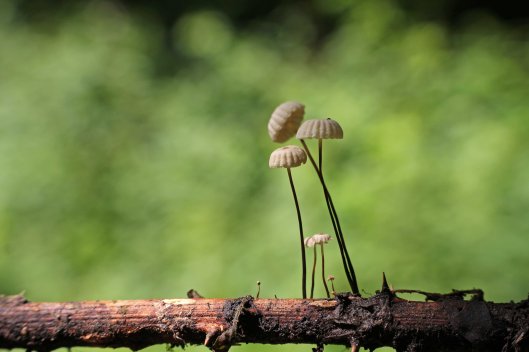
No, this post is not ‘A Practical Manual for Job-Hunters & Career-Changers’ (the book by Dick Bolles). Nor is it about the colour of ‘A cloth canopy which fills with air and allows a person or heavy object attached to it to descend slowly when dropped from an aircraft’ (Oxford Dictionary). This is about Marasmius rotula, the Collared parachute fungus, which seems to be springing up all around at the moment (well, three woodland areas near me, anyway), and the answer to the question is cream.
160628 Collared parachute fungus (1)

This little parachute is tiny: the caps range from 0.5 to 1.5cm across and these fungi grow no more than 7cm high. The epithet rotula refers to its wheel-like shape and, if you have a peep under the cap, you’ll soon seen why – the widely spaced gills are joined to a little collar that encircles the stem and the whole looks very like the spokes on a wheel. Turn it right way up and it looks for all the world like a parachute – but only one suitable for fairies! These grow mostly on the dead wood of deciduous trees and appear from June to September so if you’re out for a woodland walk, keep an eye out for them under the trees.

160628 Collared parachute fungus (2)
160628 Collared parachute fungus (3)
Like Loading...

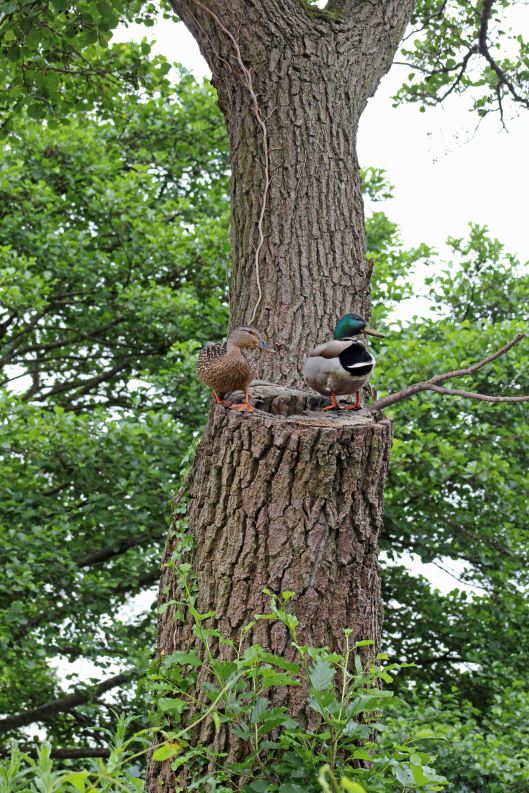
Two mallards up a tree

27 Monday Jun 2016

Posted by sconzani in birds, nature

≈ 11 Comments

Tags

birding, birdwatching, British birds, duck, Mallard

160627 mallards in tree (1)

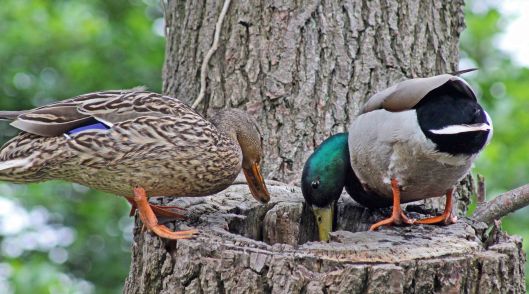
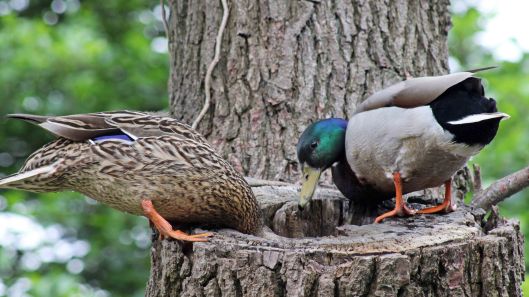
This was the scene I encountered during a recent walk around Roath Park Lake. It immediately struck me as odd as you almost never see mallards in trees, so what on earth were they doing? There’s a story here. I was on my way to catch a train so couldn’t linger long, so I don’t know what the story is, but there’s definitely a story. Feel free to post your suggestions in the comments below. Sensible or silly, I’d welcome your ideas.

160627 mallards in tree (2)160627 mallards in tree (3)160627 mallards in tree (5)160627 mallards in tree (6)

Like Loading...

The B-B C, but not as you know it

26 Sunday Jun 2016

Posted by sconzani in insects, nature

≈ 6 Comments

Tags

Broad-bodied Chaser, dragonflies, dragonfly, dragonfly ovipositing, Libellula depressa, National Insect Week

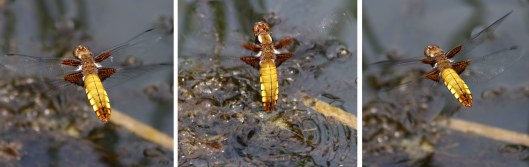
For this last day of National Insect Week 2016 we have one of my favourite types of insect, the dragonfly. Meet the Broad-bodied Chasers (or Libellula depressa to the scientifically minded). If we’re being politically correct, we won’t call them fat – they just happen to be a bit wider in the body than most other dragonflies. Both male and female start off a golden brown colour, but Mr B-B C soon develops a rather dapper layer of blue powdery granules (pruinescence) which matches perfectly with the yellow dots they both have along the sides of their abdomens.

160626 Broad-bodied chaser male

I’ve seen two pairs of Broad-bodied Chasers so far this year, both around small ponds which the males regularly patrol to ensure no intrusions into their territories. I’ve also been privileged to see them mating, a rather brief in-flight encounter, and then to see the female ovipositing – dipping her lower abdomen quickly into the water while in flight, to deposit her eggs into vegetation below the water level (as shown in the photos below). If you’re in southern England or Wales, these beauties will be around till September so go check out the show.

160626 Broad-bodied chaser female ovipositing

Like Loading...

The scorpion that doesn’t sting

25 Saturday Jun 2016

Posted by sconzani in insects, nature

≈ 7 Comments

Tags

National Insect Week, Panorpa communis, Panorpa species, scorpion fly

When is a scorpion not a scorpion? When it’s a fly, with a tail that looks like a scorpion – but only in the males and, even then, the sting can’t actually sting – it is, in fact, his genitals! This may be Panorpa communis but there are three species of scorpion fly in Britain and to distinguish between them you need to examine – you guessed it! – their genitals! (In the photos below, the male is on the left.)

160626 scorpion fly (3)
160626 scorpion fly (2)

While we’re on the subject of genitals, mating can be very risky for the male of the species, as females have been known to kill their mates. To divert the females, it seems the males have a trick up their sleeves under their wings – to woo the fly of their dreams, they offer up a gift of their own saliva which, apparently, works a treat.

160626 scorpion fly (1)

Lurking in hedgerows and woodlands, and particularly partial to nettle-filled areas, scorpion flies feed on dead insects. They are also known as hanging flies, from their habit of camouflaging themselves by dangling from leaves and twigs in order to pounce on the small unsuspecting critters that pass by. They are truly bizarre-looking creatures but completely harmless and rather comical to watch.

Like Loading...

Fluttering butterflies, no.2

24 Friday Jun 2016

Posted by sconzani in insects, nature

≈ 7 Comments

Tags

Anthocharis cardamines, British butterflies, butterfly, Celastrina argiolus, Common blue butterfly, Holly blue butterfly, Large skipper butterfly, Ochlodes sylvanus, Orange-tip butterfly, Polyommatus icarus

Though summer is well underway here in Britain, I’m not seeing a huge number of butterflies. Here are some I have seen fluttering by in recent weeks.

160624 Common Blue

There are several small blue butterflies in Britain and they can be difficult to tell apart but the Common blue (Polyommatus icarus) is, as its name implies, the most common. As is often the way with wildlife, the males are bright blue, whereas the females can be quite a drab brown.

160624 Holly blue

The Holly blue (Celastrina argiolus) looks quite similar to the Common Blue, especially in flight. The trick to identifying it is in the small black dots on the underwings. It is also the blue butterfly that emerges first from its winter hibernation so look for it near holly plants in early spring, then fluttering about ivy in the summertime.

160624 Orange tip

If this is an Orange-tip butterfly (Anthocharis cardamines), where’s the orange colour? Turns out this is a female and only the males have bright orange wing tips. Still, she’s a very pretty little thing, even if she did seem a bit shy and hid her head behind a leaf.

160624 Large Skipper

Though it’s called the Large skipper (Ochlodes sylvanus), this butterfly is relatively small, its wingspan just a couple of millimetres more than the Small skipper, so you need to look for the mottled brown markings on its upper wings to tell the two apart.

Like Loading...

The Gonzo of insect land

23 Thursday Jun 2016

Posted by sconzani in insects, nature

≈ 6 Comments

Tags

National Insect Week, Nettle weevil, Phyllobius pomaceus, weevil

Although The Muppets appeared after my childhood years, I’m still familiar with the main characters and one of my favourites has always been Gonzo. Perhaps that’s why I also love the Gonzos of the insect world, the weevils. And it’s not just their elongated snouts that remind me of him. Although weevils don’t have Gonzo’s energy, they do seem inclined towards occasional death-defying acts, teetering recklessly on the edges of leaves while reaching out for their next foothold, though they draw the line at catching cannonballs!

160623 nettle weevils (1)
160623 nettle weevils (2)
160623 nettle weevils (3)

Weevils can be difficult to identify but, as the ones pictured here were all found on nettles, I’m going to hazard a guess that they’re Nettle weevils (Phyllobius pomaceus). Being slightly more scientific, I think I can see the prominent tooth on the front femur of some of these creatures, which also helps to identify them, as does the position of their antennas on their heads. As you can see, the Neetle weevil is covered in blue-green scales that have a metallic sheen, though these can rub off as they age – and engage in death-defying (and other!) acts – so, older specimens do sometimes look more black than blue-green.

160623 nettle weevils (4)
160623 nettle weevils (5)
160623 nettle weevils (6)


Like Loading...

Spiderwoman?

22 Wednesday Jun 2016

Posted by sconzani in nature

≈ 10 Comments

Tags

Amblypygi, arachnids, spiders, tarantula, Whip spider

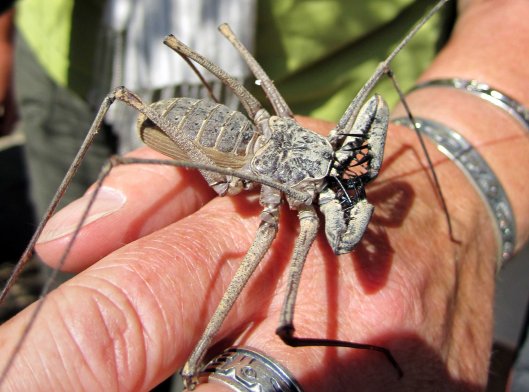
Firstly, let me just confirm that I know spiders are not insects so this doesn’t really fit for National Insect Week but I don’t have a lot of images of foreign insects so we’re having International Scary Spider Day instead. Look away now if you don’t like spiders!

160622 spiderwoman (2)

I’m not a big fan of spiders either, but somehow, some way, I’ve twice survived handling huge spiders. The first time was in Cambodia and the spider was a tarantula. The locals consider these a culinary delicacy and the one that sat on my hand was really being used as a ploy to lure tourists into buying the cooked produce. Despite being huge, this creature was delicate, and felt incredibly light and soft on my hand. And I survived!

160622 spiderwoman (1)

My second encounter with a large arachnid was in northern Peru. The beastie was a Whip spider, or more correctly an Amblypygi. They look scary but rarely bite, though you could get some nasty puncture wounds from those pedipalps (the spiked pincers) if it grabbed you. And I survived! … But, spiderwoman I am not.

Like Loading...

The rugby player of the insect world

21 Tuesday Jun 2016

Posted by sconzani in insects, nature

≈ 10 Comments

Tags

Fat-legged flower beetle, National Insect Week, Oedemera nobilis, Swollen-thighed beetle, Thick-legged beetle

160621 swollen-thighed beetle (1)

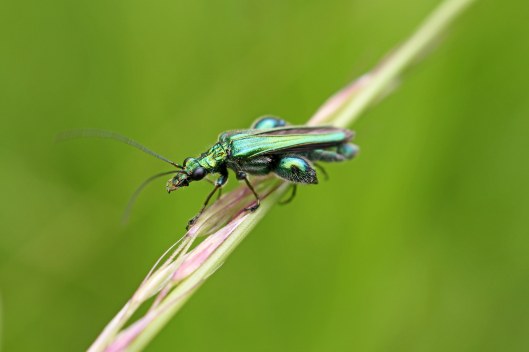
If you thought rugby players had well-developed thighs, take a look at this guy. He must work out at the gym every day of his life. Meet Oedemera nobilis, otherwise known as the Swollen-thighed beetle or, sometimes, the Thick-legged or Fat-legged flower beetle. Once seen, never forgotten … unless you see the female, whose shapely pins are nothing like the male’s.

160621 swollen-thighed beetle (2)

They’re a wonderfully vibrant green, often with a tinge of blue or gold in their metallic sheen, and they’re particularly abundant at this time of year. Though they feed on the nectar and pollen of a wide range of flower species, I’ve often found them immersing themselves in dandelion flowers, to emerge sprinkled in yellow pollen.

Like Loading...

Three moths in one day

20 Monday Jun 2016

Posted by sconzani in insects, nature, nature photography

≈ 6 Comments

Tags

Brimstone moth, Burnet companion, Cathays Cemetery, Cinnabar moth, Euclidia glyphica, moth, Opisthograptis luteolata, Tyria jacobaeae

The day I did my biodiversity hunt at Cathays Cemetery was a bumper day for moths, with three new species spotted.

brimstone (1)
brimstone (2)

The first was this beautiful Brimstone (Opisthograptis luteolata), not to be confused with the butterfly of the same name, though both are a mellow buttery yellow. I was flat out on the grass photographing this when a group of young school children passed by. ‘Teacher, what’s that lady doing?’ ‘I don’t know, David’, came the reply, as the teacher quickly ushered her charges past the mad lady lying down in the cemetery!

cinnabar (1)
cinnabar (2)
cinnabar (3)

The Cinnabar moth (Tyria jacobaeae) is a colourful character. It starts out life as a bright orange and black caterpillar, then transforms into a bright red and black moth – it gets its name from the bright red mineral mercury sulphide, also known as cinnabar. The caterpillars can be cannibalistic when their food source is scarce and, though I never saw them there, these moths were introduced to New Zealand in an attempt to control the invasive ragwort plant on which their caterpillars feed.

160620 burnet companion (3)
160620 burnet companion (4)
160620 burnet companion (5)

Last but certainly not least, as I saw several of these in one small area, was the Burnet companion (Euclidia glyphica). It apparently gets its common name from the fact that it’s often seen in the company of Burnet moths – not on this day! I make no excuses for showing its bottom, as the colour of its underside is a rich orange, almost more attractive than its top. Though they were mostly skittish, one very obligingly remained still long enough to get a head-on shot, which I love.

Like Loading...

Welsh cats

19 Sunday Jun 2016

Posted by sconzani in animals, nature

≈ 19 Comments

Tags

cat lover, cats, felines, Welsh cats

I’m a cat person. I know many people who are besotted with their dogs – about 90% of all Britons, judging by the numbers of dogs everywhere – but I just don’t get it. In fact, I get positively annoyed by dog owners who don’t clean up after their dogs or who seem to think it’s funny when their wet and muddy little rats jump up on strangers leaving wet and muddy footprints on what was clean clothing. Grrrrrr!

160619 welsh cats (2)
160619 welsh cats (6)
160619 welsh cats (8)
160619 welsh cats (9)
160619 welsh cats (10)

On the other hand, I love cats – though, I admit, these days I am frequently torn between my love of cats and my love of birds, the former being frequently the killers of the latter. Still, I love cats and would love to have one but my living arrangements prevent that. So, when I’m out walking I often spend time talking to the cats I meet along the way – lurking in long grass, keeping look-out from rooftops, guarding the wheelies, controlling the traffic, sunning on window sills, communing with spirits in the graveyard, and that battered and bruised old Tom patrolling the local patch.

160619 welsh cats (11)
160619 welsh cats (3)
160619 welsh cats (7)
160619 welsh cats (5)
160619 welsh cats (1)
160619 welsh cats (4)
Like Loading...
← Older posts
Newer posts →

About me

sconzani

sconzani

I'm a writer and photographer; researcher and blogger; birder and nature lover; countryside rambler and city strider; volunteer and biodiversity recorder.

View Full Profile →

Follow earthstar on WordPress.com

Enter your email address to follow this blog and receive notifications of new posts by email.

Recent blog posts

  • Nesting material April 28, 2026
  • Lifer: Box bug April 27, 2026
  • Peak Wild garlic April 26, 2026
  • First damsels of 2026 April 25, 2026
  • NFY: Green-veined white April 24, 2026

From the archives

COPYRIGHT

Unless otherwise acknowledged, the text and photographs on this blog are my own and are subject to international copyright. Nothing may be downloaded or copied without my permission.

Fellow Earth Stars!

  • Unknown's avatar
  • Unknown's avatar
  • Unknown's avatar
  • Unknown's avatar
  • Unknown's avatar
  • Unknown's avatar
  • Unknown's avatar
  • Unknown's avatar
  • Unknown's avatar
  • Unknown's avatar
  • Unknown's avatar
  • Unknown's avatar
  • Unknown's avatar
  • Unknown's avatar
  • Unknown's avatar
  • Unknown's avatar
  • Unknown's avatar
  • Unknown's avatar
  • Unknown's avatar
  • Unknown's avatar
  • Unknown's avatar
  • Unknown's avatar
  • Unknown's avatar
  • Unknown's avatar
  • Unknown's avatar
  • Unknown's avatar
  • Unknown's avatar
  • Unknown's avatar
  • Unknown's avatar
  • Unknown's avatar
  • Unknown's avatar
  • Unknown's avatar
  • Unknown's avatar
  • Unknown's avatar
  • Unknown's avatar
  • Unknown's avatar
  • Unknown's avatar
  • Unknown's avatar
  • Unknown's avatar
  • Unknown's avatar
  • Unknown's avatar
  • Unknown's avatar
  • Unknown's avatar
  • Unknown's avatar
  • Unknown's avatar
  • Unknown's avatar
  • Unknown's avatar
  • Unknown's avatar
  • Unknown's avatar
  • Unknown's avatar

Blog at WordPress.com.

Privacy & Cookies: This site uses cookies. By continuing to use this website, you agree to their use.
To find out more, including how to control cookies, see here: Cookie Policy
  • Subscribe Subscribed
    • earthstar
    • Join 642 other subscribers
    • Already have a WordPress.com account? Log in now.
    • earthstar
    • Subscribe Subscribed
    • Sign up
    • Log in
    • Report this content
    • View site in Reader
    • Manage subscriptions
    • Collapse this bar

Loading Comments...

You must be logged in to post a comment.

    %d