• ABOUT
  • BIRDING 2018
  • Birding 2019
  • BLOG POSTS
  • Butterflies 2018
  • Resources

earthstar

~ a celebration of nature

earthstar

Category Archives: parks

Winter heliotrope

12 Friday Jan 2018

Posted by sconzani in flowers, nature, parks, plants

≈ Leave a comment

Tags

Alexandra Park, Dingle Park, non-native invasive plant, Petasites fragrans, Winter heliotrope, winter-flowering plant

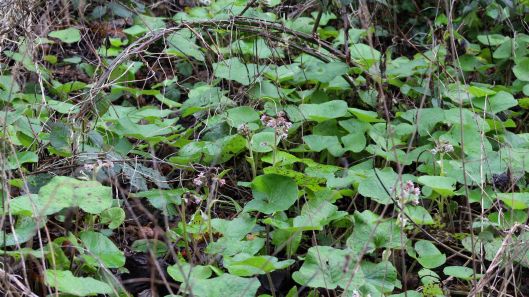
Officially, Winter heliotrope (Petasites fragrans) is a non-native invasive; unofficially, I think it’s got a rather lovely flower, which is particularly nice to see in the dead of winter, and its vanilla smell is divine.
180112 winter heliotrope (4)

According to Mabey’s Flora Britannica, it was brought to Britain as a garden plant in 1806, and the GB non-native species secretariat website states that it was first recorded in 1835 – presumably they mean the first record of it straying outside the bounds of the gardens where it had been planted. Though native to the Mediterranean and North Africa, it’s made itself at home in Britain, where it favours roadside verges, woodland margins and rough grassland. It seems very adaptable: in my local area, it favours sloping banks, a sunny slope in Dingle Park and a very wet and shady, steeply sloping streamside in Alexandra Park.

180112 winter heliotrope (1)
180112 winter heliotrope (2)
180112 winter heliotrope (3)

It can be difficult to get rid of because it grows very readily from the smallest discarded stem, sending its ‘roots’ (actually underground stems called rhizomes) spreading horizontally in all directions. Sneaky!

180112 winter heliotrope (5)

Like Loading...

The living fossil fungus challenge

05 Friday Jan 2018

Posted by sconzani in fungi, leaves, nature, parks, trees

≈ Leave a comment

Tags

Bartheletia paradoxa, fungus on Ginkgo leaves, Ginkgo, Ginkgo biloba, living fossil fungus

My local fungus group has a new challenge going for the month of January, to find a ‘living fossil fungus’. Sounds weird? Well, the ‘living fossil’ is the Ginkgo tree (Ginkgo biloba), a tree that’s been around since the time of the dinosaurs (read more about this beautiful tree on my sconzani blog here), and the fungus is Bartheletia paradoxa, a basidiomycete that only grows on Ginkgo leaves and has characteristics that are unique amongst basidiomycetes (for the science geeks out there, here’s a link to an expert article).

180105 Ginkgo fungus (1)

The fungus was not formally recognised until 1932 and was first found in Britain, on the leaves of a Ginkgo at Kew Gardens, in 2008. There are still very few official records for it but, as members of our fungus group are now discovering, it seems to be on almost every Ginkgo tree we can find.

180105 Ginkgo fungus (3)
180105 Ginkgo fungus (2)

As you can see from the photos, the fungus looks like black spots on the fallen leaves. Of course, autumn is long gone and the winter winds that have been roaring across Britain this past week have blown away a lot of fallen leaf litter but it’s still worth looking look around any Ginkgo trees you know of in your local parks. I found these leaves on Wednesday around the magnificent Ginkgo avenue in Bute Park, behind Cardiff Castle, and I have another couple of places to go looking in the next few days. So, do see if you can find yourself a ‘living fossil fungus’ as well.

Like Loading...

December at Cosmeston

28 Thursday Dec 2017

Posted by sconzani in birds, mammal, nature, parks, winter

≈ 2 Comments

Tags

birding, birdwatching, British birds, brown rat, bullfinch, Cosmeston, Cosmeston Lakes Country Park, Fieldfare, Great spotted woodpecker, long-tailed tit, Marsh tit, nuthatch, Stonechat, Tufted duck

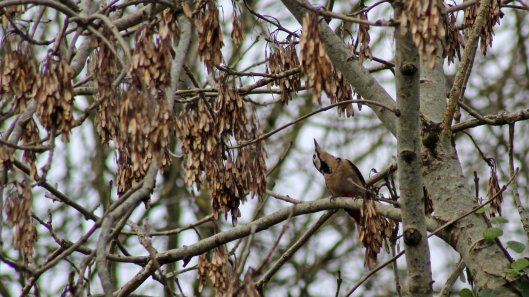
It was fairly quiet bird-wise on my first monthly visit to Cosmeston Lakes Country Park on 2 December, though there were still good numbers of the various thrushes (Mistle, Song, Redwing and Blackbird) around. A Great spotted woodpecker in the west paddock was a nice surprise – I initially thought it a Jay when I saw that peachy belly. The Tufted ducks amused, as always, and, while I sat watching them, the Brown rat I’d seen before at that particular spot came snuffling around for food. There were two more rats foraging by the boardwalk near the café.

171228 Cosmeston (1)

171228 Cosmeston (2)
171228 Cosmeston (3)

It’s a thrush takeover! On 6 December, I’d scarcely left the house to walk to Cosmeston than I was spotting Redwings, Song thrushes, and a Mistle thrush, plus Goldfinches and Chaffinches, in the trees just across the road. And when I got to Cosmeston it was more – much more – of the same, plus the first Fieldfares I’ve seen there. In Cogan Wood, the little birds were hungry so I shared my flapjack with them – there were even two Nuthatches and a half dozen Long-tailed tits picking up the crumbs on the ground. And the prize for the most colourful birds goes to the pair of Bullfinch that were munching on hogweed seeds.

171228 Cosmeston (5)
171228 Cosmeston (6)
171228 Cosmeston (7)
171228 Cosmeston (4)

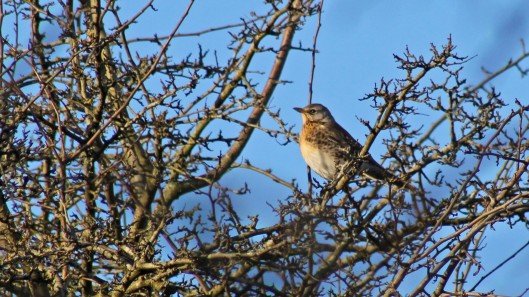
On 15 December, I finally got a reasonable, though not brilliant photo of a Fieldfare – they are very skittish so it’s hard to get close to them. I finally found a spot behind the berry trees they were feasting in, then just had to be patient and wait for one to pop up to the top of a tree.

171228 Cosmeston (8)

In Cogan Wood, one of the resident Marsh tits popped out to say hello – first sighting I’ve had since earlier in the year as they seem to disappear during the breeding season. And there was a Stonechat at the top end of the west paddock. There had been a pair of Stonechats in that area in the autumn but they seemed to have disappeared when the park staff mowed that field, so it was good to see one there again.

171228 Cosmeston (9)
171228 Cosmeston (10)

Something else happened at Cossie during this visit, something that’s never happened to me before. A squirrel climbed up my leg, not once but four times – the first time it grabbed my finger, the second time it touched my camera. I didn’t have food but it obviously thought I did. It certainly made me laugh.

Like Loading...

Bryophytes and lichens

11 Monday Dec 2017

Posted by sconzani in lichen, nature, parks, trees, winter

≈ 2 Comments

Tags

bryophytes, Cosmeston, Cosmeston Lakes Country Park, lichen on trees, lichens, mosses, mosses on trees

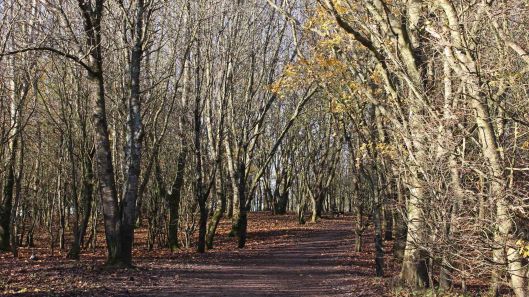
Over the summer months my eye has been distracted by all the little creatures that move – butterflies and moths, dragonflies and beetles, and all manner of other insects – but now that it’s winter and those creatures have mostly disappeared (you’ll notice one crept in to one of my photos!), my eye is again drawn to the more static beauty that surrounds me. Take, for example, this small grove of trees at Cosmeston Lakes Country Park.

171211 lichens and bryophytes (1)

I spent perhaps an hour here the other day, looking in wonder at the incredible variety of tiny lichens and bryophytes to be found on the tree trunks. I haven’t tried to identify these but I’m determined to return to them over the coming months to see which I can put names to and find out more about. For now, I just want to share their beauty.

171211 lichens and bryophytes (2)
171211 lichens and bryophytes (3)
171211 lichens and bryophytes (4)
171211 lichens and bryophytes (5)
171211 lichens and bryophytes (6)
171211 lichens and bryophytes (7)
171211 lichens and bryophytes (8)
171211 lichens and bryophytes (9)
171211 lichens and bryophytes (10)


Like Loading...

Blast from the past

08 Friday Dec 2017

Posted by sconzani in flowers, nature, parks

≈ 6 Comments

Tags

a walk in the park, Auckland, Auckland Domain, cultivated flowers, flowers, hothouse flowers, New Zealand, polyanthus, tulips, Wintergardens

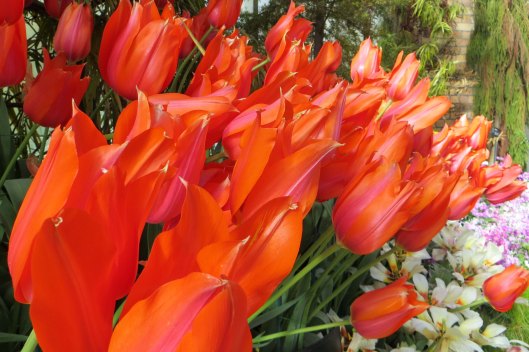
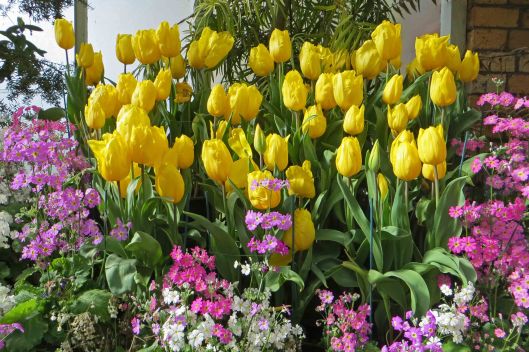
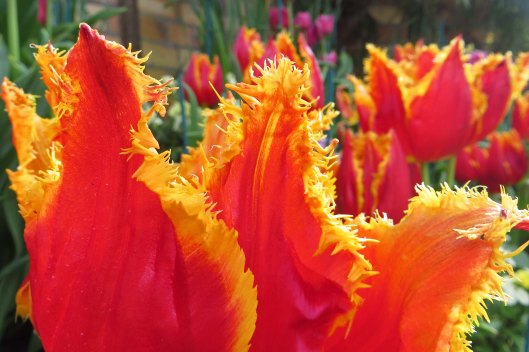
I was sorting through / clearing out files on my laptop earlier this week when, amongst my New Zealand images, I came across a temp folder of flowers. The shots were taken on 20 September 2014, when I was back in New Zealand for a couple of months, and the setting is the glasshouses of the Wintergardens in Auckland Domain, the photos taken, no doubt, on one of my many long strolls in that magnificent park. So, on this, the coldest day of winter so far here in Wales, here are some bright and cheerful hothouse flowers to offset any chill you might be feeling. Enjoy!

171208 Auckland Wintergarden flowers (1)171208 Auckland Wintergarden flowers (2)171208 Auckland Wintergarden flowers (3)171208 Auckland Wintergarden flowers (4)171208 Auckland Wintergarden flowers (5)171208 Auckland Wintergarden flowers (6)

Like Loading...

Birding at Parc Cwm Darran

04 Monday Dec 2017

Posted by sconzani in birds, nature, parks, trees

≈ Leave a comment

Tags

birding, birdwatching, Crossbill, Glamorgan Bird Club, Indian runner, Parc Cwm Darran, Siskin, Welsh valleys

With temperatures hovering around zero and a brisk wind making it feel even colder, our eleven intrepid Glamorgan Bird Club members were well wrapped up for last Wednesday’s birding at Parc Cwm Darran (and Rhaslas Pond, but more on that tomorrow).

171204 Parc Cwm Darran (1)

171204 Parc Cwm Darran (2)
171204 Parc Cwm Darran (3)

171204 Parc Cwm Darran (4)

The park sits on the site of the old Ogilvie Colliery, which was active from the early 1900s through to 1975, and various buildings and pieces of mining equipment can still be seen around the park. The scenery was stunning, with glorious old trees dotting the landscape, as well as areas of more modern plantings. One of our party was a local and showed us one particularly beautiful hidden gem, a waterfall cascading over the edge of an old quarry into a pool below.

171204 Parc Cwm Darran (5)171204 Parc Cwm Darran (6)

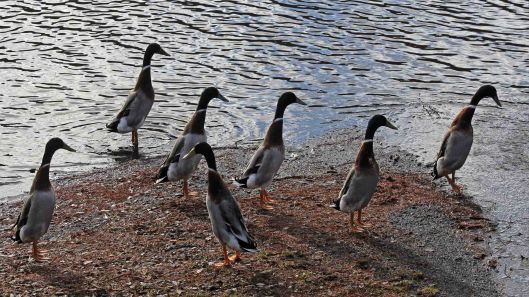
The birds were also stunning. We had good ’scope views of a male Crossbill, who sat very obligingly atop a tree for at least 15 minutes; we enjoyed sightings of several birds of prey, including four Buzzards, one of which came flying low straight towards us out of the quarry; and I saw my first Siskins of the year. The prize for the most entertaining birds, however, must go to the seven Indian runners, who looked to have Mallard in their genes and who were convinced we had food for them, running out of the water towards us and following us as we walked along the lake edge. 

171204 Parc Cwm Darran (7)

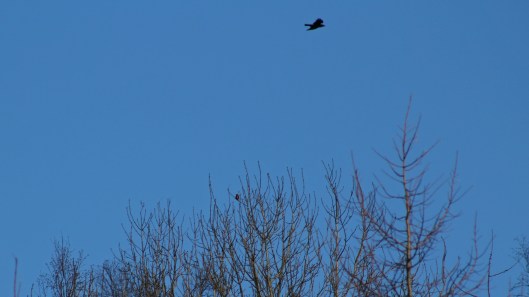
You’ll have to take my word about the dot in the tree being a Crossbill!
171204 Parc Cwm Darran (8)171204 Parc Cwm Darran (9)

The full list of the 44 species seen (these include those seen at Rhaslas Pond) is: Mute Swan, Canada Goose, Wigeon, Mallard, Tufted Duck, Goldeneye, Goosander, Great Crested Grebe, Red Kite, Sparrowhawk, Buzzard, Kestrel, Coot, Lesser Black-backed Gull, Herring Gull, Green Woodpecker, Magpie, Jay, Rook, Carrion Crow, Raven, Blue Tit, Great Tit, Coal Tit, Long-tailed Tit, Goldcrest, Wren, Nuthatch, Treecreeper, Starling, Blackbird, Fieldfare, Song Thrush, Mistle Thrush, Robin, Stonechat, Dunnock, House Sparrow, Pied Wagtail, Chaffinch, Goldfinch, Siskin, Common Crossbill and Bullfinch, though somehow I missed the Green woodpecker and Mistle thrushes.

Like Loading...

November at Cosmeston

02 Saturday Dec 2017

Posted by sconzani in autumn, insects, nature, parks

≈ Leave a comment

Tags

British dragonflies, Common Darter, Cosmeston Lakes Country Park, flies, fly, hoverfly, Mary Gillham Archive Project

I’ve only had a couple of visits to Cosmeston Lakes Country Park this month because my volunteer work on the Mary Gillham Archive Project has been taking up a bit more time as we try to get as much as possible done before the project effectively finishes at Christmas – though, having said that, I did spend four hours at Cosmeston last Friday trying to replicate, for the project website, photos Mary had taken in the early days of the park. These are a couple of those: Mary’s photo of the west lake in September 1987 on the left, and my photo from the same spot thirty years later on the right.

171202 Cosmeston west lake Sep 1987
171202 Cosmeston west lake Nov 2017

But I digress … apart from the berry-eating visitors, the Redwings and the Mistle thrushes, and finally managing to grab a couple of half-decent photographs of a Green woodpecker, I haven’t found anything particularly noteworthy bird-wise at Cosmeston during November. I have, however, been impressed by the numbers of insects still around, despite the fact that it has been noticeably colder, with daytime highs in the low teens and several overnight frosts.

171202 common darter (1)
171202 common darter (2)
171202 common darter (3)
171202 bumblebee

On 5 November, the ‘fireworks’ at Cosmeston were these lovely little Common darters. In an area shaded from the cool westerly wind but warmed by the bright sun, each had claimed itself a fencepost to bask on. And, nearby, a lone bumblebee looked like it wanted to snuggle for warmth into this seed-head ‘duvet’ of Old man’s beard (Clematis vitalba).

171202 fly (1)
171202 fly (2)
171202 hoverfly

On 24 November, though my focus was on finding the exact spots where Mary had taken her photos, I did still have one eye on the wildlife and noticed quite a lot of flies about. Like the dragonflies of two weeks earlier, these two flies and one hoverfly were favouring sheltered spots on wood to make the most of the sunshine.

Like Loading...

Wheatear

14 Thursday Sep 2017

Posted by sconzani in birds, nature, parks

≈ Leave a comment

Tags

autumn bird migration, birding, birdwatching, British birds, Cosmeston Lakes Country Park, migrating birds, Oenanthe oenanthe, Wheatear

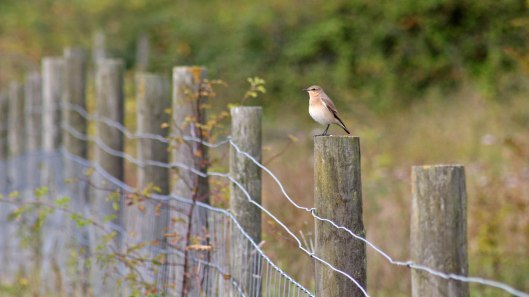
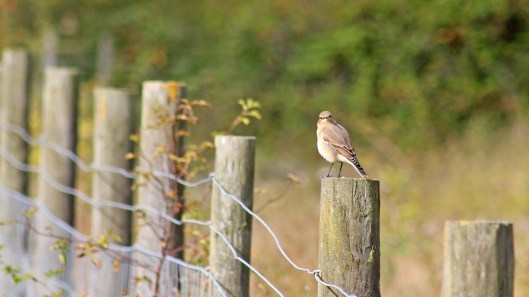
I went looking for Whinchat and Redstart but came home with Wheatear. I’m talking about birds, of course, and I didn’t actually bring the bird home, of course, just photos – and not particularly crisp photos at that, as the bird was perched on a fence post some distance away and I couldn’t get closer without spooking it. But what a lovely little bird it was!

170914 wheatear (1)

This was at Cosmeston, my local country park and nature reserve, which, as it sits very close to the Welsh coast adjacent to the Bristol Channel, is perfectly situated as a sort of springboard location for migrating birds – and the autumn bird migration is well and truly underway now. The Wheatear (Oenanthe oenanthe) breeds in upland areas of northern and western Britain but then, come the cooler days of late summer – early autumn, it wings its way south to spend the winter in central Africa.

170914 wheatear (3)
170914 wheatear (4)

The name Wheatear intrigued me so I consulted my trusty copy of Stefan Buczacki’s Fauna Britannica. It appears that many people assume, as I did, that the name comes from the bird’s tendency to consume ripening wheat. However, the etymology is older and seems to come from a Middle English word meaning ‘white arse’!

170914 wheatear (2)

Like Loading...

The Young’uns at Forest Farm

10 Sunday Sep 2017

Posted by sconzani in birds, nature, parks

≈ Leave a comment

Tags

birding, birdwatching, British birds, dunnock, Forest Farm, Forest Farm Nature Reserve, Greenfinch, Grey heron, juvenile birds, robin

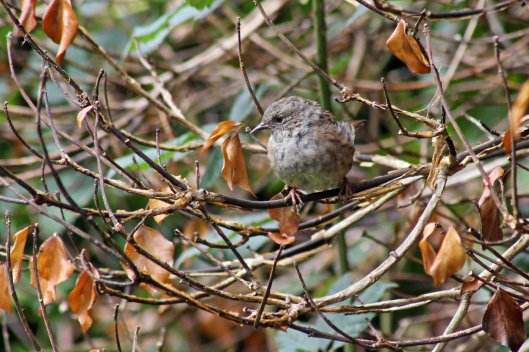
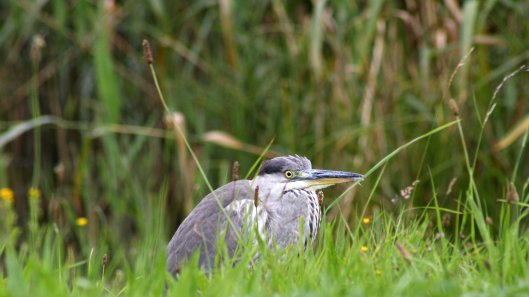
I hadn’t been to Forest Farm for a while but, when I heard some rather nice fungi had been found, I was there like a shot (more on that tomorrow). And, of course, whilst there I had to spend some quality time with the lovely birds that can be seen in this beautiful nature reserve at any time of the year. Now, in early autumn, there are a lot of young birds, and they’re always fun, and hungry, and often quite confiding.

170910 Dunnock170910 Greenfinches170910 Robin
170910 Grey heron (1)170910 Grey heron (2)170910 Grey heron (3)

Like Loading...

Dragons at Lavernock

27 Sunday Aug 2017

Posted by sconzani in insects, nature, parks

≈ 2 Comments

Tags

British dragonflies, Broad-bodied Chaser, Common Darter, dragonflies, dragonfly ovipositing, Emperor dragonfly, Lavernock Nature Reserve

There were some cracking dragonflies scooting around the pond at Lavernock Nature Reserve yesterday.

170827 Common darter male
170827 Common darter female

Both the male and the female Common darters posed very obligingly for me.

170827 Emperor male

The male Emperor kept busy patrolling the pond and indulging in occasional rapid trysts with a female. Judging by his tattered wings, he’s notched up quite a few trysts in recent days / weeks. He only stopped once, and then very briefly, so this photo doesn’t really do him justice.

170827 Emperor female

The female Emperor was then kept busy laying eggs at various spots all around the pond edges. A woman’s work is never done!

170827 Broad-bodied chaser male

The star of the show was this gorgeous male Broad-bodied chaser. Apparently, this is very late in the season for them, and he was looking pristine, so perhaps he had only recently hatched. Whatever his story, he was a stunning sight.

Like Loading...
← Older posts
Newer posts →

About me

sconzani

sconzani

I'm a writer and photographer; researcher and blogger; birder and nature lover; countryside rambler and city strider; volunteer and biodiversity recorder.

View Full Profile →

Follow earthstar on WordPress.com

Enter your email address to follow this blog and receive notifications of new posts by email.

Recent blog posts

  • Q is for Quercus December 22, 2025
  • P is for Phalarope December 21, 2025
  • O is for Odonata December 20, 2025
  • N is for nest December 19, 2025
  • M is for mite December 18, 2025

From the archives

COPYRIGHT

Unless otherwise acknowledged, the text and photographs on this blog are my own and are subject to international copyright. Nothing may be downloaded or copied without my permission.

Fellow Earth Stars!

  • Unknown's avatar
  • Unknown's avatar
  • Unknown's avatar
  • Unknown's avatar
  • Unknown's avatar
  • Unknown's avatar
  • Unknown's avatar
  • Unknown's avatar
  • Unknown's avatar
  • Unknown's avatar
  • Unknown's avatar
  • Unknown's avatar
  • Unknown's avatar
  • Unknown's avatar
  • Unknown's avatar
  • Unknown's avatar
  • Unknown's avatar
  • Unknown's avatar
  • Unknown's avatar
  • Unknown's avatar
  • Unknown's avatar
  • Unknown's avatar
  • Unknown's avatar
  • Unknown's avatar
  • Unknown's avatar
  • Unknown's avatar
  • Unknown's avatar
  • Unknown's avatar
  • Unknown's avatar
  • Unknown's avatar
  • Unknown's avatar
  • Unknown's avatar
  • Unknown's avatar
  • Unknown's avatar
  • Unknown's avatar
  • Unknown's avatar
  • Unknown's avatar
  • Unknown's avatar
  • Unknown's avatar
  • Unknown's avatar
  • Unknown's avatar
  • Unknown's avatar
  • Unknown's avatar
  • Unknown's avatar
  • Unknown's avatar
  • Unknown's avatar
  • Unknown's avatar
  • Unknown's avatar
  • Unknown's avatar
  • Unknown's avatar

Blog at WordPress.com.

Privacy & Cookies: This site uses cookies. By continuing to use this website, you agree to their use.
To find out more, including how to control cookies, see here: Cookie Policy
  • Subscribe Subscribed
    • earthstar
    • Join 667 other subscribers
    • Already have a WordPress.com account? Log in now.
    • earthstar
    • Subscribe Subscribed
    • Sign up
    • Log in
    • Report this content
    • View site in Reader
    • Manage subscriptions
    • Collapse this bar
 

Loading Comments...
 

You must be logged in to post a comment.

    %d