• ABOUT
  • BIRDING 2018
  • Birding 2019
  • BLOG POSTS
  • Butterflies 2018
  • Resources

earthstar

~ a celebration of nature

earthstar

Category Archives: plants

247/366 Amphibious bistort

03 Thursday Sep 2020

Posted by sconzani in nature, plants, wildflowers

≈ 1 Comment

Tags

Amphibious bistort, amphibious wildflower, British flora, British wildflowers, Cosmeston Lakes Country Park, Persicaria amphibia

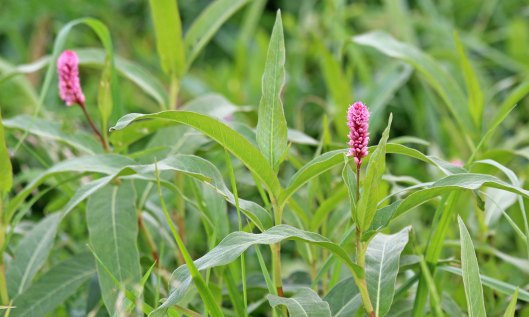
Initially, I doubted my identification of this plant – I’d seen it growing in clumps in the waters of Cosmeston Country Park’s west lake, so how could this be the same plant growing in a section of meadow, albeit a damp area where reeds are abundant?

200903 amphibious bistort (1)

The Great crested grebes like to park themselves amongst the plant, perhaps to stop them drifting while they snooze.

The clue, of course, is in its name: amphibious, ‘relating to, living in, or suited for both land and water’ (Oxford Dictionary). Amphibious bistort (Persicaria amphibia) has two forms, one that resembles a water lily, floating its leaves upon the water surface, and another that lives quite happily on land that can be quite a distance from water, as long as that land is moist.

200903 amphibious bistort (2)

This second type also shows the somewhat more elongated leaves that its generic name refers to – persicaria ‘relates the shape of leaves of this group of plants to those of a peach tree’ (First Nature) – and the land-based form has hairy leaves, which the water-growing form does not. To clinch the identification, my book (The Wild Flower Key) says to look for two stigmas in most flowers, which Amphibious bistort has but similar species do not. And very pretty flowers they are too!

200903 amphibious bistort (3)
200903 amphibious bistort (4)
200903 amphibious bistort (5)
Like Loading...

242/366 Bottoms on brambles

29 Saturday Aug 2020

Posted by sconzani in autumn, insects, nature, plants

≈ 4 Comments

Tags

blackberries, brambles, flies, insects on blackberries, insects on bramble, wasp

I don’t know about you but, when I’m out walking at this time of year, I’m often tempted to pluck and devour one of the luscious-looking blackberries growing on the bramble-covered fences and hedgerows.

200829 bottoms on brambles (1)
200829 bottoms on brambles (2)

Well, not any more. Not now I’ve seen how many flies like to suck at them and run their dirty little feet all over them. Just look at all those fly bottoms!

200829 bottoms on brambles (3)
200829 bottoms on brambles (4)

And let’s not even mention the very real possibility of getting stung by a wasp that’s jealously guarding ‘its’ berries. From now on, the berries are all for the beasties!

200829 bottoms on brambles (5)
200829 bottoms on brambles (6)
Like Loading...

239/366 Spurges

26 Wednesday Aug 2020

Posted by sconzani in nature, plants, wildflowers

≈ Leave a comment

Tags

British wildflowers, Cypress spurge, Euphorbia cyparissias, Euphorbia helioscopia, Euphorbia peplus, Petty spurge, spurge, Sun spurge

The Oxford Dictionary tells me that the word spurge was first used in Late Middle English and is a ‘shortening of Old French espurge, from espurgier, from Latin expurgare “cleanse” (because of the purgative properties of the milky latex)’. If you have sensitive skin, you may want to be wary of touching that latex, which both the stem and leaves will exude if broken, as it can irritate.

200826 Petty spurge (1)
200826 Petty spurge (2)

In fact, the latex in Petty spurge (Euphorbia peplus) is so caustic that it’s used in medications for the removal of warts and veruccas. This is the spurge I see most often, as it seems to enjoy the edges of pavements and lanes, road verges and waste ground and, though an annual, it can be seen over a long period, from April right through to October.

200826 sun spurge (2)

Sun spurge (Euphorbia helioscopia) is superficially similar to Petty spurge but is slightly larger and has a shorter growing period, from May to August. The easiest way to tell one spurge from the other is by counting the rays in the umbel: Petty spurge has three rays while Sun spurge has five. Although Sun spurge supposedly enjoys a similar growing environment to Petty spurge, I don’t see it very often in my urban area: as the photo below indicates, my find was growing in an arable field (where no crops were sown this season, but some residue crops have sprouted).
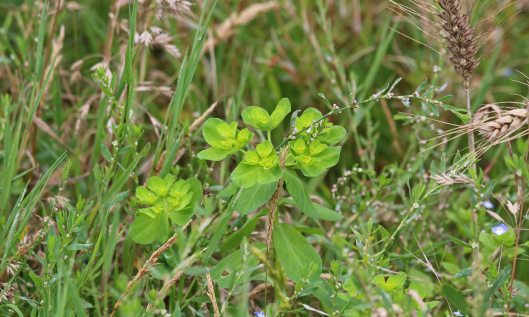
200826 sun spurge (1)

Perhaps because of its irritant sap, Sun spurge has a wealth of interesting common names. These are from the Royal Horticultural Society’s website: cat’s milk, churn staff, little good, little goody, mad woman’s milk, mare’s milk, mouse milk, wart grass and wartwort.

200826 cypress spurge (2)
200826 cypress spurge (1)

Cypress spurge (Euphorbia cyparissias) is the most unusual and intriguing of today’s spurges. I found a large area of this very attractive plant growing on top of the Aberbargoed coal spoil tip on 29 July but it’s taken a couple of weeks to get the identification confirmed. I’m not sure how the plant came to be on the tip – my guide book says Cypress spurge is ‘possibly native’ in southern Britain but a probable garden escape elsewhere (The Wild Flower Key).

Like Loading...

238/366 Midge galls

25 Tuesday Aug 2020

Posted by sconzani in autumn, insects, nature, plants, wildflowers

≈ 2 Comments

Tags

British galls, British insects, British wildflowers, Cosmeston Lakes Country Park, galls on wild carrot, Kiefferia pericarpiicola, midge gall, Wild carrot

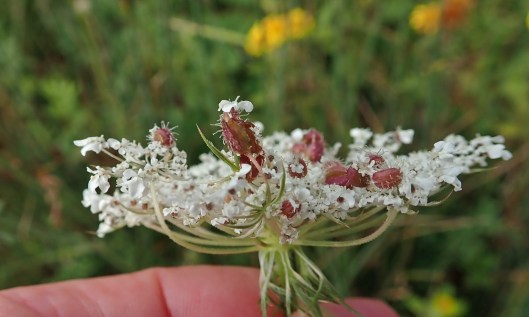
I was looking around at the various wildflowers yesterday at Cosmeston, seeing what insects might be about, when I noticed these odd growths on some of the Wild carrot flower heads. I split one open with my finger nail and a miniscule orange blob fell out; turns out that was the larva of a midge with the long-winded name of Kiefferia pericarpiicola.

200825 Kiefferia pericarpiicola (1)

The galls start off green (below left), before turning pinkish and eventually brown. According to the Nature Spot website, these galls can be seen from late summer through to autumn, after which the larvae will leave the gall and drop down to the soil to pupate. The midge only occurs in southern parts of Britain at the moment – and I only found two previous records in the Welsh biodiversity database – but perhaps that will change as our climate continues to warm and the midge flies further afield. It’s also possible, of course, that this insect is under-recorded – it seems the midge itself is almost never seen, only its gall creations.

OLYMPUS DIGITAL CAMERA
Like Loading...

227/366 Guelder rose

14 Friday Aug 2020

Posted by sconzani in autumn, nature, plants

≈ 2 Comments

Tags

autumn berries, autumn colour, Guelder rose

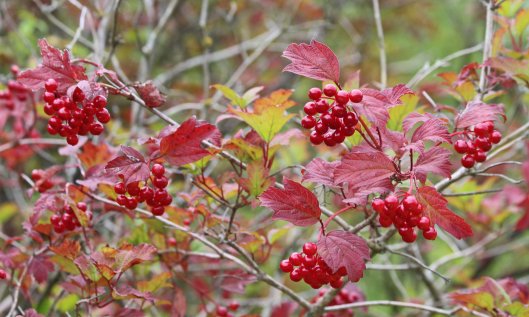
You thought I was joking with yesterday’s post about autumn arriving early this year, didn’t you? Well, the gorgeous colours of this Guelder rose look very autumnal to me. Bring on the glorious shades of autumn!

200814 guelder rose

Like Loading...

224/366 Burdock beasties

11 Tuesday Aug 2020

Posted by sconzani in insects, nature, plants, wildflowers

≈ 1 Comment

Tags

Arctium minus, Banded burdock fly, British insects, Common Green Shieldbug, Lesser burdock, Palomena prasina, Terellia tussilaginis

Lesser burdock (Arctium minus) seems to be having a good year as I’ve been finding lots of vigorous, flowering plants during my local walks, and they’re home to some interesting mini-beasties. One I always look for is the Banded burdock fly (Terellia tussilaginis), and it also seems to be thriving locally.

200811 lesser burdock (4)200811 lesser burdock (5)200811 lesser burdock (6)

And, on one particular clump of burdock, I found a bounty of Common green shieldbugs (Palomena prasina), as I’ve done before (see my previous post Keeping it in the family, from September 2017). Once again, these were a mix of juvenile stages, 3rd and 4th instars, I think.

200811 lesser burdock (1)
200811 lesser burdock (2)
200811 lesser burdock (3)

Of course, there are lots of other mini-beasties that also find Burdock flower nectar delicious – these two bees are just a couple of examples. What beasties have you seen on Burdock?

200811 lesser burdock (7)
200811 lesser burdock (8)
Like Loading...

222/366 Damp feet

09 Sunday Aug 2020

Posted by sconzani in flowers, nature, plants, wildflowers

≈ 4 Comments

Tags

British wildflowers, Common restharrow, Marsh woundwort, Purple loosestrife, wildflower

It’s Sunday – I think we need some wildflowers, and this week we have three plants that are all partial to living with damp feet, all with flowers in the pink-purple colour range.

200809 marsh woundwort (1)
200809 marsh woundwort (2)

200809 marsh woundwort (3)

Marsh woundwort (Stachys palustris)
As its common name implies, this wildflower thrives in locations where its roots can keep damp: near lakes and rivers, ponds and bogs. Its scientific name also refers to this: palustris means ‘of swamps’, while Stachys means ‘spike of flowers’, which is exactly what this lovely wildflower exhibits. And, of course, all the ‘woundworts’ were used extensively by herbalists, in this case, as an ointment to aid aching joints and as a dressing to help heal cuts and other wounds.

200809 purple loosestrife

Purple loosestrife (Lythrum salicaria)
Here’s another widespread plant of marshes and riversides, and that’s exactly where I found this example, alongside the River Ely in Cardiff. Unfortunately, I couldn’t get any closer for better photos of the individual flowers. In Flora Britannica, Richard Mabey gives this explanation for this plant’s intriguing name: ‘“Loose-strife” is a literal translation of the Greek name for the plants, which in classical times was believed to be so powerful “that if placed on the yoke of inharmonious oxen, [it] will restrain their quarrelling”.’

200809 mint (1)
200809 mint (2)
200809 mint (3)

200809 mint (4)

Water mint (Mentha aquatica)
And here’s another plant that prefers living with damp, not necessarily wet feet. Once again, this wildflower’s name tells the story: ‘Water’ and ‘aquatica’; and you only have to rub the leaves to release the delicious minty aroma, which is so refreshing. Insects love it too, as you can see from the hoverfly, butterfly and bee in the photos above.

Like Loading...

218/366 Vervain

05 Wednesday Aug 2020

Posted by sconzani in nature, plants, wildflowers

≈ Leave a comment

Tags

British wildflowers, Grangemoor Park, The Chief Herb, The Herb, Verbena officinalis, Vervain, wildflower

I’ve been trying, very slowly, to learn the names of more wildflowers so, when I couldn’t put a name to this plant at Grangemoor Park a couple of days ago, I made sure to take lots of photos of it. And today I found out this straggly, nondescript wildflower is not just any old plant, this is ‘The Herb’!

200805 vervain (1)

Vervain (Verbena officinalis) was so valued by herbalists in Anglo Saxon times that it was considered ‘The Chief Herb’, and was ‘a venerated plant, valued not just as a panacea (it was trumpeted as a cure for the plague in the Middle Ages) but as a magical charm, which could both protect against witches and demons and conjure up devilry of its own’ (Flora Britannica). 

200805 vervain (3)
200805 vervain (2)
Like Loading...

216/366 Red bartsia

03 Monday Aug 2020

Posted by sconzani in nature, plants, wildflowers

≈ 2 Comments

Tags

British wildflowers, Cosmeston Lakes Country Park, Odontites vernus, Red bartsia, wildflowers

Red bartsia (Odontites vernus) is an unobtrusive wildflower that I have tended to overlook until now but it’s very common in Cosmeston Lakes Country Park, one of my local haunts, so I thought I should take a closer look at it.

200803 red bartsia (1)

The Wildlife Trust website says Red bartsia can be found growing on low-fertility soils – places like waste ground, brownfield sites, along the edges of roads and railway tracks, and it survives in these more barren places because it’s semi-parasitic on the plants around it, tapping in to their root systems to gather extra nutrients.

200803 red bartsia (2)
200803 red bartsia (3)

Its scientific name is interesting: Odontites comes from Ancient Greek ὀδούς meaning tooth and apparently refers to the fact that Pliny the Elder used this plant to treat toothache; vernus refers to springtime, presumably when this plant comes to life for the year. It flowers for several months over the summer, providing a good nectar source for many species of bee and wasp.

200803 red bartsia (4)

Like Loading...

214/366 Butterfly eggs

01 Saturday Aug 2020

Posted by sconzani in insects, nature, plants

≈ 3 Comments

Tags

British butterflies, butterfly, butterfly egg, Common blue butterfly, Common blue butterfly egg, Painted Lady, Painted lady egg, thistle

This Painted lady is only the fourth individual I’ve seen this year but she was by far the best, not because of her appearance, which is a little ragged around the edges, but because she was laying eggs … and I’d never seen a Painted lady egg before.

200801 painted lady

At just 0.65mm high, the egg is tiny and, in my reference book, it’s described as green but, to my eye, this one is more of a pale turquoise – the plant stem is green. And the plant is a thistle – Creeping thistle, I think, though it was a young plant with no flowers, which makes it harder for me to identify but probably more nourishing for the teeny tiny caterpillar to munch on when it emerges. Now if I can only find this exact plant again in approximately a week’s time …

200801 painted lady egg (1)
200801 painted lady egg (2)

And following hot on the heels of finding that Painted lady egg, today I spotted a female Common blue butterfly laying her eggs in a sheltered clearing. You can perhaps see in the photo how she is angling her body to deposit an egg underneath the foliage.

200801 Common blue egg laying

So, once again, I was able to find the newly laid egg and take some photos. According to my book, these eggs are usually 0.5mm in diameter and just 0.25mm high, so really tiny. I have no chance of finding this egg again but I’m really glad I had the chance to see it.

200801 common blue egg (1)
200801 common blue egg (2)
Like Loading...
← Older posts
Newer posts →

About me

sconzani

sconzani

I'm a writer and photographer; researcher and blogger; birder and nature lover; countryside rambler and city strider; volunteer and biodiversity recorder.

View Full Profile →

Follow earthstar on WordPress.com

Enter your email address to follow this blog and receive notifications of new posts by email.

Recent blog posts

  • Busy Blue tits March 17, 2026
  • Cuttlebones March 16, 2026
  • No woodland here March 15, 2026
  • Family comes first March 14, 2026
  • Local Little egrets March 13, 2026

From the archives

COPYRIGHT

Unless otherwise acknowledged, the text and photographs on this blog are my own and are subject to international copyright. Nothing may be downloaded or copied without my permission.

Fellow Earth Stars!

  • Unknown's avatar
  • Unknown's avatar
  • Unknown's avatar
  • Unknown's avatar
  • Unknown's avatar
  • Unknown's avatar
  • Unknown's avatar
  • Unknown's avatar
  • Unknown's avatar
  • Unknown's avatar
  • Unknown's avatar
  • Unknown's avatar
  • Unknown's avatar
  • Unknown's avatar
  • Unknown's avatar
  • Unknown's avatar
  • Unknown's avatar
  • Unknown's avatar
  • Unknown's avatar
  • Unknown's avatar
  • Unknown's avatar
  • Unknown's avatar
  • Unknown's avatar
  • Unknown's avatar
  • Unknown's avatar
  • Unknown's avatar
  • Unknown's avatar
  • Unknown's avatar
  • Unknown's avatar
  • Unknown's avatar
  • Unknown's avatar
  • Unknown's avatar
  • Unknown's avatar
  • Unknown's avatar
  • Unknown's avatar
  • Unknown's avatar
  • Unknown's avatar
  • Unknown's avatar
  • Unknown's avatar
  • Unknown's avatar
  • Unknown's avatar
  • Unknown's avatar
  • Unknown's avatar
  • Unknown's avatar
  • Unknown's avatar
  • Unknown's avatar
  • Unknown's avatar
  • Unknown's avatar
  • Unknown's avatar
  • Unknown's avatar

Blog at WordPress.com.

Privacy & Cookies: This site uses cookies. By continuing to use this website, you agree to their use.
To find out more, including how to control cookies, see here: Cookie Policy
  • Subscribe Subscribed
    • earthstar
    • Join 668 other subscribers
    • Already have a WordPress.com account? Log in now.
    • earthstar
    • Subscribe Subscribed
    • Sign up
    • Log in
    • Report this content
    • View site in Reader
    • Manage subscriptions
    • Collapse this bar
 

Loading Comments...
 

You must be logged in to post a comment.

    %d