
One of my favourite plants, the Teasel (Dipsacus fullonum) looks fabulous whether wreathed with its tiny lilac flowers, which insects of all kinds find delicious, or bare and dry and oh-so-sculptural during the winter months.

15 Thursday Aug 2019
Posted in flowers, nature, plants, wildflowers
One of my favourite plants, the Teasel (Dipsacus fullonum) looks fabulous whether wreathed with its tiny lilac flowers, which insects of all kinds find delicious, or bare and dry and oh-so-sculptural during the winter months.
14 Wednesday Aug 2019
Tags
Bedeguar wasp gall, Diplolepis rosae, Dog-rose gall, gall on dog-rose, gall wasps, galls, Robin's pincushion
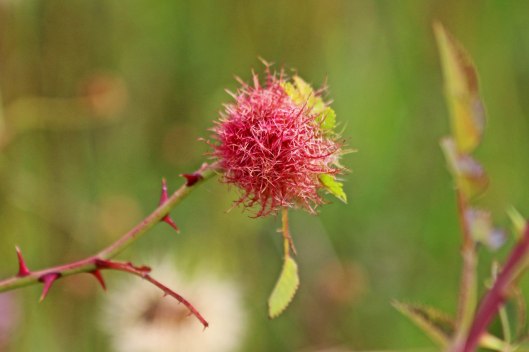
Commonly known as Robin’s pincushion and found growing on Dog roses, this is a gall, the spectacular creation of a group of larvae of the Bedeguar gall wasp (Diplolepis rosae).
18 Thursday Jul 2019
Posted in 365DaysWildin2019, nature, plants, wildflowers
Tags
#365DaysWild, British flora, Cirsium acaule, Cosmeston, Cosmeston Lakes Country Park, Dwarf thistle, thistle, wildflowers
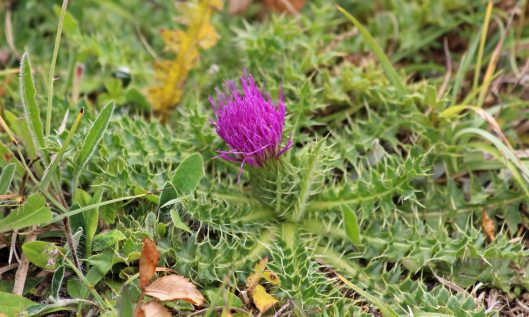
During today’s walk around Cosmeston I spotted a plant I’ve not seen before – or, at least, I’ve not consciously noticed before. It’s so easy to just walk over the things growing under your feet – although, in this case, if you were walking barefoot you couldn’t help but notice it!

It’s the Dwarf thistle (Cirsium acaule), and it’s easily identifiable as its single flower almost completely lacks a stem – the gorgeous purple flower sits right on top of a rosette of wavy and spiny edged leaves.


This thistle prefers to grow in low grasslands, particularly on calcareous soils, so it does tend to be quite localised but can be found in England as far north as Yorkshire and in south Wales.
17 Wednesday Jul 2019
Posted in 365DaysWildin2019, insects, nature, plants
Tags
British moths, caterpillars, caterpillars on ragwort, Cinnabar moth, Cinnabar moth caterpillars, orange and black caterpillars, Ragwort
It’s time to check your local patch of Ragwort for these little critters, the caterpillars of the Cinnabar moth.
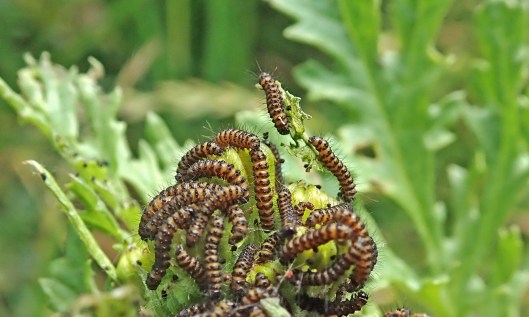
As adult moths, they’re bright red and black but as caterpillars they’re a striking combination of orange-and-black stripes, the patterns more visible the more they munch and grow.


For some reason there’s quite a size difference in this little bunch – perhaps a combination of broods hatched at different times that just happen to have chosen the same Ragwort plant to chew on.

09 Tuesday Jul 2019
Posted in 365DaysWildin2019, nature, plants
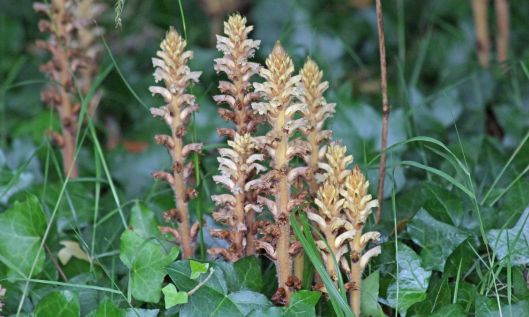
As I was walking through the park-like surroundings of All Saints Church in Penarth today, I noticed these curiosities growing amongst ivy under a couple of the trees. As the trees were different but they had ivy in common, I assume these are Ivy broomrape. Their scientific name is Orobanche hederae which, according to Wikipedia, translates as follows: ‘Orobanche is derived from Greek, and means ‘legume strangler’ … The name hederae means ‘of ivy’, in reference to its host plant, Hedera.’

All the broomrapes, the Orobanchaceae, are parasitic plants: they are unable to manufacture their own chlorophyll so cannot exist without tapping in to the roots of their host plants for nutrients. In this case the host is ivy but there are also broomrapes that parasitize trees like hazel and elm and plants like yarrow, greater knapweed and various thistles.
24 Wednesday Apr 2019
Posted in 365DaysWildin2019, nature, plants, wildflowers
Tags
ale-hoof, blue flowers, Blue runner, British flora, British wildflowers, Glechoma hederacea, Ground ivy
Ground-ivy (Glechoma hederacea) is a type of dead-nettle, common in woodlands, lurking under hedgerows and scrambling over dampish spaces. Richard Mabey’s Flora Britannica tells me this pretty little plant was once known as blue runner because of its blue-ish flowers and its habit of spreading via overground runners. Another interesting titbit: ‘before hops became widely used in brewing, it was once one of the chief bittering agents in the making of beer’, which is why another of its common names is ale-hoof.


20 Saturday Apr 2019
Posted in 365DaysWildin2019, flowers, nature, plants, spring
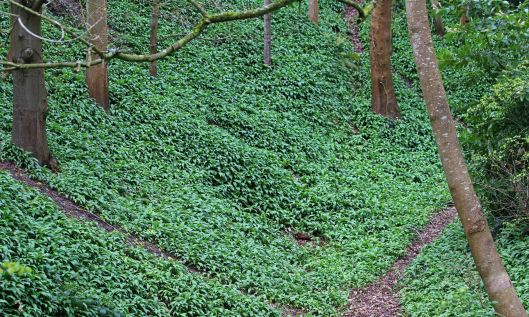
It doesn’t matter what name you call it by – Ramsons, Londoner’s lily or Wild garlic – it smells. Some people even find the smell overwhelming but I don’t mind it, and when you see Ramsons flowering en masse, they’re really very lovely.
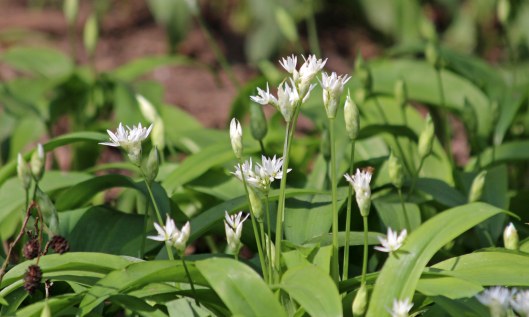
According to Richard Mabey in my ever-useful Flora Britannica, Ramsons were ‘unmistakable and abundant enough to figure in Old English place names’ and he gives the following examples: ‘Ramsey Island off Pembrokeshire; Ramsbottom, Lancashire; Ramsdell, Hampshire; Ramsholt, Suffolk; Ramshope, Northumberland; and Ramshorn, Staffordshire’.


Here in Penarth, the banks of the stream that flows alongside Alexandra Park are carpeted with Ramsons at this time of year, and their growth is also lush in the wild gardens in Cardiff’s Roath Park and under the trees in Bute Park’s woodland trail. Get sniffing!
06 Saturday Apr 2019
Posted in 365DaysWildin2019, insects, nature, plants, spring
Tags
British insects, Exapion ulicis, gorse, Gorse shieldbug, Gorse weevil, Piezodorus lituratus, shieldbugs, weevils
I got some strange looks today when I was out walking – nothing unusual about that really. This time it was because I had my nose in a gorse bush looking for its special critters – and I found them. First, I was delighted to spot two tiny Gorse weevils (Exapion ulicis). I’ve only found them once before and these two led me a merry dance, in and around the gorse leaves, not wanting to have their photo taken. One disappeared but I managed to grab a couple of pics of the other.

The other critters were much easier, at least ten of them, probably many more, hiding in plain sight – that’s how well camouflaged they are. These Gorse shieldbugs (Piezodorus lituratus) were also camera shy and the gorse thorns made a few holes in my hands as I tried to pull the gorse this way and that to get some photos. But it was worth every speck of blood!


13 Wednesday Mar 2019
Posted in 365DaysWildin2019, fungi, nature, plants
Tags
Alexanders, Alexanders plants, Alexanders rust, Puccinia smyrnii, rust, rust fungi, Smyrnium olusatrum
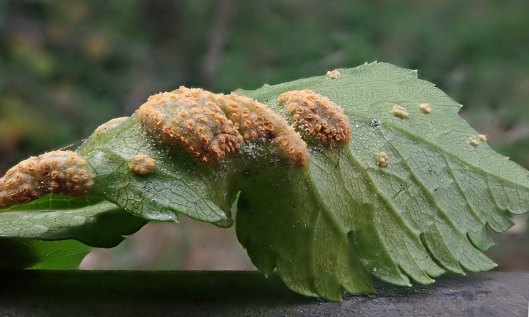
We had such a mild winter this year that the Alexanders plants (Smyrnium olusatrum) that grow well along the coastal path from Penarth to Lavernock only died down for a few short weeks, then their vibrant green once again began to appear and grow up at their usual rapid pace. And with the leaves almost immediately came the rust that loves these plants, Alexanders rust (Puccinia smyrnii). It is obviously immune to bad weather, as it has continued to flourish right through the occasional frosts and heavy downpours that were about the worst weather winter produced this year.
12 Tuesday Mar 2019
Posted in 365DaysWildin2019, nature, plants
I’d tried growing an avocado from seed several times before but this is the first time I’ve succeeded, at least so far so good. It’s been a very slow process: I first put the seed into water on 30 August last year. It was three weeks later, on 20 September, that the seed split open and I could see something was stirring.


By 11 November 2018 a root had begun to emerge but it has taken another 4 months to get to where it is now, in my third and fourth photos below, which were taken on 5 March. Let’s hope it continues to flourish.


 earthstar
You must be logged in to post a comment.