• ABOUT
  • BIRDING 2018
  • Birding 2019
  • BLOG POSTS
  • Butterflies 2018
  • Resources

earthstar

~ a celebration of nature

earthstar

Category Archives: spring

131/366 New bloomers

10 Sunday May 2020

Posted by sconzani in nature, spring, wildflowers

≈ 5 Comments

Tags

Bittersweet nightshade, British wildflowers, Common milkwort, Cut-Leaved crane’s-bill, Flax, Goat's-beard, Spring colour, Wood avens

Here are this week’s newly flowering wildflowers …
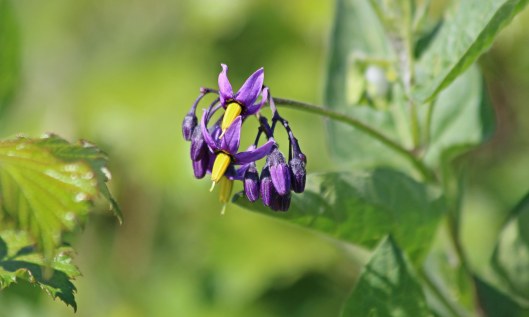
200510 bittersweet nightshade

Bittersweet nightshade (Solanum dulcamara), also known as Woody nightshade and Deadly nightshade, though my Flora Britannica assures me this is actually one of the less poisonous members of the nightshade family.

200510 cut-leaved crane's-bill

Cut-leaved crane’s-bill (Geranium dissectum), one of the many lovely members of the extended Geranium family.

200510 flax

Flax (Linum usitatissimum), a small delicate plant, with beautiful pale blue flowers. This is rather different from the plant I, as a New Zealander, usually associate with this name – see my September 2018 post Flax.

200510 goat's-beard

Goat’s-beard (Tragopogon pratensis). As well as producing these glorious large sunny flowers, this wildflower, also known as Jack-go-to-bed-at-noon, has the most wonderful seedheads.

200510 wood avens

Wood avens (Geum urbanum) – you may know this wildflower by its alternate name of Herb Bennet.

200510 milkwort

Common milkwort (Polygala vulgaris). Discovered during my walk to Lavernock Nature Reserve earlier this week, this was the first time I’d seen this pretty little plant, though it’s very small and was almost hidden amongst the other wildflowers and grasses so it may be that I had simply overlooked it on previous visits.

One theory behind its common name is that the flowers of milkwort are shaped like udders and so medieval herbalists, following the ‘signature’ belief (that body parts can be treated by plants that resemble them), used to prescribe this plant to nursing mothers to increase their milk flow.
Like Loading...

130/366 Spiderlings

09 Saturday May 2020

Posted by sconzani in nature, spiders, spring

≈ Leave a comment

Tags

Araneus diadematus, British spiders, Garden spider, Garden spider babies, spiderlings, spiders

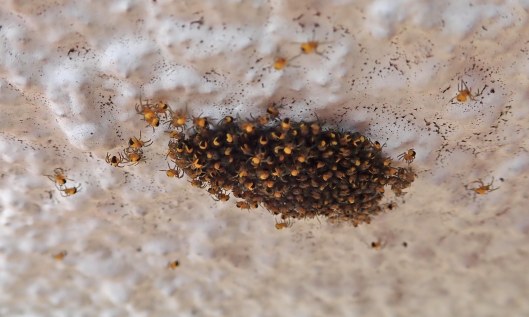
At first sight, from several feet away, I thought this splodge on the side of a building was a dollop of bird poo … but then I noticed it was moving. So, of course, I immediately got out my camera and peered closer.

200509 garden spiderlings (1)

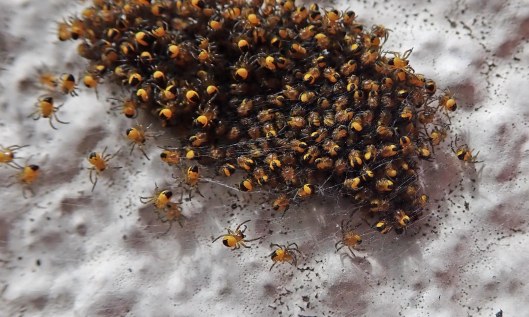
They were spider babies, hundreds of them, of the species Araneus diadematus, commonly known as Garden spiders. Both as spiderlings and as adults, these are completely harmless, though, as so often happens, several of the trashy daily newspapers have, in the past, vilified these bunches of babies with such headlines as ‘Woman’s horror as hundreds of tiny yellow spiders erupt from a nest in her back garden’ and ‘Millions of “exploding” yellow baby spiders invade Britain’.

200509 garden spiderlings (2)

When they’ve grown to adult size, these little cuties will look like those I photographed for my November 2017 blog post Wearing a diadem. You can read more about the Garden spider on the British Arachnological Society’s website.

Like Loading...

126/366 The Lady of the Woods

05 Tuesday May 2020

Posted by sconzani in insects, nature, spring

≈ 6 Comments

Tags

British butterflies, butterfly, Orange-tip 2nd instar, Orange-tip butterfly, Orange-tip egg

I know I already posted about seeing my first Orange-tip butterfly of the year (The ostentatious Orange-tip, 15 April) but, for those not familiar with this lovely springtime butterfly, I thought it might be useful to see a bit more detail. So, here is a typical male Orange-tip, from the top and the side. The speckling on the lower wings looks green but that’s an optical illusion – the colours are actually yellow and black.

200505 orange-tip male (1)
200505 orange-tip male (2)

And here’s a female from both angles. If you only see her from the top, you might confuse her with one of the other white butterflies, though the dark patches are different in all the whites, and the Orange-tip also has a distinctive wing shape.

200505 orange-tip female (1)
200505 orange-tip female (2)

I managed to find several eggs during a recent walk – the newly laid eggs are white but turn orange very quickly. You’ll find them on the caterpillar food plants: Cuckooflower, Garlic mustard and Honesty are three wildflowers this butterfly favours. And, for the first time ever, I found a caterpillar. This is a 2nd instar (i.e. stage) – the larvae proceed through 5 instars, progressively growing larger, until they are ready to pupate.

200505 orange-tip egg
200505 orange-tip larva 2nd instar

You might be wondering why I gave this post the title of ‘the Lady of the Woods’. Well, according to Peter Eeles’s superb publication Life Cycles of British & Irish Butterflies (every home should have one!), this is the name given to the Orange-tip by Benjamin Wilkes in his Twelve New Designs of English Butterflies, published in 1742.

Like Loading...

125/366 Bonding

04 Monday May 2020

Posted by sconzani in birds, nature, spring

≈ 3 Comments

Tags

birding, birdwatching, British birds, gulls mating, Lesser black-backed gull

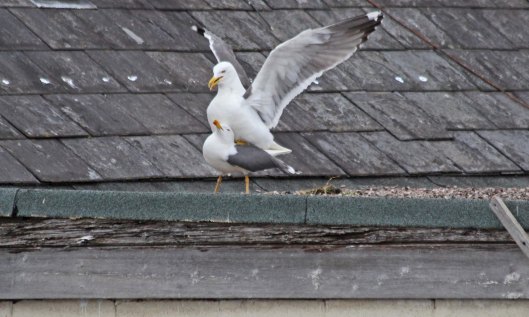
During the past couple of weeks, it’s been fascinating to watch two Lesser black-backed gulls – presumably, the same two who nested amongst a group of neighbouring chimney pots last year – renewing their pair bonds and practising their seduction techniques. The process goes a bit like this …

200504 lesser black-backed gulls (1)

They circle each other, beaks thrust towards the sky in unison, and there’s some low bird-speak (as opposed to gull shrieking) …

200504 lesser black-backed gulls (2)

One bird (the female, I think) begs the other for food, as if it is a chick, and the second bird regurgitates a niblet of food …

200504 lesser black-backed gulls (3)

There’s more circling and beak thrusting and chatter …

200504 lesser black-backed gulls (4)

Finally, the males jumps on the back of the female, though it takes them a couple of minutes to spread their wings, tails, feathers to reach the right angle to achieve copulation …

200504 lesser black-backed gulls (5)

And this happens more than once, the male remaining on the female’s back until they’ve copulated three times during this one session …

200504 lesser black-backed gulls (6)

Once finished, he jumps off, she puts her head down and waggles her rear end, and there is more low chatter, and a little beak bumping, before they both fly off.

200504 lesser black-backed gulls (7)

Like Loading...

124/366 Ragged robin

03 Sunday May 2020

Posted by sconzani in nature, spring, wildflowers

≈ 7 Comments

Tags

Bee-fly, British wildflowers, Grangemoor Park, Lychnis flos-cuculi, Ragged robin, Silene flos-cuculi, Spring colour, spring flowers

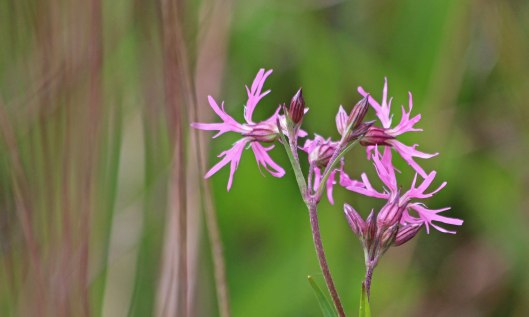
At Grangemoor Park on Friday, I spotted my first flowering Ragged robin for the year.

200503 ragged robin (1)

This gorgeous wildflower was formerly known as Lychnis flos-cuculi, but is now Silene flos-cuculi – from a scientific article I browsed, this seems a complicated story of almost constant reclassification of the species! You will still see both names used in books and on line, which is why I’ve mentioned both here.

200503 ragged robin (2)

According to a couple of books I discovered on the ‘language of flowers’, Ragged robin’s symbolic meaning is ‘wit’, and it is dedicated to Saint Barnabas. The ever-informative First Nature website says:

Lychnis, the genus name, comes from the Greek noun lychnos, meaning lamp; it refers to the use of a plant in this genus as the wick of an oil lamp. The specific epithet flos-cuculi means ‘flower of the cuckoo’ and was probably chosen because the first flowers of Ragged Robin appear just as the first cuckoos are being heard (in Britain and Ireland at least) in May.

200503 ragged robin (3)

A special moment: to try to stop it swaying in the breeze so I could get a sharp photo, I was holding one of the blooms when a bee-fly decided to zoom in for a feed of nectar. That super long proboscis comes in handy for long narrow flowers like these.

200503 ragged robin (4)

Like Loading...

121/366 Ma and her bairns

30 Thursday Apr 2020

Posted by sconzani in birds, nature, spring

≈ 2 Comments

Tags

birding, birdwatching, British birds, duckling, Mallard, Mallard ducklings

200430 mallard ducklings

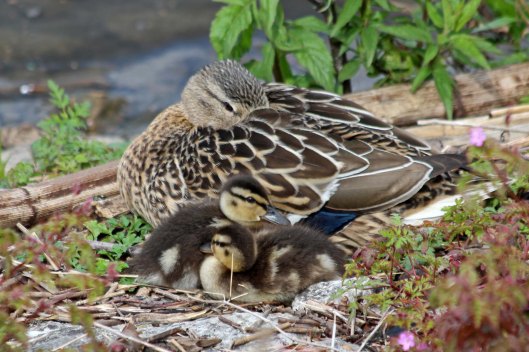
Some days we all need a dose of cuteness!

Like Loading...

117/366 It’s Pea time

26 Sunday Apr 2020

Posted by sconzani in nature, spring, wildflowers

≈ Leave a comment

Tags

British wildflowers, Bush vetch, Common bird's foot trefoil, Common vetch, Grass vetchling, Red campion, Spring colour, spring wildflowers

You know the summer’s not far away when members of the extensive Pea family start to flower and, during this week’s exercise walks, I’ve spotted four Pea species newly come in to flower. The first were three of the vetches …

200426 Bush vetch

Bush vetch (Vicia sepium)

200426 Common vetch

Common vetch (Vicia sativa) … and friends.

200426 Grass vetchling

Grass vetchling (Lathyrus nissolia)

200426 bird's-foot trefoil

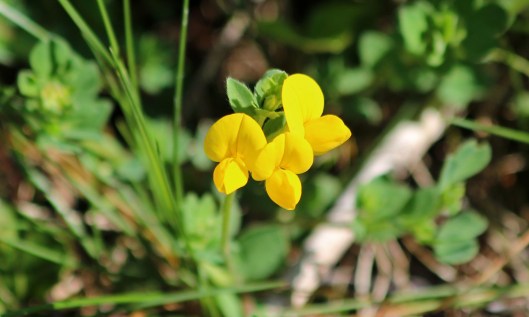
And, also, one of my all-time favourites – possibly because it’s also a favourite with a lot of the butterflies and day-flying moths I adore so much, Common bird’s-foot trefoil (Lotus corniculatus).

200426 Red campion

Oh, and this week’s new blooms also included one not-a-pea wildflower, the always lovely Red campion (Silene dioica).

Like Loading...

111/366 It’s a bugs’ life

20 Monday Apr 2020

Posted by sconzani in insects, nature, spring

≈ 4 Comments

Tags

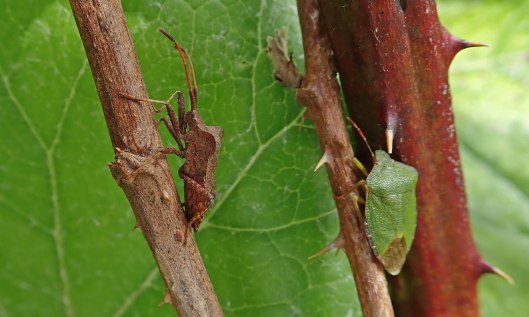
British bugs, Coreus marginatus, Dock bug, Green shieldbug, Palomena prasina, shieldbug

First, the sunbathing – sometimes alone …

200420 green shieldbug

… sometimes with a friend.

200420 dock bug

Then, later, the sex!

200420 2 green shieldbugs

Credits: Today’s post has featured the Green shieldbug (Palomena prasina) and the Dock bug (Coreus marginatus).

Like Loading...

110/366 Even earlier purples

19 Sunday Apr 2020

Posted by sconzani in flowers, nature, spring, wildflowers

≈ 2 Comments

Tags

British orchids, Early purple orchid, native orchids, Orchis macula

I spotted 8 flower spikes of Early-purple orchid (Orchis macula) during my walk last Wednesday, 15 April, though not all the flowers were yet open.

200419 early-purple orchids (1)

This sighting was earlier than last year’s, which was on 23 April and which the locals told me was earlier than usual. It seems like climate change keeps changing the goal posts for these orchids.

200419 early-purple orchids (2)
200419 early-purple orchids (3)

200419 early-purple orchids (4)

Like Loading...

109/366 Speckled Spring

18 Saturday Apr 2020

Posted by sconzani in insects, nature, spring

≈ Leave a comment

Tags

British butterflies, butterfly, Pararge aegeria, Speckled wood, spring butterflies

We’ve had much-needed rain and low-cloud gloom for the past two days but, earlier in the week, when the sun was warm and glorious and my walk took me along the coastal path, it felt like proper Spring. The bird song was almost deafening and – what clinched the Spring-ness for me – I counted 12 Speckled wood butterflies along the path, either perched sun-basking or patrolling their patch of scrub or – the males – engaged in spiralling dogfights over territory. Springtime magic!

200418 speckled woods (1)
200418 speckled woods (2)
200418 speckled woods (3)
200418 speckled woods (4)
200418 speckled woods (5)
200418 speckled woods (6)
200418 speckled woods (7)
200418 speckled woods (8)
200418 speckled woods (9)
Like Loading...
← Older posts
Newer posts →

About me

sconzani

sconzani

I'm a writer and photographer; researcher and blogger; birder and nature lover; countryside rambler and city strider; volunteer and biodiversity recorder.

View Full Profile →

Follow earthstar on WordPress.com

Enter your email address to follow this blog and receive notifications of new posts by email.

Recent blog posts

  • Beating the gloom March 10, 2026
  • No booming Bittern but … March 9, 2026
  • Danish scurvygrass March 8, 2026
  • Four weeks early March 7, 2026
  • Three shieldbug species March 6, 2026

From the archives

COPYRIGHT

Unless otherwise acknowledged, the text and photographs on this blog are my own and are subject to international copyright. Nothing may be downloaded or copied without my permission.

Fellow Earth Stars!

  • Unknown's avatar
  • Unknown's avatar
  • Unknown's avatar
  • Unknown's avatar
  • Unknown's avatar
  • Unknown's avatar
  • Unknown's avatar
  • Unknown's avatar
  • Unknown's avatar
  • Unknown's avatar
  • Unknown's avatar
  • Unknown's avatar
  • Unknown's avatar
  • Unknown's avatar
  • Unknown's avatar
  • Unknown's avatar
  • Unknown's avatar
  • Unknown's avatar
  • Unknown's avatar
  • Unknown's avatar
  • Unknown's avatar
  • Unknown's avatar
  • Unknown's avatar
  • Unknown's avatar
  • Unknown's avatar
  • Unknown's avatar
  • Unknown's avatar
  • Unknown's avatar
  • Unknown's avatar
  • Unknown's avatar
  • Unknown's avatar
  • Unknown's avatar
  • Unknown's avatar
  • Unknown's avatar
  • Unknown's avatar
  • Unknown's avatar
  • Unknown's avatar
  • Unknown's avatar
  • Unknown's avatar
  • Unknown's avatar
  • Unknown's avatar
  • Unknown's avatar
  • Unknown's avatar
  • Unknown's avatar
  • Unknown's avatar
  • Unknown's avatar
  • Unknown's avatar
  • Unknown's avatar
  • Unknown's avatar
  • Unknown's avatar

Blog at WordPress.com.

Privacy & Cookies: This site uses cookies. By continuing to use this website, you agree to their use.
To find out more, including how to control cookies, see here: Cookie Policy
  • Subscribe Subscribed
    • earthstar
    • Join 668 other subscribers
    • Already have a WordPress.com account? Log in now.
    • earthstar
    • Subscribe Subscribed
    • Sign up
    • Log in
    • Report this content
    • View site in Reader
    • Manage subscriptions
    • Collapse this bar
 

Loading Comments...
 

You must be logged in to post a comment.

    %d