As I write this, we actually have April showers but, luckily, they weren’t falling on me or this random selection of April flowers from today’s walk. First one to name them all gets … a gold star!


23 Sunday Apr 2023
Posted in flowers, spring, wildflowers
As I write this, we actually have April showers but, luckily, they weren’t falling on me or this random selection of April flowers from today’s walk. First one to name them all gets … a gold star!
17 Monday Apr 2023
Tags
Arctic tern, birding, birdwatching, British birds, Cardiff Bay birding, spring migration, spring passage
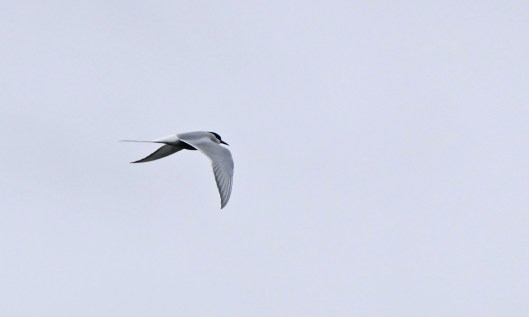
Terns of any description rarely visit Cardiff Bay but, if they’re ever going to, now, on Spring passage, is the time of year for it to happen … and it did, for two days at the end of last week. (Terns do sometimes pop in on Autumn passage as well, depending on the weather.) The Bay has some very keen and knowledgeable resident birders so when one of those, Gareth, put out the word that he’d seen a tern in the Bay, thought it was an Arctic tern but didn’t have his ‘scope with him, other locals quickly headed down with their equipment to check it out. Arctic tern it was! (Common and Arctic terns can be tricky to tell apart, and the term ‘commic’, a combination of their names, is used by birders when uncertain.)
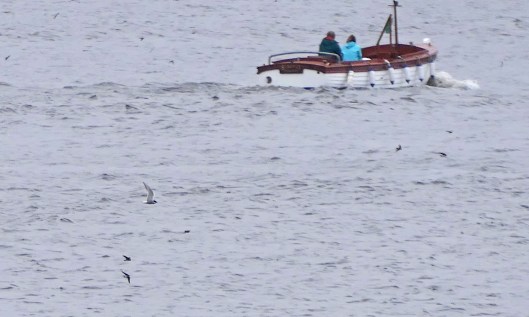
Unfortunately, I couldn’t get there that afternoon so imagine my delight when word came through from Gareth again the next day that the tern was still showing. Though rain threatened and did, in fact, interrupt play a couple of times, I managed to find the tern. Sadly, it wasn’t giving the close views it had the day before and was mostly a small dot on the other side of the water until, when it decided to fly onwards, it flew almost directly over my head. A head-terning moment!
16 Sunday Apr 2023
Posted in spring, wildflowers
Tags
#WildflowerHour, Borage family, Boraginaceae, British wildflowers, Comfrey, Forget-me-not, Lungwort, Spring colour, spring wildflowers
Finding flowering specimens of the Borage family was the target of this week’s Wildflower Hour. This family, the Boraginaceae, includes the various Forget-me-nots (Myosotis species), the Comfries (Symphytum species), Lungwort (Pulmonaria officinalis), Viper’s-bugloss (Echium vulgare), the Gromwells (Lithospermum species), Green alkanet (Pentaglottis sempervirens), Borage (Borago officinalis), of course, and a few other species as well. Unfortunately, our wet Spring, the recent cold spell and storm mean many of these wildflower species are not yet flowering locally but I have managed to find three species.
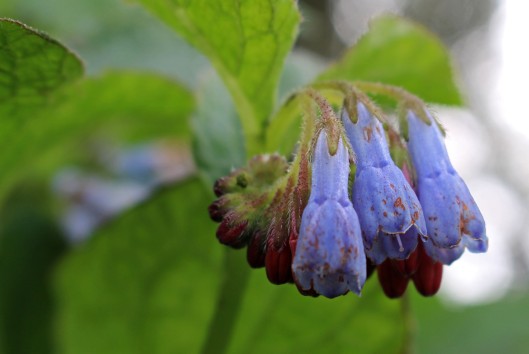
Comfrey : I’m not sure which of the Symphytum species this is. It’s growing on the edge of a carpark so is probably a wind-blown garden escape or was perhaps seeded via a bird dropping.

Lungwort : Sadly, this isn’t a common plant locally – I only know of two locations where it grows. I wish there was more as the bees love it.
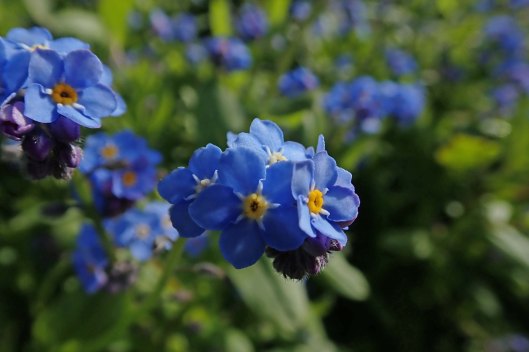
Forget-me-not : Did you know that the yellow ring at the centre of the Forget-me-not flower fades from egg-yolk yellow to white after pollination, which indicates to insects that there’s no more nectar and they should try another flower?
09 Sunday Apr 2023
Posted in plants, spring, wildflowers
Another week, another new plant – I’m on a roll!

This hairy little annual, with the sweet white flowers, is Rue-leaved saxifrage (Saxifraga tridactylites). Its three-lobed leaves (hence the tridactyl in its name) are quite distinctive and are often tinged with red, as are the plant’s stems.
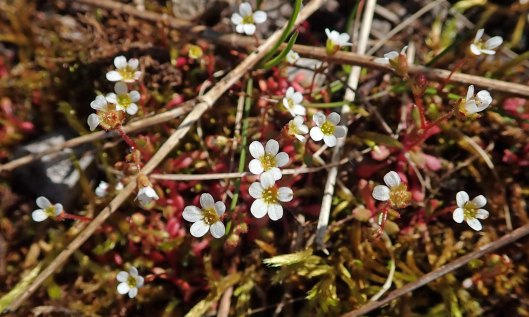
In Flora Britannica, Richard Mabey writes that this saxifrage is widespread but declining, though the book is now 25 years old so I’m not sure if that is still the case. Certainly, it’s not a plant I’ve come across before in my meanderings and these few were growing on the much-overgrown route of a former railway line so could originally have been carried this way by a train.

06 Thursday Apr 2023
The weather effect? By 1 April last year, I’d clocked 63 butterflies of 7 species. This year I’d only recorded 13 butterflies of 4 species. As well as our very wet and cool spring, it seems that last year’s hot dry summer is also having a prolonged effect on butterfly numbers. Butterfly Conservation has warned that
Drought impacts the offspring of the butterflies that are flying during the hot dry weather by causing the plants that caterpillars rely on for food to wither and die. Without sufficient food, many caterpillars will fail to survive, leading to lower numbers of butterflies in the next generation. For some of the UK species that have more than one generation in a year, the resulting major decline in numbers has already been seen. However, for others, the next generation isn’t on the wing until this summer, meaning there could be noticeably fewer butterflies around in 2023.

Imagine my delight then, when I finally spotted not one but my first two Speckled woods of 2023, a week later than last year. Let’s hope this year’s weather is a little more kind to our insect neighbours, though climate change is already affecting and will continue to affect them.

05 Wednesday Apr 2023
Tags
Bee-fly, Bombylius major, British bee-flies, dandelion, Dark-edged bee-flies, value of Dandelion flowers
Apparently, today is #NationalDandelionDay. Dandelions are brilliant for so many reasons (I’ve blogged about their value to insects previously – see Delicious Dandelions, April 2022) but what better reason than the food they provide to all the gorgeous little bee-flies that are currently emerging all over the country.
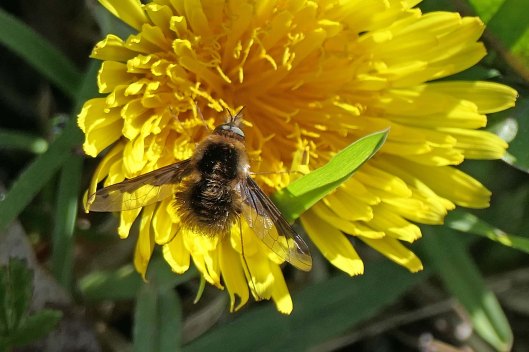
These are Dark-edged bee-flies (Bombylius major), the only bee-fly species we have locally though there are other species in Britain. The top bundle of fluff is a male and the bottom is a female. The way to tell the sexes apart is to look at their eyes – if there’s a gap between the eyes, it’s a female. The males usually emerge first, with the females following a week to ten days later.

02 Sunday Apr 2023
Posted in plants, spring, wildflowers
Tags
American winter-cress, Barbarea verna, British wildflowers, Grangemoor Park, Spring colour, wild salad plant
One of my local green spaces, Grangemoor Park, in Cardiff, an old landfill site, has been much churned up over the past year due to the need for repairs to its drainage system. Seeing the amount of damage done to the park, the huge numbers of trees cut down, the wide gravel paths laid down where once were wildflowers and scrub, has been very depressing but I’m hoping Nature will quickly repair the human damage. In the meantime, trying to be positive, I’ve been keeping an eye on the disturbed ground for any botanical surprises. And this is one!
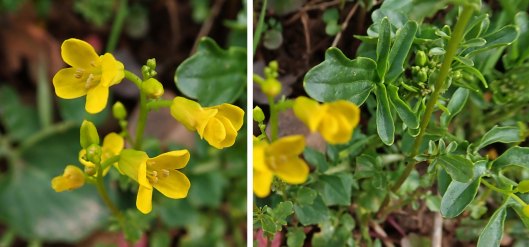
I’m 99% sure that this lovely little treasure is American winter-cress (Barbarea verna), a new plant for me. I’ve had a botanist confirm my identification but with one proviso. She thought ‘Yes I think it looks like it is B. verna as opposed to B. intermedia. If you should happen to see it again when it is in fruit, it should have long (over 4cm) curved fruits, whereas intermedia has shorter (less than 4cm) straight fruits.’ Needless to say, I will be checking the fruits in due course.

In Flora Britannica, Richard Mabey writes that Barbarea verna has proven to be ‘popular and successful as a vegetable. Originally from south-west Europe, it has been introduced as a cultivated vegetable not just to the United States and northern Europe, but to South America and Australasia. It has become widely naturalised in all these places.’ I will be tempted, once it has grown, to harvest some of the leaves, which can be used like ‘rocket’ in a salad, though it is growing in the perfect spot for passing canines to anoint so will have to be washed very thoroughly.

01 Saturday Apr 2023
There hasn’t been a lot of Turnstone activity around Cardiff Bay this winter, perhaps because the milder weather has allowed them to forage and rest in more exposed locations, so it was delightful to see a flock of 13 birds on the River Ely embankment on Thursday. Several were showing signs of the colour changes, those splodges of rusty red that come as they moult into their breeding plumage.

Judging by previous years, these superb little waders will be heading north to their breeding sites in the next few weeks and I won’t see them again until sometime in August, when they and their fledged youngsters will return to our shores.

22 Wednesday Mar 2023
There’s a Chiffchaff in my tree, chiffchaffing happily!

That was my tweet this morning after I’d spent a joyous 20 minutes standing by the open window, watching this little bird flit about the cherry tree outside my living room, catching tiny insects and singing almost the entire time.

Although some Chiffchaffs now overwinter in the warmer parts of Britain, most still migrate, and they began arriving back in my area in good number last Friday. After this morning’s home-based Chffichaff encounter, I went for a walk around Cosmeston Lakes Country Park, during which I heard and/or saw at least 23 more Chiffchaffs. Their song will soon become one of the commonplace sounds of spring/summer but, for now, it’s pure magic!

20 Monday Mar 2023
I heard him before I saw him – in fact, it took a while to spot this little chap, who was mostly hidden amongst the greenery as he sang his little tune. Was he celebrating the fact that he’d finally arrived on land after his long migration flight? Or was he practising his melody in preparation for trying to woo a potential mate? Though some Blackcaps now over-winter here, they are mostly to be found feeding in people’s gardens, taking advantage of the goodies on offer from feeders. This little fellow was by the sea, with no houses or gardens nearby, which is why I’m fairly sure he was a newly arrived migrant. And he was my first Blackcap of the year. I look forward to seeing more.

 earthstar
You must be logged in to post a comment.