Taking great pleasure …
27 Friday Oct 2017
Posted in autumn, flowers, nature, wildflowers
27 Friday Oct 2017
Posted in autumn, flowers, nature, wildflowers
25 Wednesday Oct 2017
Posted in flowers, nature, wildflowers
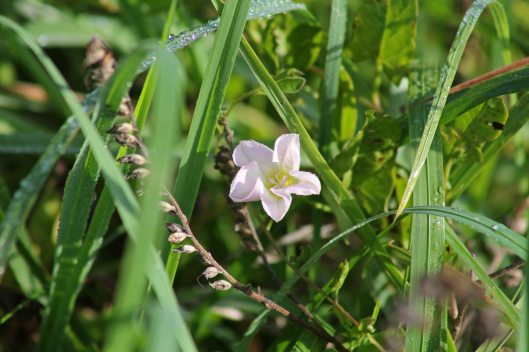
Here’s one from my volunteering on the Mary Gillham Archive Project. According to the Oxford Dictionary, nyctinasty is ‘the periodic movement of flowers or leaves caused by nightly changes in light intensity or temperature’, though I have also read that these movements, particularly the opening and closing of flowers, don’t always occur at night. When the weather is very dull due to thick cloud, or when the weather changes dramatically, as with the onset of a sudden storm, from a bright sunny day to a dark, grey, heavily cloudy sky, some flowers react by closing up. The word nyctinasty comes from the Greek and is a combination of nux or nukt meaning night and nastos meaning press or squeeze together.

20 Friday Oct 2017
Posted in flowers, nature, wildflowers
For today’s Floral Friday theme, we have a very common wildflower White clover (Trifolium repens), which is also known by the vernacular names Milky blobs, Sheepy-maa’s and Bee-bread.

It seems I had a deprived childhood because, according to Richard Mabey’s Flora Britannica, ‘Almost all children learn two traditions about white clover: that the white flowers can be pulled out of the heads and sucked for a bead of honey (hence ‘bee-bread’ …); and that four- and, even better, five-leaved clovers are lucky, though you must ideally come across them by accident.’ Okay, so I knew about four-leaved clovers being lucky but I’d never heard about sucking the flowers for honey. Did you?
06 Friday Oct 2017
Posted in autumn, flowers, nature, wildflowers
05 Thursday Oct 2017
Posted in flowers, insects, nature, nature photography, wildflowers

May the wings of the butterfly kiss the sun
And find your shoulder to light on
To bring you luck, happiness and riches
Today, tomorrow and beyond.
~ an Irish blessing, to be sure, to be sure, to be sure
29 Friday Sep 2017
Posted in flowers, nature, wildflowers
This pretty plant may look like a water-lily, it even has the words water lily in its name but it’s not actually a member of the water-lily family.

This is the Fringed Water-lily (Nymphoides peltata) and its closest plant relation is the Bogbean (the fringed edges to its petals are a bit of a giveaway). It can be found in ponds (the one in my photo is in the dipping pond at Cosmeston Lakes Country Park), lakes and other watery places where the water is still or slow moving. Apparently, it is well established in the Leeds and Liverpool canal, and in much of south-east England, as well as in the East Anglian fens. It is also widely planted in ornamental ponds in parks and gardens, and snippets of those plants may account for its spread in the wild. The gardeners amongst you may know it as Yellow floating heart, which is such a charming name, I think.
26 Tuesday Sep 2017
Posted in autumn, nature, plants, wildflowers
‘The vegetable life does not content itself with casting from the flower or the tree a single seed, but it fills the air and earth with a prodigality of seeds, that, if thousands perish, thousands may plant themselves, that hundreds may come up, that tens may live to maturity; that, at least one may replace the parent.’
~ Ralph Waldo Emerson
25 Monday Sep 2017
Posted in insects, nature, seaside, wildflowers
Tags
British moths, Humming-bird hawk-moth, Macroglossum stellatarum, moth, moth like hummingbird, Red valerian
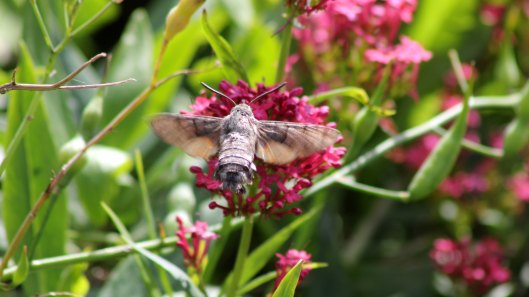
Remember how I wrote yesterday about some days being magical: first I was mobbed by Red admirals, next I discovered the Ivy bee colony and marvelled at its mating antics, and then, la pièce de résistance, I saw my very first Humming-bird hawk-moth.
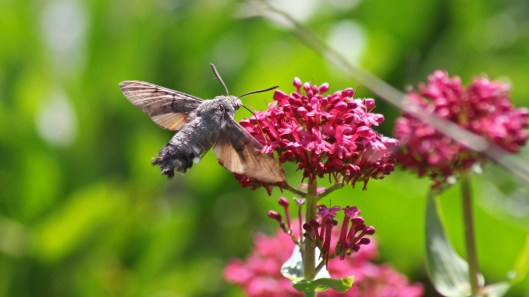
And, by golly, it was difficult to photograph. I took around 70 pictures but most are a blur because, like the bird it’s named after, this moth just does not keep still. Macroglossum stellatarum is its formal name, and it came to Britain originally from Africa and southern Europe. The adult moths can be seen flying any time from April to late November, at which time they start looking for a crevice in a building, a hole in a wall, or a handy crack in a tree to while away the winter months.
That super-long tongue allows them to specialise in feeding from tube-shaped flowers like the Echiums, though this one was enjoying the nectar of Red valerian plants growing along the high-tide line at a local beach, humming (its wings) as it hovered from one flower to the next. Incredibly, studies have shown that Humming-bird hawk-moths often return to the same flowers at the same time every day. So, it’s a moth that looks like a bird but has the memory of an elephant – simply amazing!

22 Friday Sep 2017
Posted in flowers, nature, plants, wildflowers
Tags
biological recording, clematis vitalba, Old Man's Beard, SEWBReC, species of the month, Traveller's joy
The joy of this plant is that you see it wherever you travel in Britain. See what I did there?

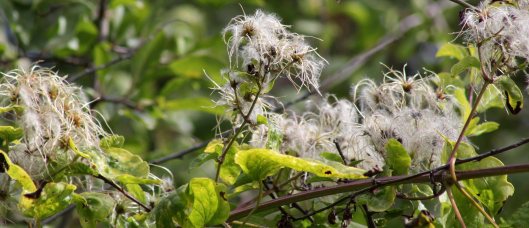
Clematis vitalba is most commonly called Traveller’s-joy but you might also know it as Old-man’s-beard, Father Christmas, Smokewood or Woodbine. Its feathery white seed heads are its most distinctive feature, making it easy to recognise and identify, and this really is a plant that you’ll see draped over hedges and fences almost everywhere in Britain.
Yet SEWBReC, the South East Wales Biodiversity Records Centre, have revealed that Traveller’s-joy is not well recorded: they have less than 2000 records in their database. And so they have made this plant their species of the month for September. If you spot Traveller’s-joy this month (or next, or the month after), please make a point of recording it with your local records centre – almost every county in Britain has its own records centre where you can log your biological sightings and those of you based in south-east Wales can find out more about biological recording, and the species of the month, on SEWBReC’s website.

16 Saturday Sep 2017
Posted in flowers, insects, nature, wildflowers
Tags
bumblebee, Comma, Devil's-bit scabious, hoverflies, insects on scabious, scabious, Six-spot burnet, Small tortoiseshell, Small white
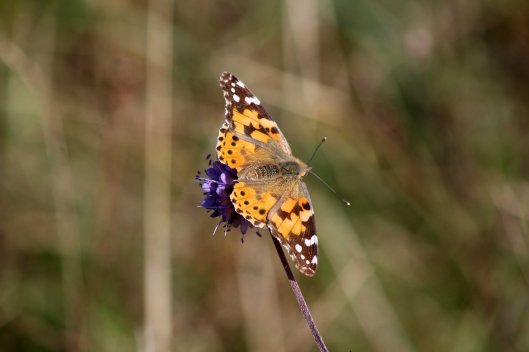
Perhaps it would be easier to ask ‘What’s not on the scabious?’ because it seems that almost every type of fly, bee, butterfly and beetle loves this plant, though that may also be because the Devil’s-bit scabious flowers in late summer – early autumn, when most wildflowers have finished flowering, and so it provides a last delicious taste of summer’s sweetness.
You must be logged in to post a comment.