• ABOUT
  • BIRDING 2018
  • Birding 2019
  • BLOG POSTS
  • Butterflies 2018
  • Resources

earthstar

~ a celebration of nature

earthstar

Category Archives: wildflowers

In praise of hogweed

30 Friday Jun 2017

Posted by sconzani in insects, nature, plants, wildflowers

≈ 2 Comments

Tags

British flora, British wildflowers, food for insects, Heracleum sphondylium, Hogweed

170630 hogweed (1)

Hogweed is so named because the flowers are said to have a pig-like smell, though I can’t say that I’ve noticed. It has a ton of interesting-sounding common names, of which Bilers, Caddy, Eltrot, Limperscrimps, Cow-weed, Kirk, Chirk and Kek are just a few. Its Latin name, Heracleum sphondylium, is also interesting: Heracleum is a reference to the mythical Greek hero Heracles, who was said to have introduced the medicinal use of the plant to humans, and sphondylium comes from the Greek sphondylo, meaning backbone, and refers to the plant’s segmented stem.
170630 hogweed (3)

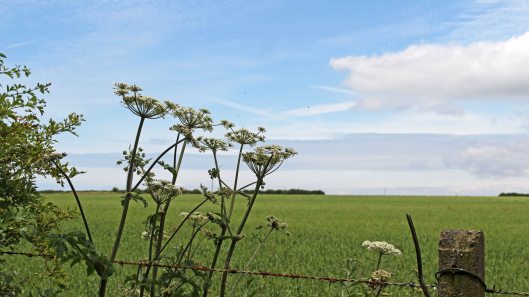
Hogweed is just coming in to flower now, adorning the roadsides, hedgerows and track edges in many of the parts of south Wales that I’ve visited recently.
170630 hogweed (2)

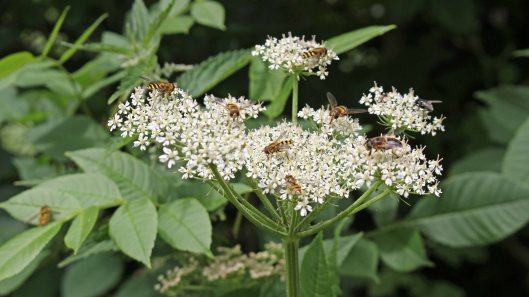
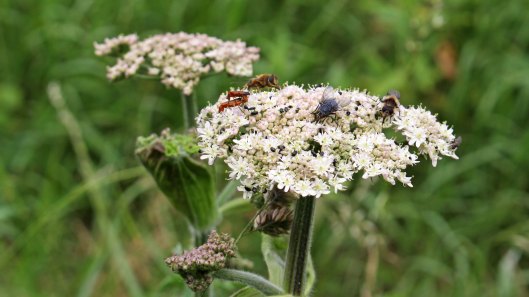
The statuesque purple-coloured-when-young stalks and those large white flower heads are glorious, indeed, but the very best thing about Hogweed, I think, is the food it provides for all manner of creatures, from flies and hoverflies to ants, bees and wasps, bugs and beetles.

170630 1 Common red soldier beetle
170630 2 Swollen-thighed beetle
170630 3 Cheilosia illustrata
170630 4 Noon fly
170630 5 Hogweed
170630 6 Broad centurion female
170630 7 Willow mason-wasp
170630 8 Stilt bug
170630 9 Hogweed leafminer
Like Loading...

Birding at Lliw Reservoirs

25 Sunday Jun 2017

Posted by sconzani in animals, birds, insects, nature, trees, walks, wildflowers

≈ Leave a comment

Tags

birding, birdwatching, Bog pimpernel, Foxgloves, Glamorgan Bird Club, Grey wagtail, Lliw Reservoirs, Red kite, slow-worm, Tormentil, Victorian dam, Victorian ironwork, Whitethroat

170625 Lliw Reservoirs (3)

I celebrated the solstice with an outing with my Glamorgan Bird Club buddies to Lliw Reservoirs north of Swansea or, perhaps that should read, I sweated through the solstice – it was one of the hottest days of the year and the middle of a mini heatwave. Still, you know what they say about mad dogs and Englishmen (and Welshmen and a Kiwi) …

170625 Lliw Reservoirs (1)

It’s a superb location. The two reservoirs were built in the second half of the 19th century, and still supply water to communities throughout south Wales. We only walked up one side of both reservoirs, through broadleaf woodland and then out onto open areas of grass and scrub and moorland, but there’s an 8-mile circular walk, which would be brilliant in cooler weather and includes large open commons of heath moorland on the hilltops.

170625 Lliw Reservoirs (2)

We heard more small birds than we saw (but that’s helping me learn their songs); buzzards and magnificent red kites were soaring overhead; we heard then saw the elusive grasshopper warbler in flight; dragonflies and damsels and the odd butterfly flitted about; and there were lots of lovely wildflowers (my particular favourites were the foxgloves, tormentil and bog pimpernel). Oh and, most importantly, the locals were friendly and the cafe serves delicious ice cream!

170625 Whitethroat
170625 Tormentil
170625 Slow-worm
170625 Lliw Reservoirs uplands
170625 Peacock
170625 Red kite
170625 Foxglove
170625 Grey wagtail
170625 Victorian ironwork
170625 Bog pimpernel
170625 Welsh sheep
170625 Pines & foxgloves
Like Loading...

Yellow

23 Friday Jun 2017

Posted by sconzani in flowers, nature, wildflowers

≈ 4 Comments

Tags

Agrimonia eupatoria, Agrimony, Bird’s-foot trefoil, Blackstonia perfoliata, Dyer’s greenweed, Genista tinctoria, Lotus corniculata, Rhinanthus minor, wildflowers, Yellow rattle, yellow wildflowers, Yellow-wort

Yellow is the colour of the week as far as the wildflowers are concerned.

170623 Bird's-foot trefoil (1)

These are some I’ve seen: Bird’s-foot trefoil (Lotus corniculata), Yellow rattle (Rhinanthus minor), Agrimony (Agrimonia eupatoria), Dyer’s greenweed (Genista tinctoria), and Yellow-wort (Blackstonia perfoliata).

170623 Dyer's greenweed (1)
170623 Bird's-foot trefoil
170623 Yellow rattle
170623 Yellow-wort
170623 Bird's-foot trefoil (2)
170623 Agrimony
170623 Dyer's greenweed
170623 Agrimony (2)
Like Loading...

Waving the yellow flag

16 Friday Jun 2017

Posted by sconzani in flowers, nature, wildflowers

≈ 3 Comments

Tags

British flora, British native flowers, British wildflowers, Iris pseudacorus, Segg, Yellow flag iris, Yellow iris

The Yellow iris (Iris pseudacorus), also known as the Yellow flag iris, is really a spring bloomer but I’m still seeing some flowers in the damper boggy and waterside areas during my countryside wanders so I thought I’d share some photos of them before they all disappear for the summer.

170616 Yellow iris (3)

Of course, the wonderfully green, spear-like leaves don’t disappear and they are, in fact, where this plant got one of its common names, Segg. According to Richard Mabey’s Flora Britannica, Segg is a variant of sedge and is derived from the Anglo-Saxon word for a short sword, though I have also seen Segg spelt secg and the Oxford Dictionary says sedge came originally from the Old English word secg, which has Germanic origins and whence also came the Latin secare meaning ‘to cut’ – hence secateurs. Here endeth today’s lesson!

170616 Yellow iris (2)
170616 Yellow iris (4)
170616 Yellow iris (1)
Like Loading...

Orchid overdose!

09 Friday Jun 2017

Posted by sconzani in flowers, nature, wildflowers

≈ 6 Comments

Tags

Anacamptis pyramidalis, Bee orchid, British flora, British orchids, Common spotted orchid, Cosmeston Lakes Country Park, Dactylorhiza fuchsii, Greater butterfly-orchid, native orchids, Ophrys apifera), orchid, Platanthera chlorantha, Pyramidal orchid

170609 Orchids Cosmeston

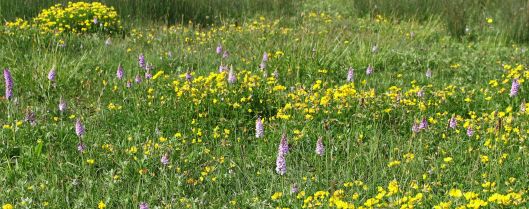
The meadows at Cosmeston Lakes Country Park are awash with orchids, Common spotted-orchids, (Dactylorhiza fuchsii), Bee orchids (Ophrys apifera), Pyramidal orchids (Anacamptis pyramidalis) and, in a secluded location off the beaten track, a tiny smattering of Greater butterfly-orchids (Platanthera chlorantha). To walk along the paths amongst these beauties is simply magical!

170609 Bee orchid Cosmeston (2)
170609 Common spotted-orchid Cosmeston (2)
170609 Bee orchid Cosmeston (1)
170609 Greater butterfly-orchid Cosmeston (3)
170609 Bee orchid Cosmeston (3)
170609 Pyramidal orchids Cosmeston (3)
170609 Common spotted-orchid Cosmeston (1)
170609 Pyramidal orchids Cosmeston (2)
170609 Common spotted-orchid Cosmeston (3)
170609 Pyramidal orchids Cosmeston (1)
170609 Greater butterfly-orchid Cosmeston (1)
170609 Greater butterfly-orchid Cosmeston (2)
Like Loading...

I made a wish …

08 Thursday Jun 2017

Posted by sconzani in flowers, nature, wildflowers

≈ 2 Comments

Tags

dandelion, dandelion seeds, making a wish, wishing on a dandelion

I made a wish, I cast my vote … but will my wish come true?

170608 Wishing on a dandelion

Like Loading...

Marsh orchids at Kenfig

07 Wednesday Jun 2017

Posted by sconzani in flowers, nature, wildflowers

≈ 3 Comments

Tags

British flora, British orchids, Dactylorhiza incarnata, Dactylorhiza praetermissa, Dactylorhiza purpurella, Early Marsh-orchid, Kenfig National Nature Reserve, native orchids, Northern Marsh-orchid, orchid, Southern marsh orchid

170607 Southern marsh-orchid (2)

Apart from 18 species of rust, there wasn’t a lot of fungi to be found during our foray at Kenfig National Nature Reserve last Saturday but what we did see was a lot of stunning marsh orchids.

170607 Southern marsh-orchid (4)
170607 Southern marsh-orchid (1)
170607 Southern marsh-orchid (5)
170607 Southern marsh-orchid (3)

Identifying these beauties can be extremely tricky, even for trained botanists, partly because they look very similar, partly because their colouration can vary quite a lot within species, and partly because they hybridise easily with each other. So, although the chances are that these are Southern Marsh-orchids (Dactylorhiza praetermissa), there may also be some Northern Marsh-orchids (Dactylorhiza purpurella) or a mixture of both. Whatever they are, they’re beautiful!

170607 Early marsh-orchid (1)
170607 Early marsh-orchid (2)

I am, however, quite sure about these next pictures. These are Early Marsh-orchids (Dactylorhiza incarnata). They thrive in damp calcareous habitats so the dune systems at Kenfig suit them perfectly – or, at least they will as long as the dune systems are managed to prevent scrub and trees taking hold: the orchids actually grow best when wind and rain are allowed to destabilise the dunes and move sand and plants around a bit.

Like Loading...

Looking frazzled!

03 Saturday Jun 2017

Posted by sconzani in flowers, nature, wildflowers

≈ Leave a comment

Tags

British flora, British native flowers, British wildflowers, Ragged robin, Silene flos-cuculi

Ragged robin (Silene flos-cuculi) certainly lives up to its name. To me, it always looks a tad stressed, a touch frayed around the edges, a bit frazzled, as if it’s had a long hard day in the meadows, but its distinctive ragged shape does at least make it one of the easiest British wildflowers to identify.

Ragged robin (4)

I say ‘always’ but I don’t actually see this pretty native very often. Perhaps that’s because it prefers to dip its feet into the damper grass- and woodlands, though the word is that it has declined in recent years in many parts of Britain, mostly due to agriculture taking over its habitats.
Ragged robin (2)
Ragged robin (3)

It was, then, even more special to spot these plants in one of my local wild places this week, and I wasn’t the only one smiling at the sight. The bees were obviously pleased to see them too! Ragged Robin flowers from May through to August so I hope you’re lucky enough to spot some too.

Ragged robin (1)

Like Loading...

The bees that don’t buzz

02 Friday Jun 2017

Posted by sconzani in flowers, nature, wildflowers

≈ 6 Comments

Tags

Bee orchid, British orchids, British wildflowers, native orchids, Ophrys apifera), orchid

Finding my very first Bee orchids (Ophrys apifera) in a local park this week made my day! I know they’re designed to entice male bees to attempt mating with their flowers in order to facilitate pollination but to me they actually look like jolly smiling and laughing mouths.

170602 Bee orchid Ophrys apifera (1)
170602 Bee orchid Ophrys apifera (2)

I had to find out more, and I have to say that, when it comes to wild plants, I love the Plantlife website – as well as giving you the straight facts and figures about British plants, they also include the most interesting fact-lets, like these:

*  The aim of the mimicry is to attract passing male bees in the hope they will try to mate and thus aid pollination. In Britain, however, Bee orchids self-pollinate so the deception is not really required.
*  This wild flower was once called the “Humble Bee” orchid (Humble being a variation of Bumble).
*  According to Roman natural historian Pliny the Elder it was used by womenfolk to darken their eyebrows.
*  The Bee orchid is the County Flower of Bedfordshire.
*  In the Language of Flowers it stands for error and industry.

170602 Bee orchid Ophrys apifera (3)
170602 Bee orchid Ophrys apifera (4)
Like Loading...

Botanising: A walk above Brynna

28 Sunday May 2017

Posted by sconzani in nature, plants, wildflowers

≈ 5 Comments

Tags

botany mentee, British flora, Bush vetch, Common vetch, Field horsetail, Glamorgan Botany Group, Mouse-ear hawkweed, Welsh poppy, Zigzag clover

Last weekend I enjoyed another full day’s walk with the Glamorgan Botany Group in the hills and vales above Brynna, in south Wales, and, though I am the first to admit that I came home with more photos of insects than plants, I am learning. It’s just that, for someone who wasn’t brought up in Britain and so didn’t learn from an early age the names of even the most common wildflowers, there’s a huge amount to take in.

170528 Brynna

So, what have I learnt? I can now tell the difference between Common vetch (Vicia sativa), on the left, and Bush vetch (Vicia sepium), on the right below.

170528 2 Common vetch
170528 3 Bush vetch

I know this is Field horsetail (Equisetum arvense) because the first joints of the leaves (which form a skirt around the stem when you break them off) are longer than the stem section (the little dark v-shaped marks on the stem in this photo).

170528 1 Field horsetail

Though the two species are very similar, I know this is not Red clover (Trifolium pratense) but rather Zigzag clover (Trifolium medium) partly because the white marks on its leaves are not as obvious but, most definitively, because at the widest part of the leaf the veins meet the edge at a 90 degree angle.

170528 4 Zigzag clover (1)
170528 4 Zigzag clover (2)

I know that the plant on the left is Mouse-ear hawkweed (Hieracium pilosella) and that beautiful flower on the right is my very first Welsh poppy (Meconopsis cambrica) growing in the wild!

170528 Mouse-ear hawkweed
170528 Welsh poppy
Like Loading...
← Older posts
Newer posts →

About me

sconzani

sconzani

I'm a writer and photographer; researcher and blogger; birder and nature lover; countryside rambler and city strider; volunteer and biodiversity recorder.

View Full Profile →

Follow earthstar on WordPress.com

Enter your email address to follow this blog and receive notifications of new posts by email.

Recent blog posts

  • Cetti’s warblers March 27, 2026
  • Goose barnacles March 26, 2026
  • Black-tailed godwits fighting March 25, 2026
  • Singing from every tree top March 24, 2026
  • Turtle bug March 23, 2026

From the archives

COPYRIGHT

Unless otherwise acknowledged, the text and photographs on this blog are my own and are subject to international copyright. Nothing may be downloaded or copied without my permission.

Fellow Earth Stars!

  • Unknown's avatar
  • Unknown's avatar
  • Unknown's avatar
  • Unknown's avatar
  • Unknown's avatar
  • Unknown's avatar
  • Unknown's avatar
  • Unknown's avatar
  • Unknown's avatar
  • Unknown's avatar
  • Unknown's avatar
  • Unknown's avatar
  • Unknown's avatar
  • Unknown's avatar
  • Unknown's avatar
  • Unknown's avatar
  • Unknown's avatar
  • Unknown's avatar
  • Unknown's avatar
  • Unknown's avatar
  • Unknown's avatar
  • Unknown's avatar
  • Unknown's avatar
  • Unknown's avatar
  • Unknown's avatar
  • Unknown's avatar
  • Unknown's avatar
  • Unknown's avatar
  • Unknown's avatar
  • Unknown's avatar
  • Unknown's avatar
  • Unknown's avatar
  • Unknown's avatar
  • Unknown's avatar
  • Unknown's avatar
  • Unknown's avatar
  • Unknown's avatar
  • Unknown's avatar
  • Unknown's avatar
  • Unknown's avatar
  • Unknown's avatar
  • Unknown's avatar
  • Unknown's avatar
  • Unknown's avatar
  • Unknown's avatar
  • Unknown's avatar
  • Unknown's avatar
  • Unknown's avatar
  • Unknown's avatar
  • Unknown's avatar

Blog at WordPress.com.

Privacy & Cookies: This site uses cookies. By continuing to use this website, you agree to their use.
To find out more, including how to control cookies, see here: Cookie Policy
  • Subscribe Subscribed
    • earthstar
    • Join 642 other subscribers
    • Already have a WordPress.com account? Log in now.
    • earthstar
    • Subscribe Subscribed
    • Sign up
    • Log in
    • Report this content
    • View site in Reader
    • Manage subscriptions
    • Collapse this bar
 

Loading Comments...
 

You must be logged in to post a comment.

    %d