• ABOUT
  • BIRDING 2018
  • Birding 2019
  • BLOG POSTS
  • Butterflies 2018
  • Resources

earthstar

~ a celebration of nature

earthstar

Category Archives: wildflowers

The everlasting thistle

18 Friday Aug 2017

Posted by sconzani in flowers, nature, wildflowers

≈ 5 Comments

Tags

British flora, British wildflowers, Carlina vulgaris, Carline thistle, Cosmeston Lakes Country Park, everlasting flower, Everlasting thistle, thistle

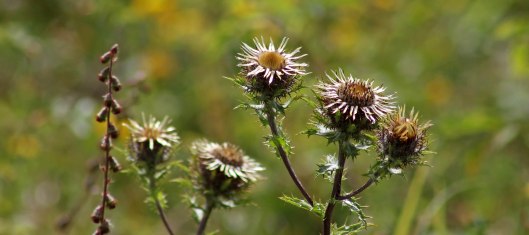
My new favourite flower resembles something you might find in a dried arrangement rather than a flower in full bloom but such is the look of the Carline thistle (Carlina vulgaris).
170818 Carline thistle (1)

It grows best on calcareous soils in Wales and England – they are thriving on the dry, stony grassland areas at Cosmeston Lakes Country Park. It’s spiny, as you would expect from a thistle, but is not a tall plant, probably no more than knee-height, and it sends up its spiky flower heads on solitary stems that have between 2 and 5 flowers on top.

170818 Carline thistle (2)
170818 Carline thistle (3)
170818 Carline thistle (4)

At first glance, you might think the flowers were dead but, if you look closer, you can see that they’re just like any other daisy-like flower, except for their brownish hues. When the sun touches them, they positively glow, and when the weather is cold and wet, they close up. The flowers can be seen from July through to September, after which they will dry out and often last right through the winter. I’m thinking that once they finish flowering, I might have to snaffle a couple to enjoy at home over the winter.

170818 Carline thistle (5)

Like Loading...

What’s on the teasel, 1

17 Thursday Aug 2017

Posted by sconzani in flowers, insects, nature, wildflowers

≈ 8 Comments

Tags

British insects, Dolycoris baccarum, Green shieldbug, insect behaviour, insects on teasels, Palomena prasina, Sloe shieldbug, Teasel

This is the sight that greeted me as I wandered home through Dingle Park the other day.

170817 whats on the teasel (1)

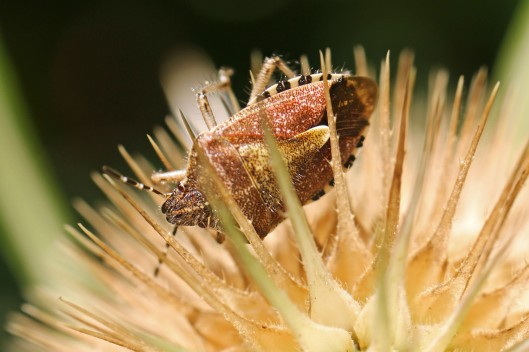
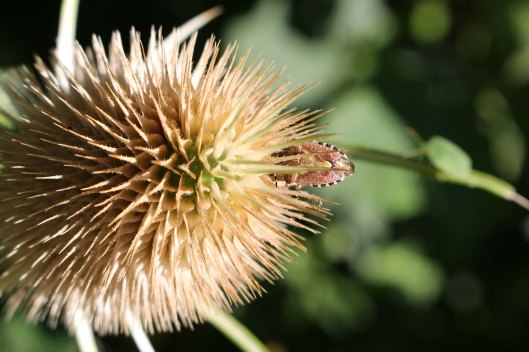
A Sloe shieldbug (Dolycoris baccarum) had its head buried deeply into the gaps between the spines of a teasel flower head. The tiny purple flowers had finished so it wasn’t nectaring, and I would’ve thought the flower head too tough for it to be sucking plant sap, so what on earth was it doing?

170817 whats on the teasel (2)

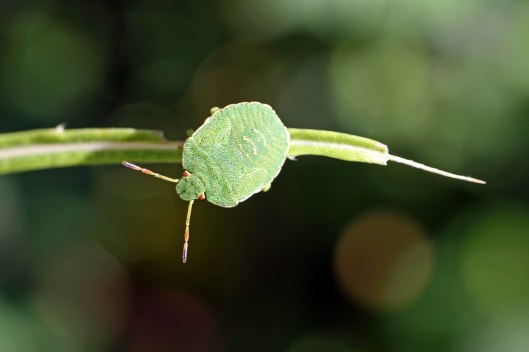
This little Green shieldbug nymph (Palomena prasina), watching from a nearby grass stem (you can see it in the background of the first image), looked as confused and bemused as I was.

170817 whats on the teasel (3)

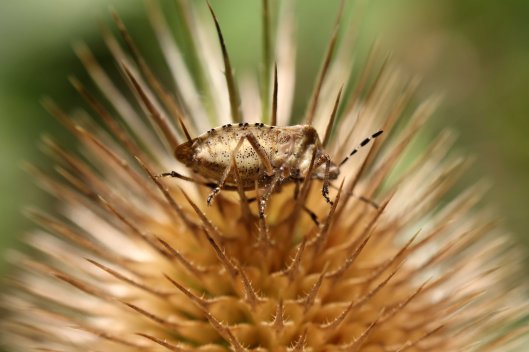
After a few minutes, the Parent bug backed out of its spiny possie but it didn’t move from the teasel.

170817 whats on the teasel (4)

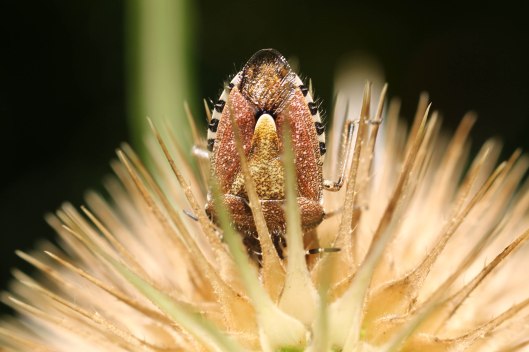
This was a good opportunity to get a photo of the underside of the bug … but I never did discover what it had been doing.

170817 whats on the teasel (5)

Like Loading...

The almost inedible parsnip

11 Friday Aug 2017

Posted by sconzani in flowers, insects, nature, wildflowers

≈ Leave a comment

Tags

British flora, British wildflowers, Cosmeston Lakes Country Park, parsnip, Pastinaca sativa, umbellifers, Wild parsnip, wildflowers

While we’re on the subject of wild vegetables (see yesterday’s Wild carrot post), I must mention the other umbellifer that’s currently in full bloom, the Wild parsnip (Pastinaca sativa). Unlike the Wild carrot, the root of the Wild parsnip is, in fact, edible, though it’s described as hard and wiry so doesn’t sound worth the bother to me. I’ve also read that the sap of the plants can cause severe rashes and burns in some people so handling doesn’t seem advisable. And, anyway, who would want to deprive the insects of their tasty feast or spoil the glorious sight of a field of parsnip in full bloom?


170810 Wild parsnip (2)
170810 Wild parsnip (3)
170810 Wild parsnip (4)

The Wild parsnip is the ancestor of the cultivated parsnip, which is one of my favourite winter vegetables – roasted, in soup, stir-fried, yum! – and its culinary use probably dates from the early Middle Ages. The wild variety can be found growing, often in large groupings, on the chalky grasslands of southern England and Wales. In Cosmeston Lakes Country Park, one particular field is like a forest of yellow, some plants taller than my 168cm, and you can smell the scent of parsnips as you walk along the tracks through the field. Delicious!

170810 Wild parsnip (1)

Like Loading...

The inedible carrot

10 Thursday Aug 2017

Posted by sconzani in flowers, nature, wildflowers

≈ Leave a comment

Tags

British flora, British wildflowers, carrot, Daucus carota, umbel, umbellifer, Wild carrot, wildflowers

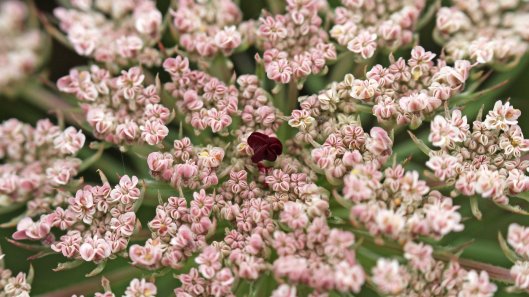
I’m finally starting to get a handle on the various umbellifers to be found in this land and the progression of their flowering through the seasons. Here in Wales, one of those currently in full flower is the Wild carrot (Daucus carota).

wild carrot (1)

Its leaves smell of the edible carrot but I’ve read that the roots of this wild variety are ‘thin and wiry and bear little resemblance to the thick, orange tap-roots of the cultivated vegetable’ so that firmly rules out any foraging! I also read, in my copy of Richard Mabey’s trusty Flora Britannica, that edible carrots ‘were developed from a distinct subspecies, ssp.sativa, probably native to the Mediterranean, and brought to Britain in the 15th century’. Fascinating!

wild carrot (3)
wild carrot (4)
wild carrot (5)
wild carrot (6)
wild carrot (7)

Meanwhile, the Wild carrots continue to grow straight and about 3 feet tall in my local wild places, to the delight of the hoverflies, sawflies, soldier beetles and other assorted insects that seem particularly to enjoy them. They have quite distinctive feathery leaves and often, but not always, a very tiny pinkish-red flower in the exact centre of their umbel. Also, when they’ve finished flowering, the umbels contract to a nest-like shape, which is why one of their common names is Bird’s-nest.

wild carrot (2)

Like Loading...

Pulling the little blossom threads

04 Friday Aug 2017

Posted by sconzani in flowers, nature, wildflowers

≈ 2 Comments

Tags

Centaurea nigra, Common knapweed, John Clare poem, John Clare poem May, knapweed, love divination game with knapweed

170804 Common Knapweed (1)

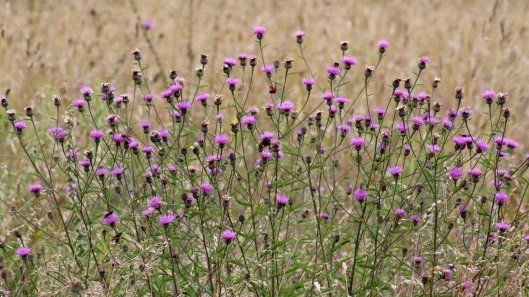
In days of old a love divination game would be played with the flowers of the Common knapweed (Centaurea nigra), as described here by English poet John Clare (1793 – 1864) in his poem ‘May’:

170804 Common Knapweed (3)
170804 Common Knapweed (4)

They pull the little blossom threads
From out the knapweeds button heads
And put the husk wi many a smile
In their white bosoms for awhile
Who if they guess aright the swain
That loves sweet fancys trys to gain
Tis said that ere its lain an hour
Twill blossom wi a second flower
And from her white breasts hankerchief
Bloom as they ne’er had lost a leaf

170804 Common Knapweed (5)
170804 Common Knapweed (6)

170804 Common Knapweed (2)

Like Loading...

Sneaky

03 Thursday Aug 2017

Posted by sconzani in insects, nature, wildflowers

≈ 4 Comments

Tags

British spiders, Daucus carota, Enoplognatha ovata, hoverflies, Pastinaca sativa, spiders, Wild carrot, Wild parsnip

I’ve got nothing against spiders: like all creatures they need to eat, but they can be rather cunning about how they ensnare their prey.

170803 Enoplognatha ovata sensu lato (1)

These Enoplognatha ovata, which come in several colourways, were taking advantage of the umbrella-shaped flowers of Wild carrot (Daucus carota) and Wild parsnip (Pastinaca sativa), lurking under the canopy created by the flower stems then darting rapidly through the gaps to grab hoverflies and other mini-beasties while they were feeding. Very sneaky!

170803 Enoplognatha ovata sensu lato (3)
170803 Enoplognatha ovata sensu lato (2)


Like Loading...

A triumph of nature

28 Friday Jul 2017

Posted by sconzani in flowers, nature, parks, wildflowers

≈ Leave a comment

Tags

British flora, British native orchids, British orchids, Broad-leaved helleborine, Epipactis helleborine, orchid, terrestrial orchid

These Broad-leaved helleborines (Epipactis helleborine) are a little past their best but I just had to post about them, partly because I love all of Britain’s native orchids and partly because these are survivors. You would usually find these terrestrial orchids growing in clearings or along path edges in forests and woodlands but these particular plants are growing on the edges of a former rubbish tip, now urban park, in Cardiff. Despite humans dumping thousands of tons of rubbish on their habitat, then covering that over with imported rocks and soil, laying tarmac paths and planting cultivated plants like cotoneaster, these helleborines have somehow survived. The idea of that made my day!

170728 Broad-leaved helleborine (5)
170728 Broad-leaved helleborine (3)
170728 Broad-leaved helleborine (6)
170728 Broad-leaved helleborine (4)
170728 Broad-leaved helleborine (2)
170728 Broad-leaved helleborine (1)
170728 Broad-leaved helleborine (7)
Like Loading...

The Pimpernels

21 Friday Jul 2017

Posted by sconzani in flowers, nature, plants, wildflowers

≈ 5 Comments

Tags

Anagallis arvensis, Anagallis arvensis ssp. foemina, Anagallis tenella, Blue pimpernel, Bog pimpernel, British flora, Lysimachia nemorum, pimpernel, Scarlet pimpernel, Yellow pimpernel

For Floral Friday this week I bring you the Pimpernels.

170721 Scarlet pimpernel

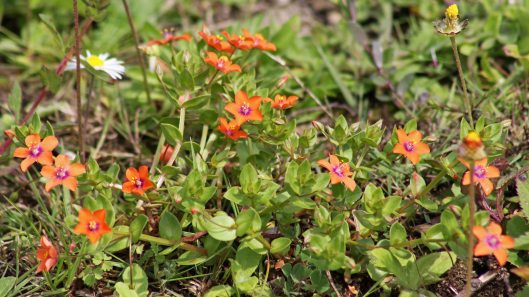
First, the pimpernel flower many of you will be familiar with, Scarlet pimpernel (Anagallis arvensis), also known as Old man’s weathervane and Poor man’s weatherglass due to its habit of shutting its petals when the weather becomes wet or dull. (I imagine they will be very firmly shut against today’s wind and rain!) The flower also functions as a timekeeper as it opens its petals around 8am and closes them at 2pm, even when the weather’s fine.

170721 Blue-flowered Scarlet pimpernel (1)
170721 Blue-flowered Scarlet pimpernel (2)

I only learned quite recently that the Scarlet has a subspecies, the Blue pimpernel (Anagallis arvensis ssp. foemina). This is supposedly quite rare and mostly found in southern England, though the one in my photographs is growing in my friend Hilary’s south Wales garden.

170721 Bog pimpernel

As its name suggests, the Bog pimpernel (Anagallis tenella) prefers watery places, marshy areas and soggy peat bogs. Its delicate pink flowers sprinkle the ground like petals under a blossoming cherry tree.

170721 Yellow pimpernel

There is also a yellow-flowered pimpernel – you guessed it, the Yellow pimpernel (Lysimachia nemorum) – that is commonly seen in established deciduous woodland and alongside shaded streams. Although it carries the name pimpernel, this lovely little plant is actually a separate genus and is more closely related to plants like Creeping-Jenny (Lysimachia nummularia) and Yellow loosestrife (L. vulgaris).

How many of these lovely pimpernels have you managed to see?

Like Loading...

Aliens in a Cardiff park

19 Wednesday Jul 2017

Posted by sconzani in nature, plants, wildflowers

≈ 4 Comments

Tags

alien flora, alien plants, Canadian Fleabane, Fennel, French bartsia, Himalayan Balsam, Himalayan blackberry, Hoary mustard, Large-flowered evening primrose, Mary Gillham Archive Project, Small-flowered evening primrose, Tansy, White mignonette, Wild radish

On Sunday the Mary Gillham Archive Project teamed up with the Cardiff Naturalists’ Society to replicate a walk that Mary Gillham had participated in many moons ago, looking for aliens in Cardiff. Of course, I don’t mean the little-green-man type of alien – these were alien plants, though the definition of alien in this case seemed quite diverse. They may have been non-native plants that had arrived in Cardiff in the sand that served as ballast in the days of sailing ships, like Canadian Fleabane (Conyza canadensis).

170719 Cardiff naturalists
170719 Canadian fleabane

They may arrived in shipments of imported grain or bird seed or perhaps in bales of wool, like Hoary mustard (Hirschfeldia incana) and White mignonette (Reseda alba). Or they may have initially been decorative plants, like the Large-flowered evening primrose (Oenothera glazoviana) that was introduced from North America in the early 17th century and has since become naturalised.

170719 Hoary mustard
170719 Large-flowered evening primrose

As well as those plants named above, we also saw the following aliens: Small-flowered evening primrose (Oenothera cambrica) (introduced to cultivation in Britain in 1775); Himalayan blackberry (Rubus armeniacus) (a garden escapee); French bartsia (Odontites jaubertianus) (mode of introduction unknown); Wild radish (Raphanus raphanistrum subsp. raphanistrum) (presumed to have spread as a weed of cultivation); Fennel (Foeniculum vulgare) (probably introduced by the Romans); Tansy (Tanacetum vulgare) (an escapee from cultivation); and, of course, the notorious Himalayan balsam (Impatiens glandulifera) (introduced as an ornamental garden plant in 1839).

The aliens are among us and they’re thriving!

170719 Fennel
170719 Himalayan balsam
170719 Himalayan blackberry
170719 Small-flowered evening primrose
170719 Tansy
170719 Wild radish

Much of the information about the origins of these plants came from the Online Atlas of the British and Irish Flora.

Like Loading...

A tale of three bindweeds

18 Tuesday Jul 2017

Posted by sconzani in flowers, nature, wildflowers

≈ 8 Comments

Tags

bindweed, Bindweed flower, British flora, British wildflowers, Field bindweed, Hedge bindweed, Large bindweed

170718 Bindweed (3)

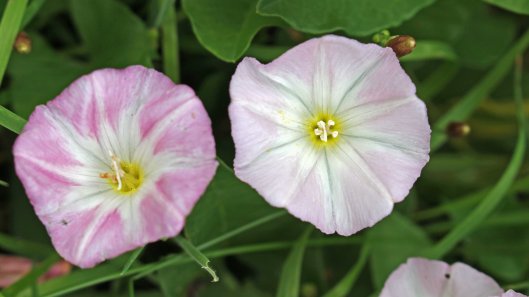
There are, in fact, five species of bindweed in Britain but I’ve only encountered three so far. One, the Field bindweed (Convolvulus arvensis) is, I think, the easiest to identify: it’s quite small, and its flowers are a delicate swirl of pink and white (as shown below).

170718 Field bindweed

Then there are the two bindweeds that have large white flowers, Hedge bindweed (Calystegia sepium) and the aptly named Large bindweed (Calystegia silvatica). To my untrained eye, these two look remarkably similar but I have recently learnt how to tell them apart so I thought I’d share that little snippet of knowledge. My wildflower key tells me that Hedge bindweed has an epicalyx of 2 bracteoles that don’t (or scarcely) overlap, whereas the Large bindweed has strongly inflated, overlapping bracteoles. Okay, so you might now be thinking, “Huh?” Well, the photos below show the difference: Hedge, left, and Large, right. Easy now, right?

170718 Bracteoles Hedge bindweed
170718 Bracteoles Large bindweed

Oh, and one more thing I found out while looking at all those bindweeds. The flowers often look like a little fairy has come along and snipped pretty patterns in their petals with miniature scissors. A fanciful idea I admit, but it’s almost true – these have been created by bees and other insects desperate to get at the sweet nectar inside so they cut their way into the flower bud before it opens.

170718 Bindweed (1)
170718 Bindweed (2)
Like Loading...
← Older posts
Newer posts →

About me

sconzani

sconzani

I'm a writer and photographer; researcher and blogger; birder and nature lover; countryside rambler and city strider; volunteer and biodiversity recorder.

View Full Profile →

Follow earthstar on WordPress.com

Enter your email address to follow this blog and receive notifications of new posts by email.

Recent blog posts

  • Blood bees April 29, 2026
  • Nesting material April 28, 2026
  • Lifer: Box bug April 27, 2026
  • Peak Wild garlic April 26, 2026
  • First damsels of 2026 April 25, 2026

From the archives

COPYRIGHT

Unless otherwise acknowledged, the text and photographs on this blog are my own and are subject to international copyright. Nothing may be downloaded or copied without my permission.

Fellow Earth Stars!

  • Unknown's avatar
  • Unknown's avatar
  • Unknown's avatar
  • Unknown's avatar
  • Unknown's avatar
  • Unknown's avatar
  • Unknown's avatar
  • Unknown's avatar
  • Unknown's avatar
  • Unknown's avatar
  • Unknown's avatar
  • Unknown's avatar
  • Unknown's avatar
  • Unknown's avatar
  • Unknown's avatar
  • Unknown's avatar
  • Unknown's avatar
  • Unknown's avatar
  • Unknown's avatar
  • Unknown's avatar
  • Unknown's avatar
  • Unknown's avatar
  • Unknown's avatar
  • Unknown's avatar
  • Unknown's avatar
  • Unknown's avatar
  • Unknown's avatar
  • Unknown's avatar
  • Unknown's avatar
  • Unknown's avatar
  • Unknown's avatar
  • Unknown's avatar
  • Unknown's avatar
  • Unknown's avatar
  • Unknown's avatar
  • Unknown's avatar
  • Unknown's avatar
  • Unknown's avatar
  • Unknown's avatar
  • Unknown's avatar
  • Unknown's avatar
  • Unknown's avatar
  • Unknown's avatar
  • Unknown's avatar
  • Unknown's avatar
  • Unknown's avatar
  • Unknown's avatar
  • Unknown's avatar
  • Unknown's avatar
  • Unknown's avatar

Blog at WordPress.com.

Privacy & Cookies: This site uses cookies. By continuing to use this website, you agree to their use.
To find out more, including how to control cookies, see here: Cookie Policy
  • Subscribe Subscribed
    • earthstar
    • Join 642 other subscribers
    • Already have a WordPress.com account? Log in now.
    • earthstar
    • Subscribe Subscribed
    • Sign up
    • Log in
    • Report this content
    • View site in Reader
    • Manage subscriptions
    • Collapse this bar

Loading Comments...

You must be logged in to post a comment.

    %d