• ABOUT
  • BIRDING 2018
  • Birding 2019
  • BLOG POSTS
  • Butterflies 2018
  • Resources

earthstar

~ a celebration of nature

earthstar

Category Archives: wildflowers

Wales Walks: Cwm George, and more

22 Saturday Apr 2017

Posted by sconzani in nature, spring, trees, walks, wildflowers

≈ 3 Comments

Tags

beech woodland, Bluebell, Cadoxton River, Coed Twyncyn, Cwm George, Cwm Penllwynog, Dinas Powys, Vale of Glamorgan walks, Wild garlic

I can’t believe it’s almost a year since I visited Cwm George. Luckily, I now live much nearer to this magnificent woodland so I’ll definitely be going back more often. I had a long walk here on Thursday with my friend Hilary, chatting and botanising and soaking in the beauty of the wild garlic and the bluebells and so much more.

This walk, called Salmon Leaps, is one of eight in the Vale of Glamorgan for which there are downloadable pamphlets available (see here for this one). Locals say there haven’t been salmon in these streams for years but don’t let that put you off. Ours was a variation of the routes in the brochure but with much of the same picturesque scenery. Let me show you me some of the highlights …

170421 Cwm George walk (1)

Crossing the Cadoxton River (well, stream, really)

170421 Cwm George walk (2)

The beeches of Cwm George, carpeted with swathes of wild garlic

170421 Cwm George walk (3)170421 Cwm George walk (4)

Looking across farmland to the village of Michaelston-le-Pit

170421 Cwm George walk (5)

A weir, with a small lake behind, on the upper Cadoxton River near Cwrt-Yr-Ala (where the salmon are supposed to leap)

170421 Cwm George walk (6)

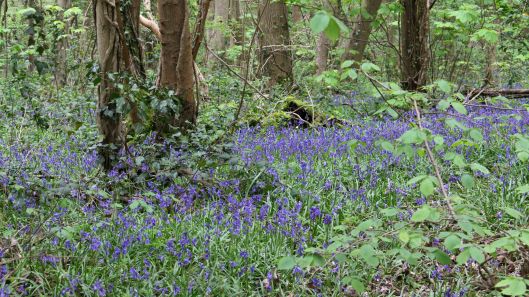
Heading in to another woodland, Cwm Penllwynog, and, below, some of its beautiful bluebells

170421 Cwm George walk (7)170421 Cwm George walk (8)

Wildflowers lined the hedgerows as we headed back towards Dinas Powys along Beauville Lane

170421 Cwm George walk (9)

More woodland – this is Coed Twyncyn

Like Loading...

‘A silent eloquence’

21 Friday Apr 2017

Posted by sconzani in flowers, nature, spring, wildflowers

≈ 4 Comments

Tags

Bluebell, Bluebells in springtime, British bluebells, Hyacinthoides non-scripta, quintessential spring flower, wildflowers

170421 bluebells (1)

‘A fine and subtle spirit dwells
In every little flower,
Each one its own sweet feeling breathes
With more or less of power.
There is a silent eloquence
In every wild bluebell
That fills my softened heart with bliss
That words could never tell.’
~ from ‘The Bluebell’ by Anne Brontë

170421 bluebells (4)
170421 bluebells (2)
170421 bluebells (3)
170421 bluebells (5)

170421 bluebells (6)

Like Loading...

Attracting thunderstorms and adders?

18 Tuesday Apr 2017

Posted by sconzani in flowers, nature, wildflowers

≈ Leave a comment

Tags

Cardamine pratensis, Cuckooflower, Lady's smock, Milkmaid, Spring colour, spring flowers, wildflowers

170418 Cuckooflower (3)

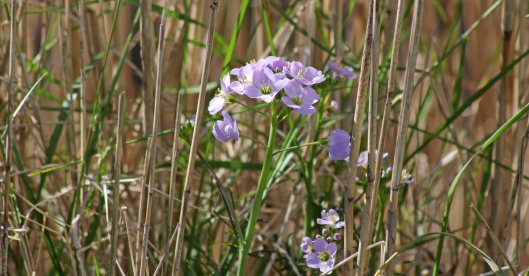
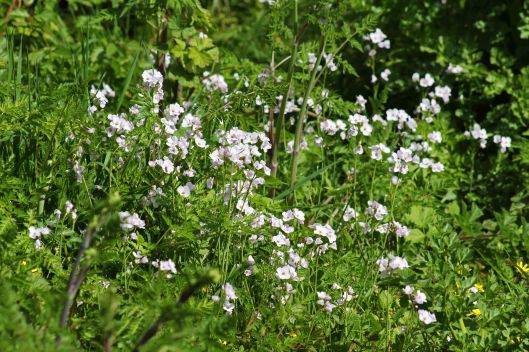
It seems that everywhere I walk at the moment there’s Cuckooflower. With its penchant for damp soggy ground, it can be found sprinkled amongst the reeds at the edge of Cardiff Bay wetlands, underlining the willow scrub along the edges of the River Taff, accentuating the lines of a drying drain at Cosmeston Lakes Country Park. And it’s such a pretty little thing, with its pale lilac flowers sitting high on an upright stalk, all the better for the bees and butterflies to find them.

170418 Cuckooflower (1)
170418 Cuckooflower (2)

Its scientific name is Cardamine pratensis and, if you don’t know it as Cuckooflower (it flowers at the time the cuckoos return to Britain), then you may know it by its other popular names, Milkmaid and Lady’s smock. Milkmaid is the older name, possibly a reference to its feminine colour and blousy shape when the flowers are first opening and I read, in an article in the Darlington & Stockton Times 23 June 2006, that

‘When Christianity came to these islands, that feminine association was transferred to the Virgin Mary, which led to a host of other names for the flower, such as my lady’s smock, lady’s glove and dozens more.
There is one old story which says that St Helena found Our Lady’s smock in a cave near Bethlehem, an article of clothing she left behind. It was later taken to St Sophia and then to Aix la Chapelle, where it was venerated for centuries, with this little wild flower being named in several European countries in honour of that relic.
‘In Europe, a lot of superstition used to surround this flower. It was thought that if anyone picked it, a thunderstorm would break out. It was also thought to generate lightning and for this reason was never taken into a house. In parts of England, it was believed to attract adders, Britain’s only poisonous snake, with a notion that anyone picking the flower would be bitten before the year was out.’

170418 Cuckooflower (5)
170418 Cuckooflower (4)

Luckily, I prefer to leave wildflowers where they are for everyone to enjoy so haven’t picked any, though I’m now almost tempted, just to see what happens … almost.

170418 Cuckooflower (6)

Like Loading...

Mad with joy

07 Friday Apr 2017

Posted by sconzani in flowers, nature, spring, wildflowers

≈ 12 Comments

Tags

spring, Spring colour, spring flowers, wildflowers

‘People from a planet without flowers would think we must be mad with joy the whole time to have such things about us.’ ~ Iris Murdoch

170407 spring flowers (1)
170407 spring flowers (2)
170407 spring flowers (3)
170407 spring flowers (4)
170407 spring flowers (5)
170407 spring flowers (6)
170407 spring flowers (7)
170407 spring flowers (8)
170407 spring flowers (9)
Like Loading...

Station blooms

05 Wednesday Apr 2017

Posted by sconzani in flowers, nature, spring, wildflowers

≈ 2 Comments

Tags

daffodil, Penarth railway station, Penarth station, Snake’s head fritillary, Spring blooms, Spring colour, spring flowers, tulips

Though Penarth is a wonderfully historic Victorian seaside town, with lovely parks, an iconic pier and grand buildings, its station is nothing to write home about. The original stone-built station buildings were demolished in the 1980s and replaced with a functional but ugly brick structure. So, it’s not one of those picturesque stations with hanging baskets full of summer flowers but it does have one redeeming feature. The scruffy and uncared-for dirt bank alongside the platform is currently home to a delightful display of Spring blooms. So, while the other morning commuters spend their waiting time scrolling through the latest social media happenings on their smartphones, completely oblivious to their surroundings, I enjoy the flowers. I hope you do too!

170407 Penarth station blooms (1)
170407 Penarth station blooms (2)
170407 Penarth station blooms (3)
170407 Penarth station blooms (4)
170407 Penarth station blooms (5)
170407 Penarth station blooms (6)
170407 Penarth station blooms (7)
170407 Penarth station blooms (8)
170407 Penarth station blooms (9)
Like Loading...

Wales walks: Penarth to Lavernock

01 Saturday Apr 2017

Posted by sconzani in geology, insects, lichen, nature, seaside, walks, wildflowers

≈ 8 Comments

Tags

Lavernock, nature walks, Penarth, Penarth to Lavernock, Wales Coastal Path, walks

Since moving to the seaside two months ago I have been thoroughly enjoying exploring my new surroundings and a particular favourite has been the walk from Penarth to Lavernock, a very small 1.5km section of the Wales Coastal Path.

170401 Coastal Path flora

Despite its short length, it can take me rather a long time to walk because the path is bordered with all manner of trees, shrubs and wildflowers, so my eye is constantly drawn to checking these out.

170401 Coastal Path insects (1)
170401 Coastal Path insects (2)
170401 Coastal Path insects (3)

I am fast discovering that the abundance of flora supports a wonderful array of fauna: flies and bees are flocking to the freshly opened flowers of Alexanders (Smyrnium olusatrum), recently arrived migrant Chiffchaffs (Phylloscopus collybita) are announcing their arrival with their familiar onomatopoeic song while recharging their batteries on flying insects, and various species of terrestrial snails sleep, slide and slither amongst the leaves.

170401 Coastal Path lichens (1)
170401 Coastal Path lichens (2)
170401 Coastal Path lichens (3)

There’s also a huge diversity of lichens, presumably much encouraged by the Welsh rains, the occasional wild winds, and the clean and salty seaside air.

170401 Coastal Path geology

Here and there gaps in the trees and shrubs reveal tantalising glimpses of the fascinating geology this coast is famous for (I have yet to venture down the cliffs but that will soon happen).

170401 Coastal path Flatholm

Boats and ships chug up and down the Bristol Channel; planes from Cardiff airport fly off overhead to foreign shores; the lighthouse on Flatholm beckons; and views of Penarth’s iconic pier abound.

170401 Coastal Path

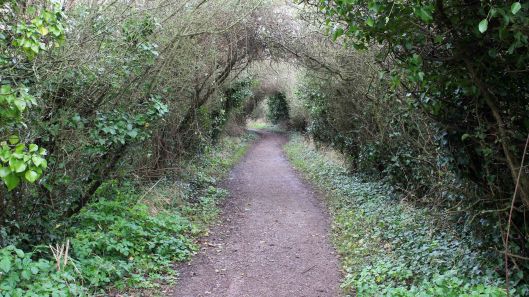
But most of all I love the places – and there are many – where the foliage closes in overhead, to create little tunnels of vegetation. I find there’s something magical about such spaces, a little like stepping through the wardrobe door to emerge in a real-life Narnia.

Like Loading...

It’s Weed Appreciation Day!

28 Tuesday Mar 2017

Posted by sconzani in flowers, nature, plants, wildflowers

≈ 8 Comments

Tags

benefits of weeds, Weed appreciation day, weeds

Yes, it’s another of those international days of celebration. No, this is not a post about marijuana. The Oxford Dictionary defines a weed as a ‘wild plant growing where it is not wanted and in competition with cultivated plants’ but I prefer Ralph Waldo Emerson’s definition, ‘a weed is a plant whose virtues have not yet been discovered’.

170328 weed or wildflower (1)
170328 weed or wildflower (2)
170328 weed or wildflower (3)

So, for the obsessive gardeners out there, remember these:
Weeds provide food and shelter for insects, so they help to provide biodiversity and attract insects that are beneficial to the pollination of non-weeds.
Some weeds are also edible by humans, providing good sources of vitamins and minerals.
Weeds often thrive in impoverished soils and help to restore nutrients to those soils, as well as helping to stabilise the soil surface and prevent erosion.
Some weeds also have the ability to absorb heavy metals so can reduce contamination in industrial wastelands. They’re Nature’s clean-up crew!
Many weeds contain chemicals that are useful in medicines and herbal remedies, and research has shown that some weeds can be used as a source of biofuel.

170328 weed or wildflower (4)
170328 weed or wildflower (5)
170328 weed or wildflower (6)
170328 weed or wildflower (7)
170328 weed or wildflower (8)
170328 weed or wildflower (9)
Like Loading...

Signs of Spring, 3

25 Saturday Mar 2017

Posted by sconzani in insects, ladybird, nature, spring, wildflowers

≈ 7 Comments

Tags

bees, butterflies, flies, hoverflies, insects, insects in springtime, ladybird, shieldbugs, Spring has sprung

You know Spring has well and truly arrived when the insects start appearing in reasonable quantities so, judging by the numbers of insects I’ve seen on my walks over the past two days, I would say Spring has most definitely sprung, wouldn’t you?

170325 Spring insects (1)
170325 Spring insects (2)
170325 Spring insects (3)
170325 Spring insects (4)
170325 Spring insects (5)
170325 Spring insects (6)
170325 Spring insects (7)
170325 Spring insects (8)
170325 Spring insects (9)
170325 Spring insects (10)
170325 Spring insects (11)
170325 Spring insects (12)
Like Loading...

Herb Robert

12 Sunday Mar 2017

Posted by sconzani in nature, spring, wildflowers

≈ 6 Comments

Tags

Cranesbill, Death comes quickly, Geranium Robertianum, Herb Robert, herbal medicine, Knecht Ruprecht, Red Robin, Robin Goodfellow, Storksbill

One of the highlights of yesterday’s walk was seeing this little geranium in flower. Though thought to have an offensive odour – some say it smells of burning tyres, others that it emits has an unpleasant mousey smell, hence one of its common names, ‘stinking Bob’ – I admit I haven’t noticed its stink and instead find myself attracted to its delicate ferny foliage, its reddish stalks, and its pretty pink flowers.

170312 Herb Robert (1)

This is Geranium robertianum, most commonly known in Britain as Herb Robert but with a plethora of other common names which, in part, reflect the folklore around it: Storksbill, Crow’s foot, Death comes quickly and Red Robin are just a few of its 100-odd regional variants. The origins of the name ‘Robert’ are disputed – some attribute it to the abbot and herbalist Robert of Molesme, others to Saint Robert or Rupert of Salzburg, and there appear also to be associations with the German hobgoblin Knecht Ruprecht and the English equivalent Robin Goodfellow (Puck in Shakespeare’s A Midsummer Night’s Dream). (You can read more in this excellent blog on the Metropolitan Museum of Art’s website.)

170312 Herb Robert (2)
170312 Herb Robert (3)

Herb Robert has long been valued by herbalists, for its healing properties – everything from wounds and toothache to its supposed ability to increase oxygen at a cellular level in the human body, thus assisting in the body’s fight against cancer. Personally, rather than ingest it, I think I’ll just continue to enjoy the dainty dabs of colour this pretty little plant adds to the countryside of my walks.

170312 Herb Robert (4)

p.s. Some of these photos were taken last summer.

Like Loading...

Grangemoor Park: a first look

11 Saturday Mar 2017

Posted by sconzani in fungi, insects, lichen, nature, parks, spring, wildflowers

≈ 4 Comments

Tags

biodiversity, Cardiff parks, Grangemoor Park, old rubbish tip, Penarth Moors, River Ely, signs of spring

I had my first wander around Grangemoor Park yesterday and I’ll definitely be going back, though perhaps when it’s a little drier underfoot. With an extensive area of grass and scrub that rises up to two central mounds (from which you get quite good 360-degree views over Cardiff), this land wasn’t always a park. You have only to look at old maps to see that, once upon a time, the River Ely meandered through Penarth Moors here but, once the river was realigned, the hollows thus created were used as one of Cardiff’s rubbish tips. When the tip was full, Cardiff Council had a load of underground drains built, as well as ventilation pipes to allow the methane to escape, covered the lot with tons of clay – hence the very soggy ground, edged it all around with a solid stone wall, and changed its designation to a park in 2000.

170311 Grangemoor (1)
170311 Grangemoor (2)
170311 Grangemoor (3)
170311 Grangemoor (4)
170311 Grangemoor (5)
170311 Grangemoor (6)

That may sound like a sad history but, according to locals, the park now hosts quite a broad range of flora and fauna, and I certainly saw many of the stirrings of Spring. There were bumblebees and flies, a butterfly and a ladybird, masses of primroses almost hidden under bushes, golden coltsfoot and dandelions in bloom all around and horsetail pushing through everywhere, as well as incredibly vibrant lichens and a healthy growth of Oak curtain crust fungi. I will be going back!

170311 Grangemoor (7)
170311 Grangemoor (8)
170311 Grangemoor (9)
170311 Grangemoor (10)
170311 Grangemoor (11)
170311 Grangemoor (12)
Like Loading...
← Older posts
Newer posts →

About me

sconzani

sconzani

I'm a writer and photographer; researcher and blogger; birder and nature lover; countryside rambler and city strider; volunteer and biodiversity recorder.

View Full Profile →

Follow earthstar on WordPress.com

Enter your email address to follow this blog and receive notifications of new posts by email.

Recent blog posts

  • Cetti’s warblers March 27, 2026
  • Goose barnacles March 26, 2026
  • Black-tailed godwits fighting March 25, 2026
  • Singing from every tree top March 24, 2026
  • Turtle bug March 23, 2026

From the archives

COPYRIGHT

Unless otherwise acknowledged, the text and photographs on this blog are my own and are subject to international copyright. Nothing may be downloaded or copied without my permission.

Fellow Earth Stars!

  • Unknown's avatar
  • Unknown's avatar
  • Unknown's avatar
  • Unknown's avatar
  • Unknown's avatar
  • Unknown's avatar
  • Unknown's avatar
  • Unknown's avatar
  • Unknown's avatar
  • Unknown's avatar
  • Unknown's avatar
  • Unknown's avatar
  • Unknown's avatar
  • Unknown's avatar
  • Unknown's avatar
  • Unknown's avatar
  • Unknown's avatar
  • Unknown's avatar
  • Unknown's avatar
  • Unknown's avatar
  • Unknown's avatar
  • Unknown's avatar
  • Unknown's avatar
  • Unknown's avatar
  • Unknown's avatar
  • Unknown's avatar
  • Unknown's avatar
  • Unknown's avatar
  • Unknown's avatar
  • Unknown's avatar
  • Unknown's avatar
  • Unknown's avatar
  • Unknown's avatar
  • Unknown's avatar
  • Unknown's avatar
  • Unknown's avatar
  • Unknown's avatar
  • Unknown's avatar
  • Unknown's avatar
  • Unknown's avatar
  • Unknown's avatar
  • Unknown's avatar
  • Unknown's avatar
  • Unknown's avatar
  • Unknown's avatar
  • Unknown's avatar
  • Unknown's avatar
  • Unknown's avatar
  • Unknown's avatar
  • Unknown's avatar

Blog at WordPress.com.

Privacy & Cookies: This site uses cookies. By continuing to use this website, you agree to their use.
To find out more, including how to control cookies, see here: Cookie Policy
  • Subscribe Subscribed
    • earthstar
    • Join 642 other subscribers
    • Already have a WordPress.com account? Log in now.
    • earthstar
    • Subscribe Subscribed
    • Sign up
    • Log in
    • Report this content
    • View site in Reader
    • Manage subscriptions
    • Collapse this bar
 

Loading Comments...
 

You must be logged in to post a comment.

    %d