
Beautiful demoiselle (Calopteryx virgo) : simply stunning!

08 Wednesday Jun 2022
Posted in insects
Beautiful demoiselle (Calopteryx virgo) : simply stunning!
07 Tuesday Jun 2022
Remember A Holly blue and her egg, my post on 24 May? Well, the egg has now hatched and I’ve had my first glimpses of the larva, so incredibly tiny that, with my poor eyesight, I had to take some macro photographs and look at those to be sure of what I was seeing – spot the hairy larva in the photo on the right below.

These images were taken one day apart, so the larva can have been no more than 24 hours old at this stage. In his essential publication Life Cycles of British & Irish Butterflies, author Peter Eeles writes: ‘The larva starts to feed by burying its head deep into the bud on which the egg was laid’. This is the first of four stages the larva goes through before it pupates, so I’ll be checking back regularly to try to monitor its progress.
06 Monday Jun 2022
Tags
British moths, Coleophora anatipennella, larval cases of moths, leaf-mining moths, moth larval cases, Pistol case-bearer
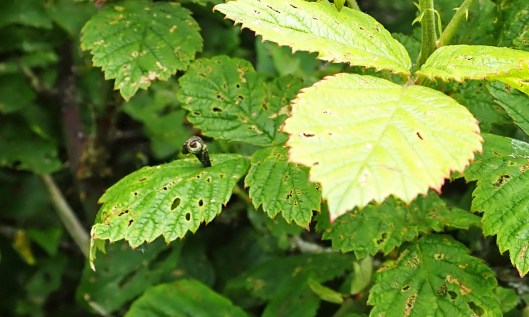
The UK Moth website explains the name of this rather bland-looking moth: ‘The “Pistol Case-bearers” are so named from the resemblance of their larval cases to an old flintlock pistol in shape.’ And I think you can see that likeness in my photos.

I’d not seen anything like these before so turned to some Twitter experts for help with their identification. Fortunately, Rob Edmunds, of British Leafminers website fame, was able to confirm that these are indeed the larval cases of the Pistol case-bearer moth (Coleophora anatipennella). Their feeding makes tiny holes in the leaves, which you can see in the photos above and below, and these particular ‘pistols’ contain larvae that have over-wintered in their cases, which Rob thinks are now ‘in position pupating on the upper leaf surface’. Nature never ceases to amaze me!
05 Sunday Jun 2022
Posted in flowers, wildflowers
The site where I usually see Southern marsh-orchids (Dactylorhiza praetermissa), Cardiff’s Grangemoor Park, has been closed for several months (it’s a former landfill site and the aged infrastructure that manages escaping methane gas and the leaching of contaminated water into the adjacent river is being upgraded). So, it was a thrilling surprise to discover three of these beauties in the damp lower edge of a local meadow where they’ve not been recorded before.

04 Saturday Jun 2022
Tags
British moths, moth larvae, Spindle ermine, Spindle ermine larvae, Spindle ermine moth, Spindle ermine webs, Spindle tree, Yponomeuta cagnagella
Back in June 2021, I blogged about the webs I was finding on Spindle trees in a local woodland, the silken creations of the larvae of the Spindle ermine moth (Yponomeuta cagnagella), and I’ve been seeing a multitude of these webs and larvae again in recent weeks. They don’t do a lot of damage to the larger Spindle trees but, as you can see below right, the larvae’s voracious appetites can strip the smaller saplings.
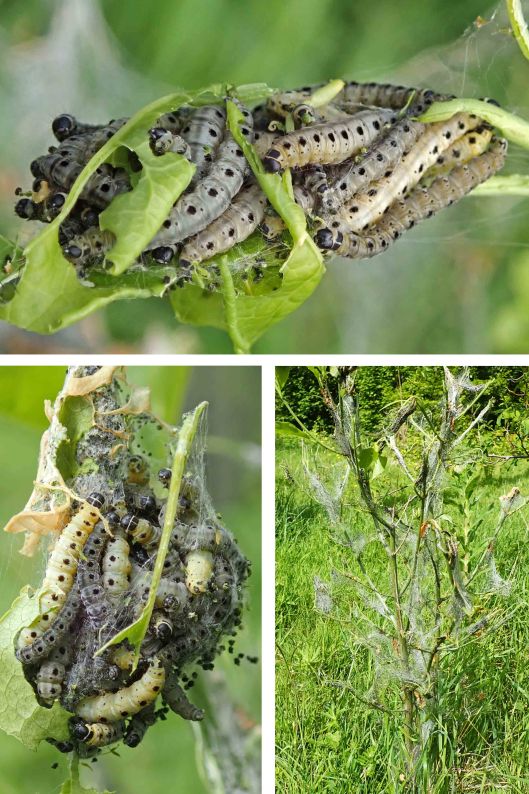
I’d heard that when the larvae are fully grown, they drop to the ground to pupate, often dangling in writhing groups from a silken thread. This was the first time I’d seen the larvae doing just that.

During my most recent visit to this woodland where Spindle trees – and the Spindle ermine larvae that munch on them – are most plentiful, I finally saw some of the adult moths**, and what beautiful little creatures they are. There were four, all sitting on thistles within a few feet of each other, so I assume they had recently emerged from pupation. And so the life cycle begins again.
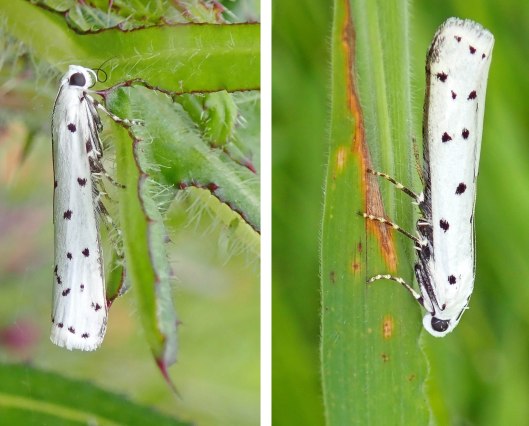
** A correction: Well, wouldn’t you know it? My Spindle ermine moths turned out to be Thistle ermine (Myelois circumvoluta). Serves me right for assuming they must be Spindle ermine just because of all the larvae in the area.
03 Friday Jun 2022
Posted in insects
A moment of miniscule magic! I found this Small copper perched, waiting for the sun to come out, and then a leafhopper (yet to be identified) decided the butterfly was a good place to perch.


02 Thursday Jun 2022
Posted in insects
This was a surprise.

I’d just come to the end of a long meandering wander around woodland rides and meadows, finding little in the way of critters to photograph or ponder over, and was heading homewards, stomping up a private road, when I looked down and spotted this bizarre-looking mini-beastie tootling along. It’s a Glow-worm larva and the Wildlife Trusts website has this to say about them: ‘Glow-worms live for up to three years as predatory larvae, living under rocks and hidden deep in grassy tussocks where they mainly feed on snails.’

01 Wednesday Jun 2022
Posted in insects
Tags
They’re tiny – some more so than others; they’re odd looking – those snouts; they come in a variety of colours – that red; and they’re very very cute. During recent walks, I’ve been seeing lots of weevils, of various sizes, shades and shapes, sunning themselves on leaves on trees and shrubs, so do cast an eye their weevil way.

31 Tuesday May 2022
Brownish? Check. Pale veins? Check. ‘The vertex has two streaks at the anterior edge which may join in the middle’? (You can’t really see this in my photos – I had to enlarge them to find them. Also, if, like me, you aren’t familiar with the anatomy of a leafhopper, the British Bugs website has an illustrated page of bug bits.) Check. ‘And there is an orange-brown transverse band behind this’? Check. ‘The anterior of the pronotum has variably dark markings’? Check.
Six checks is a winner! This little leafhopper, a new find for me, is Speudotettix subfusculus. Look for it on trees, especially Oak trees.

30 Monday May 2022
Posted in nature
We’ve had a break from leafmines for a while but now the leaves are once again green and lush, it’s time to check them for signs of the mines of munching moth and fly and beetle larvae.

Today’s example is a new one for me: Agromyza anthracina, a fly whose larvae thrive on Nettles. It’s common in England and, though there aren’t many Welsh records, it seems that’s because it’s under-recorded rather than rare. Since a Twitter friend found mines on Nettles in a local park last week, I’ve found mines in several locations on my walks.

I’ve lightened these images a lot to try to show more clearly the details of the mines: some are quite intestinal in design and the frass in the galleries is like a child’s scribble pattern.
 earthstar
You must be logged in to post a comment.