… seeing my first Bee orchid for 2022!


29 Sunday May 2022
Posted in flowers, wildflowers
… seeing my first Bee orchid for 2022!
28 Saturday May 2022
You’d have grey hairs and a muddy beak too if you were busy rooting out worms ten to the dozen all day long to feed the demanding hungry mouths back home in the nest.

27 Friday May 2022
Posted in plants
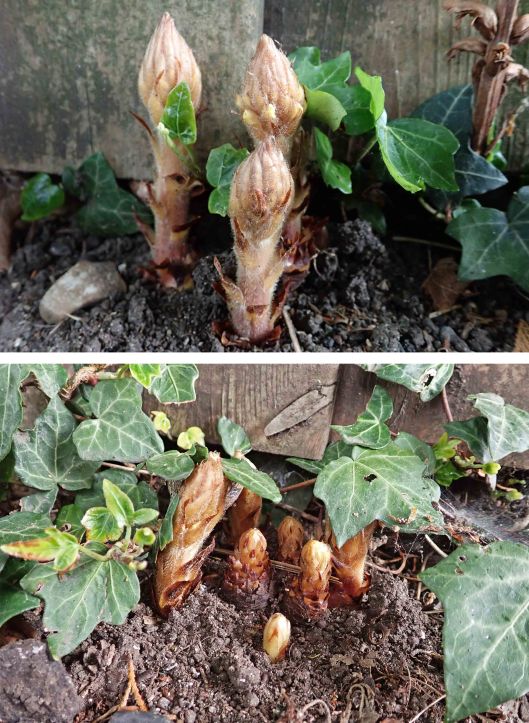
When I spotted these furry shoots bursting up out of the dirt, I wasn’t immediately sure what they were. Then I noticed the fully grown spike next to one group and, of course, the Ivy leaves: putting two and two together, I realised the answer was Ivy broomrape, the ‘legume strangler’, the chlorophyll parasite. You can read more in a previous blog, from July 2019, here.
26 Thursday May 2022
Posted in insects
≈ Comments Off on An illegal introduction
I’ve seen my first Marsh fritillaries of the year, always a magical moment, except this year that magic was dulled somewhat by the fact that these particular butterflies in this particular location have obviously been introduced illegally, possibly as eggs or as larvae.

Expert opinion is that the site is too far from known populations of Marsh fritillary to have occurred naturally and, sadly for the butterflies (at least three individuals have been identified), the site does not have enough of the right habitat, so it is highly unlikely they will survive. (You can read more on the laws that apply to butterflies, including the Marsh fritillary, a fully protected species, on the UK Butterflies website.)

25 Wednesday May 2022
Posted in insects
This snipe fly (possibly Rhagio scolopaceus) came to sit on my hand while I was watching butterflies flit about in a field, and then posed nicely for photos. I wondered if it was my skin cream that had attracted it – it’s described as coconut, which means, to local insects, I smell like a walking Gorse bush. But then a Twitter friend replied to my post with a photo of the same species of snipe fly perched on his Tesco-washing-powder-smelling shirt, which blew my theory out the water. Maybe snipe flies just like hitching a ride.

24 Tuesday May 2022
Posted in insects
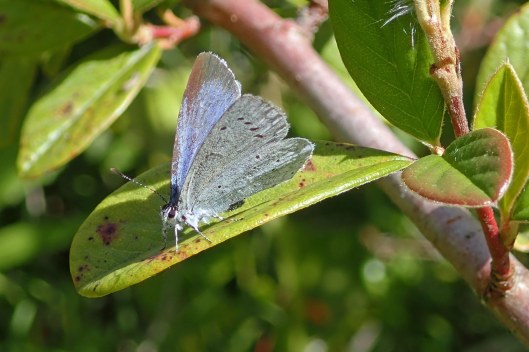
This Holly blue butterfly was egg-laying as I watched so I was able to get photos of one of her amazing eggs, in this case laid on the flower buds of Dogwood.

23 Monday May 2022
Posted in insects
This is the closest I’ve ever got to a European hornet (Vespa crabro). Now that I’m without a long lens and only using my Olympus point-and-shoot camera, I have to get within a foot, often closer, to get reasonable images. So, I was quiet and my approach was slow and steady, and the Hornet didn’t seem bothered by my presence, luckily.
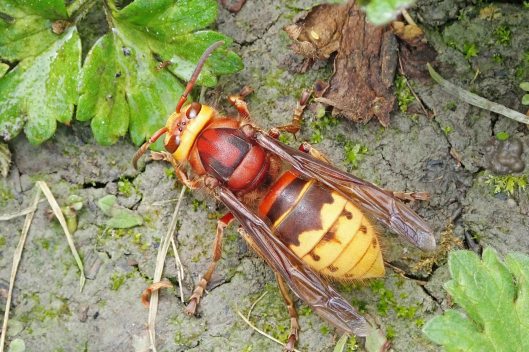
I wasn’t sure what this queen was doing on the ground but I have just been reading on Wikipedia (not sure how reliable it is, but looks well referenced) that Hornets use soil when building their nests (‘trace amounts of silicon, calcium, iron, and potassium were found’ in nest fibres) so perhaps she was mineral gathering for her latest construction project.
22 Sunday May 2022
Posted in flowers, wildflowers
It’s amazing what a bit of rain can do. I’ve been watching the rosettes of Common spotted-orchids in various locations over the past week or so as their leaves flesh out and their flower spikes develop but I was still surprised to see this year’s first two plants with open flowers during my morning walk.

They may be common but they are truly glorious, and I can’t wait for the time when the meadows are full of their flowers.

21 Saturday May 2022
Tags
Chalcidoidea, Eulophidae, gem-coloured wasps, parasitic wasp, parasitoid wasp, wasps on Oak leaves
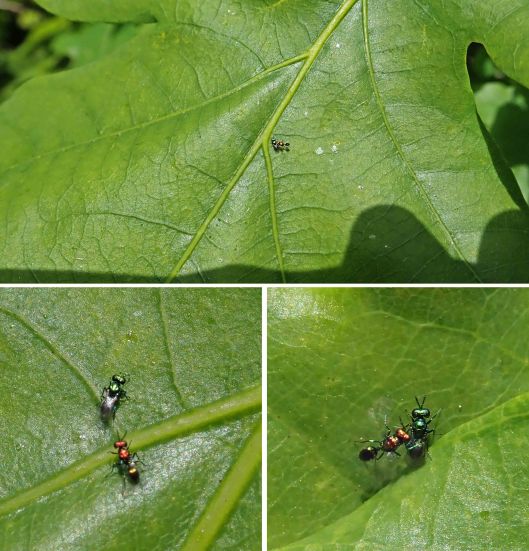
Tiny specks of metallic green and red caught the light as the sun emerged from behind large fluffy clouds and touched the leaves of an Oak tree. But what were they? Even when I edged closer, I could barely make them out, so miniscule were they. Turns out these are parasitoid wasps belonging to the superfamily Chalcidoidea, and probably from the genus Eulophidae, but that’s as far as the experts online could go without microscopic examination of these startling creatures. An article on the Natural History Museum website begins: ‘Described as “gem-like inhabitants of the woodlands by most never seen nor dreamt of”, chalcidoids include some of the most beautiful insects on the planet’, and I think you can see why.
20 Friday May 2022
Posted in flowers, insects, wildflowers
Tags
ants, ants nectaring on EFNs, Brimstone, Common vetch, EFNs, extrafloral nectaries, Grass vetchling, nectar sources on plants, Vetches, Vicia species
Two for the price of one today: a lovely female Brimstone butterfly, which I was really happy to catch feeding on Common vetch.
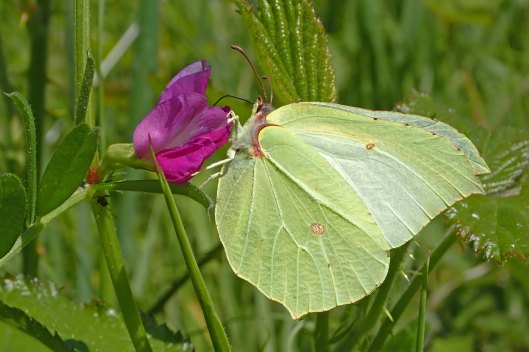
But, lurking beneath the flower, you may be able to spot a small creature. It’s an ant and, if you’ve ever looked closely at the flowers of any of the vetch family (Common, Bush, Tufted, and the vetchlings), you may have noticed they all prove attractive to ants.

I’ve only recently discovered the reason for this: these plants all have extrafloral nectaries (EFNs), tiny glands on the stems and other areas of a plant, where nectar is secreted. The vetches aren’t the only plants to have these EFNs – according to a report on the University of Florida website (and there are many other scientific papers online, if this subject intrigues you), EFNs have been found in over 2000 plant species. Scientists don’t seem completely sure why plants ‘feed’ ants in this way, though it may be a means of rewarding ant species for their protection against the plant-munching larvae of other insect species.
 earthstar
You must be logged in to post a comment.