114/366 Little and large

Tags

, , , , , , , ,

During yesterday’s exercise meander around Penarth, I found two lovely Lepidoptera in one of the few local parks that’s still open.

200423 green long-horn moth

The first was this amazing day-flying moth, the Green long-horn (Adela reaumurella). It may have a wingspan of only 14-18mm, but just look at those antennae (hence, the name ‘long-horn’). This is a male; the females have shorter antennae, which are half black, half white.

200423 large white butterfly

Then, to my delight, soon after seeing that stunning little moth, I spotted my first Large white butterfly (Pieris brassicae) for 2020. And, compared to the moth, it really is large, with a wingspan between 63 and 70mm. This is also a male; the females have two grey-black spots on their upper wings.

113/366 Hairy shieldbugs

Tags

, , , ,

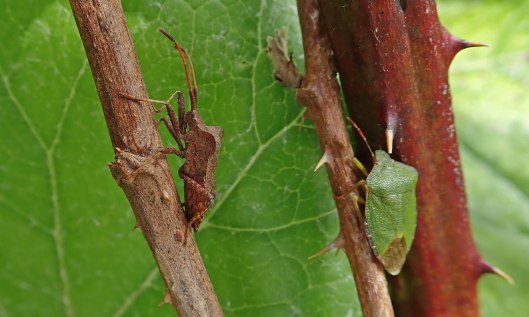
You wouldn’t think an insect that looks like it’s wearing armour (hence ‘shield’ bug) could be hairy but the Hairy shieldbug (Dolycoris baccarum) is living proof. It’s difficult to see the hairs when you’re viewing them in full sunshine, as their shield-shaped backs are quite shiny, but if you can get a close view in a shady setting, you can see the hairs on their legs and, in my photo below, along the top of the shield.

200422 hairy shieldbug (5)

I found at least 20, probably more, of these handsome creatures in the scrub alongside a seldom-walked local path, and will be keeping an eye on this area to see if I can spot their offspring in the coming months, as it’s always interesting to see the different stages of growth. You can see images of these different instars, not only for the Hairy shieldbug but also for all the other shieldbug species, on the excellent British Bugs website.

112/366 The May tree

Tags

, , , ,

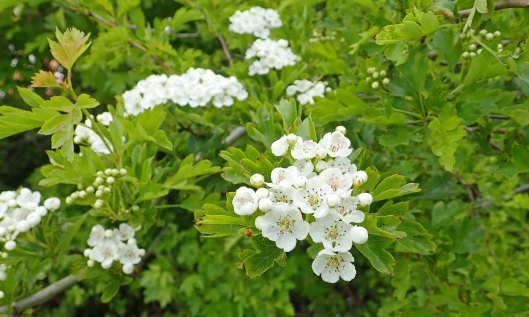
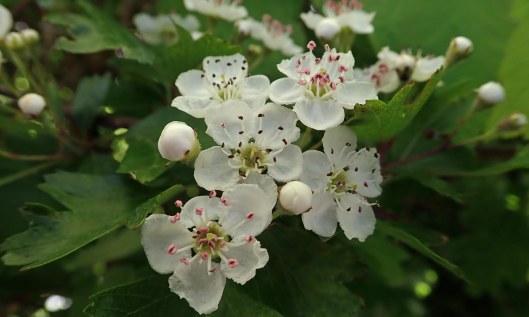
It’s that time of year again, when the Hawthorn blossom scents the air with its distinctive perfume and carpets the ground with its snow-like blossom.

204021 hawthorn (1)

My Flora Britannica reminds me that Hawthorn, also known as the May tree, was ‘the ancestor of the Maypole, the source of May Day garlands … and one of the models for the foliage which wreathes the faces of Green Men carved in churches and inns.’

204021 hawthorn (2)

For lots more fascinating information on the Hawthorn, check out my previous post here.

204021 hawthorn (3)

110/366 Even earlier purples

Tags

, , ,

I spotted 8 flower spikes of Early-purple orchid (Orchis macula) during my walk last Wednesday, 15 April, though not all the flowers were yet open.

200419 early-purple orchids (1)

This sighting was earlier than last year’s, which was on 23 April and which the locals told me was earlier than usual. It seems like climate change keeps changing the goal posts for these orchids.
200419 early-purple orchids (4)

109/366 Speckled Spring

Tags

, , , ,

We’ve had much-needed rain and low-cloud gloom for the past two days but, earlier in the week, when the sun was warm and glorious and my walk took me along the coastal path, it felt like proper Spring. The bird song was almost deafening and – what clinched the Spring-ness for me – I counted 12 Speckled wood butterflies along the path, either perched sun-basking or patrolling their patch of scrub or – the males – engaged in spiralling dogfights over territory. Springtime magic!

108/366 Tawny miners

Tags

, , ,

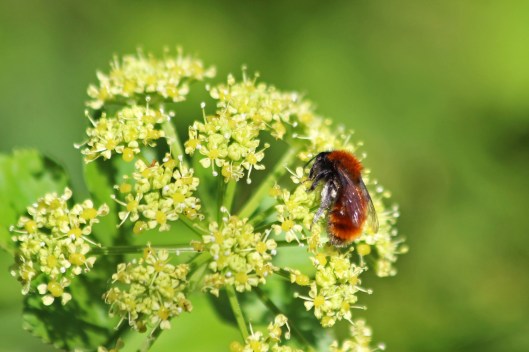
Another day, another mining bee. You’ll recall we had the grey-haired Ashy mining bee on Tuesday; well, today we have the Tawny mining bee (Andrena fulva). And what a cracking colour it is! I’d love to have hair like this.

200417 Tawny mining bee (1)

The Bumblebee Conservation Trust website says these bees ‘can be found nesting in large groups and can be common in urban environments and garden lawns’ but I think that depends on location as the bees I see locally are usually singles, in less urban environments and, sadly, not as common as I’d like them to be, as their rich vibrant colour is very cheering.

200417 Tawny mining bee (2)

Unfortunately, just like the Ashy mining bees, the Tawnies can also fall victim to bee-fly predation. You can read more about that and the bees themselves on the BCT website here.

107/366 In my tree

Tags

, , , , , , , , ,

It’s amazing how much time you can ‘waste’ trying to take photos of all the birds that spend time in a tree. I know because I’ve spent several hours doing just that. I can watch the tree as I sit at my desk/dining table or on my living room sofa (my kitchen/dining/living room is just one big room) so it’s easy to spot birds arriving or to hear them singing and calling, but it’s not so easy to sneak over to the open window to take photos because, obviously, if I can see the birds, they can also see me! So, my clothes drying rack was moved in to service as a not-very-effective bird hide.

200416 1 bird hide

First up was a Blue tit – always cute and very chirpy. As the tree – some kind of ornamental cherry – is now quite leafy, it’s hard to get a clear shot and, of course, the birds don’t exactly pose for me.

200416 2 blue tit

Next, and returning continuously throughout the day, a couple of Goldfinches. Their cheerful twittering has been a joy in recent days.

200416 3 goldfinch

Surprise of the day was this Willow warbler, a real rarity in my urban setting. It visited on and off for a couple of hours then, presumably, continued its migration path, heading north to the Welsh Valleys to find a spot to breed.

200416 4 willow warbler

And so to bed … this Woodpigeon had obviously had a hard day.

200416 5 woodpigeon

106/366 The ostentatious Orange-tip

Tags

, , , , ,

If there is one butterfly whose male makes a truly conspicuous effort to impress the female of the species, then it must surely be the Orange-tip (Anthocharis cardamines). Those vivid orange wing tips are hard to miss, even when the males are speeding past at a hundred miles an hour. Today, at last, I saw my first Orange-tip for 2020 – in fact, I spotted four of these handsome chaps and, after following a couple back and forth along their chosen territories, I finally managed a single photo of one as it was refuelling.

200415 orange-tip

105/366 A colony of miners

Tags

, , , , ,

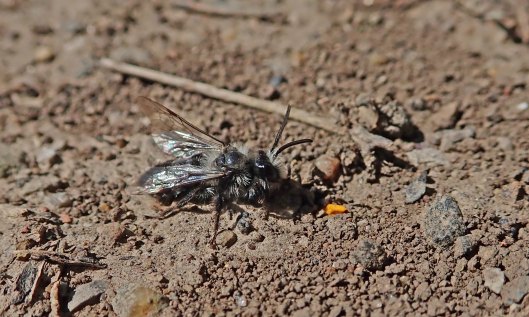
I’d forgotten about this little colony of Ashy mining bees (Andrena cineraria) until I walked past on today’s exercise walk, saw their buzz of spring activity, remembered them at this location last summer. The female bees have set up home – a series of individual nests, accessed by the small holes you can see in my photos – in a sandy bank near the entrance to one of the few local parks that’s still open.

200414 ashy mining bee male (1)200414 ashy mining bee male (2)

The males in this group (2 of perhaps 20 shown above) were particularly active, sometimes fighting each other for access to the larger females (the two photos immediately below), sometimes battling with the females as they tried to mate with them.

200414 ashy mining bees

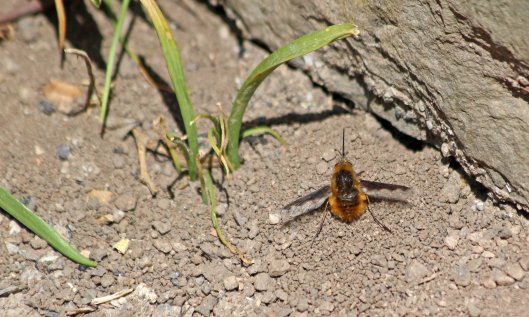
Unfortunately, I was not the only creature watching the bees’ activity – a Dark-edged bee-fly (Bombylius major) was also hovering nearby, waiting to roll its eggs into the bees’ tunnels so its larvae could predate the bees’ offspring. Not surprisingly, the bees were dive-bombing, trying to make it flee.

200414 dark-edged bee-fly