154/365 Frits again

Tags

, , , , , ,

The weather wasn’t ideal for my visit to Aberbargoed grasslands today, with little sun and a fresh breeze, but I thought I’d give it a try as the rest of the week is looking little better – in fact, it’s looking downright miserable, with rain forecast most days. To see butterflies, you really need sunshine and warmth.

190603 marsh fritillary (1)

Moaning aside, as you can tell from my photos, I did manage to find some Marsh fritillaries – I counted at least 25, some of which were already looking a little worn from their flying about, bumping into plants, and their interactions with others of their kind.

190603 marsh fritillary (2)

What I was really hoping to find were Small pearl-bordered fritillaries, as they’ve been seen at this site in the past week and they would have been a new sighting for me for the year. And I did see some – two, perhaps three – but they were either distant or flying rapidly past. They did, however, look much more orange in flight than the Marsh frits and their flight pattern was different. Luckily, I managed to grab one photo, with both a Small pearl-bordered fritillary and a Marsh fritillary on the same flower. It’s a heavy crop but I still like it.

190603 apb and marsh fritillaries

153/365 The geranium and the bee

Tags

, , , , ,

190602 geranium and bee

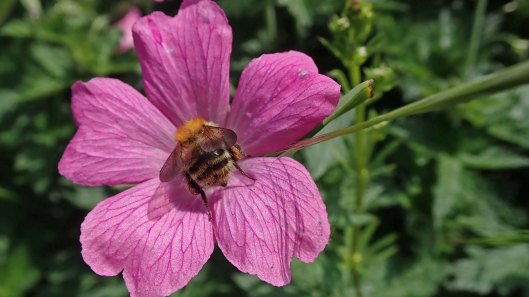
This photo was actually taken yesterday because, being the occasional numpty that I am, I didn’t take my camera with me when I went out for a stroll and some groceries this afternoon, after the rain had cleared. The bee is a Common carder (Bombus pascuorum) but I’m not sure about the geranium. Although it’s growing beneath a hedgerow in a rural lane, I think it’s a garden escape, as its description doesn’t fit with the native geraniums in my plant book. Whatever it is, it’s obviously tasty … if you’re a bee.

152/365 Hovering

Tags

, , , , , , , ,

I found a new path today, which led me through swathes of long grass bordered by brambles and low shrubby bushes. I emerged with wet shoes and trousers from the dew still coating the grass but with lots of photos of hoverflies, so I will definitely be going back to explore further. Here are the hovers …

Volucella bombylans and Volucella bombylans subsp. plumata
At first glance you might think these two hoverflies were bumblebees, and that’s exactly what they want you to think – or, rather, what they want bumblebees to think, because they don’t want to be caught out when sneaking in to lay their eggs in the nests of the bumblebees they mimic (which are the Red-tailed bumblebee Bombus lapidarius and the White-tailed bumblebee Bombus lucorum respectively).

Helophilus pendulus and Chrysotoxum bicinctum
Do you see why the hoverfly on the left is known as The Footballer? I’m not sure which football team his colourful markings are meant to represent – perhaps Helophilus pendulus has its own team. Its distinctive bands of bright yellow make Chrysotoxum bicinctum one of the easier hoverflies to identify.

Xanthogramma pedissequum and Episyrphus balteatus
Xanthogramma pedissequum is another hoverfly with reasonably easy to identify markings – believe me, not all hoverflies are so easy! And with its rich orange colouring, Episyrphus balteatus looks almost edible, which is probably why it’s called the Marmalade hoverfly.

151/365 Leptastic

Tags

, , , , , , , , , ,

I’ve had a lucky week with my Lepidoptera sightings – that’s moths and butterflies, for those who didn’t know – and the week’s not over yet. As well as the Narrow-bordered Bee Hawk-moth on Monday and the Burnet Companions on Tuesday, yesterday I found my first (three) Large Skipper butterflies for the year at Cosmeston.

190531 large skipper (1)190531 large skipper (2)

And, today, my wander around Grangemoor Park was something of a Lep-fest, with the first (five) Mother Shipton moths I’ve seen in 2019.

190531 mother shipton (1)190531 mother shipton (2)

And I spotted a nice Latticed Heath moth trying to hide in the grass.

190531 latticed heath

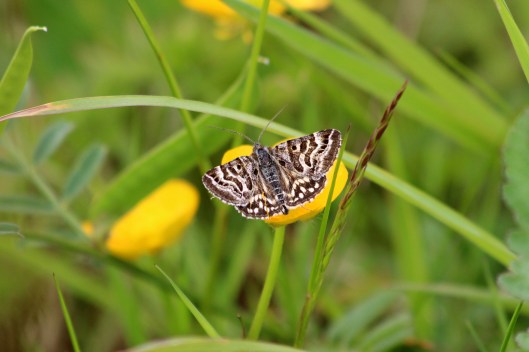
And, then, just as I was about to head for home, I noticed something small flitting about along a side path, went to investigate and found two Brown Argus butterflies, which I have seen already this year but not in Wales. You can see why I named this blog ‘leptastic’!

190531 brown argus (1)190531 brown argus (2)

150/365 The squire of the spire

Tags

, , , , , , ,

I know Blackbirds like to find a nice high location from which to sing their lovely warbling melody but this local Blackbird has shunned the chimney pots and tree tops to seek out the highest possible spot he can find, the top of the only church spire in town. Several times a day he’s up there, announcing his presence, advertising his territory, spreading joy to all who hear him … except, perhaps, other male Blackbirds.


149/365 Goldfinch foraging

Tags

, , , , ,

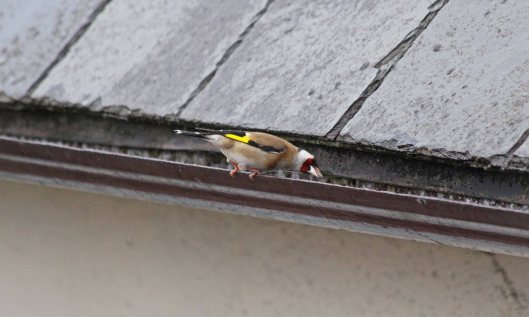
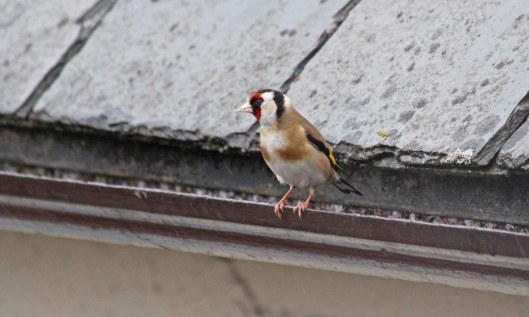
It’s been cold, wet and windy all day but the family’s got to be fed. So, along with all the other birds with hungry chicks to feed, Mr and Mrs Goldfinch have been working hard despite the inclement weather.

190529 goldfinch (1)

I’ve heard them several times in the ornamental cherry at the front of my house and found them twice foraging in the gutters out back.

190529 goldfinch (2)

I’m not sure what they’re finding – wind-blown seeds of some kind perhaps. It doesn’t look enough to satisfy a nest full of rumbling tums but I guess, for today, it will have to do.

190529 goldfinch (3)

148/365 The one that got away

Tags

, , , , , , ,

I mentioned in yesterday’s post about the amazing Narrow-bordered Bee Hawk-moth that I had actually been trying to re-find a Burnet Companion moth when I spotted the Hawk-moth. Well, today I got the one that got away yesterday – not the actual moth, as today I was at Cosmeston not Lavernock, and not just one but three Burnet Companions appeared for my camera today.

190528 burnet companion (1)

I felt a bit sad for the first one I saw (below left). Either it hadn’t developed properly in its pupa or something had happened to it since hatching, as its wings appeared damaged and it didn’t seem able to fly.

But the other two were flitting merrily from flower to flower, drinking in as much Bird’s-foot trefoil nectar as their tiny tongues could manage. And not only do they have lovely markings on the top side of their wings but they’re a wonderful buttery yellow underneath as well (above right).

190528 burnet companion (4)

147/365 Narrow-bordered Bee Hawk-moth

Tags

, , , , , , ,

I had a heart-stopping few moments at Lavernock Nature Reserve this afternoon. I’d just taken a rubbish photo of my first Burnet Companion moth of the year but it had flitted off and I was trying to re-find it when I spotted this beauty … and I couldn’t believe what I was seeing. It’s a Narrow-bordered Bee Hawk-moth (Hemaris tityus) and it’s something of a rarity here in south Wales.

190527 narrow-bordered bee hawk-moth (1)

According to Aderyn, Wales’s Biodiversity and Information Reporting Database, this species has not been recorded anywhere near my area for more than 50 years, yet they seem to be having a good year in 2019: George, from our local Butterfly Conservation branch, tells me this special moth has been seen in three new sites in south Wales so far this year. Long may this trend continue!

190527 narrow-bordered bee hawk-moth (2)

146/365 House building

Tags

, , , , , ,

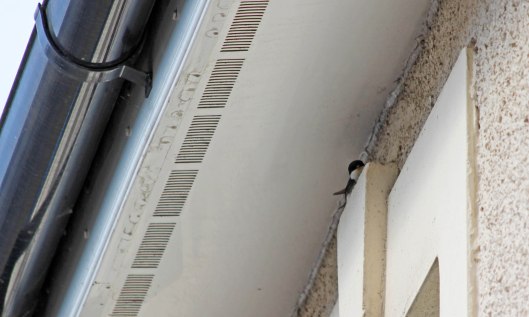
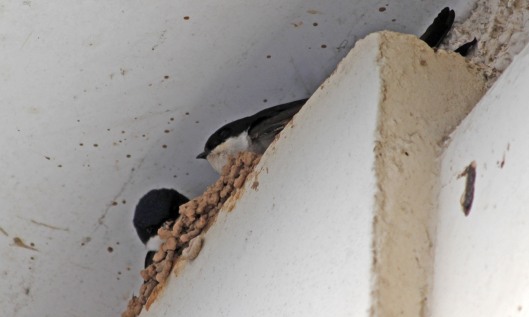
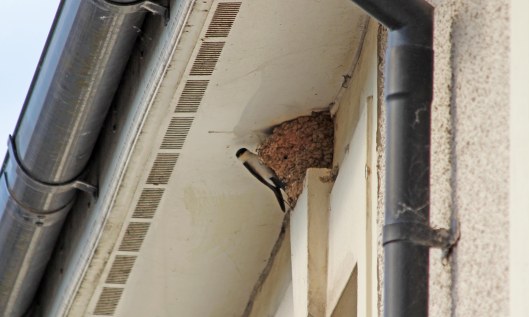
The House martins are back in town and have started refurbishing, renovating and rebuilding their nests so they can get on with breeding this year’s offspring. There’s one particular local street where the architecture of the houses suits them perfectly – the upper-storey windows have a decorative moulding which could almost have been purposely designed to have a nest propped upon it.

190526 house martins (1)

And what amazing nests they are! Imagine having to build your own home by flying to and from the muddy bank of a nearby stream, river or pond with small amounts of mud in your mouth, back and forth for hours until you’ve formed a structure that will safely house your eggs and later chicks.

190526 house martins (3)

Sorry these photos aren’t great – the day’s been wet and grey, and it’s a little dark under the eaves so I’ve had to ramp up the light on these shots so you can get the picture.

190526 house martins (2)

145/365 An orchid update

Tags

, , , , , , , ,

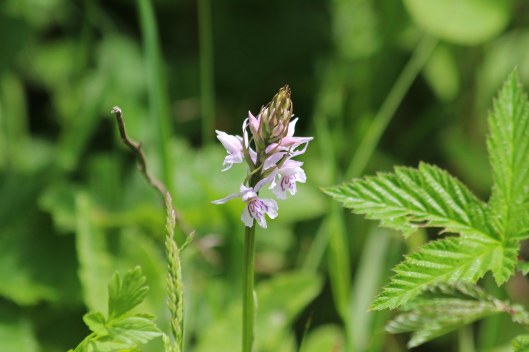
As more and more orchids are now appearing, I thought I’d post a few photos of those I’ve seen so far this year. The first were the aptly named Early purples (Orchis macula), though this year they were even earlier than usual I’m told – I spotted these beauties at Lavernock Nature Reserve on 23 April.

190525 early purple orchids

Next up were these pretty little Heath spotted-orchids (Dactylorhiza maculata) found growing at the Aberbargoed Grasslands National Nature Reserve on 15 and 21 March, when I was visiting for the Marsh fritillaries.

190525 heath spotted-orchid

During Monday’s wander at Lavernock I spotted the first open flower of a Common spotted-orchid (Dactylorhiza fuchsia) and on Thursday, 23 May, I found the first couple of these at Cosmeston Lakes Country Park.

190525 common spotted lavernock190525 common spotted cosmeston

And today’s delightful discovery, also at Cosmeston, was my first Bee orchid (Ophrys apifera) for 2019. I look forward to the warm summer days when the fields at Cosmeston are awash with (mostly Common spotted) orchids – they’re a joy to behold!

190525 bee