Looking daggers at me?

Tags

, , , , , ,

Yesterday, when I was checking out some local Oak trees for leaf mines, I came across this vibrant character. It turns out this is the larva of the Grey dagger moth (Acronicta psi), a very colourful creature when compared with its parent (you can see images on the UK Moths website here).
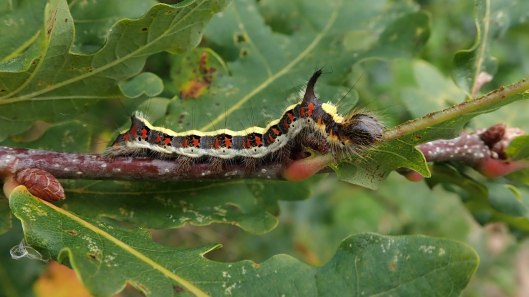
181009 grey dagger (1)

The larvae are about from July through to November and can be found on a wide variety of food plants. They are much easier to identify than their parents: the Grey dagger is almost identical to the Dark dagger moth and an examination of their genitals is required to tell them apart. I’m so glad I found the caterpillar not the moth – and I don’t really think it was looking daggers at me!

181009 grey dagger (2)

Busy little Ivy bees

Tags

, , , , ,

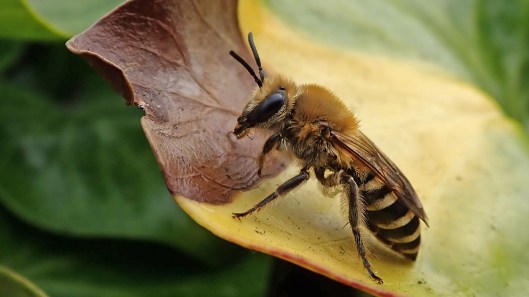
Most of the Ivy bees (Colletes hederae) I spotted when I was out walking last week were living up to their reputation as busy little mini-beasties.

But then I spotted this one, sitting on a leaf, cleaning the pollen off its legs, wings and body. I asked politely if it would please smile for the camera … and it did … I think.

Ivy bees only arrived in Britain in 2001 but they’ve slowly expanded their range across southern England and in to south Wales. They’re very handsome little bees and completely harmless but can only be seen when the Ivy is flowering, from September to November. If you spot one, it would really help if you could report it so that the wonderful folk at BWARS (the Bees, Wasps and Ants Recording Society) can track the bees’ spread around Britain.

Just peachy

Tags

, , , , ,

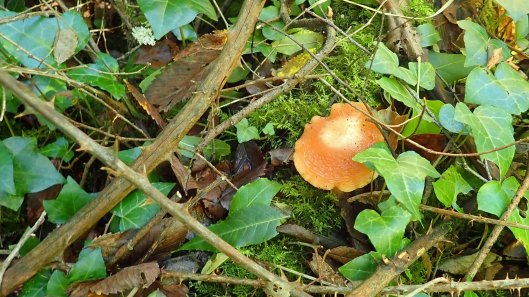
I was over the moon when I spotted this first little burst of peachiness growing on an old, ivy-smothered log a week ago.

181006 Wrinkled peach (1)

Why? Because this is one of the few fungi I can positively identify by sight, and it’s quite the rarity in most parts of Britain these days because it grows on Elm, a tree that is itself increasingly rare in Britain nowadays. According to the Forest Research website, 60 million Elm trees have been killed by Dutch Elm disease since it was first discovered in Britain in the 1920s, the majority of those dying since the 1970s.

181006 wrinkled peach (2)181006 wrinkled peach (3)

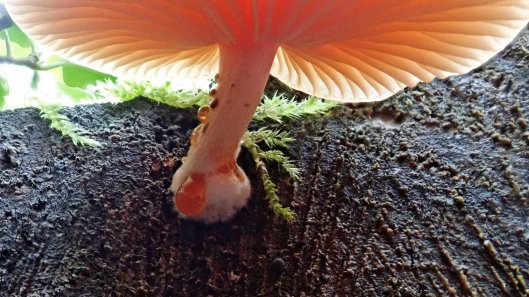
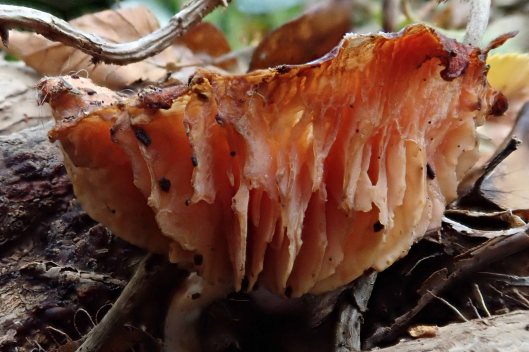
This fungus is the wonderfully named Wrinkled peach (Rhodotus palmatus). Rhodotus comes from the Ancient Greek Rhodon, meaning rose, and palmatus is Latin and means ‘shaped like a hand’, presumably a reference to the surface texture of the fungus’s cap resembling the lines on the palm of a hand.

181006 Wrinkled peach (4)

Incredibly, I found nine of these fungi on two different logs, and then, on a subsequent visit, found another one growing on a log a few metres away. Presumably the logs are the remains of an Elm that was cut down when Dutch Elm disease was at its height.

181006 wrinkled peach (7)

As you can see from my photos, the fungi range from the very young and fresh to the aging and wrinkled and decaying. Wrinkled peach, when seen at all, is usually found between July and November, so I have a few more weeks yet to enjoy these little beauties.

181006 Wrinkled peach (8)181006 Wrinkled peach (9)

Eyecatching blue

Tags

, , , , , ,

There’s just something about a blue-coloured flower that catches my eye and this Chicory grabbed me by the eyeballs as I walked home from Penarth Marina yesterday.

Although Chicory (Cichorium intybus) is a native British wildflower, these particular plants were not truly wild; they’re growing in a series of large wildflower beds planted around the edges of Penarth Marina Park. (Interestingly, the park itself is also artificial – it was once part of the inner basin of Penarth Docks, then became a rubbish dump, before being repurposed as a park in the 1980s – details and photos here.)

Chicory, also known as Succory, used to be widely cultivated. Its spears (buds) and leaves were eaten, and the dried and ground root has been used as a substitute for coffee. I think I’ll stick with my cup of tea, thanks.

A Nuthatch moment

Tags

, , , ,

181004 nuthatch (1)

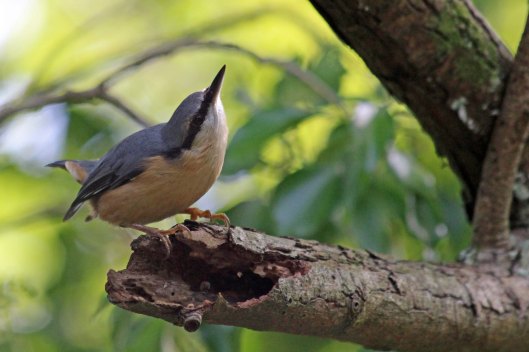
This Nuthatch is pretending to be calm and aloof and not interested in the fact that I’ve just been dishing out food to the other small birds. But really …

181004 nuthatch (2)

‘Hey lady, have you got any seed for me?’

181004 nuthatch (3)

‘Maybe you put some in here.’

181004 nuthatch (4)

‘Nope. I don’t see it.’

181004 nuthatch (5)

Rest assured, it did get some seed. It just had to come down out of its tree to get it.

I found a new plant!
Tags

, , , , ,

In case you think I’ve made a profoundly important botanical discovery, perhaps I should clarify that title: although I have noticed this plant growing in one particular place at Cosmeston Lakes Country Park during my walks in the past couple of weeks, Monday was the first time I had a close look at it, took some photos and worked out what it was, and it is a plant I had not previously seen.

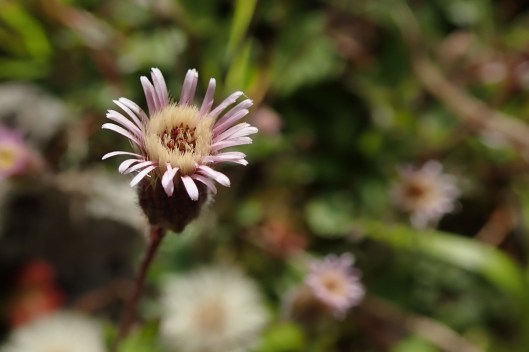
This is Blue fleabane (Erigeron acris), a member of the daisy family, though why it is called Blue fleabane I have no idea as the flower petals I’ve seen are pink, and both my plant ID guidebook and the various online sites I’ve looked at describe them as lilac or purplish.

This is a coastal plant, which usually grows in dry areas of grassland, on sand dunes or on stone walls. That fits with the site at Cosmeston, where it’s growing in a very dry, stony location and it’s probably only a mile to the sea as the crow flies. As you can see from the fluffy seed heads in my photos, it’s actually at the end of its flowering period – usually between July and September – so I have been very remiss in not noticing it before now.

181003 blue fleabane (6)

Friday’s walk 3: a Clouded yellow!

Tags

, , , , ,

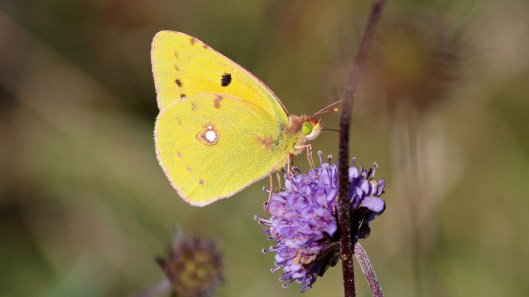
Having enjoyed some wonderful bird sightings on Sully beach, I walked on along the Wales coastal path, through Swanbridge and past St Mary’s Well Bay to Lavernock. This lovely nature reserve, perched high on the cliffs above some of south Wales’s most dramatic coastline, is the best place I know to see butterflies over the spring and summer months.

181001 Clouded yellow (1)

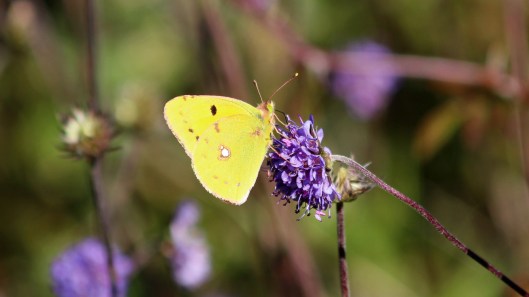
However, this was late September and there was a cool wind blowing so, although the Devil’s-bit scabious was still flowering, I didn’t really expect to see many butterflies this day. How wrong I was! Not only did I see three Small coppers, a couple of Red admirals, a Painted lady and a Common blue, as well numerous Small whites and Speckled woods, I was absolutely delighted to spot this glorious Clouded yellow, a butterfly we don’t see very often in this neck of the woods.

181001 Clouded yellow (2)

181001 Clouded yellow (5)

Friday’s walk 2: Rocky the pipit

Tags

, , , , , , , ,

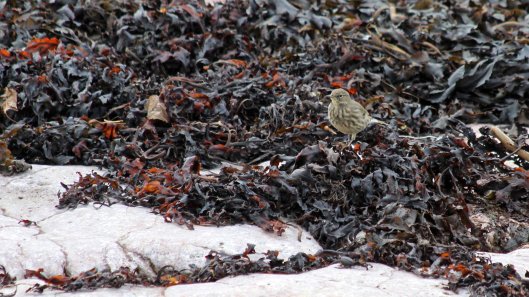
Before leaving Friday’s walk along Sully beach, I have another bird encounter to share.

180930 Rocky the pipit (1)

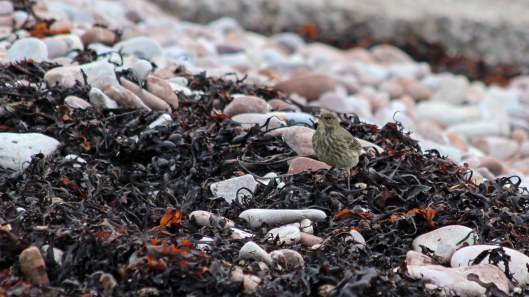
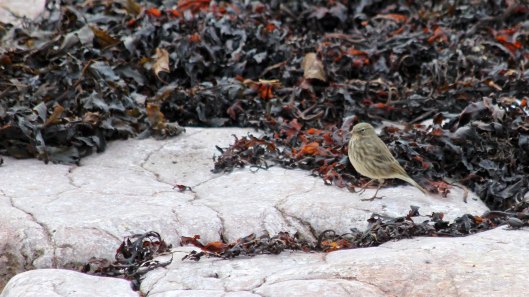
There were a lot of Rock pipits foraging amongst the rocks and piles of seaweed, more than I have seen before on Sully beach.

180930 Rocky the pipit (2)

One bird was reasonably close to where I was sitting so I had the camera up, trying to get some photos of it, when I noticed what seemed like rather odd behaviour.

180930 Rocky the pipit (3)180930 Rocky the pipit (4)

The bird hopped down from the seaweed on to a flat stone and started to stamp its feet and shuffle back and forth, looking for all the world like it was practising its line-dancing moves.

180930 Rocky the pipit (6)

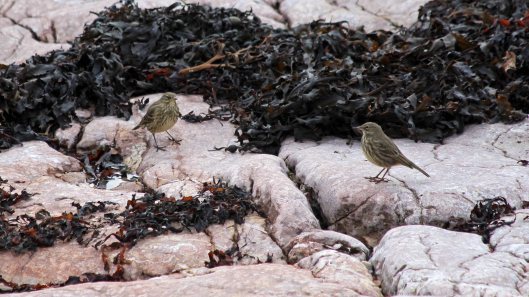
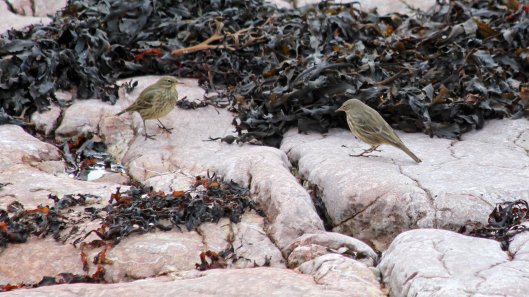
Because I had the camera up to my face and was zoomed in on this one bird – let’s call him Rocky – I didn’t realise that there was actually another Rock pipit standing very close by.

180930 Rocky the pipit (7)

Rocky was focused intently on this other bird. He puffed up his chest and strutted about and did some more line-dancing moves, but the other bird didn’t seem very impressed. If this had been springtime, I would have said Rocky was trying to impress a female but it’s autumn.

180930 Rocky the pipit (8)

Next thing, Rocky’s done with the dancing and flew straight at the other bird.

180930 Rocky the pipit (9)

They bumped chests, flapped wings and generally fluttered about for a couple of minutes, presumably each bird trying to assert its dominance through this display.

180930 Rocky the pipit (10)

The other bird relinquished the rock, and the seaweed, to Rocky, who looked rather pleased with his success. I’ve since read that Rock pipits can be very territorial so I assume Rocky was defending his patch on the beach from the intruder. It was certainly fascinating to watch.