Wild word: fasciated

Tags

, , , , ,

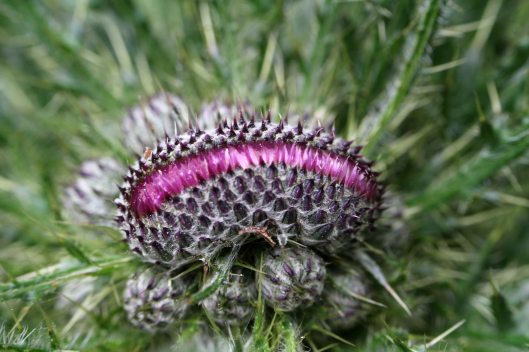
Fasciated: Adjective; (Botany) Showing abnormal fusion of parts or organs, resulting in a flattened ribbon-like structure (Oxford Dictionary).

The thistle in my photo is an example; instead of developing in the circular shape that is usual for this plant, the flower has, for some unknown reason, become distorted into a flattened and elongated, almost oblong shape.

180711 fasciated

I’m following a tree: July 2018

Tags

, , , ,

I paid a visit to Mono, my tree, yesterday and was slightly surprised but much relieved to see it didn’t appear to be suffering any ill effects from the continued heatwave and drought we’re having here in south Wales and, indeed, throughout much of Britain. I guess the tree has very deep roots and will also benefit from the shelter of the trees around it.

180708 tree following (1).jpg

I was certainly enjoying the shelter its canopy afforded me from the fierce sunshine.

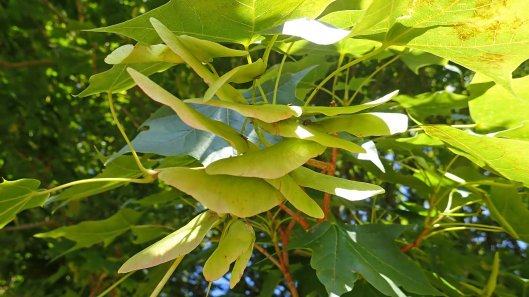
And looking up into its branches, I noticed my tree now has seeds, which means I obviously missed its flowering. Apparently, the greenish-yellow flowers appear in April-May in upright clusters.

180708 tree following (2)

180708 tree following (5).jpg

The seeds – actually called samaras – are really winged nuts, of the type that are commonly found on ash and maple trees. Mono’s are between 2 and 3cm long, inclusive of the wing, and are greenish in colour when still hanging on the tree, though those seeds that have already dropped off have dried to a light brown, with their wing-like structure clearly visible. All the better to spread those seeds on the wind when the time is right!

180708 tree following (6).jpg

A sunbathing Blackbird

Tags

, , , , , , ,

180707 sunbathing blackbird (3)

I spotted this Blackbird during a wander along the woodland trail in Cardiff’s Bute Park today, and it was concentrating so hard on its sunbathing that it didn’t notice me at first.

180707 sunbathing blackbird (1)

The sun was fierce, which I think accounts for the bird sitting with its mouth open, trying to cool itself down. As for the sunbathing itself, here’s the explanation from the British Trust for Ornithology website:

‘Sunbathing’ is used by some birds as part of their routine feather maintenance and is most commonly seen … in Blackbirds and Robins. The birds invariably adopt a posture in which the body feathers are fluffed up and one or both wings are held out from the body, with feathers spread. It is thought that using the sun in this way does two things. It both helps the preen oil to spread across the feathers and drives parasites out from within the plumage. Some of these parasites feed on the feathers themselves and all are highly specialised, with many only found on a single species of bird.

 180707 sunbathing blackbird (2)

Aberbargoed Grasslands revisited

Tags

, , , , , , , , , , , ,

On Wednesday I made my second visit to Aberbargoed Grasslands National Nature Reserve with my friend Sharon. Last time we dipped on seeing the Marsh fritillaries because it was too overcast; this time, we dipped again because the recent spell of hot dry weather has meant their season has finished for the year. Still, we have now walked most of the paths around the reserve so we’ll know exactly where to look next year. And, though we missed out the fritillaries, there were still plenty of other butterflies and moths to charm and delight us.

180705 1 small heath

Small heath (Coenonympha pamphilus)

180705 2 Ringlet

Ringlet (Aphantopus hyperantus)

180705 3 Small skipper

Small skipper (Lycaena phlaeas)

180705 4 Large skipper

Large skipper (Lycaena dispar)

180705 5 Burnet companion

Burnet companion (Euclidia glyphica)

180705 6 Pyrausta purpuralis

Common purple & gold (Pyraustra purpuralis)

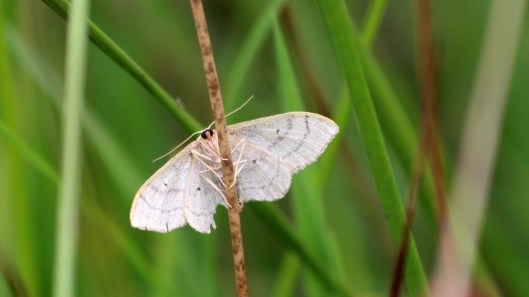
180705 7 Riband wave

Riband wave (Idaea aversata)

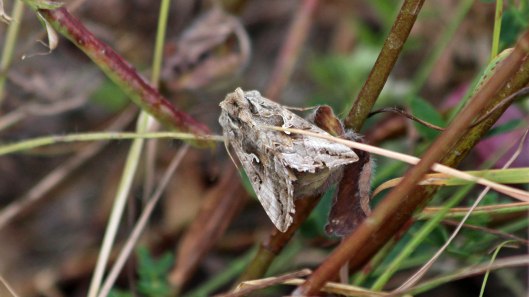
180705 8 Silver Y

Silver Y (Autographa gamma)


In a Pengam garden

Tags

, , , , , , , , , ,

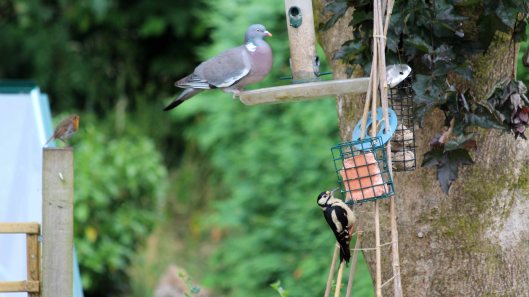
My friend Sharon has a lovely garden: an area of lawn bordered by flowers, shrubs and hedge; a separate area for growing vegies, the glasshouse and the beehives; and a lovely little bit of wild woodland at the end. It’s a paradise for birds, particularly because Sharon also has lots of feeders that she keeps stocked up with seeds of various kinds and suet blocks. As a person who lives in a first-floor flat with no garden, I just love visiting Sharon’s garden. I could sit watching the birds all day long.

180705 1 Pengam garden birds

My photos show just a few of the birds that entertained us yesterday – and these 14 species are not the only birds that visit: House sparrow, Blue tit, Great tit, Collared dove, Woodpigeon, Chaffinch, Goldfinch, Bullfinch, Carrion crow, Great spotted woodpecker, Magpie, Robin, Dunnock, and Blackbird.

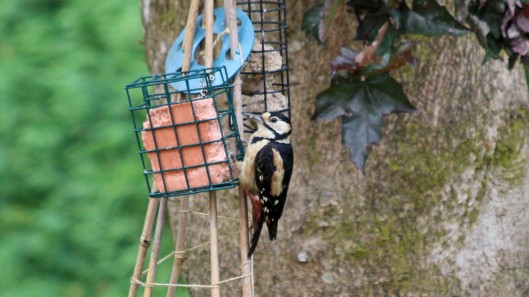
180705 2 Great spotted woodpecker

The Great spotted woodpeckers have been bringing their offspring to the garden this year

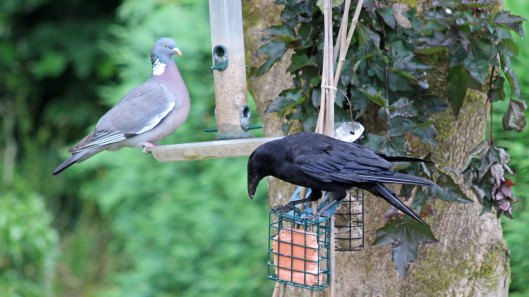
180705 3 Woodpigeon and Carrion crow

The Woodpigeon doesn’t look too happy about the Carrion crow being so close

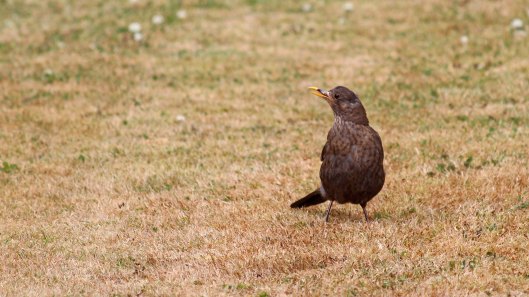
180705 4 Blackbird

A Blackbird with an odd beak

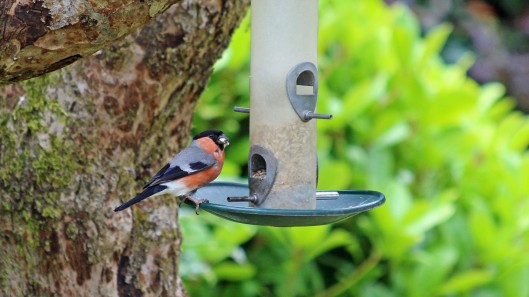
180705 5 Goldfinches and Bullfinch

‘This is ours’, squawked the Goldfinch to the Bullfinch, but …

180705 6 Bullfinch

… the Bullfinch won out on the day!

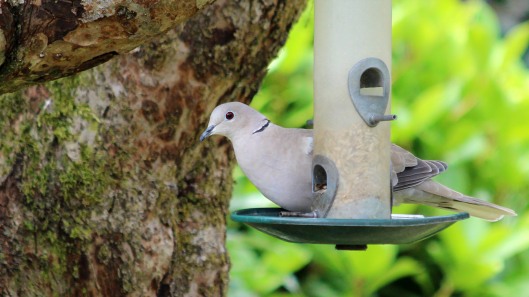
180705 7 Collared dove

A beautiful Collared dove

A Common footman

Tags

, , , ,

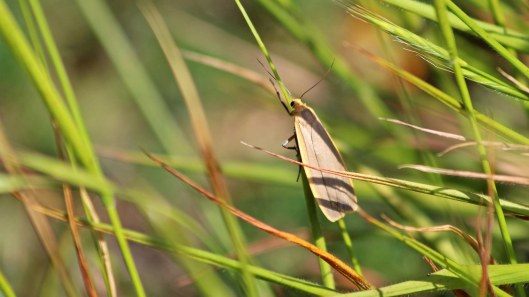
Moths have some wonderful names. I mean, you’ve got to wonder why one little group is named after a domestic servant. As well as this one, the Common footman, there are also Buff, Orange, Scarce, Dingy, Northern, Pigmy, and Hoary footmen, all members of the Eilema group of moths.

180703 common footman (1)

I spotted this little chap, Eilema lurideola, floundering around in the grass at Cosmeston recently. It might well be an elegant flier but it was having a great deal of trouble climbing up stalks of grass.

The Gatekeeper

Tags

, , ,

I saw my first Gatekeeper of the year on Saturday and was curious about its name. The consensus seems to be that the common name comes from this butterfly’s tendency to frequent those areas of rough grassland adjacent to hedgerows and field edges, like, for example, the areas around farm gates. Makes sense.

180702 gatekeeper (1)

Its scientific name, Pyronia tithonus, is a little less obvious. Pyronia is derived from the Greek πυρ (pyr) meaning fire, presumably a reference to the bright blazing orange on the butterfly’s wings, but the epithet is odd. Tithonus was a figure in Greek mythology, a member of the Trojan royal family who was kidnapped and loved by Eos, the goddess of the dawn. Wanting to keep her lover with her always, Eos asked Zeus to grant him immortality but forgot to ask for eternal youth, so Tithonus was doomed to grow old and remain old forever. Perhaps this tale held some special meaning for Hubner, the man who classified this genus, but I haven’t been able to discover what that was.

180702 gatekeeper (2)

Birding at Rhossili and Mewslade

Tags

, , , , , , , , , ,

Yesterday was my second visit to Rhossili with my friends from the Glamorgan Bird Club, though I still haven’t walked along this magnificent beach.

180702 1 Rhossili beach

Our group of 15 met in the National Trust car park at Rhossili, then slowly meandered along the cliff tops towards the point, birding as we walked.

180702 2 Heading towards the worm

I saw my first Choughs, Fulmars were spotted gliding majestically below us, and a Great black-backed gull flew in and landed on a headland.

As mentioned in yesterday’s post, here I also saw my first Grayling butterflies. The first, pictured here on a discarded Coke bottle, was spotted by eagle-eyed Tate, and the second by another birder, Rob.

At the point, we enjoyed superb views, and the last of the bright sunny weather, while eating our lunch. Then, despite the rain starting, 11 of our intrepid team headed across the causeway to The Worm, where their scrambling and climbing and drenching were rewarded with views of Guillemots, Razorbills, Puffins and Manx shearwaters.

180702 7 Crossing to The Worm

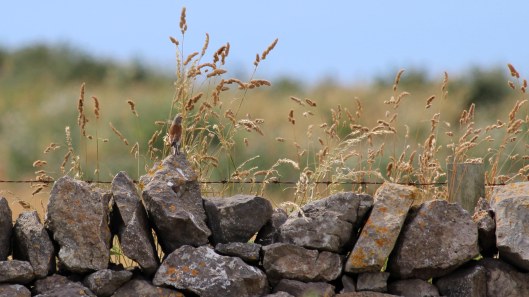
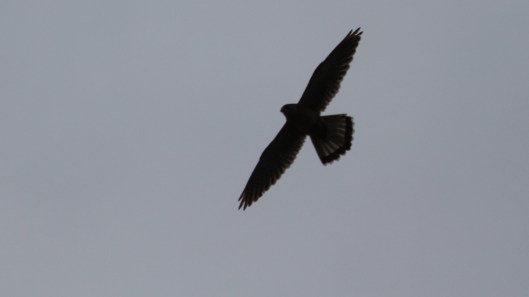
Three of us chose, instead, to do the circular walk around the headland, seeing lots of Linnets and Meadow pipits in the fields, a Kestrel hovering in search of prey, and two lovely fresh-looking Small tortoiseshell butterflies.
180702 8 Linnet

After some of the team returned from The Worm, four of us went for a brief visit to nearby Mewslade, a beautiful little valley that runs down to a sheltered cove. Here we had incredibly close views of a Lesser whitethroat feeding young, spotted two very yellow-faced Great tit fledglings in an area of burnt gorse, and watched more Choughs and another Kestrel flying through. It was yet another superb field trip with my bird club friends.

180702 11 Kestrel