Spider: Cheiracanthium erraticum

Tags

, , , ,

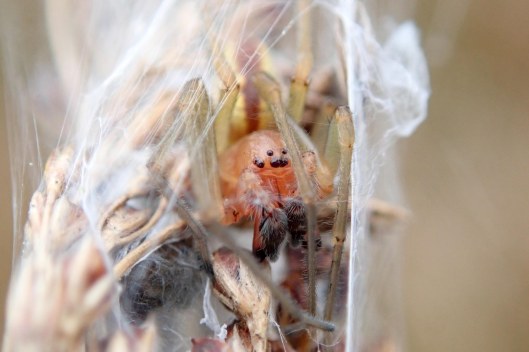
Having first been recorded here in 1861, this spider is a relative newcomer to Britain and, though it is still most frequently seen in southeastern England, it is slowly expanding its range north and west. I found this one at Cosmeston Lakes Country Park, not because I was looking for it, but simply because I noticed something had spun a web to bind two or three reed seedheads together and wondered what it was.

The adult spider was visible inside, and my photos were clear enough to see the distinctive red stripe that runs within a broader band of cream down the centre of its abdomen, which helped confirm this as Cheiracanthium erraticum. It favours grassland, more particularly areas of heathland, where it is typically found in low vegetation.
Cygnet cuteness

Tags

, , , , , ,

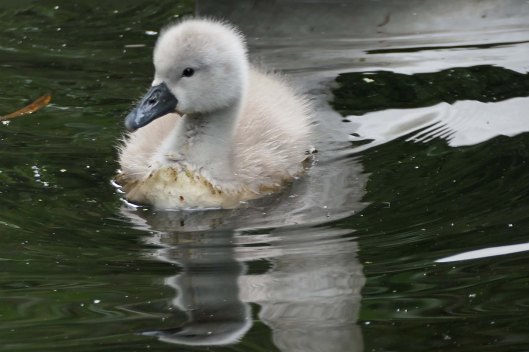
I had to go in to Cardiff today so I included a walk through ‘Little Venice’, the small network of canals south of the city centre. When I turned the first corner, this lovely family of Mute swans came immediately in to view – two adults and their six adorable cygnets.

Sometimes these canals are full of rubbish but, fortunately for the wildlife, it seemed much cleaner today – perhaps the local river-cleaning volunteer group have been busy.

As the canals have footpaths along both sides and are frequently used by pedestrians, the wildlife gets used to humans, and these adult swans were obviously used to people. They swam over to me, looking for food, and I was happy to oblige with some of the suet pellets I usually carry, though I was pleased to see that the cygnets remained wary and stuck to a vegetarian diet.

Cacopsylla ambigua

Tags

, , , ,

Have you ever heard of jumping plant lice? No? Me neither, until very recently. But when a tiny insect that I initially thought was a barkfly leapt rather dramatically from its leaf into the vegetation a metre or so below rather than have its photograph taken, I thought ‘well, that’s odd’.

The family name for the jumping plant lice is Psyllidae and at least 77 species have been found living in Britain. Fortunately for me, the two Psyllids shown here stayed completely still, allowing me to get close enough for reasonable photos; they’re only 3-4mm long so getting very close is the only way for me to photograph them.

I haven’t yet had their identity confirmed but these have the characteristics of Cacopsylla (formerly Psylla) ambigua that I found listed on the British Bugs website, and they were found on Willow trees, which also fits; they are generally plant-specific, which certainly helps with their identification.

Two dragons

Tags

, , , , , ,

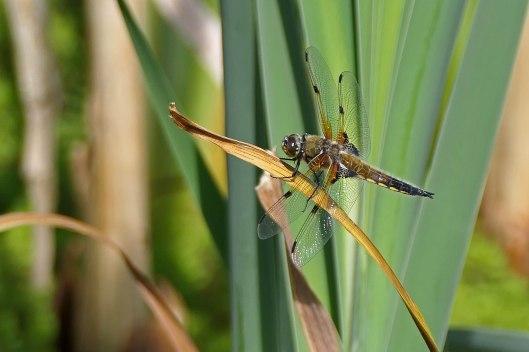
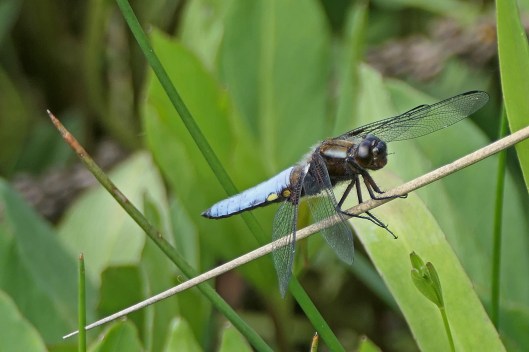
For me, the larger dragonflies have been few and far between this Spring. I’ve seen the odd one but fleetingly and its flown off before I could get a good view. Or I’ve heard one, that distinctive sound of the small wings rustling together as it takes flight. So, finally to have found two dragons that stayed still long enough for me to admire their colours and get some photographs has been very welcome indeed. Below are a Four-spotted chaser (Libellula quadrimaculata) and a Broad-bodied chaser (Libellula depressa). Fingers crossed for more sightings to come.

Leafhopper: Oncopsis alni

Tags

, , , , ,

Oncopsis alni is one of the more chunky leafhoppers and it lives almost exclusively on Alder, hence the alni in its name. As I’ve been strolling along my various local walking routes this Spring, I’ve been checking the Alder trees for signs of leafhoppers, and have seen quite a lot of nymphs of various sizes but, as they’ve been juveniles, I haven’t been certain of their identification.

Now that some of the nymphs are reaching adulthood, it’s possible to be somewhat more certain. Although the Naturespot website warns that this species ‘can only be identified by examination of internal genital structure’, the information on the British Bugs website is a bit more optimistic. For one thing, and with the proviso that bugs don’t always stick to the rules, this is the only member of the Oncopsis genus that is found on Alder. Also, ‘although males can show extensive dark markings on the upper part of the face, the discoidal spots below these are small in both sexes’, and I think I can see this distinguishing feature in my various photos. I should add a disclaimer though: my finds have not yet been verified by the national recorder.

Fly: Poecilobothrus nobilitatus

Tags

, , ,

Its name sounds like an incantation a Harry Potter acolyte might chant to turn an annoying peer into a toad, though Google AI suggests: ‘The genus name Poecilobothrus comes from the Greek words “poikilos” (various, or variegated) and “botryx” (a cluster of grapes), likely referring to the diverse and ornate nature of some dance fly species’ and ‘The species name nobilitatus is derived from the Latin word “nobilitatus,” meaning “made noble” or “ennobled,” which could relate to the elegant or showy appearance of the fly, particularly during courtship.’ I can certainly agree that this little long-legged fly is an ornate and elegantly formed creature.

I don’t usually have much luck identifying fly species but, fortunately for me, this one was a male and so it has distinctive white markings on the end of its wings, which it flashes at potential mates during its courtship display. I spotted this specimen sitting on vegetation next to a local footpath but they are usually to be found in wet locations, often sitting on weed floating on the surface of a pond or slow-moving stream.

Orchids already?

Tags

, , , ,

This year seems to be flying by. I mean, how can the Common spotted-orchids be flowering already?

Maybe it’s just me, and the house move, and everything associated with that that’s made this year seem to be passing so quickly. Or maybe it’s just old age – when I was young, time often seemed to drag; now it zips by too quickly.

Anyhoo, whether or not I was ready for them, the orchids are out and looking as gorgeous as they always do. I hope you get to enjoy them too.

Demoiselles

Tags

, , , , , ,

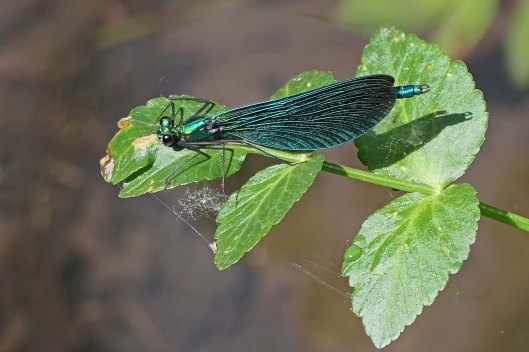
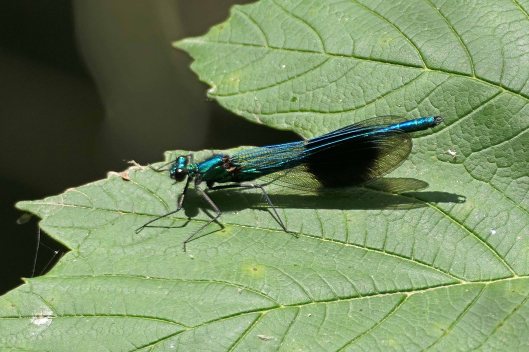
Thursday was a good day for demoiselles. As I strolled along the old Glamorgan canal at Forest Farm Nature Reserve, I was almost constantly entertained by both the Beautiful (Calopteryx virgo) and the Banded demoiselles (Calopteryx splendens), though there were definitely many more of the former than the latter.

 ~ male Beautiful demoiselle

While the females mostly perched quietly on leaves somewhat removed from the males – the only way to escape their attention, the males seldom kept still. They flashed their wings, displaying their metallic blue hues to impress any female that did venture past, and competed with other males for the best territories, those with sun, and shelter, and perches, and suitable places for egg-laying. What was serious breeding business for these stunning creatures was enchanting and magical for me.

~ male Banded demoiselle

A skipper surprise

Tags

, , , ,

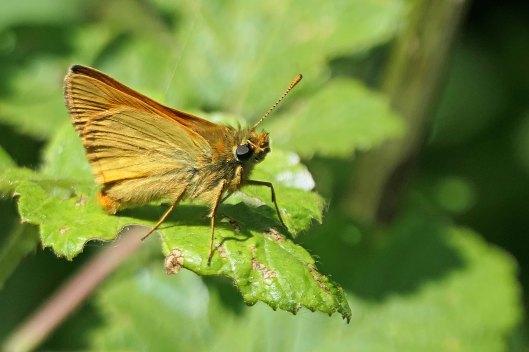
You could’ve knocked me over with the draft from a butterfly’s wing when this gorgeous creature flitted up from the foliage to greet me as I walked the coastal path on Tuesday. Large skippers don’t usually appear locally until early June but our lengthy spell of warm dry weather is having a very obvious effect on insect emergence times this year.

Meligramma trianguliferum larvae

Tags

, , , ,

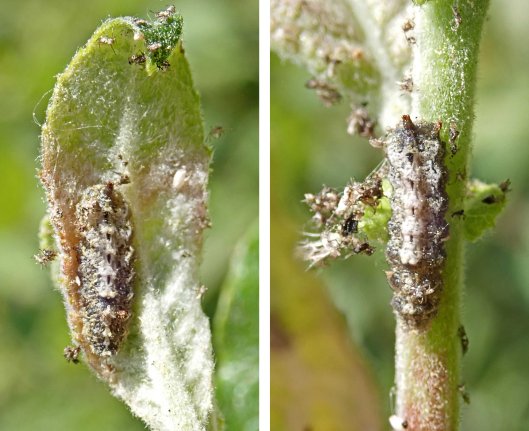
I’ve never seen an adult Meligramma trianguliferum hoverfly due, no doubt, to the fact that this species is rare in Wales, with only four previous sightings logged. However, I am now very hopeful I will see one this summer, as I found six larvae on one particularly heavily aphid-infested shrub in a local park, and there were probably more larvae that I didn’t spot lurking under the leaves.

I didn’t recognise the species when I saw it, of course, but, fortunately for me, the national hoverfly larvae recorder Geoff is on social media and is very willing to identify sighting from photographs where possible. There were so many aphids on this shrub that it was sticky with honeydew and even the larvae were covered in it and looking quite manky so I’m glad Geoff was still able to recognise them. To see the adults, check out the photos on the Naturespot website and, fingers crossed, I’ll find some and share photos of those sometime in the summer.