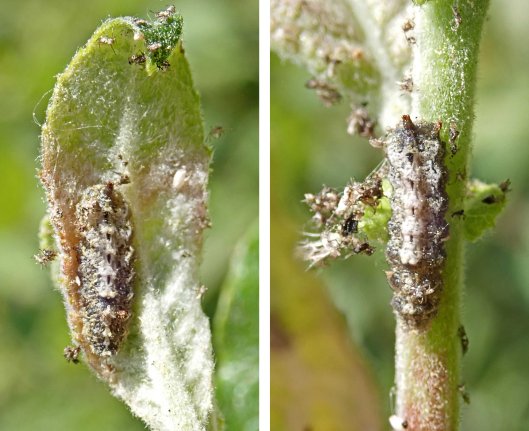
Meligramma trianguliferum larvae

Tags

, , , ,

I’ve never seen an adult Meligramma trianguliferum hoverfly due, no doubt, to the fact that this species is rare in Wales, with only four previous sightings logged. However, I am now very hopeful I will see one this summer, as I found six larvae on one particularly heavily aphid-infested shrub in a local park, and there were probably more larvae that I didn’t spot lurking under the leaves.

I didn’t recognise the species when I saw it, of course, but, fortunately for me, the national hoverfly larvae recorder Geoff is on social media and is very willing to identify sighting from photographs where possible. There were so many aphids on this shrub that it was sticky with honeydew and even the larvae were covered in it and looking quite manky so I’m glad Geoff was still able to recognise them. To see the adults, check out the photos on the Naturespot website and, fingers crossed, I’ll find some and share photos of those sometime in the summer. 
Spider: Segestria florentina

Tags

, , ,

With this year’s focus on identifying spiders, I’m getting better at being close to them but this large beast did give me pause. Fortunately, it wasn’t in my house or any other enclosed space; I spotted it sitting on an external house wall as I walked along a street. After consulting a local with good spider knowledge, I can confirm this is the tube web spider Segestria florentina, though its chelicerae (fanged mouthparts) are not the shiny green colour described in my guide book. Perhaps that was just due to the light conditions when I photographed it.

Segestria florentina usually lives in a tube-shaped web, tucked in a hole in a wall or amongst rocks, speeding out to grab its prey when it passes the hole. You definitely wouldn’t want to poke your finger in its hole, as it does have a venomous bite, though apparently it’s not dangerous, and the spider’s only found in the south of the UK. If you want to know more, the iNaturalist website has a good article and excellent photos.

Thistle tortoise beetle

Tags

, , , , ,

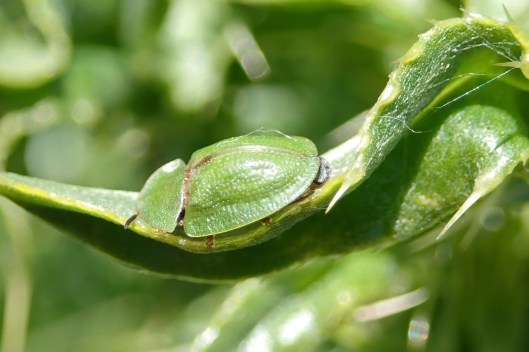
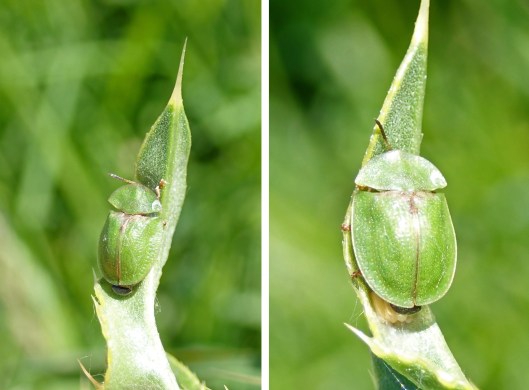
Back in 2022, I blogged about this beetle’s bizarre larvae, the ones that carry their own poo above their backs as camouflage (see Thistle tortoise beetle larvae, July 2022). It’s taken me almost three years to spot an adult Thistle tortoise beetle (Cassida rubiginosa) but, now that I see how well they blend in to their thistle surroundings (no poo required), I understand why.

I also understand now why they’re called tortoise beetles, as their ‘shell’ really is tortoise-like. And, even better, if you look closely at the rear end of the beetle in the photo below right, you may be able to spot some tiny cream-coloured tubes – this beautiful beetle was a female and she was egg-laying.

Scribbled wingwaver

Tags

, , , ,

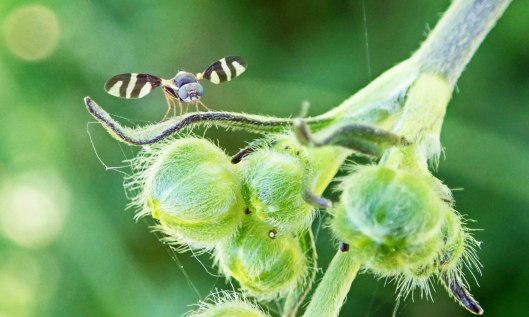
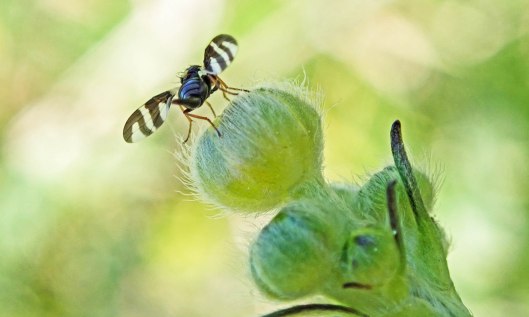
Is this the most charming insect name you’ve ever heard? The Scribbled wingwaver (Herina frondescentiae), one of the aptly named picture-winged flies, does indeed wave its pretty little wings around. Whether this is to attract the attention of other passing wingwavers or to warn off potential predators, I’m not sure, but it certainly attracted my eye.

At just 3mm long, this is one of Britain’s smallest picture-winged flies. The one shown here is a female, which is why she has that large pointy bit on her rear end; it’s for depositing her eggs, possibly in rotting vegetation, but the species’ life cycle seems not to have been investigated fully yet.

According to the Naturespot website, it usually inhabits ‘wet, rush-dominated habitats and brownfield sites’. I found mine during a wander around some local farm fields that have been earmarked for a housing development, though the site is adjacent to an old abandoned railway line so I guess that counts as brownfield. Apparently, the Scribbled wingwaver is quite common throughout Britain, so do keep your eyes peeled for a tiny fly waving its patterned wings at you as you walk by.

Kidney vetch

Tags

, , , ,

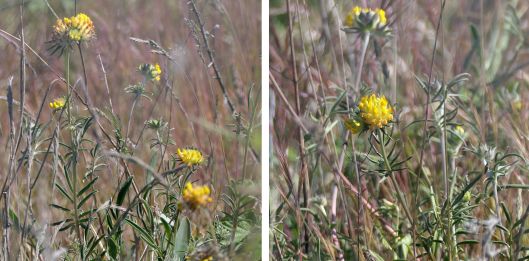
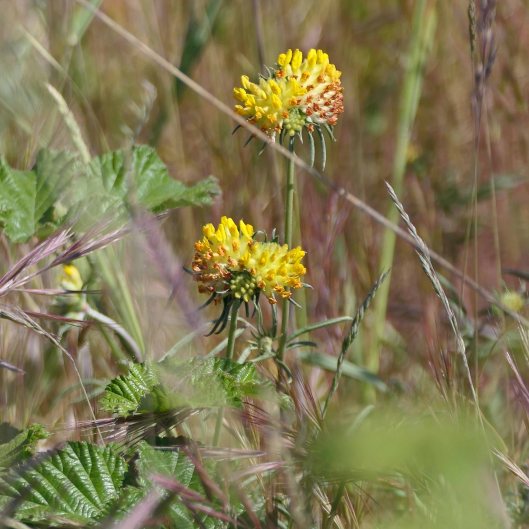
If only Cardiff Bay had a large thriving area of Kidney vetch (Anthyllis vulneraria), then we might also have a small thriving colony of Small blue butterflies, as this is their larval food plant.

Sadly, the few plants that manage to survive in the Bay are locked away behind a tall barrier of diagonal wire mesh in a tiny patch of waste ground; the fact they’re inaccessible is probably the only reason they’ve survived Cardiff Council’s ‘spray herbicide on everything’ policy of environmental (mis)management. The mesh also means the plants are very much overlooked and under-appreciated, as well as being difficult to photograph, which is a great shame, as Kidney vetch is a very attractive wildflower.

Cocksfoot moths

Tags

, , , , ,

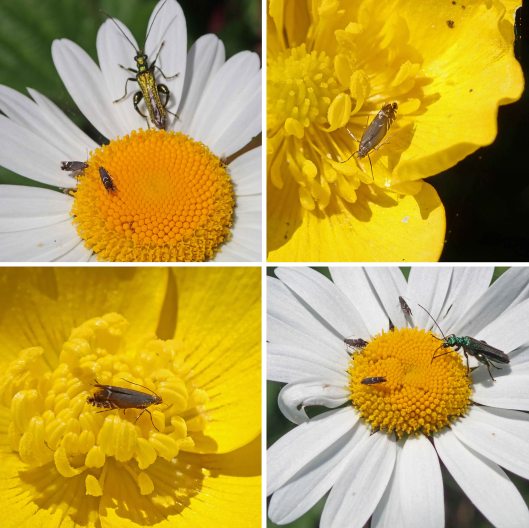
These tiny moths were one of yesterday’s highlights, as I wandered slowly around some of the local coastal fields.

With the scientific name Glyphipterix simpliciella but known more commonly as Cocksfoot moths, because their larvae feed on the seeds of the grass Cock’s-foot (Dactylis glomerata), they are found most often on the flowers of the various members of the buttercup family and, yesterday, I also found lots on Oxeye daisy flowers (often, as you see, in the company of Swollen-thighed beetles). Between now and the end of July, they can often be seen in large numbers but are easily overlooked due to their miniscule size (just 3-4mm long).

Bagworms

Tags

, , , , , , , ,

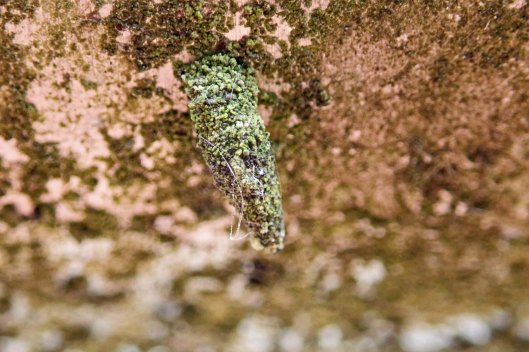
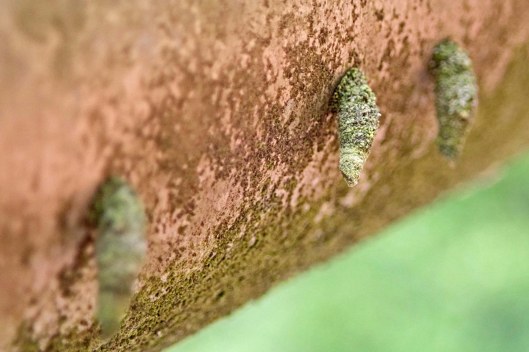
You may initially think the title of today’s post is move related and that I found worms in my baggage when packing/unpacking, but no. Bagworm is the rather unflattering name for the moth Luffia lapidella, also known as Ramshorn bagworm, Virgin smoke, and Grey bagworm, whose larvae create cases to live in from the lichen they also like to eat. I’ve only ever found single cases before (see Casebearer: Luffia lapidella, February 2024), and those only twice in the ten years I’ve been living in the UK, so, when I found this site with well over 20 cases, I thought the species was worth revisiting with another blog.

The location was unexpected: they are all living on the metal railings that run along one side of a path by the River Ely in Cardiff but the waterside location means the undersides of all those railings are covered in lichen and, fortunately, they’re never cleaned, so the bagworms have found the perfect place to live.

Luffia lapidella is a very odd moth. The main moth websites in the UK all say that ‘only the self-fertile wingless female is known’, though I did find a blog, British Lepidoptera, that says males do occur in Cornwall. That website also shows a photo of a deceased female and photos of the larvae that lives in their colourful lichen ‘bags’.

Refuelling

Tags

, , , ,

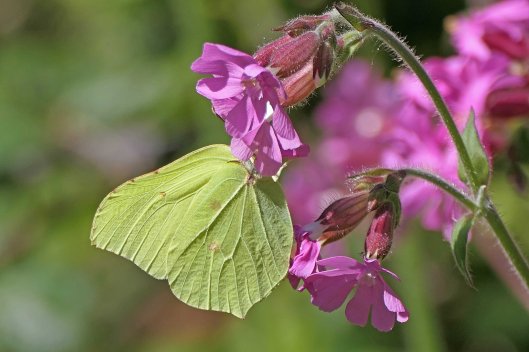
I feel a bit like these beautiful Brimstones, needing to refuel to restore my energy after yesterday’s house move. My surroundings are still chaotic but I made sure to get out for a short time today because walking in Nature is how I heal, how I find peace amongst the madness, how I refuel my mind and my spirit.

The image above shows a female Brimstone, which is paler than the more yellowy male in the photo below. Red campion was their flower of choice this day.

Cantharis decipiens

Tags

, , ,

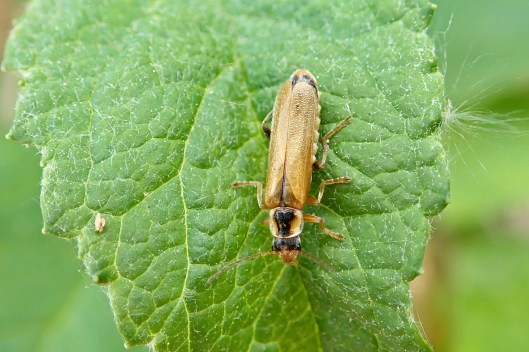
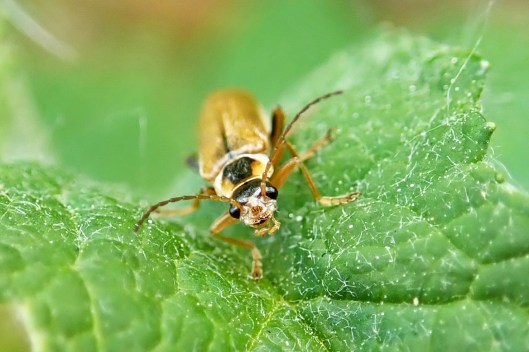
Another day, another recent new insect find, this time one of the Cantharidae, otherwise known as soldier beetles.

There are a couple of similar species but, if you check a series of particular features carefully, then you can be fairly confident of getting your identification of Cantharis decipiens correct. The Naturespot website has a very helpful checklist, which includes the beetle’s length (I often take a photo with my thumb or a finger in the image to help me figure that out later), the various colours of its body parts, and, what they charmingly call ‘the butternut squash black mark’ on the pronotum. If you’re not familiar with the shape of a butternut squash, you could be in trouble!

My second photo, the close up on its face, conveys exactly how I’m feeling today as, tomorrow, I’m finally FINALLY moving house!