Butterfly catch up

Tags

, , , , , , ,

Just as it’s always magical to see my first butterfly of the year, so is it just as special each time I see the first of each new species. These are the four most recent beauties that have made me smile.

On 25 April my first Large white of 2025 flitted along the footpath next to me, sipped on a Dandelion, then settled on a Bramble leaf long enough for me to photograph.
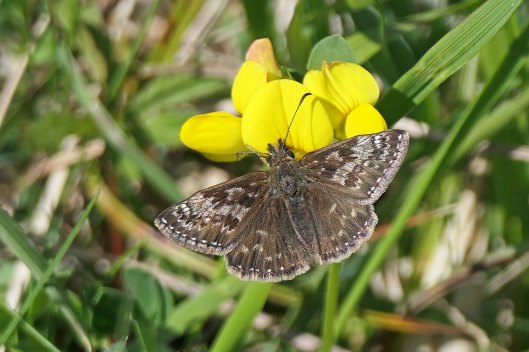
The next butterfly species to appear for me locally, on 27 April, was this lovely Dingy skipper at an unexpected location – a bonus!

The last few days of hotter than usual temperatures have presumably triggered the early emergence of some species. This stunning male Common blue popped up on 28 April, five days earlier than my previous earliest date.

And, this very morning, eight days earlier than I’ve ever seen one before, I caught a flash of brilliant orange and there sat this gorgeous Small copper, always a treat to see.

First brood

Tags

, , , , ,

The Moorhens that make their home in the dipping pond at Cosmeston Lakes Country Park are prolific breeders, producing on average three broods of between 5 and 7 chicks each year. The little cutie pictured here is one of this year’s first brood and, though one parent was keeping an eye on this one and its siblings, the other adult was already preparing their next nest. According to the BTO, though the record for Moorhen survival currently stands at over 11 years, their average lifespan is just 3 years, and they begin breeding at age one. With statistics like that, you’d think our waterways would be overrun by Moorhens but their predation rate is high, with both wild and domestic mammals taking their toll, as well as birds like Grey herons and the large gull species feasting on the smaller chicks. This Moorhen chick may be a little sweetie but its life will almost certainly be a tough one.

Hoverfly: Portevinia maculata

Tags

, , , ,

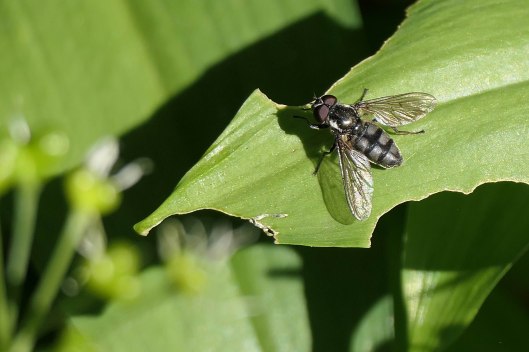
I have one of you to thank for the inspiration for this post; through his comments on my recent post about Wild garlic, Philip Strange (who, if you don’t already know and follow him, produces a really interesting science and nature blog) reminded me to look for the hoverfly associated with that plant. And so I did. And here it is.

For those of you who don’t live in Britain, we are currently experiencing a week of high (for us) temperatures (this is probably our summer, and normal conditions will resume shortly), so, yesterday, a walk through a shady woodland seemed like a good plan. When I arrived at Cwm George, in the nearby town of Dinas Powys, I was delighted to find it was peak garlic time and, when I stood watching those patches of flowering Wild garlic on which sunshine streamed through the tree canopy, I was even more delighted to spot several small grey-patterned hoverflies, both perched on and hovering around the plants.

These are Portevinia maculata hoverflies, and they have a very strong association with Wild garlic (aka Ramsons), as their larvae mine the bulbs and stem bases of those plants. My guide book says that ‘Where Ramsons is abundant, this hoverfly is usually also abundant’ but Philip and I might both dispute that statement. In my local park, where I took the photos for my recent blog and where Wild garlic is prolific, I’ve never seen this hoverfly. So, I was really pleased to find it in good numbers at Cwm George.

Common nettle bugs

Tags

, , , , ,

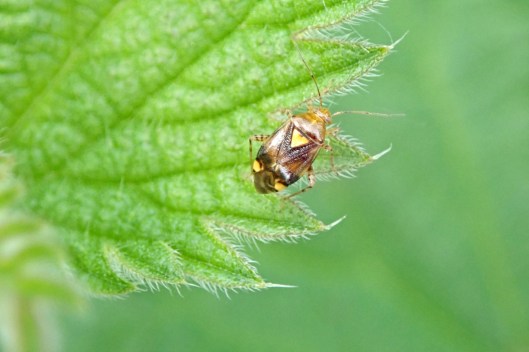
I’ve been finding a few new insects recently and this is one of them, the supposedly common Common nettle bug (Liocoris tripustulatus). Perhaps I’ve never noticed them because they tend to live mainly on Stinging nettle (and you know by now that I find nettles challenging – those stings!). This month I’ve seen them twice and they can, apparently, be seen all year round. And, fortunately, with their three yellow dots, these little (4 to 5 mm long) plant bugs are easy to identify.

Leafmines: Orchestes alni

Tags

, , , , , ,

It seems, from my online research, that some of my North American readers may consider today’s creature a pest (see, for example, this web page from The Morton Arboretum in Illinois) but, here in Britain, sightings are few and far between; my find was the first in my local 10km area since 1916, and only 20 records are showing in the Welsh biodiversity database.

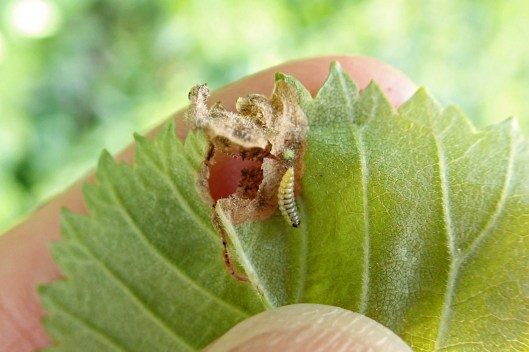
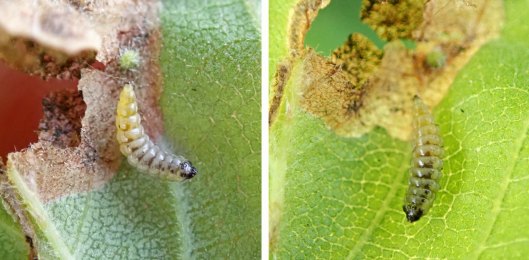
Making a change from the usual moth and fly larvae leafminers, today’s mines were made by the larvae of a weevil, Orchestes alni, also known as the European elm flea weevil. The adult female weevil lays her eggs inside the midrib of a leaf on one of the Elm species, in this case on Wych elm (Ulmus glabra); you might just be able to make out the scar in the midrib of the underside of the leaf, shown in the photo on the right above. Once hatched, the tiny larva burrows into the leaf, initially creating a gallery mine running towards the leaf edge, then the mine widens out to a blotch. When it’s eaten its fill and the time is right, the larva spins itself a cocoon and pupates within the mine. The hole in the leaf shown above indicates that the adult weevil has emerged from its cocoon and exited the mine.

I found several mines on this one Wych elm, and most were already empty – this leafminer starts early in the season – but a couple were still occupied. As I didn’t think I would be damaging the weevil population and, yes, I was curious – I’d never seen a weevil larva before – I opened one of the mines. So, now you get to see a tiny weevil larva as well.

There is another weevil that also mines the leaves of Elm species, Orchestes betuleti, but, as I wrote above, Orchestes alni starts early in the season, whereas O. betuleti doesn’t usually begin egg-laying until May.

Bells of blue

Tags

, , , ,

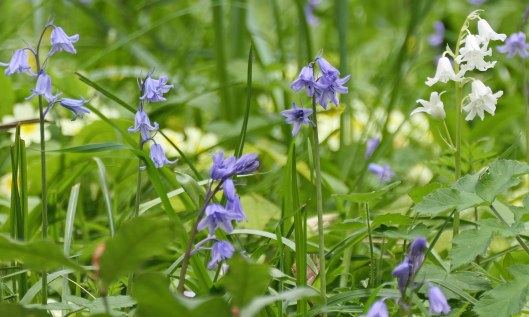
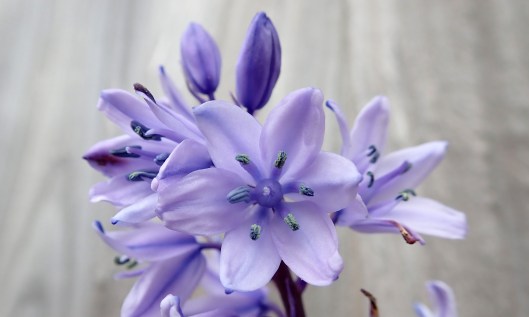
I had hoped to get to my local slice of ancient woodland for a walk amongst the native Bluebells this week but it didn’t happen so here are some beautiful non-native but naturalised Bluebells that I’ve encountered in this week’s urban meanders. I hope you all have woodlands near you with Bluebells to enjoy.

Fine streaked bugkins

Tags

, , , , , ,

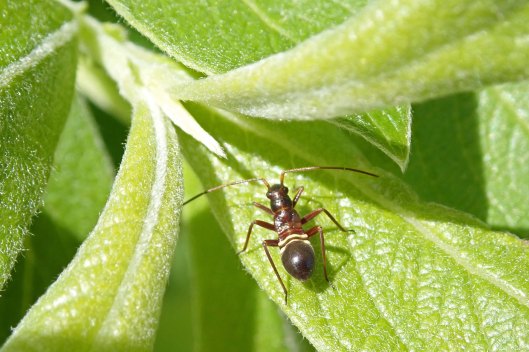
At first glance, I thought these little creatures were fancy ants but a closer look took in the striped waist, the longer antennae and the generally larger size, and I knew they definitely weren’t ants. But what were they?

At this time of year, many insects are still in their early stages of development, particularly those that have over-wintered as eggs, so they can be tricky to identify. Usually, some well-focused internet research produces an answer, or a clue I can then follow, and, luckily, that was the case with these tiny creatures.

These are the nymphs of Miris striatus, a plant bug that has the wonderfully descriptive common name of Fine streaked bugkin – although these nymphs have their small yellow stripes, the streaking actually refers to the adult bugs, photos of which you can see on Naturespot by clicking this link.

That website entry states that these insects are usually associated with Oak and Hawthorn but, as I often find, creatures don’t read websites, and these bugkin nymphs were all on a single willow sapling (though there were Hawthorn bushes nearby). I’ll have to keep an eye out for the adults from May through to July.

Rust on roses

Tags

, , , ,

I haven’t seen many fungi lately but this blob of bright orange rust really stood out amongst the greenery of this Field rose. The two possible species that might have caused this spectacular sight, Phragmidium mucronatum and Phragmidium tuberculatum, can be tricky to separate so I haven’t tried. If you’re interested in reading a discussion on the subject, check out this link to the UK Fungi Forum.

In long-term decline

Tags

, , , , ,

The UK Butterfly Monitoring Scheme recently released its latest report on how our butterflies are faring, and, for the majority of the 58 British butterfly species, the news is not good.

The latest butterfly to emerge in my locale has been the Green-veined white (Pieris napi), which is described by the UKBMS as ‘stable’ but I’m not sure I’d agree with their definition of stable when these are the statistics they list:

Status since 1976 is Stable with a change of -23.1% since monitoring began for this species.
Status over the last 20 years is Stable with a change of -20.8%
Status over the last 10 years is Stable with a change of -35.7%

In fact, on social media, the Head of Science at Butterfly Conservation wrote: ‘One of the big shocks of last year’s UK Butterfly Monitoring Scheme results was that, after its worst year on record in 2024 and a run of six below average years, Green-veined White (Pieris napi) is now in long-term decline.’ This seems a far better summary of the situation. So far, I’ve only seen these two Green-veined whites this year; fingers crossed I manage to see more.

Mystery solved, sort of

Tags

, , , , , ,

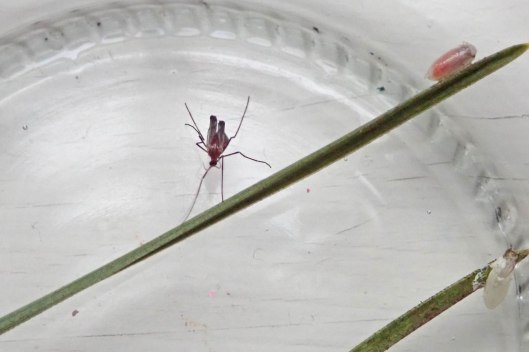
Earlier this month I blogged about the mysterious ‘things’ I had discovered on the needles of some local Pine trees (Mystery: on a Pine tree, 10 April). Well, the mystery has now been partly, but not entirely solved.
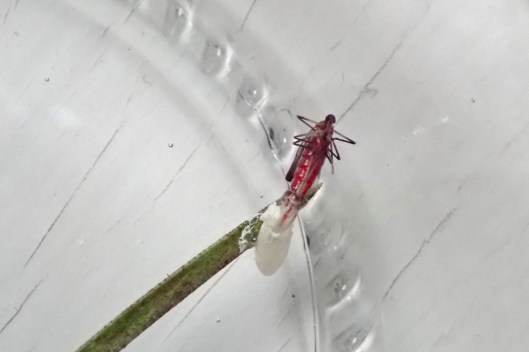
Last Friday, the 18th, I was making a sandwich for lunch when I noticed a change in one of the ‘things’. A creature had obviously made itself a hole in one end and was very slowly squeezing its way out. I quickly grabbed a camera, though it was neither easy to get photos looking in to the little jar, nor through the glass sides.

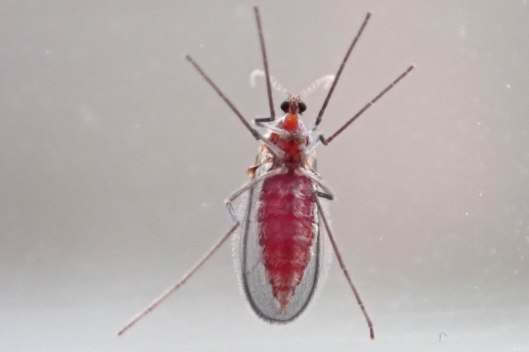
The tiny creature crawled unsteadily across the bottom of the jar then climbed one side, where it clung as its wings slowly dried and unfurled. Its bright pink colour was a lovely surprise.

So, the ‘thing’ was a pupal case or cocoon but I’m still not completely sure what the creature was. Some online research led me to think it was some kind of midge or gnat, and that was later confirmed by the Dipterists forum folk on social media: ‘one of the midges in family Cecidomyiidae’. I researched further, trying to find a similar-looking external cocoon or an association with Pine trees within that family of midges but found nothing in the UK that seemed to fit. I did find some US references to Cecidomyia piniinopis, which looks very similar, but that species is not listed in the taxonomy for Britain.

Still, I’m pleased I managed to at least partially solve the mystery and seeing the adult midge emerge was quite special. It, and the other cocoon, have been returned to where I found them to, hopefully, live their best lives.